
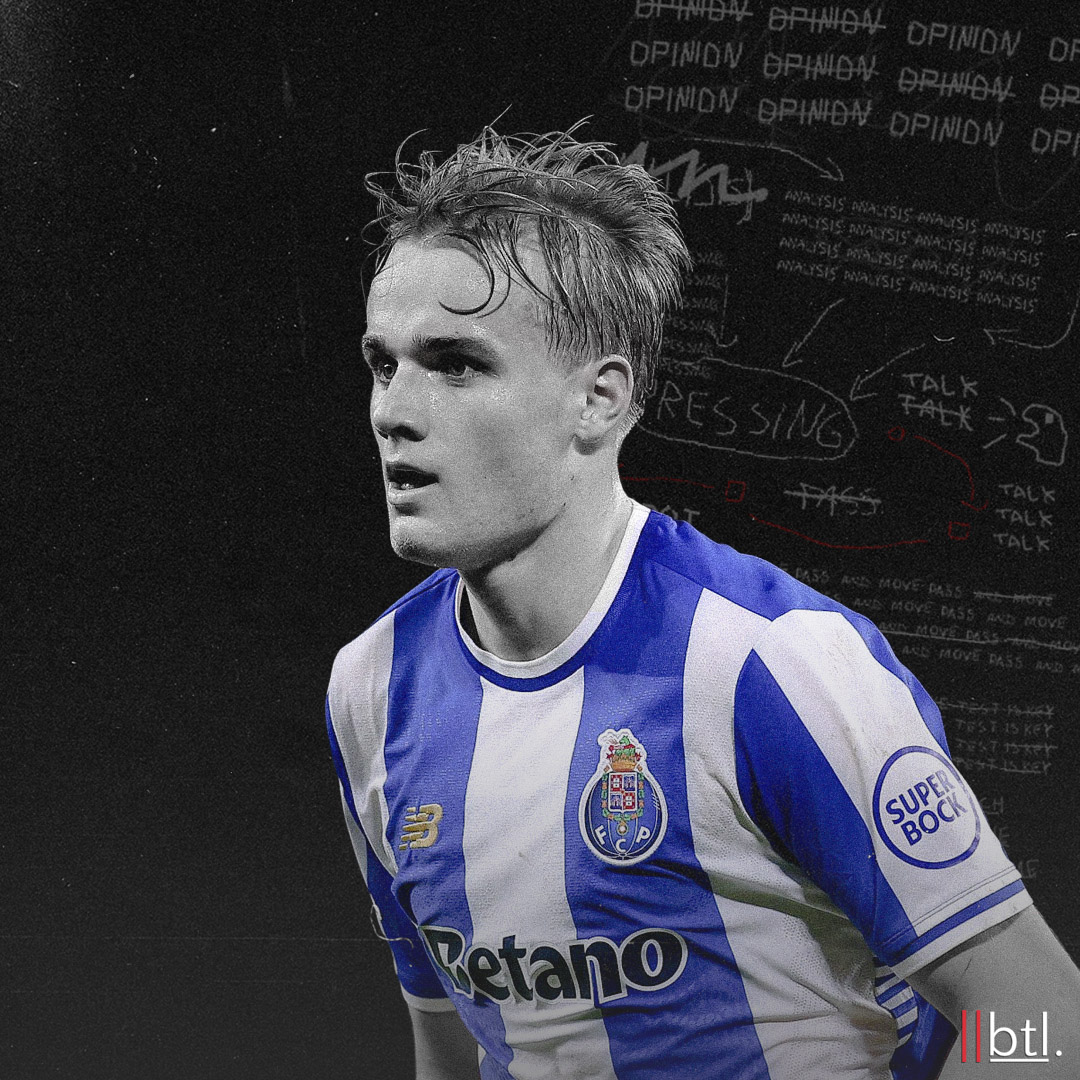
Victor Froholdt: Analyzing Porto’s Danish Dynamo
First Name: Victor Mow
Last Name: Froholdt
Known Name: Victor Froholdt
Nationality: 🇩🇰 Danish (Current Senior National Team)
Place of Birth: 🇩🇰 Vallensbaek, Denmark (a town connected to Copenhagen)
Date of Birth: 25.02.2006 (19)
Primary Position: Central Midfielder
Secondary Positions: Attacking Midfielder
Preferred Foot: Right
Height: 1.87 meters
Weight: 73–76 kg
Club: 🇵🇹 FC Porto (Liga Portugal Betclic, Taça de Liga, Taça de Portugal and UEFA Europa League)
Contract Start Date: 23.07.2025
Contract End Date: 30.06.2030
Annual Net Salary: €0.5M + €0.12M Bonuses
Shirt Number: 8
Player Analysis
Due to his tall stature, Victor Froholdt is not an agile player; he has average agility, a durable body, and long legs. For this reason, his speed increases as the distance increases. In the Porto 3–0 Vitória match, there is a sequence where he runs from his own penalty area to the opponent’s penalty area. The measurements are not exact, but approximately: I measured his speed as 25–26 km/h over the first 11.5–12 meters, 27–28 km/h over the next 20–21 meters, and 29.5–31 km/h over the following 32–33 meters.
A clear numerical speed cannot be stated from a single running sequence, but I can say that he runs short distances slightly below average and long distances at average or slightly above average speed. At Liga Portugal level, he can still make runs at the same speed in the final minutes of every match as in the opening minutes; at UEFA Champions League level, he could do this in at least most matches.
Because he is 1.87 meters tall and weighs 73–76 kg for that height, his body balance is low. Due to his height, his center of gravity is high. His low balance negatively affects his actions while running. Regardless of how well he performs his actions, he does not plant his feet firmly on the ground. Although he stays on his feet in physical duels, his body can be disrupted.
According to Opta, he averages 1.7 aerial duels per 90 minutes. I will exclude set-piece situations. The reasons for this low number are that his short-distance speed is slightly below average, which may cause him to arrive late to aerial duels; due to his age, he sometimes fails to time his jump properly and therefore gives up jumping; and although he is a very brave player on the ground, he is not timid but also not brave in aerial duels.
Winning 0.9 of the 1.7 aerial duels gives him a 54% success rate. This is an above-average percentage, but it does not do justice to a height of 1.87 meters. Poor timing cannot be shown as a major reason for this percentage because his height already provides an advantage.
The reasons for this are: lack of strength; when he is running alongside an opponent before entering an aerial duel, his low balance sometimes prevents him from challenging as he wants; and lack of aggressiveness (in aerial duels). Being slightly weak causes him to struggle more during aerial contact moments and negatively affects his jumping ability.
Because his legs are also weak and not powerful, he cannot jump well and jumps at an average level. Timing, strength, balance, aggressiveness, courage (in the air), and jumping can be improved in the future due to his young age. Since he is 1.87 meters tall, he has the potential to become a successful player in aerial duels in the future. When his team takes set pieces, he usually positions himself at the near post or moves toward it, and thanks to his height, he can be effective with an average jump.
Despite being very young, he plays with high intensity and is very hardworking. More importantly, despite his young age, his body capacity is sufficient for the high-intensity game he wants to play. If this were not the case, he would perform poorly in possession after so many duels, and his injury record would not be clean. According to Opta, averaging 8.0 ground duels per 90 minutes shows that he likes physical play and is brave on the ground. His tackling ability is at an average level, and his long legs can provide an advantage.
However, when an opponent attempts to dribble past him, he reads these dribbles poorly due to his age; according to Opta, opponents successfully dribbled past him in 59.4% of his tackle attempts. This causes him to fail to find proper opportunities to tackle. Rather than going directly toward the opponent to win the ball, he is often a player who can win the ball after making contact. Because he has average agility and, despite being tall, does not have good tackling ability, he struggles to win the ball when the opponent has their back to him.
His aggressiveness is average but varies depending on the situation. According to Opta, averaging 9.6 total duels and committing 1.3 fouls per 90 minutes shows that he is not a clearly aggressive player (this could be misleading if he were very good in physical play, but he is not such a player). If he is very close to his opponent, he shows controlled aggression; but even if there is a small distance between them and the opponent’s back is turned, he remains soft even when he could force the situation and win the ball.
In such situations, he tries to push the opponent backward. In summary, he has the work ethic mentality to run constantly and the physical capacity to consistently turn that mentality into action; he has the courage to make his runs meaningful by entering physical contact after running; after contact, he has average tackling ability, and he cannot sense dribbles when the opponent takes him on.
Diogo Costa: The Present and Future of Portugal’s Goalkeeper Position
Froholdt prefers to push the opponent backward rather than being aggressive when there is some distance and the opponent’s back is turned, but when the distance is very close, he is moderately aggressive. His strength sometimes is aggressive but insufficient. Tackling ability, aggressiveness, and strength are traits that can be developed over time.
Therefore, as with aerial duels, he is not fully successful in physical play, but he can become successful in the future. Not because of strong anticipation but because he is highly concentrated, he cuts passing lanes well by moving to intercept opponent passes, as long as he can reach the ball.
Since he is not that fast, he intercepts medium- and long-distance passes rather than short ones, and he contributes to his team’s high press by intercepting long passes from center-backs and goalkeepers when the opponent tries to build from the back.
According to Opta, he averages 1.1 interceptions per 90 minutes, but this statistic is misleading. Some long passes prevented during the opponent’s build-up are not recorded as interceptions by Opta because it is not clear who the intended target was. He also needs to learn correct positioning to intercept short passes or close passing angles.
Why Martim Fernandes Could be the Heir to Trent’s Throne at Liverpool
When he is focused on his opponent, he marks very well all over the pitch, including during set pieces. He defends his man well. However, when defending zonally, he leaves opponents unmarked; his defensive awareness and positioning are poor due to his age. Zonal defending inside the penalty area is dangerous for his team.
While undergoing physical development, both his lower and upper body should gradually strengthen proportionally and his tissue should become firmer, especially because he plays with high intensity even in the final minutes. Since he is not an agile player, he does not overstretch his legs excessively within a high-intensity game, but due to his poor balance, his legs can sometimes open dangerously during running actions.
Still, he is not an injury-prone profile, but he is not far from it either; therefore, it would be beneficial for him to learn to defend by positioning himself intelligently rather than playing with very high intensity in the final minutes. He has a good left foot for a weaker foot, and it is gradually improving. He can control simple passes, play short- and medium-range passes, and take short- and medium-range shots.
Because he is concentrated and not rushed, he does not lose control when receiving slow- and medium-speed passes, whether on the ground or in the air; however, when receiving passes while running vertically, he sometimes fails to adjust his control angle vertically. Due to his low body balance and inability to plant his feet firmly, he mostly fails to control fast passes and loses the ball. Opta records a failed ball control when the player loses possession immediately after the first touch without a second touch.
Alberto Costa: From Portuguese Obscurity to the Land of Italian Giants
This season, according to Opta, there are 14 matches in which he has at least 30 touches. When dividing the number of touches by the number of failed controls in these matches, the average is 6%. However, within these 14 matches, there are 4 matches with a rate of 3% or lower and 4 matches with a rate of 9% or higher. The inconsistency of the failed control rate suggests that he controls the ball well in certain situations and poorly in others. The determining factor is whether the pass arrives fast. If he improves his balance, he can become a complete ball controller.
He does not prefer deceptive or creative dribbles and is not talented enough to execute them. He successfully performs effective dribbles that do not require extra skill but rely on using his body, taking advantage of his 1.87-meter height. He dribbles in the correct direction and does not push the ball too far from his feet, maintaining control. However, he does not scan his surroundings well while dribbling, so he does not play visionary passes afterward. Because he is mature, he times his release of the ball well.
According to FBref, he averages 2.1 successful progressive carries per 90 minutes; according to Opta, he averages 1.1 successful dribbles per 90 minutes. For a carry to be considered progressive, it must cover at least 10 meters (unless ending inside the opponent’s penalty area), but Opta’s dribble statistic does not have such requirements. Therefore, not all dribbles are included in progressive carries. Less than half of his progressive carries include a dribble, supporting the idea that he uses his body well while dribbling.
He lacks creativity and, because he is right-footed, needs to play on the right side. When dribbling vertically in the right half-space, opponents usually approach from his left, allowing him to place his body between the ball and the opponent, which facilitates successful dribbles. On the left side, he cannot do this when dribbling in the half-space. Even if he reaches the final phase on the left side, being right-footed would require creativity to find an angle, which he lacks.
Under pressure, if he can see space, he dribbles and often succeeds. If he cannot see space, he cannot break pressure with a pass. This is because both his scanning (slightly poor) and his vision (average) are not good enough, and even if his vision were better, his technique (average or slightly above) is not sufficient to play visionary passes. Because of his game maturity and calmness, he does not lose the ball with unnecessary risks; he plays safe and makes the most correct decision if he cannot escape pressure.
He does not lose the ball, but he also cannot break pressure unless he sees space to dribble. His scanning is slightly poor because he focuses more on the ball or the player he is marking. He adjusts the direction of his passes well, but the quality of the pass itself—his technique—is average, which prevents him from playing difficult passes. He plays medium-difficulty line-breaking passes well. He is quite compatible with his teammates when passing. All of this makes him an average-level playmaker.
According to Opta and FBref, averaging 0.3 accurate long passes per 90 minutes (44.4%), 0.1 xA, 1.6 key passes, 3.4 progressive passes, 0.1 through balls, and 85.2% overall pass accuracy alone suggests he is not average but a poor playmaker; however, considering that he does not take on playmaking responsibility and has limited touches, the data also indicate that he is an average playmaker. According to Opta, he averages 42.0 touches per 90 minutes.
His scanning is already slightly poor; when the ball comes to him in the assist zone while running, or when he is carrying the ball, his scanning is very poor, as mentioned earlier, because he focuses more on the ball. Therefore, he crosses into space rather than toward a specific player. According to Opta, his crossing accuracy is 6%. His crosses are more effective when there are many teammates in the opponent’s penalty area.
Due to his low balance, he does not use his plant foot well when crossing while running, and his crosses usually do not travel far, whether he intends them to or not. If he becomes more aware in scanning and improves his balance, he can deliver good crosses, because although he does not have good technique, he has enough technique to deliver accurate crosses. For long-range shooting to be good, a player must plant his feet firmly and use his plant foot well; since he lacks these qualities, his long-range shots are very weak.
His most important quality is his constant runs into the opponent’s penalty area and the final third. First, he has the desire to make vertical runs and the endurance to do so for 90 minutes. Second, his runs are near-perfect—very correct runs. To elaborate: before starting his run or while making small movements, he scans his surroundings and runs accordingly.
If making the run would leave no teammate behind to collect second balls, he runs, he identifies a likely zone to receive the ball while running, and he adjusts the intensity of his run to arrive in that zone at the right time; and he uses deceptive running angles to mislead opponents.
Froholdt possesses all the requirements of good movement and performs them frequently. According to Opta, averaging per 90 minutes—all inside the opponent’s penalty area—3.36 touches, 0.92 shots, an average of 0.15 xG per shot, and 0.39 key passes support this analysis. According to FBref, averaging 13.6 touches per 90 minutes in the final third also supports this, and having 13.6 of his total 40.2 touches in the final third shows that his team fully utilizes this quality.
He does not only make runs toward the penalty area and final third; he also makes short- and medium-length runs to offer passing options and disrupt opponent lines. He does not only get on the ball in the box and final third through runs; he also has a sense of sneakiness.
While stationary in the penalty area, he frees himself from opponents with small movements and becomes an option. All of this shows that his concentration, game awareness, offensive intelligence, and maturity are at a very high level, and a player with these traits at this age is very rare.
When he has the ball in the opponent’s penalty area and final third, he has the ability to occasionally crown those runs and subtle movements. He chooses the direction of his close-range shots well and can execute them. Although he can select and strike the correct direction, his low balance causes poor use of his plant foot, resulting in most of his shots being inaccurate.
He often suffers from his lack of balance, but when he does not, he does not miss. Because he adjusts direction well, his accurate shots are very clean and hard to save, even though his shooting repertoire is limited. According to Opta, he has taken 14 shots inside the penalty area this season, only 2 of which were on target—and both were goals.
When he receives the ball in the opponent’s penalty area and final third and has some space ahead, he immediately focuses solely on shooting and does not remain calm; therefore, he fails to see passing options and does not consider moving with the ball to get into a better position. If he does not think about shooting, he makes the correct decision and passes to a free teammate. Although he is not a creative player, because he receives the ball in suitable positions, he has reached 4 assists so far.
Character Analysis
Concentration and Seriousness:
During matches, he is concentrated and serious. He reacts quickly after losing possession. While defending during set pieces, he focuses on his assigned opponent and marks tightly. Even if the opponent makes movements to escape marking, they often cannot get away from him. He avoids unnecessary risks and plays a mature game. Even in the final minutes of a high-tempo match, he maintains full focus and seriousness.
Work Rate and Bravery:
He is very hardworking and gives everything he has. He transitions between both sides of the game. He is not afraid of physical contact and engages in it. He is a brave player.
Tendency to Argue:
He avoids arguments and fights during matches. Although he marks his opponent tightly, the fact that he never engages in arguments shows his calmness. When the referee makes decisions against him or his team, he usually does not protest.
Rarely, he slightly opens his arms to show disagreement but never engages verbally. There are players who have high concentration and seriousness but sometimes lose their composure; he belongs to the minority who maintain both composure and seriousness. This calmness is not due to passivity but because he knows it is unnecessary.
Professionalism:
A player who is focused, serious, and consistently calm is very likely highly professional, and he is. He follows his coach’s instructions faithfully and maintains good communication with teammates. He values training and takes good care of his body, prioritizing fitness.
At Vallensbaek IF, where he received his first football education, children are taught the philosophy of being open to development, and he embodies this philosophy. He constantly wants to improve and has stated this in interviews. He has no nightlife or toxic social circle; in his free time, he sometimes prefers playing golf and table tennis. He has very little personal ego.
Leadership:
He is not a leader. In fact, he is currently far from leadership, which is normal considering his age. In the future, he could become a leader because he possesses the professionalism, concentration, and seriousness required of a leader. Currently, he sometimes directs teammates during matches by pointing with his arm.
Ambition:
Because he is open to development as both a player and a person, he is ambitious. His avoidance of arguments, fights, and protests shows that his ambition does not turn into something harmful.
Adaptability:
Because he is reserved and highly professional, adapting is easy for him. He rarely appears in crowded environments. The city or country he is in does not matter to him. He speaks English at a good level and is trying to learn Portuguese.
Sense of Belonging:
His sense of belonging is currently slightly low or at an average level. His willingness to leave Copenhagen at age 19 but not wanting to force his club excessively indicates this.
Conclusion
Victor Froholdt’s current level is not yet sufficient for Europe’s top 5 leagues, he is very suitable for Liga Portugal, and his potential is at a level where he could play regularly for the best teams in the top 5 leagues. He is a dynamic, mobile box-to-box player who is very effective with his vertical runs in a three-man central midfield structure.
There is no attribute, apart from technique, vision, agility, and speed/acceleration (to some extent), that is not at a good level or that he cannot show notable development in. If he improves his body balance even slightly, the quality of many of his actions will increase. His focused, serious, and professional approach, along with his personality that is willing to develop, gives trust that he can reach his potential.
By: Rohat Zirek / @Rht_09_
Featured Image: @GabFoligno / Diogo Cardoso / Getty Images Sport