
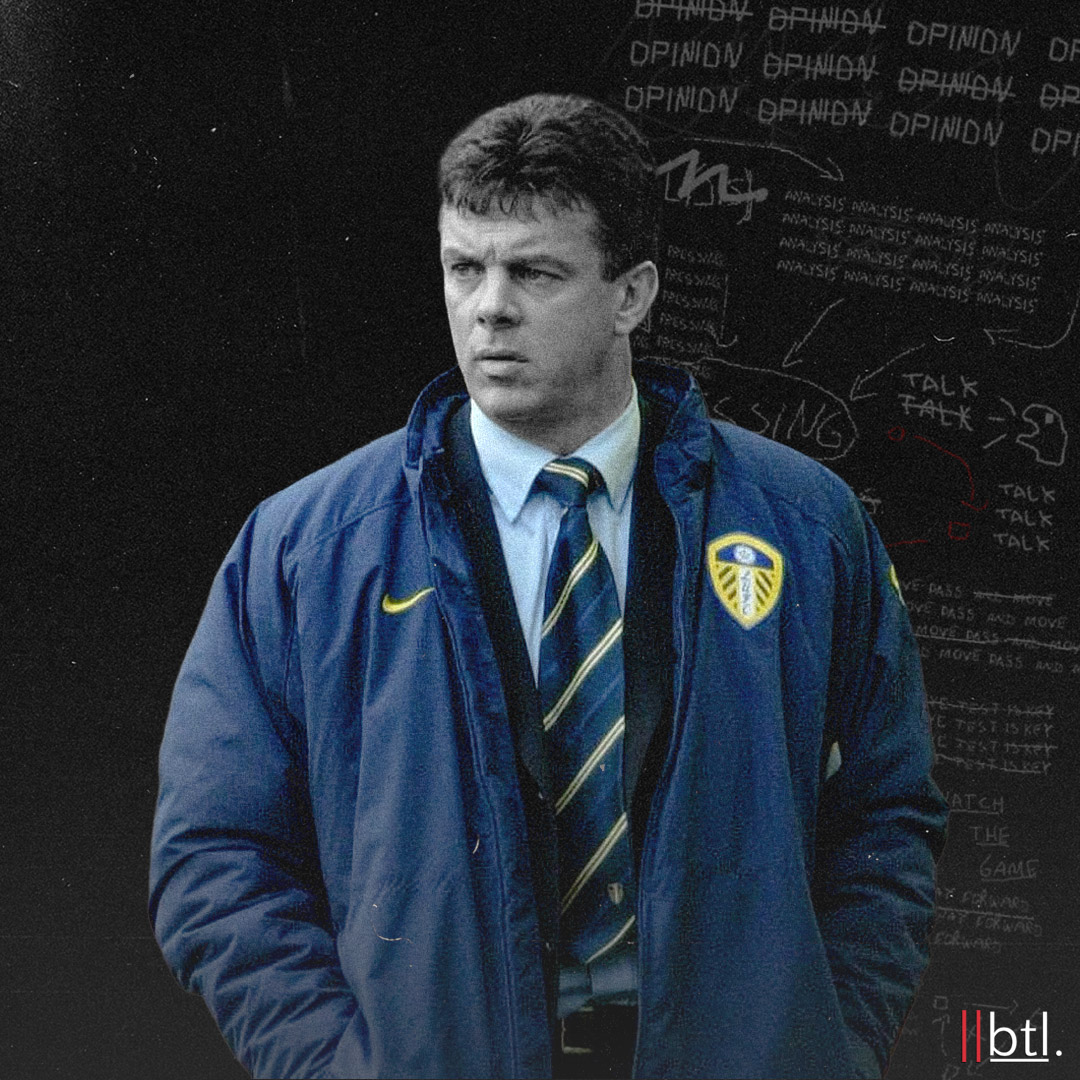
25 years on: Remembering Leeds United’s Win at Lazio
At the final whistle on 2 May 2004, Bolton Wanderers’ Reebok Stadium witnessed an astonishing outpouring. In the away section, inconsolable children and howling adults – some shirtless – were the picture of despair. Their team, Leeds United, had just lost 4-1 and been effectively relegated from the Premiership.
On the pitch, a distraught young man traipsed around the ground applauding the travelling supporters, stopping occasionally to wipe his tears with the hem of his white shirt. At 23 years old, Alan Smith had experienced the ups and downs of a lifetime in a six-year senior career with Leeds.
Consoled by goalkeeper Paul Robinson, Smith cried and applauded the fans, stopping in between to wipe his tears, to shake hands, to drink from his bright blue bottle. Smith’s clumsy juggling of the usual post-match duties with his overflowing emotions was like that one Gilmore Girls episode where the Gilmores are having it out over dinner and they go from yelling at each other, to appreciating the food, to laughing together, to yelling again.
Grief is rarely a coherent emotion. Ask a Leeds fan with memories of that painful day – they might recall a teary-eyed Smith in Leeds’ famous white shirt. Only, that wasn’t a Leeds shirt – they had on their black, pinstriped away kit that day. At the final whistle, Smith had embraced Bolton’s Jay-Jay Okocha and swapped shirts with him. The most famous image of Leeds’ relegation – of Smith, the doomed youth – pithily captured the profound sense of dislocation seeping through the scene: the young striker applauding his fans in the other team’s shirt.
The Evolution of the Deep-Lying Playmaker: From Pirlo to Rodri
Not too long ago, though, Leeds had felt like they really belonged. Three and a half years earlier, on 5 December 2000, following a famous 1-0 win over star-studded Lazio in the second Champions League group stage, a 20-year-old Smith, the scorer of the game’s only goal, issued comments of a maturity beyond his years:
“It was important to bounce back after Saturday’s result and I thought we defended excellently tonight…We’ve showed we can do it on the big stage and when we get back in action in the Premiership we have got to do it there as well. Tonight I think we came of age. We grew up as people in Milan and Barcelona and have taken that on with our performance here.”
Twenty-five years on, Smith’s immediate recognition of the significance of both the result and the performance against the Serie A champions is striking. It was perhaps Leeds’ finest hour.
***
After nineteen seconds at the Stadio Olimpico, Robinson thumped the ball downfield and Smith was in action, throwing himself into a challenge as opposing centre-backs Alessandro Nesta and Fernando Couto converged. Lazio captain Nesta was nimble enough to leap over but Couto was not so lucky, crashing to the floor after being caught by Smith. Barely half a minute in and we had near enough, but not quite, the early ‘reducer’.
Soon after, still not three minutes in, Diego Simeone obstructed Lee Bowyer on the right flank and Leeds were awarded a free kick. Bowyer himself launched the set piece but just as Jonathan Woodgate made headed contact, referee Claude Colombo blew his whistle. It was Smith’s strike partner Mark Viduka.
The Wizard Of Alvalade: The Magic, the Madness and the Making of Ricardo Quaresma
As the free kick soared in, Viduka had reacted to Nesta’s shirt-pulling with an elbow. The defender collapsed to the turf clutching his face, rolling around slowly. For the offence, Viduka was summoned by Colombo and booked, the tiny balding official theatrically whipping out the yellow card for the towering Viduka.
He joined Smith and Eirik Bakke on a yellow, all three now perched uncomfortably on the disciplinary tightrope. Viduka’s reaction was brief and muted – slight remonstration to Colombo, slight touch on the ref’s back, walked away slightly shaking his head. On with the game.
And here’s where things went off script for Lazio – the Australian Viduka, signed from Celtic in the summer, refused to be muzzled. What instead followed was an astonishing display, adroit and awesome in equal measure, Viduka both terrorising Lazio’s defence and turning them inside out, juggled with an act of disciplinary funambulism.
His quick footwork was on full display that night, twisting one way and turning the other, the Melbournian ironically bringing out the rugby league steps to win a football match. A quarter-century later, it warrants recounting as one of the great performances by a Leeds forward.
Viduka’s formidable riposte to the early booking began immediately. A few yards up the same right flank from whence came the fateful free kick, his charge up the line was unfairly arrested by the luckless Couto in a failed attempt to halt his dribble-past.
Eight minutes into the game, and Leeds had a second, identical free kick. Again, Bowyer slung in the set piece which zipped across the face of goal, somehow entirely missing the Viduka/Smith/Woodgate pile-on that threw themselves pell-mell trying to connect with the delivery. Viduka, showing no signs of inhibition from the bullet of a yellow card lodged in his formidable constitution, was looking dangerous.
***
In 1999/2000, Leeds United made an intrepid run to the semi-finals of the UEFA Cup, knocking out Fabio Capello’s Roma along the way. Nine months before the Lazio game, Leeds made their first trip of 2000 to Italy’s capital for the fourth round first leg against Roma on 2 March.
A year away from their first Scudetto since 1983, Roma’s star was on the rise and the talismanic Francesco Totti in particular shone across the tie, but here a splendid goalkeeping performance by Nigel Martyn helped Leeds escape with a 0-0 draw. A single Harry Kewell goal at Elland Road had Leeds on course to progress when the tie, already a fractious affair, finally exploded into a rumpus at the end of the second leg. Reduced to nine men, Roma limped out of the UEFA Cup.
The semi-final legs against Champions League dropouts Galatasaray landed two weeks apart in April 2000, during Leeds’ worst period of an impressive season until that point, and they exited the UEFA Cup after a 4-2 aggregate defeat, the gloom of sporting heartbreak overshadowed by real tragedy as Leeds fans Kevin Speight and Christopher Loftus were stabbed to death the night before the first leg in Istanbul. Galatasaray went on to beat Arsenal on penalties in the final.
It was Leeds’ most impressive European accomplishment in more than a generation, their deepest run in continental competition since the odyssey to the European Cup final in 1975. In none of the club’s 1990s European campaigns had they made it past the second round. In that respect, Leeds and O’Leary’s European success – consecutive semi-final appearances in the UEFA Cup and then the Champions League – was truly their own.
The other really remarkable thing is how Leeds under O’Leary became very successful very quickly in Europe – and how they fell off just as fast. All told, Leeds only ever had two seasons in the Champions League eight years apart. Domestically between 1999 and 2002, Leeds, together with a Liverpool side undergoing a revolution of their own under Gérard Houllier, were developing the strongest challenge to Manchester United and Arsenal.
Of the two, Leeds’ challenge had been following a steadier upward trajectory and seemed to have time on their side. “In 1999/2000 the average age of their starting XI was 24 years and 162 days,” notes Michael Cox in The Mixer, “the youngest in the Premier League era.”
And for a while, it seemed as if O’Leary’s babies would achieve their destiny well ahead of schedule. In 1999/2000, they won 14 out of their first 19 league games and led the Premier League for 11 matchdays in all, including a run of seven straight weeks from November to January. Progression through the early rounds of the UEFA Cup and in particular a late Lucas Radebe goal in the second leg against Spartak Moscow to advance on away goals only reinforced the seemingly cosmic inevitability.
But then, a run of two wins in seven games followed after Boxing Day, including defeats to direct rivals Arsenal, Liverpool, and Manchester United. A further four-game losing run in late March and early April poured water over any flickering ambitions of a title challenge.
Eventually, Manchester United cantered to another title win, twenty-two points ahead of Leeds in third, but that’s only the story of the final nine games of the season as Alex Ferguson’s team swelled their lead from four points to their eventual margin of eighteen. United’s nose-thumbing gallop past the finish line belies just how far and for how long Leeds’ considerably less experienced young guns had pushed their most emphatic title-winning side. It had been pretty close until three-quarters of the way.
***
It’s safe to say Leeds were unfancied in Rome and the defence was under particularly severe scrutiny. Three days earlier, Leeds had travelled to Leicester City with new record purchase Rio Ferdinand, now Britain’s most expensive footballer, debuting in a remodelled back three. It was a disaster. Within half an hour, the Foxes were 3-0 up having netted three headed goals; ten minutes after Gerry Taggart’s third, O’Leary jettisoned the new look defence. Woodgate was withdrawn and Leeds returned to 4-4-2 before half time.
An improved display followed, although there was a further defensive mishap in the sending off of Radebe for two yellow cards; Leeds’ only tangible reward from the fiasco at Filbert Street was a Viduka consolation fifteen minutes from the end. Ferdinand was ineligible for Rome, which at least rendered moot O’Leary’s selection dilemma from the weekend – and arguably to Leeds’ benefit, automatically resolving the quandary in favour of the familiar, more cohesive backline.
The Leicester game also, importantly, marked the return of the electric Kewell from injury – he played half an hour as a substitute. At the Stadio Olimpico, however, he was again only fit enough for the bench. Meanwhile, Nesta and Juan Sebastián Verón started for the Serie A holders.
Not that you’d suspect a mismatch given how Leeds began this game. Almost as impressive as the quality of his performance was the way Viduka’s efforts set the tone of Leeds’ attack. Set pieces were the theme and Viduka created two of Leeds’ first three serious dead ball situations – the tank, in a role-reversal, clearing a path for the air raids.
For the second of those, standing with his back to goal and using his left arm to hold off Couto, Viduka cleverly made as if to collect Kelly’s pass with his left foot but instead took it on the outside of his right, into space, and rid himself of Couto, all in one delectable, superbly coordinated motion. He won the corner off Simeone and Bakke went the closest yet, his well-directed header from twelve yards blocked on the line by Attilio Lombardo on guard duty at the post.
Lazio’s quality in those opening exchanges was obvious in the way they alternated gorgeous one-touch play with the more direct stuff, how they expertly probed the opposition’s weakness, but it was Leeds who came closer to scoring in the first quarter of an hour. That header, however, was the end of Leeds’ opening salvo and finally, twenty minutes in, Lazio began to threaten the Leeds goal more seriously, wresting the momentum two minutes after Bakke was denied on the line.
A pair of Verón corners, one from either side, got things underway. Hernán Crespo went close from the first of those, leaping to meet the delivery in the air inside the six-yard box but only side-footing into the side-netting as Radebe and Smith failed to close him down. Three minutes later, from the left, Verón went for the back post and Giuseppe Pancaro, having comfortably outjumped Jason Wilcox’s ineffectual hop, inexplicably missed, rattling the frame of the goal from point-blank range with his head.
Between Leeds’ feeble defending, the accuracy of Verón’s deliveries, and the proximity of the chances, it’s a wonder neither Crespo nor Pancaro put Lazio ahead. Lazio’s other avenue of attack was down the Dominic Matteo-guarded left flank. After absorbing Leeds’ early burst, Pavel Nedvěd came across from the opposite flank to make the first incision. Soon, both right-sided players, Lombardo and Pancaro were merrily hammering away in search of an opening, delivering their low crosses relatively unhindered.
As Lazio ran increasingly close, Viduka remained Leeds’ main outball, finding time between those Verón corners to lead a counter attack studded with another delightful piece of skill. Much credit should go to Olivier Dacourt, who began by expertly dispossessing Marcelo Salas to win the ball and then arrested Robinson’s thump for Wilcox to stab into Viduka’s feet.
With Simeone closing him down, Viduka shaped to pass backwards, delayed until the Argentinian had committed his weight and then pulled out of the move, instead using his second touch to pivot brilliantly into the wide expanse to his left and leave Simeone for dead. Storming past the half-way line, Viduka even threw in a stepover to keep Couto honest and then fed the onrushing Bowyer to his right. The cross was claimed by goalkeeper Angelo Peruzzi.
His footwork now recalibrated for counter attacks launched from deep, running with the ball to relieve pressure, these breaks also captured Viduka’s superb judgement of the other’s movements, striking when the opponent had overextended themselves and was most vulnerable.
That recalibration was partly out of necessity. Lazio had the midfield in such a chokehold and Leeds were having such trouble playing through them consistently that Viduka dropping deep was vital to turn the wheel of the attack. Robinson’s many thunderous punts downfield were, truthfully, their most reliable option of getting the ball close to Lazio’s goal.
In the heart of that midfield, Verón’s technical quality was obvious – the skill with the ball, the wicked accuracy of his long passes and set pieces – and more than once, it’s as though the game paused for La Brujita to juggle nonchalantly in possession. It was also his creativity from deep that so nearly put Lazio in front after thirty-six minutes.
Aiming for Nedvěd on the left, Verón found his man with a strong header and the cross was on. Nedvěd went for the far post and Salas beat Radebe to the punch, arrowing a diving header into the ground. The awkwardness of the bounce and angle were enough to beat Robinson and it would’ve been 1-0 had Woodgate not cleared off the line.
It wasn’t for want of trying that Leeds didn’t play more progressively in the first half. It’s just that their multiple attempts to knit short passing moves usually broke down in some hilarious fashion and Wilcox proved particularly inept. In one such move, he was late to Dacourt’s return as the Frenchman tried to round off a simple one-touch sequence also involving Matteo, stepping with the ungainly haste of a commuter trying to make it to his train before its doors shut. The ball went into touch.
The instigator of this move was Bakke, the other Leeds player in the first half with the willingness to play progressively and the technique to follow through. After that early header cleared off the line, he, too, donned the dancing shoes on the night. Together, Bakke and Viduka were a pair of ballet dancers, the Norwegian and the Australian enacting Swan Lake in this open-air theatre on the banks of the Tiber. It’s little wonder that Leeds’ best chance came when this pair combined for a pas de deux.
In first half stoppage time, Bakke delicately cushioned a Matteo throw on the left, looping it up for Viduka to take on his chest. The striker shrugged off Nesta and, four passes later, collected Bakke’s gentle roll with his back to goal before completely ruining first Nesta and then Pancaro with two more titillating turns. As the fullback went sprawling, Viduka completed a full rotation, paused for a half-second, and dinked a spring-loaded cross for Bowyer arriving at the back post.
It was so nearly the perfect move. Bowyer lunged in completely unmarked but only connected with his heel and into the ground – and the wrong side of the post. An excellent chance, created by some genuinely exquisite play, and Leeds should’ve landed a real haymaker on the stroke of half time.
***
Prior to taking charge in October 1998, O’Leary had served as George Graham’s assistant at Leeds for two years. In that time, the Scot had done much to instill better defensive habits that Leeds desperately needed. In his first season, 1996-97, Leeds conceded 38 Premiership goals, down from 57 the year before.
Both coaches, in turn, benefited from the good work of Howard Wilkinson, the winner of the final First Division title in 1992 – Leeds’ only trophy not won by Don Revie. “[Leeds] were reaping the rewards of their excellent youth system,” Cox writes, “partly thanks to Howard Wilkinson’s groundwork in the early 1990s, which developed players such as Harry Kewell, Jonathan Woodgate, Ian Harte, Alan Smith and Paul Robinson.”
The Best Footballers That Became Politicians After Retirement
If O’Leary had seen further, it was by standing on the shoulders of giants. For three consecutive seasons from 1997, Leeds United registered a consistent improvement of one league place every season. As they went from gazing wistfully at the prospect of Champions League qualification from a particularly distant UEFA Cup spot, to a season of consistently pushing if not outright breaking into those Champions League places, to mounting a title challenge so serious that even its spectacular failure got them into Europe’s top-tier competition the following season.
It was all in the space of three years, the highwater mark of 1999/2000 – and indeed, the two campaigns that followed – swiftly made the ‘prequel’ seasons of 1997-98 and 1998-99 look dowdy by comparison. And yet, the fifth and fourth place finishes of the prequel seasons were Leeds’ highest Premiership finishes until then. Their improvement might seem steady from season to season, but take a step back and the impressive trajectory of the full five-season arc is revealed. While the speed of Leeds’ domestic improvement was not as blinding as their improvement in Europe, the slipstream it generated was still fairly powerful.
After a particularly difficult, injury-ravaged first half of 2000/01 that left them languishing in tenth as late as February, Leeds rallied to produce, considering its starting point and the size of the deficit they clawed back, their most impressive run of league form under O’Leary, winning twelve and losing just one of their last 16 Premiership games while qualifying for the Champions League semi-finals.
There was also something about this team that really struck a chord with fans. “Indeed, it was only during David O’Leary’s ill-fated four-year reign that football came to dominate in the same way that it did in Liverpool and Manchester,” write Rob Bagchi and Paul Rogerson in The Unforgiven. “Leeds under O’Leary won nothing, yet they were a far more popular draw than Revie’s side, one of the finest post-war club teams, ever were. For all O’Leary’s detractors, in his last three seasons the ground was almost full for every league game for the only time in Leeds United’s ninety-year history.”
Ultimately, Leeds didn’t secure Champions League qualification for 2001/02 by either available method. Their late surge in the league wasn’t enough to reel in Liverpool, who finished a single point ahead of Leeds in the last Champions League spot, and they fell to a resolute Valencia side, also enjoying their best period in two decades, over two legs in the semi-final, albeit not without controversy.
Which Players Have Scored in Each of Europe’s Top Five Leagues?
Normally, with a bit of perspective, one could take a lot of heart from the fact that fourth and a Champions League semi-final could be considered a disappointment at all. But Leeds’ financial problems were about to give this disappointment an especially sinister hue.
***
Ten minutes after the restart, some diligent pressing from Salas forced Robinson to blast Kelly’s back-pass upfield and Lazio were back up the Leeds end in no time, Nedvěd controlling Lombardo’s cushioned header with his chest and sashaying down the right flank just inside the box. Matteo was unable to stop the cross, which somehow missed both Crespo’s head and Radebe’s leg but would’ve fallen to Salas inside the six-yard box had Woodgate not repelled it in the nick of time.
Dacourt could only eject it for a throw and this time it was Verón poking a perfectly weighted through ball for Nedvěd to try again from the same inside right position. He lashed it high into the side-netting, raising a hand in acknowledgement as he jogged away.
Considering the scrutiny they were under, the performances of Radebe and Woodgate in this game were particularly impressive. Throughout the contest, their under-pressure firefighting was heroic and largely successful, frequently stepping up to cut out Lazio’s more direct efforts or scrambling to prevent the final ball from reaching its intended target.
In the first half, Woodgate’s critical headed intervention prevented Nedvěd’s fiendish cross from dropping onto the head of Salas on the six-yard line – and now, into the game’s final half-hour, he was about to have his best spell. As Lazio intercepted a Bowyer cross and launched a counter attack, Nedvěd swiftly released Crespo down the left. With his teammates all out of position, Woodgate shone in the one-on-one situation, blocking off all of Crespo’s options and haranguing the forward into playing the ball back to Giuseppe Favalli.
Lazio then switched play to the opposite flank, but Woodgate was on hand again to head Pancaro’s cross out for a throw. The home side tried again and there was Woodgate again, this time heading away Verón’s delivery to neutralise the attack for good. It was outstanding defensive work and he almost capped a dream passage of play with a goal at the other end when he dragged wide from inside the box.
Just before Lazio brought on Fabrizio Ravanelli for Verón on 70 minutes, Leeds put together a superb team move, perhaps their best of the game, in what was almost a practice run for the goal. It began in their own inimitable way, from a Robinson goal kick for territory before Radebe started the move proper, initiating a nine-pass move involving eight of Leeds’ ten outfielders.
It was a fantastic blend of quick, possession-transferring stabs, flank-switching square balls, and incisive vertical passes that vivisected Lazio, the tempo rising and falling and rising again as Leeds worked their way towards the home side’s goal. The ninth and final pass was Viduka’s through ball to Smith that caught the young forward in retreat, perhaps trying not to be caught offside, which, coupled with Peruzzi’s speed off his line, was enough for the goalkeeper to beat Smith to the ball by a fraction of a second.
***
And so we’ve come to Robbie Fowler’s chip in the snow, the cap to a 3-0 win at Upton Park on New Year’s Day 2002 that put Leeds on top of the Premiership, seventeen games from greatness. It was the high point, inexplicably, of their worst season under O’Leary.
Champions League qualification was vital and to their credit, Leeds were on course in the entire first half of the season, remaining in the Champions League spots while progressing through the first three rounds of the UEFA Cup. But the drop was never too far away on the Leeds rollercoaster and 2001/02 was the perfect encapsulation. Leeds had already weathered a poor run of one win in seven games between October and December without dropping out of the top four; after the win at West Ham on 1 January, they were dumped out of the FA Cup by Second Division Cardiff.
They then embarked on a seven-game winless run in the league and by the time they next won a Premiership game, it was early March and they had slipped to fifth, where they finished the season five points behind Newcastle United in the final Champions League spot.
Compared to 2000, the pain of the missed opportunity was even more acute considering both Liverpool and Manchester United were flailing as Leeds were flying. Plus, that seven-match winless run began at truly the worst possible time, just as Liverpool recovered from their slump to win 13 of their last 15 games and United reeled off 12 wins in 13 between December and February to insert themselves back in the title race.
Really, though, the sourest note of all was the genuine wretchedness of Leeds’ own form. Two miserable seven-game runs proved more than their title challenge could handle and that year, as the table proved, just one win in any selection of 14 games wasn’t even Champions League-worthy form. But here’s the real kicker: they weren’t actually getting worse.
Remarkably, Leeds’ first four Premiership seasons under O’Leary were all about the same, with points totals of 67, 69, 68, and 66 from 1998 to 2002. In fact, for three straight years from ‘99 to ‘02, they posted a virtually identical record away from home. Their costly failure in 2002 was actually down to a deteriorated home record, too many draws, and not nearly enough goals.
What does this tell us? First, that although the era is remembered as the apogee of the Arsenal-Manchester United rivalry, Leeds and Liverpool were actually a hell of a lot closer to Arsenal than you would think. In 2000, Leeds’ young side were only four points behind Arsenal with the same number of goals conceded and in 2001, only a point each separated Arsenal in second from Liverpool in third, and Liverpool from Leeds in fourth.
But it also reveals the sober, oft-repeated truth about football – that standing still is falling behind. Leeds were spending heavily and significantly bolstering their squad, but in raw statistical terms, their financial gambles simply weren’t making them that much better a side – and their rivals were outdoing them just that much faster.
Ronaldo Luís Nazário de Lima and the Riddle of a God Amongst Men
The stagnancy of Leeds’ away record is especially poignant because in the last of their good years, 2001/02, Arsenal completed the extraordinary feat of going unbeaten away from home – as if to show that the bar had soared way above Leeds. That summer, O’Leary was sacked. Given the price that Leeds subsequently paid, the corollary is particularly depressing – what was it all for?
***
On 77 minutes, after a Leeds attack broke down, one of Lazio’s direct long passes in behind finally found Crespo with only Robinson to beat. Holding off Radebe, he reached out with his right foot to chip the goalkeeper first time while he still had the space to arc it up and over. But Robinson, having come twelve yards off his line, pulled off a splendid save as the ball was climbing over his head, leaping straight up once in position, cat-like, having correctly surmised Crespo’s intentions.
And where Crespo missed, Smith hit. Five minutes after replacing Wilcox in Leeds’ only change, Kewell was part of a sharp, three-man move on the left side with Smith and Viduka. This spell of possession was less protracted but no less skillful, Smith guiding the move first by activating Kewell wide on the left and then jogging alongside as Leeds #10 advanced a few paces, awaiting the return at inside left.
The speed of the move from here was coruscating – four seconds between Kewell knocking it back infield to Smith scoring in the far corner, going under Peruzzi’s dive. From Smith instantly offloading Kewell’s return to Viduka and galloping into the empty space that opened up behind Nesta, the big forward backheeling to send Smith clean through on goal who finished first time – it was four seconds of slick, scintillating football, conducted by Smith as much as concluded by him, closing a circuit with the two brilliant Australians.
Smith cast a second backwards glance as he peeled away with Lazio arms raised beseechingly for the offside. But the flag stayed down and now Smith’s left arm was aloft, an inverse Shearer, as he ran off gleefully. He first found the arms of Kewell, and Smith was soon embraced by Matteo and then Bowyer as the 6,000-strong Leeds travelling contingent went wild up in the stands. Peruzzi’s despondency, hands on hips, was the cherry on top.
With ten minutes still to play, Leeds immediately fell into game-saving mode, smashing the ball forwards in anywhere-will-do fashion and taking almost every counter attack – even the really good ones – straight to the corner flag. Fortunately, however, the denouement was relatively drama-free – the most notable incident was Nedvěd hobbling over the goal-line for treatment after coming off worse in a coming-together with Woodgate. A great through ball to Crespo didn’t survive a tight offside call while Simeone failed to connect with a cross from a counter – and that was about as good as it got.
At last, Leeds were home. After more than two months, they had secured a win in the Champions League as well as their first points of the second group stage.
***
None of those statistics, though, capture Leeds’ self-confidence or their ability to go toe-to-toe with the very best, both of which the Lazio game certainly did. It all becomes even more impressive when you dig a little deeper and discover the one quality running through Leeds’ greatest campaign under O’Leary, 2000/01, and perhaps that chapter in their history more generally – resilience.
The most eye-catching manifestation of this resilience was in how frequently Leeds overcame so much adversity that year. Plunged into deep difficulty from literally day one, 9 August 2000, Leeds had to contend with a colossal injury crisis and two red cards as they beat 1860 Munich 2-1 in the first leg of the Champions League qualifying round, completing a 3-1 aggregate win in Germany two weeks later.
In November, a month before the Lazio game, Leeds came out on top in a 4-3 thriller against Liverpool at Elland Road – without irony a certified Premier League classic, Leeds battling back from 2-0 and 3-1 down to win the match with Viduka scoring all four goals, even as they were wrecked by injury to the point they were unable to fully stock their bench with substitutes. Three weeks later, floundering in tenth, Leeds put in a staunch defensive performance to beat second-placed Arsenal 1-0.
Leeds also made a welcome habit of responding to setbacks throughout the season in truly awesome fashion. In the midweek preceding that 4-3 win against Liverpool, for instance, they’d been dumped out of the League Cup at First Division Tranmere after throwing away a two-goal lead.
Lazio, of course, was a particularly fine response to losing at Leicester but another bounce-back against Italian opposition is worth mentioning. Six days after a 4-0 hammering at Barcelona, Leeds were forced by injury to deploy the decidedly makeshift pairing of Michael Duberry and Danny Mills in the heart of defence and name a particularly thin bench against Milan in the first group stage. They won 1-0 with a late goal from Bowyer.
Even the near misses were really something. The dramatic second act to the Lazio game was a 3-3 draw at Elland Road in March 2001, a weakened Leeds side came back from 2-0 to lead 3-2 before Siniša Mihajlović equalised in the 90th minute. They were also seconds away from beating Barcelona in October after leading the whole game, Robinson’s excellent performance between the sticks fiercely protecting the early lead established by Bowyer’s brilliant free kick only to be denied by Rivaldo in stoppage time. Against holders Real Madrid at the Bernabéu, they put in a courageous performance in a 3-2 defeat.
Lazio weren’t the only champions Leeds vanquished, either. In the quarter-finals, they brought up a sparkling win against La Liga defending champions Deportivo La Coruña – ‘Super Depor’ at their peak – in the first leg at home, their 3-0 advantage enough to withstand a 2-0 defeat in the return leg and progress to the semi-finals. The late rally to finish fourth that season was in character.
***
Leeds’ tangible accomplishments – Champions League semi-final, title challenge – actually came after the Lazio. That game was, in the grand scheme of things, really a rather nondescript group stage encounter. But if you wanted an example of Leeds belonging at the top level, there are few better.
It is also, if nothing else, a reminder of the failure of league tables to capture the challenges that burned brightly, brilliantly, and all-too-briefly, the runs full of sound and fury that signified nothing. Not just for Leeds, either. A couple of seasons before Leeds hit the stratosphere, John Gregory’s Aston Villa blazed a trail in the first half of 1998/99, heading into 1999 at the top of the table.
But as the campaign approached its denouement, and Manchester United held off Arsenal, got past Newcastle United, and came from behind to beat Bayern Munich, and won one, two, three trophies, Villa’s early season form, including a 12-match unbeaten run to start the season, a run of 14 consecutive matchdays at the top of the Premiership and 16 in 20 in the first half of the season, was lost to the ether.
There exist some photos of Smith after this game in a Lazio shirt, arms raised in triumph, applauding, looking like he belongs – the exact opposite of the dejected figure at Bolton save for their common taste in opposition shirts. He was often at the centre of the agony and ecstasy, euphoria and heartbreak that frequently came bundled together for the club in that era.
Perhaps Leeds’ story can be summed up the same Leeds player in a Bolton shirt and a Lazio shirt from two very different games – one out of place and one who very much belonged.
By: Sushain Ghosh / @sushainghosh
Featured Image: @GabFoligno / Martin Rickett – PA Images