

Biggest Jackpot Slots Available at Leading Online Casinos
Progressive jackpot slots at leading online casinos accumulate prize pools reaching millions of dollars across networked gaming platforms, with record jackpots exceeding $20 million in individual wins. These high-volatility machines attract substantial player volume through potential life-changing payouts despite lower baseline return-to-player percentages ranging from 85% to 95% compared to 96%+ standard slots.
Progressive Jackpot Mechanics and Accumulation Systems
Progressive jackpots function through networked systems where small percentages of all player wagers flow into shared prize pools that grow continuously until someone triggers the jackpot condition. Unibet Casino and comparable leading operators establish progressive networks spanning multiple casinos and platforms, enabling rapid jackpot accumulation that generates headline-worthy prize amounts. A single progressive machine might accumulate $50 daily from 500 players wagering $100 each, while networked progressives accumulate $5,000+ daily across thousands of simultaneous players.
The operational mechanism involves automated systems redirecting specified percentages of wagers (typically 0.5% to 2%) from base game returns into dedicated jackpot pools. When players trigger jackpot symbols or special conditions, they claim accumulated amounts at that moment. By implementing progressive structures, casinos sacrifice guaranteed payout percentages that fixed-prize machines would provide, accepting variable payouts in exchange for player attraction through dramatic prize potential. Fixed-prize slots maintain consistent mathematical returns while offering lower maximum wins, while progressives sacrifice baseline consistency for unlimited accumulation potential.
Progressive Versus Fixed Jackpot Comparison and Strategic Implications
Progressive and fixed jackpot machines represent distinct strategies with different mathematical foundations and appeal profiles. Progressive machines feature a lower baseline RTP (85-95%) because portions of wagers fund jackpot pools rather than returning directly to players. Fixed-prize machines maintain a higher baseline RTP (96%+) because all wagers fund player returns without jackpot allocation. Progressive machines attract players seeking dramatic multi-million payouts, while fixed-prize machines attract mathematically-focused players optimizing long-term returns.
Here are the primary differences between progressive and fixed jackpot slot structures:
- Progressive jackpots accumulate across multiple casinos, creating multi-million prize pools versus fixed jackpots capped at predetermined amounts
- Progressive baseline RTP ranges from 85-95% due to jackpot funding versus a fixed-prize baseline RTP of 96%+ with direct player returns
- Progressive machines generate excitement through dramatic prize growth versus fixed machines, providing consistent mathematical expectations
- Progressive triggers occur randomly, creating unpredictable winning moments, versus fixed triggers occurring at predetermined frequencies
- Progressive prize amounts vary with network activity, versus fixed amounts remaining constant regardless of player volume
- Progressive machines require networked infrastructure versus fixed machines operating independently on individual platforms
Biggest Jackpot Titles Currently Available at Leading Platforms
The largest progressive jackpot pools currently available at licensed online casinos feature accumulated balances exceeding $10 million, with certain titles maintaining perpetual mega-jackpot status through continuous player volume. Mega Moolah consistently features the largest progressive jackpots across the industry, with accumulated pools regularly reaching $15-20 million before winning events. Hall of Gods, Arabian Nights, and Divine Fortune maintain $5-10 million jackpot balances through dedicated player bases across multiple casinos.
The functional distinction involves identifying jackpot titles, maintaining consistent large balances, versus emerging titles with smaller current balances. Established titles attract continuing player volume, sustaining rapid accumulation, while new titles require extensive marketing investment to build player bases, generating meaningful jackpot growth. By playing established jackpot titles, players sacrifice novelty and cutting-edge graphics in exchange for larger current prize pools and statistically higher probability of jackpot triggering during their play sessions.
Leading Jackpot Slots and Current Prize Pool Information
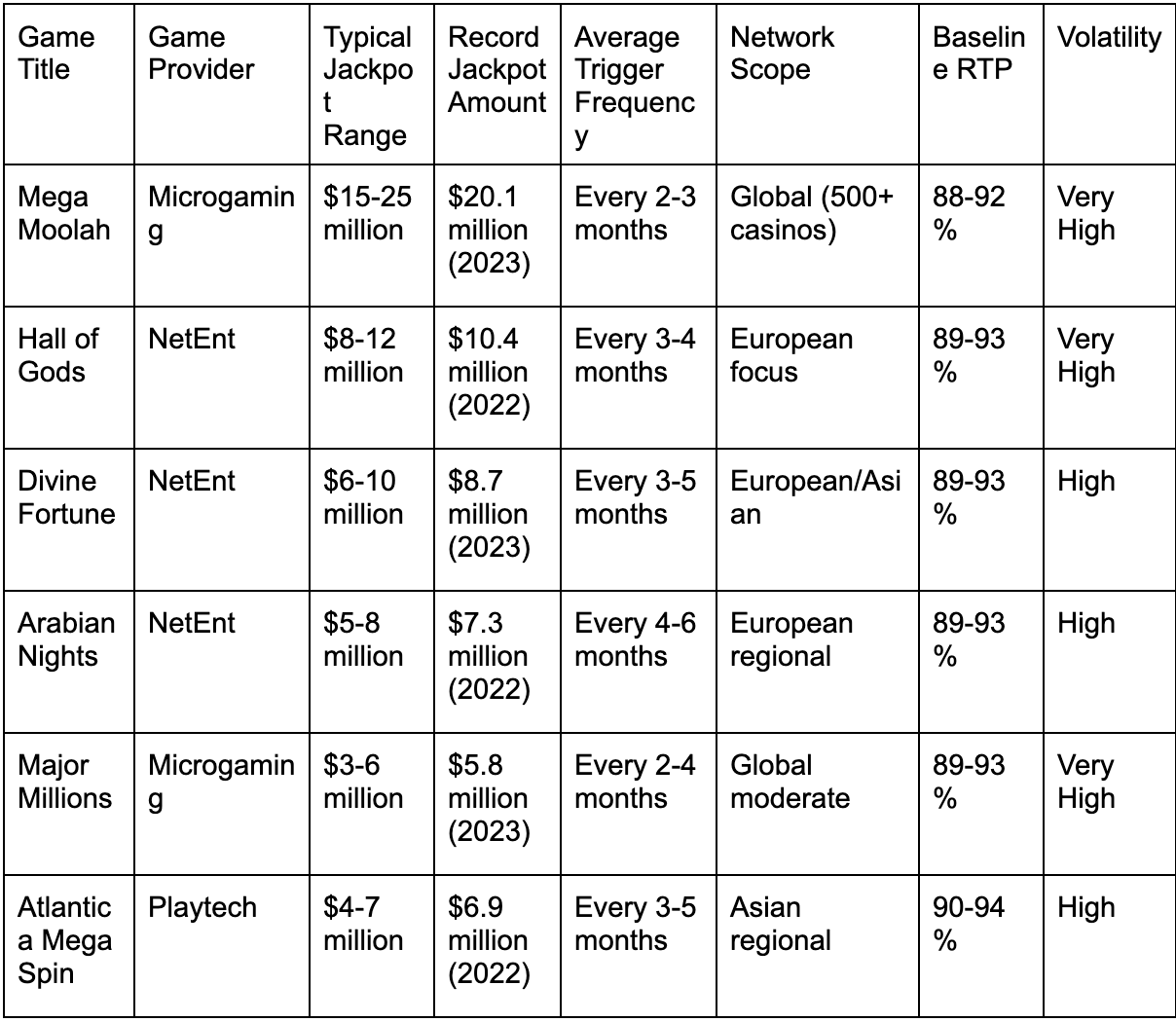
Major jackpot titles demonstrate distinct accumulation patterns based on player volume, network size, and promotional emphasis. Mega Moolah generates the largest reported jackpots through a global gaming network spanning hundreds of casinos and millions of players. Progressive Eureka and Atlantica maintain substantial jackpots through regional player concentrations rather than global distribution, creating different accumulation velocities.
Here is a comprehensive breakdown of leading progressive jackpot slots with typical prize pool information:
Volatility and Winning Probability in Jackpot Slots
Jackpot slots universally feature very high volatility, creating dramatic variance between frequent modest losses and rare substantial wins. Players experience long stretches of base game play without significant payouts, punctuated by sudden bonus features or jackpot triggers generating multi-million dollar returns. This volatility pattern requires substantially larger bankrolls than standard slots, with expert recommendations suggesting minimum $500-1,000 bankrolls for sustainable jackpot play.
The operational mechanism involves random number generators programmed with jackpot trigger frequencies typically occurring once every 50-100 million spins per machine. Because individual players cannot generate millions of spins, jackpot triggers appear completely random despite mathematical certainty across infinite play cycles. By implementing extreme volatility for jackpot potential, game designers sacrifice session stability that low-volatility machines provide, accepting dramatic swings in exchange for dramatic winning possibilities.