

Live Online Gaming Strategies That Actually Work
Professional esports players maintain consistent win rates exceeding 55% through systematic strategy application rather than pure reflexes, demonstrating that competitive gaming success depends on learnable tactical frameworks rather than innate talent alone. Real-time decision-making under pressure separates high-ranked players from casual competitors, requiring specific mental models and practiced responses to recurring situations.
Live online gaming mechanics operate through simultaneous action processing where multiple players execute decisions within compressed timeframes. Unlike turn-based games allowing unlimited deliberation, live games demand instantaneous choices responding to dynamic opponent behavior and environmental changes. The system processes your inputs alongside opponents’ inputs, creating emergent scenarios requiring adaptive reactions. This real-time constraint eliminates pre-planned strategies in favor of responsive frameworks adjusting to actual conditions. By choosing live gaming for competitive intensity and social engagement, players inevitably sacrifice the methodical planning possible in turn-based alternatives, accepting higher cognitive load and faster decision pressure.
Competitive Gaming Fundamentals
Britsino Online Casino and similar competitive platforms measure success through ranked progression systems reflecting consistent decision quality. The ranking algorithms distribute players into skill tiers based on win-loss records and game metrics. Understanding this progression structure matters because it establishes objective standards for strategy effectiveness. Strategies generating 52%+ win rates across 100+ games demonstrate statistical validity, while single-game performances reflect variance rather than system mastery.
The fundamental difference between casual and competitive play involves consistency requirements. Casual players succeed through occasional smart decisions or opponent mistakes. Competitive players succeed through repeatedly executing optimal decisions regardless of previous outcomes. This requires developing automated decision-making for routine situations, freeing conscious thought for novel scenarios demanding creative problem-solving.
Real-Time Decision Framework
Competitive players process information through layered decision hierarchies responding to different time scales. Immediate reactions handle threats requiring sub-second response, tactical decisions address positioning and ability usage within seconds, and strategic decisions govern resource allocation across minutes.
The following framework structures decision-making across different time scales:
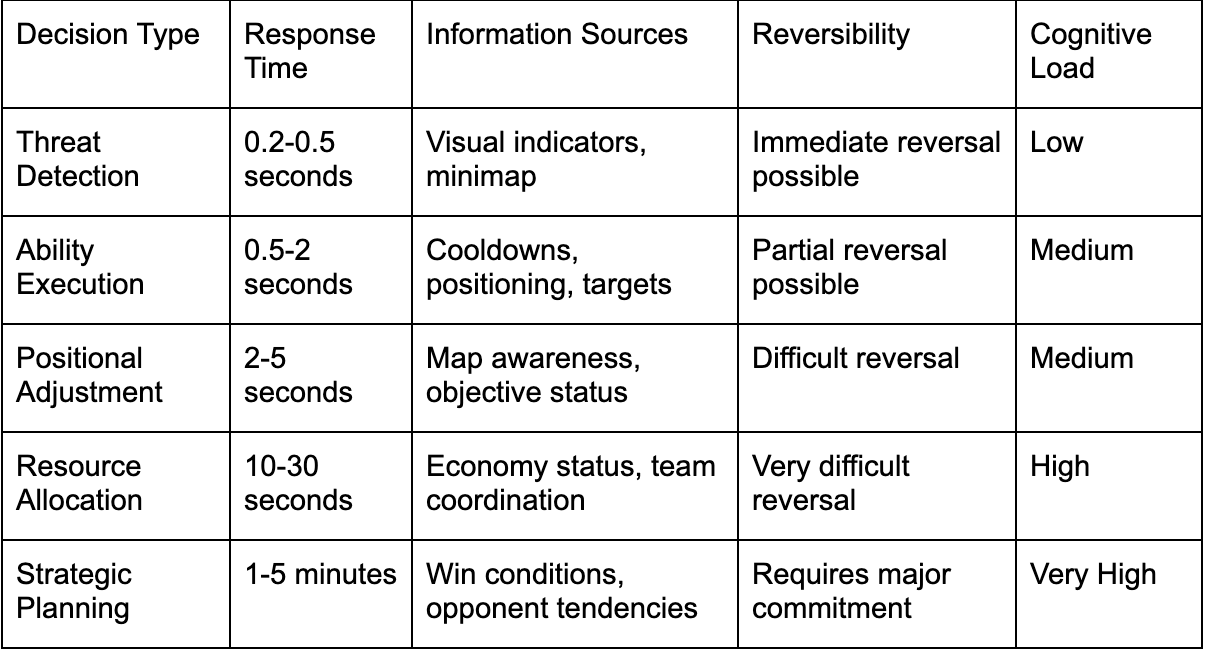
This hierarchy enables efficient decision-making because immediate threats receive faster processing than strategic considerations. Players recognizing threat patterns automatically execute appropriate responses without conscious deliberation, reserving mental resources for novel situations.
Reaction Time Optimization
Professional gamers maintain 60+ frames per second display refresh rates enabling sub-100 millisecond visual latency. This technical requirement matters because reaction time improvements beyond ~150 milliseconds demand equipment upgrades rather than practice alone. Average response time for threat detection improves from 400-500 milliseconds through consistent practice to 200-250 milliseconds, representing approximately 40% reduction. By investing in equipment optimization, players sacrifice financial resources but gain mechanical advantages unavailable through practice alone.
Opponent Behavior Analysis
Successful players recognize recurring opponent patterns enabling predictive responses before opponent actions complete. Common patterns include ability usage sequences, positioning tendencies, and economic behavior. Identifying an opponent favoring aggressive early-game tactics enables defensive preparation preventing early momentum loss. Pattern recognition develops through accumulated experience watching specific opponents, requiring 20-30 match exposures to establish reliable predictive models.
Resource Management and Economic Optimization
Competitive games feature resource systems governing equipment purchases, ability upgrades, and strategic investments. Optimal resource allocation determines whether players maintain technological advantages enabling favorable engagements. This economic dimension requires understanding cost-benefit analysis of different purchases and investment timing.
Key resource management principles include:
- Priority resource investments must align with immediate win conditions rather than future scaling
- Defensive purchases prevent momentum loss when opponents maintain economic advantage
- Coordinated team investments enable powerful spike windows dominating specific phases
- Economy denial through killing opponent units forces suboptimal purchase sequences
- Risk-reward evaluation determines whether resource accumulation or immediate purchases maximize winning probability
- Flexible building paths adapt purchases to opponent strategy rather than following predetermined plans
The main compromise of optimized economic play is that it requires continuous recalculation based on actual game state, eliminating comfort of following static build orders. Players must actively evaluate whether predetermined purchases match current circumstances, accepting higher cognitive demands than automatic execution.
Team Coordination and Communication
Multiplayer competitive gaming demands synchronized decision-making across multiple players executing coordinated actions. Team communication establishes shared information preventing individual players from making decisions based on incomplete data. Effective communication reduces individual error rates by approximately 40% compared to silent play, transforming random individual brilliance into reliable group performance.
Team coordination requirements vary across game types:
- Direct threat communication alerts teammates of immediate dangers requiring collective response
- Objective focus establishes shared priority preventing fragmented player efforts
- Ability coordination times crowd-control sequences maximizing damage output
- Economic transparency ensures teammates understand buying capacity preventing desperate fights with inferior resources
- Rotation planning coordinates positioning for objective contests
- Call timing establishes when coordinated actions execute preventing premature engagement
Successful competitive teams develop standardized communication protocols reducing message ambiguity. “Rotate top” means all available players move to the top section of the map, while “ight only if winning” establishes conditional engagement rules. Standardized terminology prevents miscommunication causing coordination failures during high-pressure moments.
Practical Implementation Framework
Developing competitive gaming competence requires structured practice combining isolated skill development with integrated match play. Professional players allocate 70% of playtime to focused practice addressing specific weaknesses rather than casual competitive matches. This practice-to-match ratio reflects that match results reflect cumulative skill development rather than determining skill itself.
Live online gaming success emerges from combining real-time decision frameworks with systematic opponent analysis and coordinated team execution. Players mastering these elements consistently achieve win rates reflecting skill rather than luck, establishing sustainable competitive rankings through reliable decision-making under pressure.