
Tyler Morton: Liverpool Midfielder, Lyon Transfer, Stats and Career Outlook
Who Is Tyler Morton?
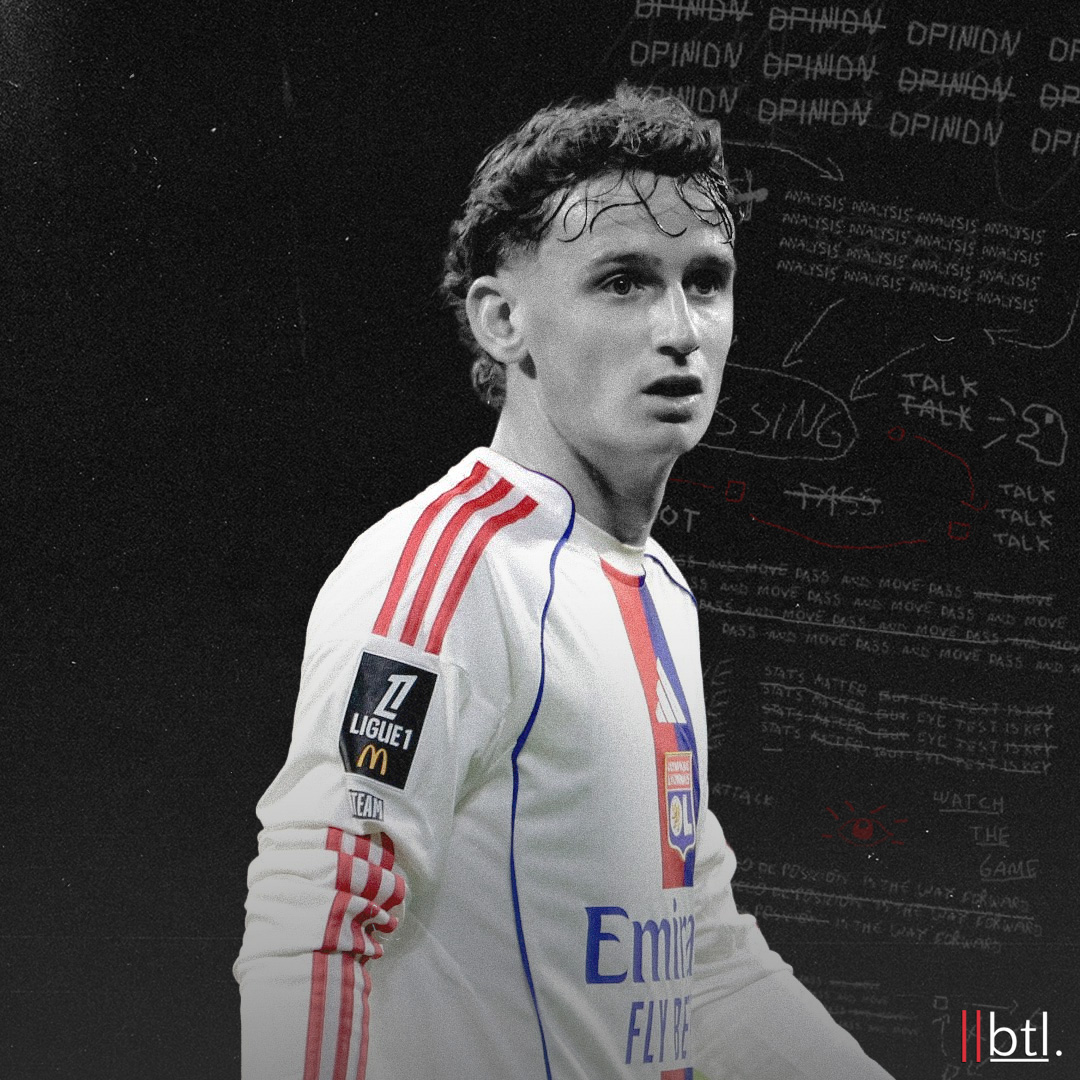
Tyler Morton is a 22-year-old English midfielder and a graduate of the Liverpool academy. He recently moved to the French club Lyon for a fee reported to be up to £15 million.
The transfer has been widely discussed in the media. Reports regularly mentioned different scenarios — staying at Liverpool, leaving permanently, or going out on loan. Recently, Morton’s name has appeared in connection with transfer negotiations, with Lyon showing clear interest and the player himself seeking regular playing time. Journalistic reports from Sky Sports and Anfield Index stated that Liverpool were in talks with Lyon over a transfer worth around £15 million.
Why Tyler Morton’s Move to Lyon Makes Sense
After two seasons in the Championship, one thing became clear: continuing on loan meant stagnation. I watched Morton at Blackburn and Hull City — he controlled the midfield well, played clean, accurate passes, but that level was becoming a ceiling rather than a step forward. Liverpool could not offer him regular minutes, and the competition in his position was simply too high. At that point, taking a risk was necessary — and he took it.
The move to Lyon looks well-calculated. Ligue 1 is not a step down. It is fast, physically demanding, and gives young players real opportunities for consistent playing time. Morton himself noted in interviews that the tempo is no lower than the Premier League, and in some matches the physical intensity is even higher. This shows on the pitch: in his first 13 matches, he logged over 1,100 minutes, performed his role reliably, and helped stabilize Lyon’s midfield.
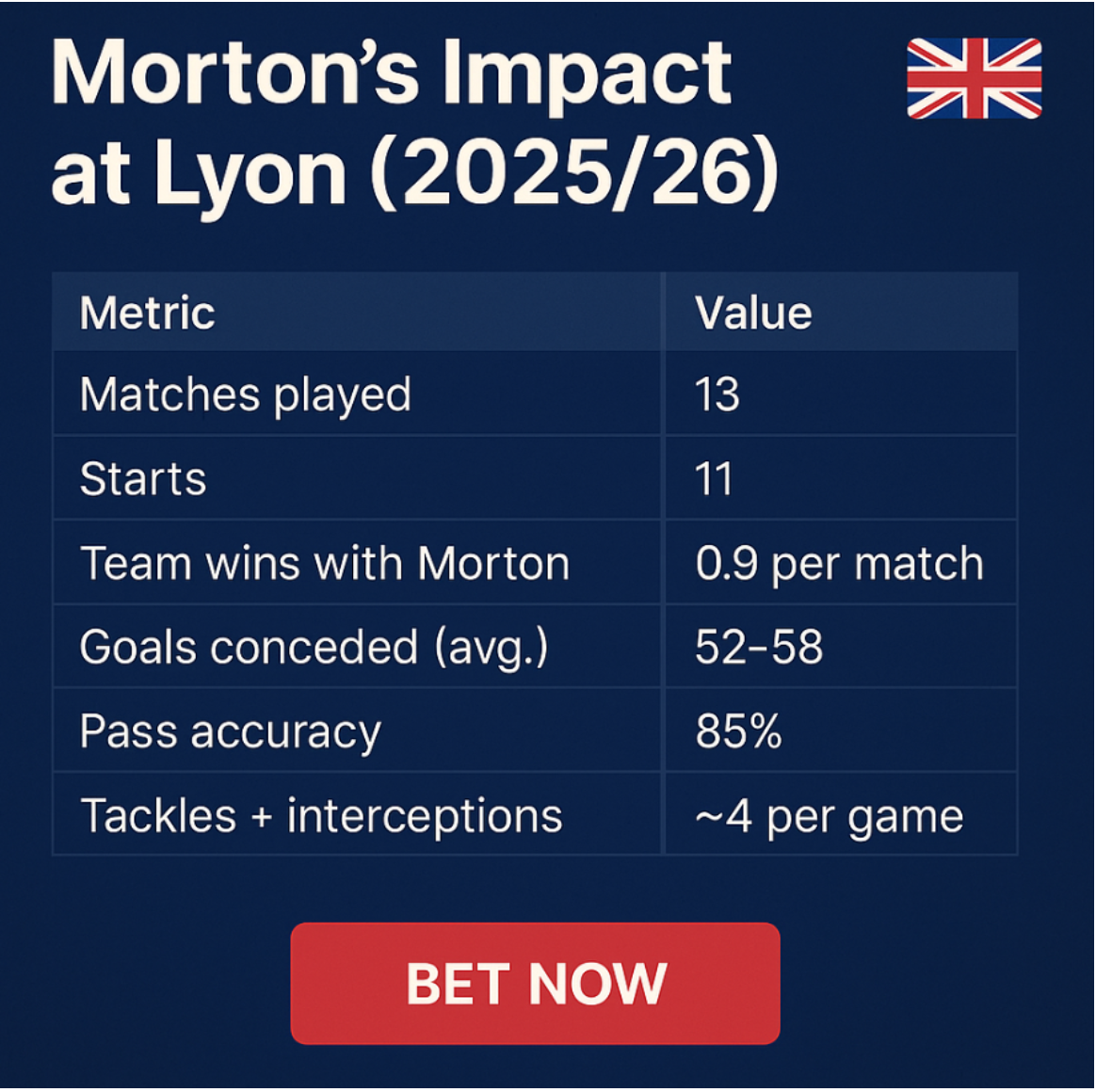
Morton’s Impact at Lyon (2025/26)
| Metric | Value |
| Matches played | 13 |
| Starts | 11 |
| Team wins with Morton | 6 |
| Goals conceded (avg.) | 0.9 per match |
| Passes per game (avg.) | 52–58 |
| Pass accuracy | 85% |
| Tackles + interceptions | ~4 per game |
What He Actually Does on the Pitch
Morton is not a highlight player. His role is to:
- neutralize the central zone,
- slow down opposition attacks,
- initiate the first phase of possession.
When he is on the field, Lyon lose the ball less often and move out of pressure more confidently. This is especially noticeable against teams that rely on vertical, high-tempo football.
A Broader View for Deeper Match Analysis
An important point for those who analyze football beyond goals and assists:
more people now view matches as a combination of data, structure, and individual metrics, not just results. I see this myself — the more data you have, the easier it becomes to anticipate game scenarios.
As an example of platforms where such data can be used to engage more deeply with football, mad casino can be mentioned — without bonuses or promises, simply as a tool to expand perception of the game. Not just who will score, but who controls tempo, who breaks attacks, and who plays a key role without the ball.
Basic Profile of Tyler Morton
Age and Career Stage
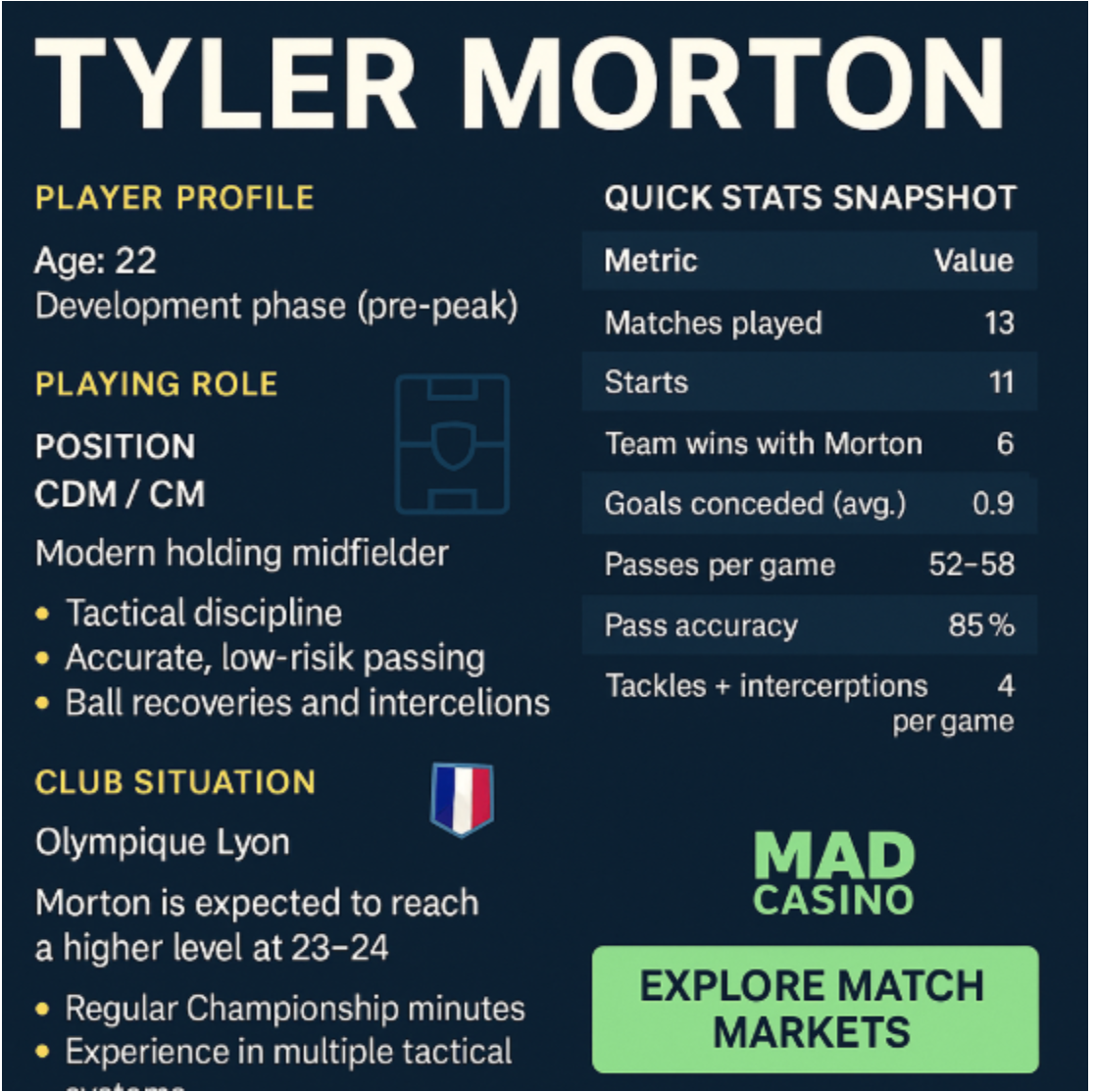
Age: 22 (born 31 October 2002).
In football terms, this is a transitional phase — no longer a youth prospect, but not yet at peak performance. Players at this age move from “young talents” to rotation and squad-level options in top leagues. This timing makes Morton attractive on the market, as clubs are more willing to invest in players with development upside rather than finished products.
Position and Playing Role
Position: Defensive midfielder / central midfielder (CDM / CM).
Morton is described as a modern holding midfielder capable of balancing attack-oriented teams. His main strengths are:
- tactical discipline,
- accurate passing,
- ball recoveries and interceptions.
He is valued more for structure and control than for creativity or scoring output.
Current Club Situation
Current club: Olympique Lyon (France).
Since August 2025, Morton has joined Lyon on a permanent 5-year contract.
Before this move:
- He was part of the Liverpool system.
- Spent two seasons on loan in the Championship (Blackburn Rovers and Hull City).
- Made 14 appearances for Liverpool, mainly in domestic cup competitions.
Status at Liverpool Before the Transfer
At Liverpool, Morton was considered a technically gifted academy product, especially noted for his passing accuracy. However, breaking into the first team proved difficult due to heavy competition in midfield, including established and emerging players ahead of him.
Under successive coaching staffs, there was no clear pathway to regular starts, which ultimately made a permanent move the most realistic option for his career progression.
Development Outlook
Morton’s current age represents a formation period, not a peak. He is expected to reach a higher performance level around 23–24 years old.
Several factors support the belief in his potential:
- consistent playing time in the Championship,
- experience in different tactical systems,
- UEFA U21 European Championship 2025 victory, including an assist in the final.
These indicators explain why clubs see him as a player who can still make a significant leap forward with the right environment and minutes on the pitch.
Summary Table
| Attribute | Details |
| Name | Tyler Morton |
| Date of birth | 31 October 2002 |
| Age | 22 |
| Position | Defensive / Central Midfielder (CDM, CM) |
| Current club | Olympique Lyon |
| Contract | Permanent, 5 years (from August 2025) |
| Former club | Liverpool |
| Loan experience | Blackburn Rovers, Hull City |
| Key traits | Tactical discipline, passing, ball recovery |
| Career stage | Development phase, pre-peak |
Morton Within the Liverpool System
Tyler Morton progressed through the Liverpool academy and made his first-team debut in September 2021, initially receiving minutes in the EFL Cup and the Champions League. Coaches consistently praised his football intelligence and ability to play accurate, composed passes.
However, he never secured a regular starting role. Competition in the defensive midfield position was intense, and under Liverpool’s coaching staff — later under Arne Slot — the role demanded not only technical quality but also high physical intensity. One coach, Jürgen Klopp, openly acknowledged Morton’s talent while pointing out the need to improve his physical strength, even suggesting extra gym work. The message was clear: talent was evident, but the system required more.
Why He Stayed a Squad Player
This situation is common at elite clubs. A talented academy graduate does not automatically become a starter.
Morton delivered solid numbers — key passes, recoveries, interceptions — but Liverpool’s midfield model required:
- extreme endurance,
- rapid decision-making under pressing,
- explosive acceleration over short distances.
In this context, Morton became a rotation option, not a first-choice midfielder.
Minutes Tell the Story
| Season | Club | Minutes Played |
| 2024/25 | Liverpool | 351 minutes |
| 2024/25 | Young attacking midfielders (e.g. Harvey Elliott) | Significantly higher |
Despite his reliability, Morton’s playing time remained limited. Even younger, more attack-oriented midfielders accumulated far more minutes.
Tactical Fit Under Arne Slot
Liverpool under Arne Slot played with constant intensity. Central midfielders had to:
- press aggressively,
- cover large zones,
- support attacks and recover instantly.
Experts described Morton as a well-rounded holding midfielder — capable both defensively and in build-up play — but not explosive enough to fully match the system’s physical demands. He performed well in cup competitions and European matches, yet could not turn that into a permanent role.
Expectations vs Reality
After strong loan spells, many expected Morton to return and compete seriously for a starting place. Instead, injuries within the squad, a congested fixture list, and Liverpool’s transfer plans left him as a third or fourth option in his position.
For both the club and the player, a long-term future in that role made little sense.
The outcome: a permanent transfer — allowing Morton to continue developing elsewhere, rather than remain a talented but underused squad player.
Tyler Morton Statistics: What the Numbers Show
Below is a concise summary table of Tyler Morton’s key performance indicators across clubs. The figures are aggregated and rounded to reflect his role and usage, not highlight moments.
Career Statistics Overview
| Club | Season | Matches | Minutes | Assists | Pass Accuracy (%) | Recoveries / Tackles (per game) |
| Liverpool | 21/22, 24/25 | 14 | ~400 | 0 | ~80–85%* | 1–2 |
| Blackburn (loan) | 22/23 | 46 | ~3,500 | 0–2 | ~78–82%* | 2–3 |
| Hull City (loan) | 23/24 | 41 | ~3,300 | 3 | ~80–83%* | 2–3 |
| Lyon | 25/26 | 13 | 1,137 | 1 | ~82–85%* | 2–3 |
* Pass accuracy and defensive actions are seasonal averages compiled from multiple match reports. Individual games could be higher (for example, single-match pass accuracy near 88%), but season means are lower.
How to Read These Numbers
The statistics reflect Morton’s primary function as a holding midfielder:
- Few goals — scoring is not his task.
- High passing volume and accuracy — focus on circulation and build-up.
- Consistent defensive actions — interceptions and recoveries over highlights.
Using Hull City as an example:
3 goals plus several assists over a full season is a solid return for a defensive midfielder. At Blackburn, assists were limited, but the team played compact football and Morton’s contribution was largely positional and defensive.
At Lyon, the raw output is smaller (1 goal, 1 assist so far), but the key signal is usage: almost full 90 minutes on average across 13 matches.
Why Minutes and Roles Distort Simple Comparisons
Direct comparisons can be misleading without context.
- At Liverpool, Morton often appeared for 10–30 minutes, usually from the bench.
- Loan spells offered full-match exposure, but within stable systems and lower-pressure environments.
- Short substitute appearances tend to depress averages (fewer actions, less rhythm).
This is why Liverpool numbers look modest compared to Championship seasons.
What the Trend Shows
When the data is “decoded,” a clear pattern appears:
- High pass accuracy → reliability in build-up.
- Steady defensive metrics → positional discipline.
- Rising minutes over time → growing trust from coaches.
Across clubs and levels, Morton’s influence has increased as his playing time stabilized. In total, he has logged around 120 matches at club level, including youth competitions (based on aggregated data from public databases).
The numbers do not point to a star creator — they point to a dependable midfield stabilizer whose value becomes clearer the longer he stays on the pitch.
Tyler Morton’s Transfer Situation
Why Liverpool Agreed to Let Him Go
In recent seasons, Morton was outside Liverpool’s regular starting plans. In the 2024/25 season, he played just 351 minutes for the first team. The club had already defined roles for its main defensive midfielders, and funds from his sale were needed to strengthen the squad after a successful campaign.
Experts pointed out that Liverpool’s midfield was overcrowded, leaving Morton with two realistic options: another loan spell or a permanent transfer. From the club’s perspective, a sale made more sense — both financially and strategically.
Transfer Structure: How the Deal Was Built
Several formats were discussed initially:
- a loan with an option to buy,
- or a full permanent transfer.
In the end, Liverpool and Lyon agreed on a straight sale. Lyon paid around €10 million upfront, plus performance-related bonuses, and included a 20% sell-on clause in case of a future transfer.
This type of structure is typical for Liverpool. They did not simply offload the player but secured potential long-term upside. These often-overlooked contract details can generate significant revenue later if the player’s value increases.
Why This Made Sense for Liverpool
Premier League clubs often sell young players early if they do not see an immediate pathway into the starting XI. This allows them to:
- recover investment quickly,
- reinvest in the squad,
- avoid keeping players stuck as long-term backups.
In Morton’s case, Liverpool could receive around £8.7 million upfront, plus up to £4.4 million in bonuses, while retaining 20% of any future resale. Just as importantly, the move gave the player a genuine chance to develop elsewhere. For Liverpool, selling Morton was more rational than keeping him as a third- or fourth-choice option for years.
Overall, it became a win-win scenario: the club secured financial value, and the player gained regular playing time.
Lyon’s Interest
Why Lyon Chose Morton
Lyon had been searching for reinforcement in central midfield for some time. In the summer of 2025, financial restrictions limited their options, but the club still committed to rebuilding its Ligue 1 squad with young, high-upside players.
Morton stood out as a balanced defensive midfielder — strong in duels, disciplined in positioning, and reliable in distribution. These were precisely the qualities Lyon lacked in midfield.
His Role at Lyon
At Lyon, Morton entered the starting lineup immediately. Injuries and squad depth issues meant he started from the opening rounds of the season.
Coaches see him as a tempo controller:
- comfortable on the ball,
- capable of progressing play forward,
- responsible for organizing the central zone.
He operates between the lines and anchors the midfield, a role that fits Lyon’s tactical setup well. Morton himself has said that he enjoys the French style of football, and experienced teammates have helped him adapt quickly.
Why Ligue 1 Works for Him
The idea that moving from the Premier League to France is a step backward is largely a myth.
For Morton, Ligue 1 represents progress, not regression:
- the league combines physicality and technique,
- match tempo is comparable to the Premier League,
- defensive midfielders are encouraged to build play, not just destroy it.
Morton noted himself that Ligue 1 is “on the same level as the Premier League in terms of speed.” At Lyon, the average passing distance is higher than the league mean, giving holding midfielders more influence in shaping attacks.
Comparisons and Broader Context
More English players are now choosing continental pathways to accelerate development. Recent examples show that moving abroad can increase experience and market value rather than stall a career.
Morton fits this trend well. He has openly described the move as a good decision, and early performances suggest that the environment in Lyon gives him exactly what Liverpool could not at that stage: responsibility, minutes, and room to grow.
The Harvey Elliott – Tyler Morton Comparison
Tyler Morton is often mentioned alongside Harvey Elliott. Both are 22-year-old English academy graduates from Liverpool, both played for youth national teams, and both went through loan spells. However, their player profiles are fundamentally different.
Elliott is an attacking midfielder / wide playmaker, known for quick accelerations, creativity, and decisive actions near the box. At one point, he was even described as a “pass magician”.
Morton, by contrast, is a classic holding midfielder — he builds the game from deep positions and focuses on defensive balance rather than flair.
Key Differences in Development
Elliott reached top-level football earlier:
- by the age of 20, he had already played hundreds of senior matches,
- scored important goals in the Premier League,
- and in the summer of 2023 moved to Aston Villa for a significant fee.
Morton’s path was different:
- most of his senior experience came through Championship loan spells,
- fewer headline moments,
- more positional, system-based responsibility.
Because of this, Elliott’s adaptation to elite football appeared smoother. His profile naturally produces goals and assists, which accelerate recognition. For a holding midfielder like Morton, progress is slower by nature — conditioning, defensive reading, and timing take longer to mature.
Who Adapts Faster at the Top Level?
Elliott is likely to adapt faster in attacking leagues because he is already accustomed to high-tempo offensive patterns and decisive actions near goal.
Morton, on the other hand, needs:
- more matches to stabilize defensive metrics,
- time to fully adjust to physical duels,
- consistent minutes to raise interception and recovery numbers.
For both players, the decisive factor is playing time. Elliott expects a regular role at Aston Villa; Morton is targeting the same at Lyon. The more starts they get, the faster their adaptation curve.
Tyler Morton’s Contract Situation
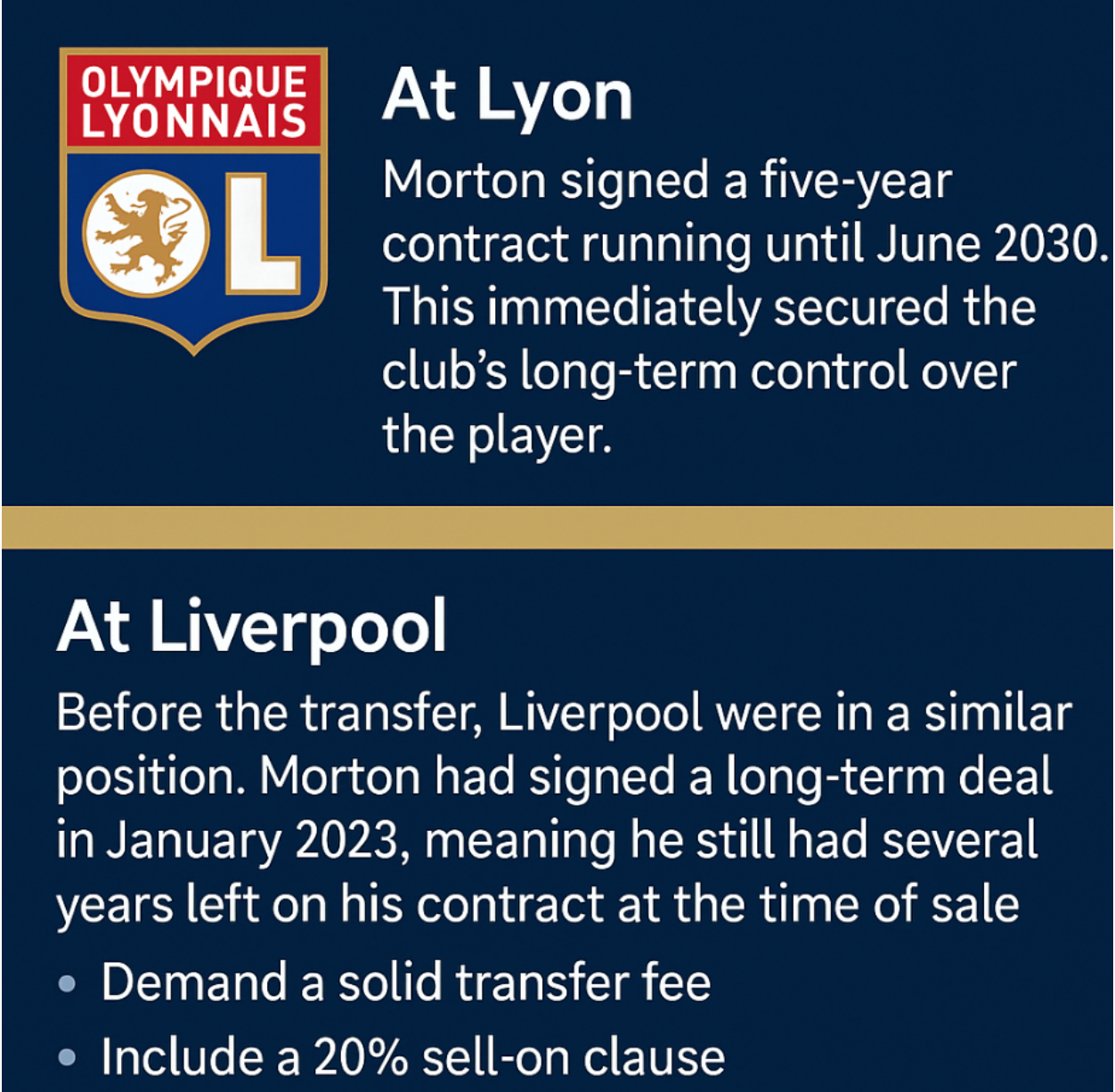
At Lyon, Morton signed a five-year contract running until June 2030. This immediately secured the club’s long-term control over the player.
Before the transfer, Liverpool were in a similar position. Morton had signed a long-term deal in January 2023, meaning he still had several years left on his contract at the time of sale. This allowed Liverpool to:
- demand a solid transfer fee,
- include a 20% sell-on clause,
- avoid any risk of losing him for free.
Contract Timing and Club Strategy
When a contract is close to expiry, clubs must choose between renewal or sale. In Morton’s case, there was no urgent deadline — his deal was still fresh. Nevertheless, Liverpool chose to sell earlier, as buyers were ready and squad planning required flexibility.
This behavior is typical:
- renewing usually signals long-term trust,
- selling signals that the club does not see a near-term role.
How the Contract Shaped the Deal
A long contract naturally increased Morton’s market value. Lyon accepted a deal running until 2030, showing readiness to invest now for long-term use.
The 20% sell-on clause protects Liverpool’s future interests. Analysts often point out that such clauses can later generate substantial payouts — this is standard financial planning in modern football.
Tyler Morton’s Salary
Exact salary figures are not publicly confirmed. Estimates from analytics platforms suggest Morton earns around €1.2–1.3 million per year, roughly €24–25k per week (gross).
This places him:
- above Championship-level wages,
- below Premier League elite salaries.
Young players’ contracts are usually structured with a base salary plus bonuses (appearances, results). Morton likely also received a one-off signing bonus upon joining Lyon.
Importantly, a move abroad can be financially efficient:
- lower taxation compared to England,
- regular top-flight minutes,
- increased future market value.
Salary Does Not Equal Player Level
High wages are typically reserved for established stars. Players like Morton, still in the development phase, earn moderate contracts relative to veterans.
For Lyon, this balance makes sense:
- a higher transfer fee,
- a controlled salary,
- upside potential later.
Injuries and Physical Condition
Overall, Morton has been relatively healthy. His only major setback came in the 2024/25 season, when a shoulder injury sidelined him from 7 February to 10 April 2025 — 63 days, 14 matches missed.
Other injuries were minor and short-term.
For a defensive midfielder, even small interruptions matter. Fitness, endurance, and timing are critical. Each break requires time to rebuild match rhythm and physical sharpness.
Clubs generally account for this with young players, allowing recovery without rushing — especially when long-term development is the priority.
Personal Life
Tyler Morton keeps his private life out of the public eye. I found no tabloids, rumors, or unofficial stories — only information from the official Liverpool FC website and standard interviews. There is no public data about a partner or family.
He was born in Wallasey (Wales) and grew up in England. At this stage, Morton appears fully focused on football. This is typical for young professionals who avoid publicity until they establish themselves at the top level.
Note: Google often expects a “personal life” section, but in Morton’s case the content is limited and uninteresting without verified sources. The correct approach here is restraint: nothing has been publicly reported about his romantic life, and that is completely normal. Modern players tend to talk about football, not relationships.
Tyler Morton in EA Sports FC 25
Morton is also featured in EA Sports FC 25 (formerly FIFA). His overall rating is 76, listed primarily as CDM.
This places him in the solid, mid-tier category — recognizable to fans, but not among elite players (usually rated 85+).
What stands out in-game:
- strong defensive attributes,
- high stamina,
- reliable tackling.
Presence in the game increases his visibility among gamers and data-oriented fans, many of whom compare attributes and potential growth. This virtual exposure often feeds real-world interest in a player’s development.
Career Outlook and Projections
There are several realistic scenarios for Morton’s future.
Scenario 1: Establishing Himself at Lyon
If he adapts quickly and maintains consistent performance, Morton can become a key midfield stabilizer at Lyon. Regular starts, positive match ratings, and coach trust could:
- solidify his role,
- raise his market value,
- open the door to England senior team consideration.
Morton himself has emphasized that his priority is playing regularly and progressing.
Scenario 2: Moving On or Returning to England
If circumstances change — a new coach, increased competition, or tactical mismatch — alternatives remain:
- a move to another European league (Bundesliga or Serie A),
- or a return to England.
Because Lyon holds a long-term contract, any move would likely involve financial upside, including Liverpool’s 20% sell-on clause, which could bring Morton back into transfer headlines.
Key Factor for Progress
The decisive elements are:
- adaptation to pace and physicality,
- performance stability,
- sustained minutes in competitive matches.
Morton has already stated that Ligue 1 matches the Premier League in speed, making this phase a real test. Passing it increases his chances of a significant step forward.
Predicting where he will be in five years is difficult. What is clear is this: he is at a critical upward point.
- For Lyon: a cost-effective, high-upside project.
- For Morton: the chance to play, grow, and be seen.
Final Takeaway (Search Closure)
So who is Tyler Morton right now?
A young English midfielder developed at Liverpool who, after failing to secure a permanent first-team role, moved to Lyon in 2025 for a serious fee. Media interest around him is driven by that transfer and the broader trend of English players building careers abroad.
Why is the attention justified?
- strong youth international record (UEFA U21 champion),
- consistent Championship loan performances,
- a club that needs exactly his profile.
Is he worth following? Absolutely.
This is a defining phase. If he adapts at Lyon and maintains form, a higher level is realistic within a year or two — with Liverpool still benefiting financially.
Conclusion:
Tyler Morton is a developing player with real potential, supported by facts — appearances, trophies, transfers, and data. He has left Liverpool’s system and is now fighting for his place in a strong European team. After this point, the basic questions are answered — there is no need to return to search for fundamentals.
📚 References
Wikipedia — Tyler Morton
https://en.wikipedia.org/wiki/Tyler_Morton
Transfermarkt — Tyler Morton (profile, transfers, statistics)
https://www.transfermarkt.com/tyler-morton/profil/spieler/