
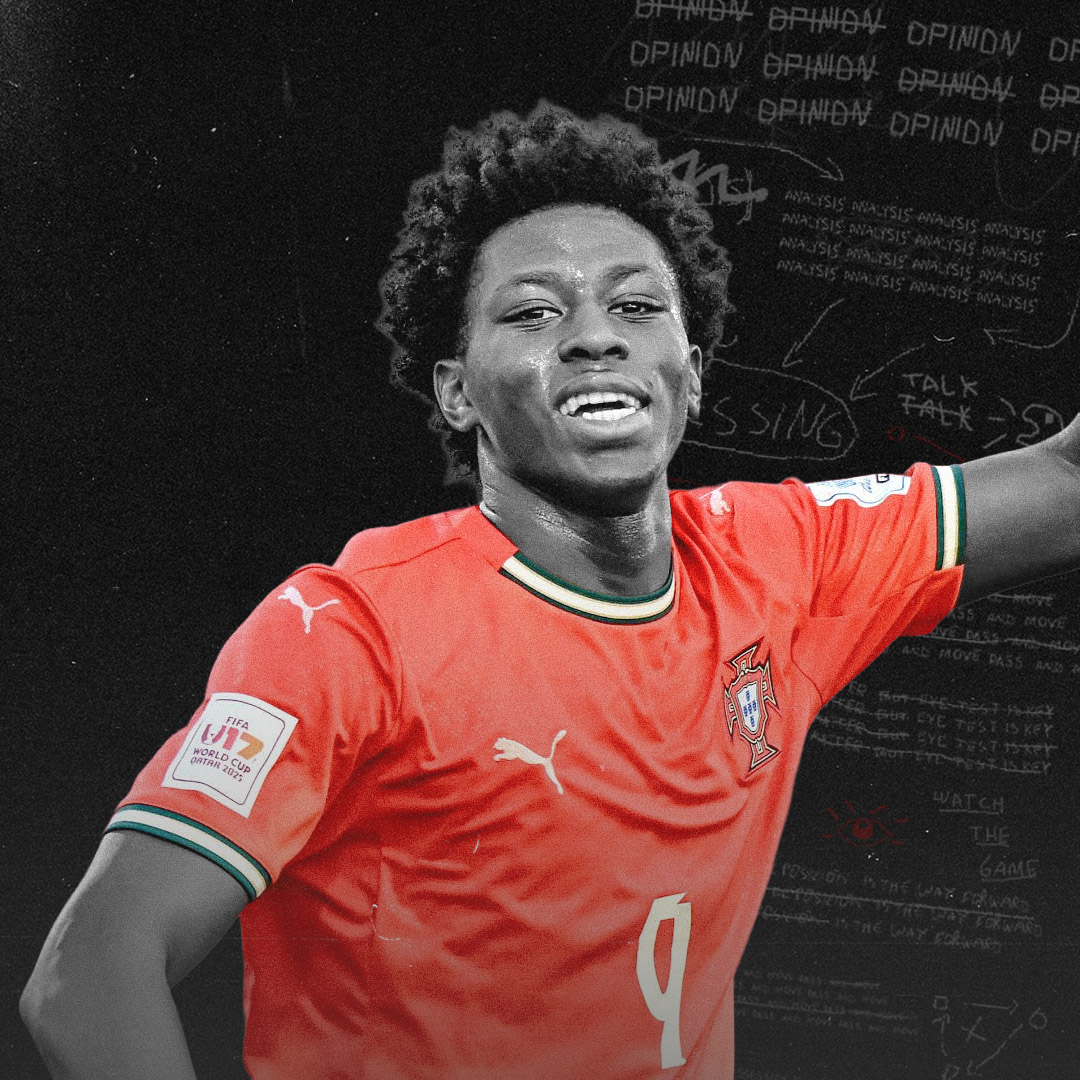
Anísio Cabral – The Rising Portuguese Centre-Forward
Anísio Cabral is not the next Cristiano Ronaldo, nor the next Eusébio. He is the first Anísio Cabral: a compact, left-footed, transition-hungry centre-forward who, at just 17, has already outscored most European peers in high-stakes youth tournaments. Winner of the 2024 U17 European Championship, top scorer contender at the 2025 U17 World Cup, and Benfica’s most lethal academy product since João Félix, Cabral combines Bissau-Guinean power with Lisbon-bred cunning. Still raw in places, he is nevertheless the most physically advanced and goal-dangerous Portuguese teenager since Ronaldo himself burst onto the scene two decades ago.
This concise profile examines what he already does at an elite level, where he currently falls short, and what he must refine to fulfill a trajectory that already points toward Europe’s biggest clubs. As a tactical writer with a focus on youth development and positional play, I approach Anísio Cabral not merely as a statistic or highlight reel, but as a 17-year-old prototype in evolution.
Born on February 15, 2008, in Lisbon to Bissau-Guinean parents, Cabral embodies the multicultural fabric of modern Portuguese football—a blend of African physicality and Iberian technical finesse. At 178 cm, he’s not the towering target man of yesteryear; instead, he’s a compact, explosive No. 9 who thrives in transitional chaos, pinning markers while exploiting half-spaces.
Tactical Analysis of Xabi Alonso’s First El Clásico as Real Madrid Manager
His trajectory from local academies to Benfica’s senior fringes, capped by international silverware, positions him as a cornerstone for Portugal’s golden generation. This analysis dissects his historical roots, tactical blueprint, and developmental roadmap, drawing from his 2024-25 campaigns at Benfica U19 and his pivotal role in Portugal’s U17 triumphs.
Historical Background: From Lisbon Streets to European Pedigrees
Cabral’s story is one of rapid ascent in Portugal’s hyper-competitive youth ecosystem, where Benfica’s Seixal academy serves as both forge and filter for talents bound for the elite. He kicked off in 2015 with modest beginnings at Alta, a grassroots club in Lisbon’s suburbs, before Benfica snapped him up in 2016 at age eight. This move was prescient: the Águias’ youth setup, renowned for producing global exports like João Félix and Rúben Dias, honed Cabral’s raw attributes into a cohesive profile.
By 2024, his dominance in Benfica’s youth ranks—26 goals in 33 games across U17 and U19 levels—earned a professional contract, a rarity for a teenager still navigating physical maturation. Internationally, his Bissau-Guinean heritage could have pulled him toward Guinea-Bissau’s senior setup, but Portugal’s U17 call-up in September 2024 sealed his allegiance. That year, he spearheaded Portugal to the UEFA U17 European Championship title, scoring the opener in a 3-0 final win over France after a penalty shootout semifinal against Italy.
Fast-forward to November 2025: At the FIFA U-17 World Cup in Qatar, Cabral emerged as the tournament’s deadliest finisher, netting 6 goals in 5 matches (including a strike against Austria U17), outpacing peers in a field stacked with prospects like Brazil’s Endrick.
Igor Jesus: A Comprehensive Analysis of Brazil’s Rising Forward
With 33 goals in 38 youth outings, his trajectory mirrors Darwin Núñez’s explosive Benfica breakthrough—raw, relentless, and ripe for first-team integration. Yet, at 17, he’s no finished product; his history underscores a player forged in high-stakes youth cauldrons, where tactical versatility trumps specialization.
Tactical Detailing: A Modern 9 in Fluid Formations
Cabral operates as a “terminal” centre-forward in Benfica’s fluid 4-3-3 or 4-2-3-1 youth systems, but his intelligence elevates him beyond the poacher archetype. He’s a saturation finisher: not reliant on individual brilliance, but on volume fixing centre-backs (CBs) to drag them wide, creating channels for wingers or overloads in the box.
His left-footed preference adds asymmetry; he receives to feet in deeper pockets (think hybrid 9-10 role), then explodes into runs that attack the near-side shoulder of defenders, using quick body feints and directional changes to unbalance static backlines. In possession phases, Cabral drops short to link play, but sparingly—his 88 touches in a typical U19 match skew toward the final third, where he boasts elite aerial duel success (65-70% win rate) despite modest height.
He manipulates markers with imposing physicality, shielding the ball before spinning into half-spaces for cutbacks or lay-offs. Defensively, he’s disciplined in a mid-block, tracking runners and contributing 2-3 recoveries per game, though his pressing is more zonal than man-oriented. At the U17 Euros, his goal vs. France exemplified this: a darting run off a midfield pivot, timed to exploit a momentary lapse, followed by a composed finish.
In Qatar, his 6 goals stemmed from diverse origins—2 headers from crosses, 3 tap-ins from rebounds, 1 long-range curler—highlighting adaptability in build-up from deep or direct switches. Weak in low-block scenarios, he shines against high lines, where his 34 km/h top speed and acceleration weaponize transitions. Tactically, he’s a cog in Portugal’s U17 possession-dominant setup (58% average), but his real value lies in chaos: creating shot volume (3.5 xG/90) through relentless duels.
Strengths: Physical Prowess and Lethal Instincts
Cabral’s toolkit is headlined by elite physical and technical fundamentals, making him a nightmare for adolescent defenders. His body usage is “fabulosa”—a Portuguese scout’s term for how he leverages a low center of gravity to bully markers, winning 70% of ground duels through sheer torque and balance.
Technically, he’s absurdly competent for 17: left-footed volleys with whip, first-touch control under pressure, and a knack for sequencing plays (e.g., holding up for No. 10s like in Benfica’s U19 setup). Explosiveness defines him—6 goals at the U17 World Cup weren’t flukes; they’re symptoms of a forward who disputes every ball, from 50-50s to second balls, generating 4.2 shots/90.
Tactically, his completeness shines: competent in all phases, from pinning to pressing, with a modern edge in half-space occupation. He’s a “valve of escape,” per analysts, always offering an outlet in breakdowns. This was evident in Portugal’s Euros run, where his assists (2 in the tournament) complemented his scoring, fostering team-wide lethality.
Ian Maatsen: Aston Villa’s Versatile Fullback Destined for the Top
At Benfica, his 26-goal youth haul underscores clinical instincts—finishing by saturation, thriving in cross-heavy systems (he’s converted 25% of headed chances). For a left-footer in a right-leaning league, his diagonal attacks create mismatches, forcing adjustments that benefit the collective.
Weaknesses: Refinement Gaps in Decision-Making and Versatility
No prospect is without fissures, and Cabral’s lie in the subtleties of elite finishing. His link-up play lags: while he drops deep, passes into the box are erratic (under 50% accuracy in tight spaces), limiting him against compact defenses. In low-block games, he “disappears”—fewer touches, forced into peripheral isolation, as seen in a 2025 U19 draw where Benfica dominated possession but Cabral registered zero shots.
Clinically, he’s not ruthless; 6 World Cup goals mask a 15% conversion rate overall, plagued by rushed decisions in the last third (e.g., opting for power over placement). Defensively, timing issues emerge: poor “timing do salto” (jump timing) in high presses leads to fouls (1.2/90), and he’s naive against feints or crosses from the opposite flank.
Dynamism is middling—no elite carrying (under 1 progressive dribble/90)—and his right foot remains underdeveloped, restricting angles. These aren’t fatal; they’re youth artifacts, but they cap his ceiling in possession-heavy senior setups like Benfica’s under Bruno Lage.
Exequiel Palacios: Leverkusen’s Unsung Argentine Dynamo in Midfield
Areas of Improvement and Work as a Player
To ascend, Cabral must prioritize refinement over raw output—transforming from U17 destroyer to senior orchestrator. Decision-making in the final third tops the list: drills emphasizing scan-pass-shoot sequences could boost his 25% key pass conversion, evolving him into a world class player.
Clinical finishing demands video analysis of elite 9s (e.g., Kane’s one-touch variety); targeting 20%+ conversion via gym work on core stability for headers and finishing under fatigue. Physically, he has the versatility in pressing and shifting from zonal to aggressive triggers, he would add 1-interceptions/90, vital for high-line teams. Tactically, right-footed integration and link-up fluency via small-sided games could mitigate low-block woes, allowing drops into 10 roles.
Off-pitch, mental resilience: at 17, handling senior scrutiny (e.g., Benfica B loans) will curb naivety. With 2026 U19 Euros looming, a loan to a Liga Portugal 2 side could accelerate this—exposing him to senior tempo without Benfica’s youth cocoon. If scaled, Cabral’s dominance could mirror Félix’s: from academy assassin to European elite. For now, he’s Portugal’s most lethal teen forward—watch him detonate. Anisio is physically ready, transition-dominant goal scorer who already looks senior-ready in chaotic games.
By: Ogunniyi Abayomi / @Cerebralcaldo
Featured Image: @GabFoligno / NurPhoto