

Why Casino RTP Varies Between Games And Providers
RTP is often presented as a single percentage that tells players everything they need to know. In reality, RTP varies widely between games, providers, and even different versions of the same title. In 2026, transparency around RTP has improved, but misunderstanding remains common. Knowing why RTP differs helps players interpret that number correctly instead of treating it as a guarantee.
What RTP Actually Measures
Return to Player, or RTP, represents the theoretical percentage of wagered money a game returns to players over a very long period. An RTP of 96% means that, on average, $96 is returned for every $100 wagered across millions of bets.
RTP at NineWin Casino does not describe short sessions. It is a long-term statistical property built into the game’s mathematical model and verified through testing.
Game Design Has A Direct Impact On RTP
Different game types are built for different purposes. Slots, table games, and instant games all balance entertainment, volatility, and speed differently. Games with complex bonus features or progressive elements often allocate more value to rare outcomes, which can reduce base RTP.
Simpler games with fewer mechanics are easier to balance tightly, resulting in higher RTP.
| Game Category | Typical RTP Range | Design Focus |
| Video slots | 94–97% | Features and volatility |
| Classic slots | 95–98% | Simplicity |
| Table games | 97–99% | Predictable odds |
| Live dealer games | 97–99% | Real-world rules |
| Instant games | 93–97% | Speed and repetition |
These ranges reflect structural differences rather than casino preference.
Provider Strategy and Market Positioning
Game providers choose RTP settings strategically. Some studios position themselves as player-friendly, offering higher average RTP to attract experienced users. Others prioritize mass appeal with higher volatility and slightly lower RTP.
In 2025–2026, many providers release the same game with multiple RTP configurations. Casinos select which version to deploy based on market, regulation, and commercial agreements.
Regional Regulation and RTP Limits
Regulators influence RTP more than most players realize. Some jurisdictions impose minimum RTP thresholds or require disclosure of RTP ranges. Others allow wider flexibility as long as values are certified and transparent.
This means a game played in one country may legally operate at a different RTP than the same game elsewhere.
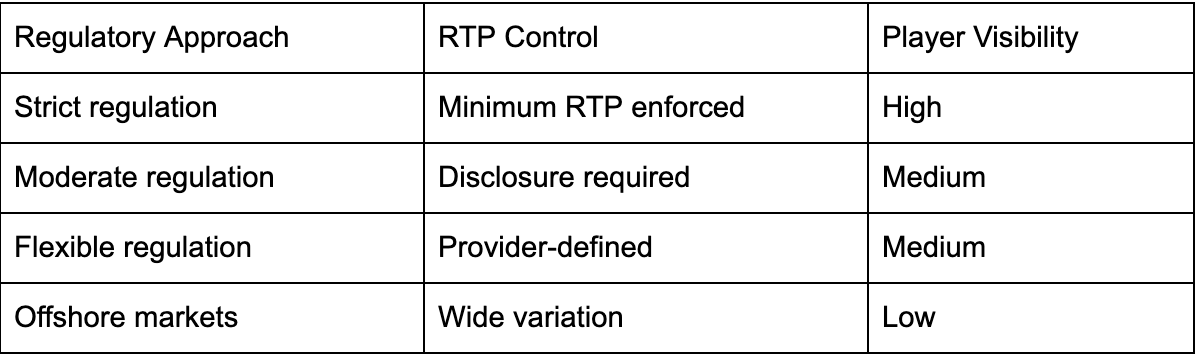
Understanding regulation explains why RTP labels sometimes differ by location.
Casino-Level Configuration Choices
Casinos can influence RTP indirectly by selecting game versions, promoting certain titles, or structuring bonuses around specific games. While casinos cannot alter RTP dynamically, they can shape which RTP profiles dominate the lobby.
This is why two casinos with the same provider portfolio can feel different in practice.
Volatility and RTP Are Often Confused
High RTP does not mean low risk. A game can return 97% over time while delivering long losing streaks due to high volatility. Conversely, a lower RTP game may feel smoother because it pays smaller wins frequently.
Players often judge RTP emotionally based on short-term results, which leads to incorrect conclusions.
Progressive Jackpots and RTP Trade-Offs
Progressive jackpot games typically have lower base RTP because part of each wager contributes to the jackpot pool. While the headline prize is attractive, the average return is reduced unless the jackpot is won.
This trade-off is deliberate and disclosed in certified paytables, but it is easy to overlook.
Why RTP Should Guide, Not Decide
RTP is a useful comparison tool, not a decision-maker on its own. Session length, volatility tolerance, bonus conditions, and personal goals matter just as much. In 2026, many experienced players combine RTP awareness with volatility control and bankroll planning.
Using RTP in isolation often leads to disappointment. Casino RTP varies because games are designed with different priorities, providers follow different strategies, and regulators impose different rules. In 2026, RTP is more transparent than ever, but it still requires context. Players who understand why RTP differs can interpret it correctly,using it as a guide to cost and expectation rather than a promise of outcome.