
From Rambler to Rover: Sean McLoughlin and Football Tourism
The terms ‘tourist’ and ‘tourism’ when applied to football support have evolved in recent years to embrace two variant and in many ways opposite approaches to travelling in order to watch a match.
The first iteration involves the now familiar individuals who travel to watch English Premier League clubs as a form of entertainment, a Disneyland for adults, often on an all-inclusive package provided by specialist travel agencies. These are the ‘fans’ who unselfconsciously buy half-and-half scarves before games and queue for hours to get into the Bishop’s Blaize outside Old Trafford, or its equivalent in other British cities, proudly carrying their bulging Superstore bag, crammed with the latest team merchandise.
Much has changed in the nearly fifteen years since I last attended matches regularly (two to three times a year) in England. Back then, when we travelled to Manchester, we got our tickets from the well-known United supporter Pete Boyle, the guy who led the pre-match chants in the previously mentioned Bishop’s Blaize.
As supporters from Ireland, we were always made to feel welcome, reflecting the deep connections between United and the Irish, but equally, we were acutely aware of the deference that was owed to the indigenous Mancunian supporters. When we collected our tickets from Pete, we would never wear a replica shirt, reflecting the traditions of United supporters adopted from away games. There’s a reason why the United firm was known as the ‘Men in Black’.
At the time, the concept of a half-and-half scarf was so foreign that it was unimaginable to us. Now they are ubiquitous. Back then, the term ‘tourist’ was an insult reserved for those who sat in the third tier of the North stand or ‘Little Scandinavia’ as it was then known.
Many more eloquent writers have written on this phenomenon, how clubs have actively encouraged this type of fandom as entertainment, with reduced season ticket allocations and the ever-spiralling admission prices. To many traditionalists, it is a trend that has diluted football culture. For the clubs, it is a welcome and increasing revenue source.
I, however, wish to concentrate on the other, newer form of football tourism, where football fans travel to a club, often from a lower league, with a deep appreciation for the identity and culture of the club they chose to visit.This has become known as groundhopping. I have witnessed this at my own club, Cobh Ramblers, who play in the First Division of the League of Ireland.
On one occasion, I struck up a conversation in the clubhouse bar with a guy from Germany who had come to the game as he was in the area. On another occasion, it was a group of three English ‘tourists’ who likewise wished to experience League of Ireland football. At the recent Cork derby between Ramblers and local neighbours Cork City, a group of Málaga fans was in attendance.
How Football and Sports Helped Me Grieve with Losing My Father
Having not attended a game in England for well over a decade, in early 2026, I decided to embrace this growing trend and made a trip to Ewood Park. To visit the home of Blackburn Rovers, once great rivals of Manchester United, might on the surface seem strange, but there was an ulterior motive to my journey.
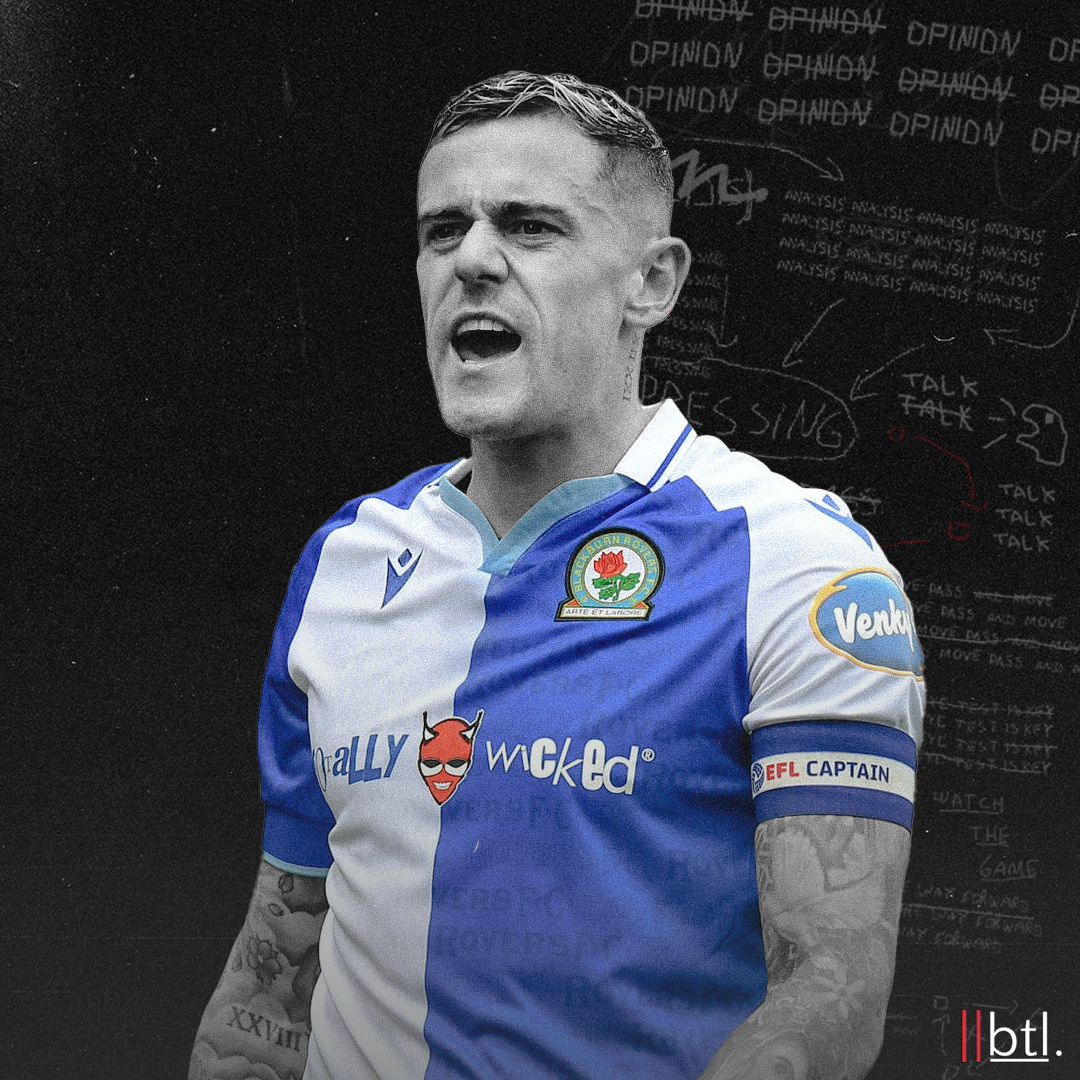
The current centre half and occasional captain of Rovers is Sean McLoughlin, a 29-year-old Irish defender who is not only from my home town of Cobh but grew up in the same estate as I did, less than a hundred meters from my parents’ home, though at 21 years my junior, we moved in very different social circles. Sean’s father was also briefly my boss when I served in the Irish Naval Service.
McLoughlin began his schoolboy career at Springfield Ramblers, the established feeder club for my own beloved Cobh Ramblers. Sean’s talent, however, brought him to the attention of our local rivals, the traditionally more successful Cork City, where he played in their underage structure between 2013 and 2015. He spent a year at Munster Senior League side College Corinthians and a further year at University College Cork before returning to Cork City in 2017.
In two years, he played 48 times for Cork City, scoring 5 goals before moving across the English Channel to Hull City. Hull immediately loaned him to St Mirren in Scotland. This coincided with the first time I watched McLoughlin on television when he played against Celtic on the 26th of December 2019 in a two-nil defeat. He played 21 times for St. Mirren, scoring one goal before returning to Hull at the start of 2020.
Sean would go on to feature 129 times for Hull over the next 6 seasons. During this time, I would occasionally see him play when Hull’s games were televised. I watched as they narrowly maintained their Championship status at the end of the 2025 season on goal difference.
I briefly met Sean and his father in a pub in Cobh that summer and enquired if he would be staying at Hull. I genuinely don’t think he knew who I was and answered with an enigmatic shrug and smile. He signed for Blackburn Rovers in July 2025 on an initial two-year deal.
So in January 2026, I decided to become one of these newer, more acceptable tourists, and check out my neighbour, in the flesh, at my first ever English game outside the Premier League, my first ever English fixture that didn’t feature Manchester United. In preparation, I began listening to The Blackburn End podcast to get at least a basic understanding of how fans felt about their side. Needless to say, like many clubs worldwide, the natives were not happy with the manager Valérien Ismaël coming in for particular criticism.
My journey began with an early flight on Sunday morning, the 4th of January, to Manchester. Blackburn Rovers would be playing Charlton Athletic that afternoon. Upon arrival, I had to navigate the spiderweb that is the railway system in Northern England. One train took me to Manchester Picadilly, while the train to Blackburn departed from Manchester Victoria. There was a connecting tram, but trying to interpret the timetable was beyond me, so I walked. At least the pint in the Manchester Victoria railway station bar was a reward worthy of my effort.
Arriving in Blackburn about two hours before kick-off, I was struck by a bitterly cold wind before sharing a taxi with a couple from Belfast who were also there to see the game. The lady informed me she had roots in the area and used to come much more often, but this was her first visit of the season. They even paid for the cab. I had decided to stay at the Fernhurst Pub, located on Bolton Road, literally a stone’s throw from Ewood Park.
I checked in and made my way to the main bar to catch the second half of Leeds versus Manchester United on the numerous TV screens broadcasting Sky Sports. The game ended in a draw when Matheus Cunha equalised for United after Leeds took the lead through Brenden Aaronson. It would prove to be Ruben Amorim’s final game as Manchester United manager.
My first surprise was that there were as many Charlton fans in the bar as there were Blackburn, red mixing easily with blue and white. During my halcyon days at Old Trafford, only United supporters were allowed access to the Bishop’s Blaize or the Trafford Arms, but there was no segregation here. I enquired to be told by staff that such segregation only happens for the visits of the ever-notorious Millwall and Blackburn’s Lancashire rivals Preston North End.
It made for a pleasant change as both sets of fans watched the Premier League encounter before their own sides’ game. Football fans will watch any match that’s available. Once the final whistle blew in Elland Road, both Charlton and Blackburn fans drank up and made their way to the ground, minds focusing on what lay in store.
If anything, it had gotten colder in the intervening hour, and it started to snow as we walked to the stadium. I did want a souvenir, but wasn’t going to attend the match with a bag from the Rovers fan shop in my hand, so I settled on a grey baseball cap. Once purchased, I tore the tags off and wore it, blending in with the regulars. My ticket was in the Ronnie Clayton Blackburn End, located behind the goal.
Ronnie Clayton had made 581 appearances for Blackburn Rovers between 1950 and 1969. He was capped 35 times for England. He died in 2010, and in 2011, the Blackburn End was renamed The Ronnie Clayton End. My research indicated this stand was known for hosting the most vocal home supporters. It was remarkably easy to get a beer in the concourse behind the stand unlikely the long queues I remembered from Old Trafford. To be fair, the stadium was far from full.
It didn’t start well for Blackburn. Charlton’s Charlie Kelman scored two goals in the 28th and 34th minutes, the second from the penalty spot. McLoughlin played at the centre of a back three with the Englishman George Pratt to his left and the Australian Lewis Miller to his right. His experience showed, with nearly 150 games in the English Football League, playing all but one of those seasons in the Championship. He marshalled the less experienced players around him well, but it was clear this was a team in trouble.
Like all football clubs at two nil down, the supporters were unhappy, blaming the ref, the English Football League, the club owners, and their manager Valérien Ismaël. Sentiments remarkably similar to those heard at various times in St. Coleman’s Park, the home of my own Cobh Ramblers. The Frenchman had played for Strasbourg, Crystal Palace, Lens, Werder Bremen, Bayern Munich, and Hannover 96.
QPR’s Resurgence: How Martí Cifuentes Steadied the Ship at Loftus Road
Ismaël began coaching on the continent before stepping into management in the Championship with Barnsley, West Bromwich Albion, and Watford. My research, through The Blackburn End podcast, had suggested he wasn’t popular. Rovers had been fifth when he took over in February 2025. Now they lie in twentieth.
Things did improve. Moussa Baradji scored before the break to cut the deficit in half. Again, much to my delight, it was remarkably easy to get a beer at halftime. Frenchman Moussa Baradji, on loan from Swiss Super League club Yverdon-Sport, scored again in the 77th minute as Blackburn Rovers came from 2-0 down to earn a deserved draw.
As a marginally biased neutral, I thought Rovers had shown a lot of fight to earn a point. In my judgement, McLoughlin had played well. The result left Blackburn in 20th with 28th points. Chalton were one place higher in 21st place on 29 points. At full time, I waited outside the players’ entrance in the gathering snow. Again, the experience was markedly different from what I had experienced at Old Trafford, where players are largely kept at a distance from fans.
Charlton emerged first, signing autographs and taking selfies with those plucky souls brave enough to resist the cold. Then the Blackburn players emerged, mingling with fans. One young supporter questioned several of his heroes for his social media feed, his mother filming the encounter. When Sean McLoughlin exited, I congratulated him on a good game.
He recognised the Irish accent but didn’t recognise me, but we quickly established he knew my brother and wider family, much as I knew his. He told me to contact him the next time I travelled over, and he’d get me tickets. I’m not one for autographs, but would have loved a selfie. Unfortunately, my phone had died. We parted ways, and I wandered off into the cold Blackburn evening.
Valérien Ismaël limped on for less than a month, eventually departing the club by mutual consent on the 2nd February. Blackburn were sitting in the relegation zone, three points from safety. The club had failed to win any of its last eight games. He had been at the club less than a year. On 13th February 2026, Rovers appointed the Northern Ireland manager Michael O’Neill on a job share deal with the Irish FA, lasting until the end of the 2025–26 season. I was familiar with O’Neill.
He had managed Shamrock Rovers in the League of Ireland between 2009 and 2011, where the Portadown man won two League titles. O’Neill’s first game resulted in a 3–1 win over Queens Park Rangers. This was followed by a victory over Preston in the Lancashire derby. His first defeat came at home to Bristol City in his third game in charge. The next two games were a loss to Derby County and a draw with Portsmouth. Sean McLoughlin was the captain in all these games.
Rovers currently sit 20th in the English Championship, four points clear of the relegation zone. My intention is to return on the last day of the season to witness them escaping the dreaded drop to League One and all the dire consequences that would follow. I certainly won’t feel like a ‘tourist’ anymore. I’m confident they’ll be okay. Sean McLoughlin’s been here before, escaping relegation with Hull on the last day in 2025. I suspect he’s a lucky omen.
By: Kenneth Hickey / @kenny_k75
Featured Image: @GabFoligno / Dave Howarth – CameraSport