

4 Effective Signs Every Football Event Needs
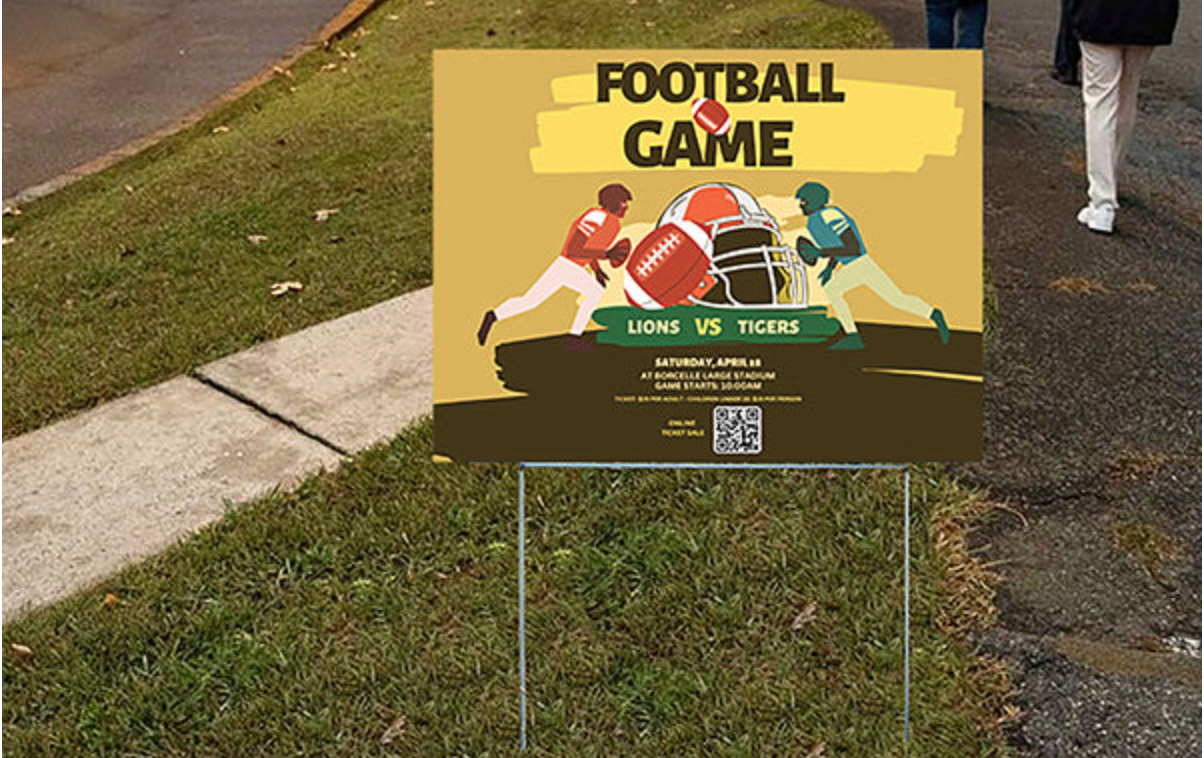
The four simple signs to fix gameday chaos are entrance markers, schedule boards, sponsor banners, and team spirit areas.
Deploying these specific signage categories at grassroots football events eliminates parking confusion and prevents missed kick-off times. Properly marked venues transform chaotic volunteer efforts into professional, easy-to-navigate experiences.
Picture a Saturday morning at a local secondary school hosting its annual under-twelves cup tournament.
Four pitches are chalked and ready, while volunteers sort bibs and print the match programme. Families begin arriving early with folding chairs and cool bags in hand. Very quickly, however, everything begins to unravel.
Three different families approach the registration table, asking which pitch their child is on.
A coach from a visiting club wanders the perimeter looking for the warm-up area. Two cars have parked across the emergency access lane because nobody indicated where the vehicles should go.
A parent calls the coordinator to ask what time their child’s second game kicks off.
The football is organised, and the volunteers are prepared for the day ahead. Yet, the morning feels amateur because of what is absent before a single whistle blows.
The gap between chaotic and professional often comes down to visual markers that most organisers simply forget to plan for.
These elements address distinct matchday needs and transform a well-intentioned event into a memorable experience.
1. Guide Every Family From the Gate to the Right Pitch
At a multi-pitch school tournament, the first two minutes of arrival set the emotional tone. If a parent carrying a kit bag cannot easily locate the under-eights games, their morning begins with frustration.
That frustration accumulates across hundreds of attendees and lands squarely on the volunteers trying to manage the flow.
Entrance and wayfinding signs exist to solve this before it begins.
Placed at the car park entrance and every route fork, they answer the unspoken questions every arriving family carries. Wayfinding problems are cited by 68% of visitors entering large public facilities as a major contributor to negative impressions, including early departures.
They tell visitors exactly where to go, where to park, and where to find first aid.
Effective wayfinding displays for grassroots football events communicate pitch numbers, parking directions, and refreshment locations.
For larger events spanning sprawling public parks, secondary directional indicators keep visitors oriented without requiring staff assistance. When sourcing materials to direct heavy foot traffic, many organisers rely on yard signs from YardSigns.com to provide durable outdoor guidance.
These markers remain clearly visible from the entry gate to the touchline throughout the entire event.
There is a safety dimension here that goes beyond first impressions.
Clearly marked emergency access points and first aid locations are basic event management responsibilities. Every $1 invested in signage yields up to $8 in safety-management benefits.
Proper outdoor entrance markers built to withstand the full event protect the investment of everyone involved.
| Warning/Important: Avoid using paper signs for outdoor navigation. Rain and wind quickly destroy temporary directions, leading to parking chaos and confused visitors. Durable, weather-resistant markers ensure your event stays organized from kickoff to the final whistle. |
2. Let the Schedule Speak for Itself
Ask any tournament coordinator what question they answer most often, and they will highlight inquiries about kick-off times.
Close behind it are predictable questions about pitch assignments and sudden schedule changes.
Football tournament organisation fails most visibly when vital information fails to reach the people who need it. A clearly displayed fixture and schedule board removes the single biggest source of confusion at local events.
An effective schedule board communicates match times, bracket progressions, and any real-time updates as the day evolves.
For youth academy showcases where multiple age groups run simultaneously, a well-designed board serves as a central operational document.
This strategic placement frees coordinators to manage logistics rather than field repetitive questions.
Placement matters significantly when setting up these informational hubs.
Schedule boards perform best near the main entrance, at central intersections, and beside refreshment areas. Positioning them where families naturally pause means the information reaches visitors organically without requiring active searches.
The stakes of poor schedule communication are not trivial for event flow.
In one community tournament, changes communicated exclusively by word of mouth caused two teams to miss their matches entirely.
Durable materials are essential here, as a board that fades halfway through the morning creates false impressions. Reliable schedule displays keep the bracket moving and prevent coordinators from spending the afternoon managing complaints.
3. Give Your Sponsors Something Worth Paying For
The funding reality of most grassroots football clubs heavily relies on local business contributions. These businesses cover kit and ground maintenance in exchange for visibility at club events.
The relationship works best when sponsors feel their financial contribution generates a visible return. Sponsorship awareness increases donation likelihood by 40% when logos are prominently displayed at entrances and high-traffic areas.
Sponsor displays transform vague goodwill into measurable physical presence.
When a family walks past a banner featuring a neighbourhood mechanic placed along the boundary, community association solidifies.
That visual connection is the engine behind strong community football culture. A well-positioned visual marker remains the most immediate expression of this local partnership.
The most effective placements for sponsor visibility are near pitch entrances and along boundary fencing. Registration tables and refreshment areas also provide excellent opportunities for prominent logo display.
These specific locations guarantee high dwell times and repeat exposure across the entire matchday.
Fundraising banners serve a parallel purpose by directing foot traffic toward revenue-generating activities.
A visible prompt promoting a half-time raffle or a club membership campaign captures attention that would otherwise wander. Families at a football tournament are engaged and highly community-minded.
A clear focal point is often all it takes to convert passive attendance into active financial support.
| Pro Tip: Take high-quality photos of every sponsor banner during the matches. Including these images in your post-event report provides sponsors with visual proof of their community impact, making it much easier to secure funding for next year. |
4. Build the Moments Families Remember
Consider a familiar scene where a group of under-tens have just won their age group bracket.
They are gathered near the trophy table, exhausted but exhilarated, while parents capture the moment on smartphones.
Too often, the background of these cherished photographs is just a chain-link fence and a recycling bin. Upgrading this visual backdrop instantly elevates the perceived quality of the entire tournament.
Team spirit displays and branded photo-area backdrops are highly resonant yet frequently overlooked event materials.
A custom banner featuring the club crest positioned near the trophy presentation area transforms an ordinary moment. This strategic placement carries the club identity into every household that shares the image online.
It creates a lasting visual legacy that extends far beyond the final whistle.
The matchday atmosphere at grassroots events depends heavily on this kind of visual identity. Players walking onto a pitch framed by a welcome banner are already thinking differently about the game ahead.
Motivational messages at pitch entrances reinforce the idea that the club takes immense pride in its presentation. These subtle cues shape the emotional experience for both home and visiting teams.
For youth academy showcases, a designated photo area signals that the club values community alongside competitive results.
When families share well-branded matchday photographs online, they become organic ambassadors for the organisation. Belonging is built through repeated visual associations with a shared local identity.
Strategically placed visuals remain the most affordable way to create those community associations at scale.
Making It Work on a Grassroots Budget
The practical challenge with event materials is familiar to any volunteer coordinator managing local sports. Grassroots football event budgets are real constraints, forcing organisers to work with incredibly tight margins.
Most clubs operate on compressed timelines without a dedicated production budget for professional displays.
Therefore, any solution must balance affordability with the rugged demands of outdoor environments.
Informational markers need to be durable enough to survive a full outdoor matchday in variable weather. They also must be straightforward to install without requiring specialist equipment or extensive labour.
Crucially, they need to be affordable enough to order in the large quantities a multi-pitch tournament requires. This ranges from directional arrows at every gate to sponsor banners along multiple pitch boundaries.
This context is where corrugated plastic designs make practical sense for community football initiatives. Organisers needing weather-resistant outdoor markers find this medium to be a workable fit for varying event scales.
Built to last outdoors with UV-resistant inks, they hold their colour through a full day without warping. Double-sided printing proves particularly useful for markers that must be readable from both directions along busy pathways.
None of this requires a massive budget or a professional events management team. It simply requires identifying what each piece of information needs to communicate to the crowd.
Organisers must decide where items need to be placed and source materials that will last the length of the event.
Thoughtful planning ultimately stretches modest budgets to create highly professional matchday environments.
| Key Insight: Strategic signage functions like an extra set of volunteers. By answering repetitive questions about schedules and locations automatically, you free up your actual staff to manage the game and handle urgent issues effectively. |
The Big Picture
Return to that tournament car park on a typical Saturday morning. Four pitches, hundreds of families, and a dedicated team of volunteers are running a community football event.
Now imagine the same morning with clear markers at the entrance directing traffic and indicating pitch assignments.
A schedule board sits at the central hub, sponsor banners line the boundaries, and a branded backdrop awaits the champions.
The quality of the football did not change, and the volunteers put in the same effort.
However, the experience for every family, player, and sponsor who attended improved dramatically. Grassroots football continues to depend heavily on community support and local business sponsorship to survive.
A professional presentation acts as the infrastructure that makes clubs credible to families and attractive to returning sponsors.
Clubs that invest in the matchday experience build loyalty and give sponsors something tangible to reference. Memorable football environments are built through small operational details just as much as tactical drama on the pitch.
A directional marker at the gate or a schedule board by the refreshment table are never just afterthoughts. They are the essential details proving that this club knows exactly how to host a proper matchday.
| Author Profile: YardSigns.com is the leading online retailer of custom yard signs for businesses, political campaigns, real estate professionals, and special events. |