

Financial Success of Player Transfers: The Algorithm
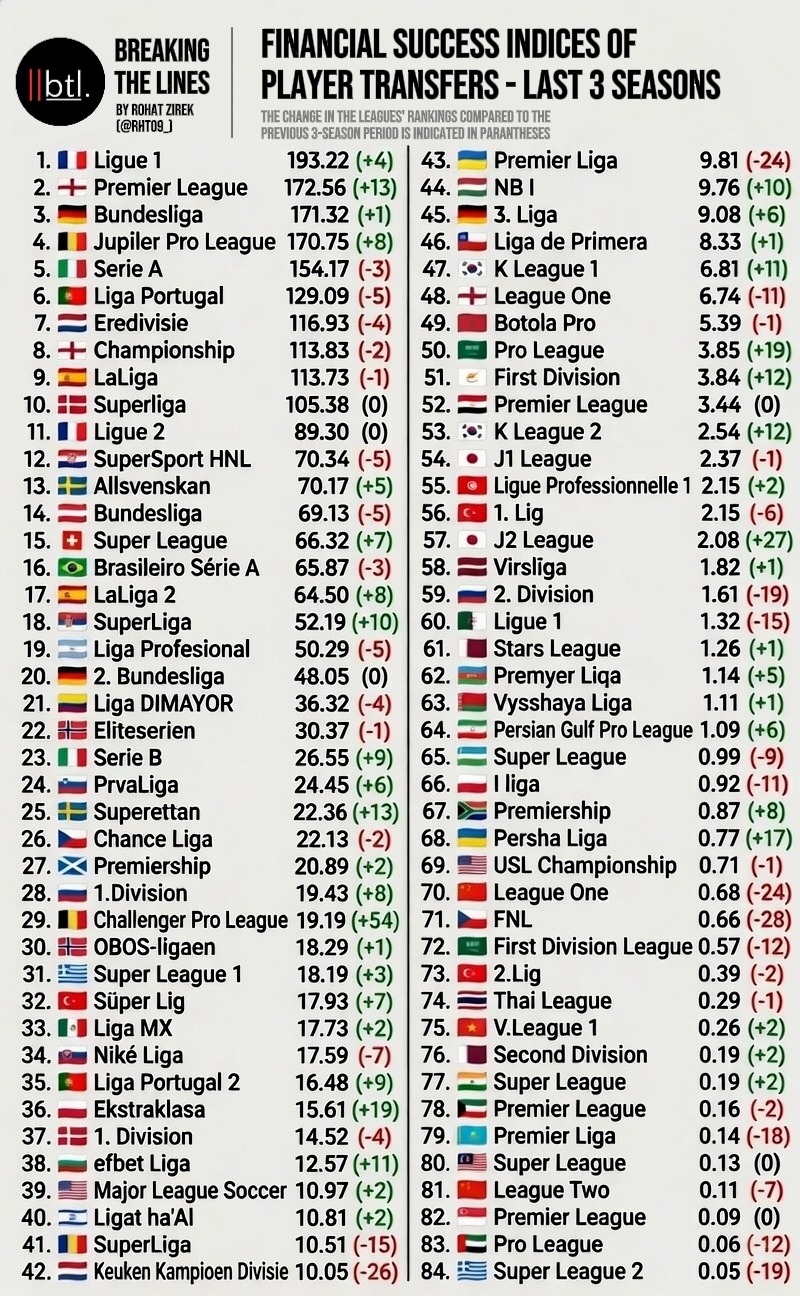
In football, the money generated through player transfers plays an outsized role in the financial structure of clubs and leagues. As a result, transfer revenues and expenses directly influence whether a system is financially stable or not, and financial stability usually has a direct impact on sporting stability as well. This research goals to evaluate league performance in this very important area.
Some leagues generate high income from selling players, while others generate less. However, simply looking at total sales is not enough to understand how successful a league is in the transfer market. A league might earn a lot, but at the same time spend heavily on incoming transfers. In that case, the overall table does not clearly show how efficient the league actually is. The main goal is to identify which leagues manage the transfer market in a more efficient and sustainable way. To measure this, a balanced algorithm was created based on three main components:
– Total revenue from player sales
– The ratio between transfer income and transfer spending
– The average number of clubs in each league.
The number of clubs is important because leagues do not all have the same structure. Therefore, comparing only raw totals would not provide a fair or meaningful evaluation. Only leagues that meet the following conditions were included in the algorithm:
– Leagues with professional status
– Leagues that are not officially classified as “development leagues”
– Leagues that exceed a defined minimum transfer sales volume
– Leagues that do not exceed a defined maximum unknown-fee transfer ratio
The research does not only look at the last three seasons, but also includes the previous three seasons before that. This allows a clearer view of how leagues change over time, whether they are improving or declining in their transfer market performance.
Some Interesting Points In The List
Especially with the development of data platforms, scouting networks are expanding worldwide. Thanks to increasingly advanced data programs, not only major clubs and leagues but also more modest clubs and leagues can now access information without difficulty. For this reason, when we look at the list, we see that many of the leagues in the middle ranks are on the rise.
Svensk Elitfotboll launched a project in 2021 to improve success in player sales. With this project, clubs began to place more emphasis on youth development and the African market, since it would be more cost-effective. The significant improvement in both of Sweden’s included leagues, Allsvenskan and Superretten, shows that this project has been successful so far.
Belgian football was already successful in this area, and they continue to build on that. Nearly all clubs in both the top division and the lower division value young players and continue to develop both data scouting and on-site scouting. Some of their teams have partnered academies in Africa and scouts based there. In addition, a significant number of clubs are not afraid to play a risky style, which helps young players avoid confidence issues and display their qualities more effectively.
Dutch football is still successful in this area, but it is experiencing a decline. The main reason is that in the TOP 5 leagues, more importance is now given to physical attributes in player selection than before. In the Netherlands, however, both academies and professional leagues place more emphasis on possession play and technique. In doing so, they give up a bit too much in terms of the physical side of the game. One of the reasons for the decline in club performance in European competitions is also this.
South American leagues are still successful in this area as well, but they are also experiencing a slight decline. There is actually no clearly decrease in player sales. The reason for the decline is that they are spending more money on older players. Spending more on players who do not promise financial return has lowered their index points.
By: Rohat Zirek @RHT09_
Featured Image: @GabFoligno / Zed Jameson/MB Media / Getty Images