
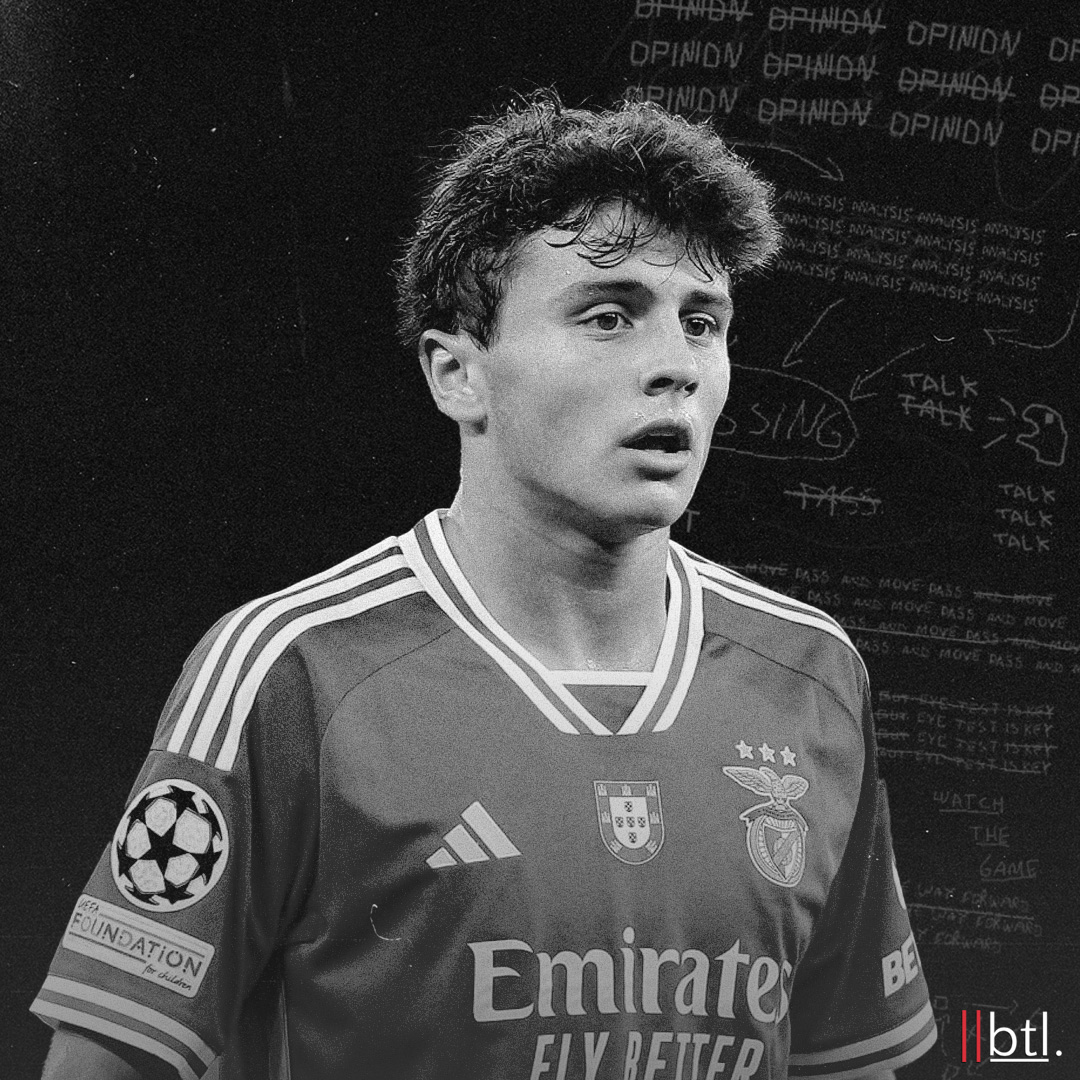
João Neves: What Makes The PSG Playmaker So Special
In an era where midfielders are often broadly categorized as ball winning, deep-lying, playmaking, box-to-box or holding midfielders, João Neves – the Paris Saint-Germain wonderkid – has emerged as a rare hybrid: a near complete, relentless, and technically exquisite engine.
At just 21 years old, Neves’ elite, press-resistant playmaking combined with his relentlessly aggressive defensive work rate has demonstrated that whilst he is still a developing talent; he is as close to a finished product in several key departments as you will find. Here’s what makes João Neves so exceptionally good.
The Bite of a Veteran Ball-Winner
At just 5’7”, though not the most physically imposing, Neves leads the PSG press in the midfield battle zones (central midfield corridor and half spaces) and wins duels primarily due to two factors: timing and tenacity. Neves puts it simply “If you are not strong physically, you have to be smart.”
He possesses an innate ability read the opposition’s body shape just before they receive the pass. Unlike the traditional destroyer, Neves has no desire to ‘let them know he’s there’ or chase the ball aimlessly; rather his intelligence and timing allows him to set pressing traps and anticipate the touch. Once engaged, his low center of gravity allows him to leverage his hips into his opponent before stripping them off the ball without committing fouls – an art form he has perfected.
Achraf Hakimi and the Architecture of Chaos: How PSG’s Right Side Broke Bayern’s System
In this season’s edition of the Champions League, Neves finished second only to fellow countryman and teammate Nuno Mendes (92) in most ground duels won (91). He ranks in the top percentiles for duels won, interceptions and fouls drawn whilst being in the bottom percentile for fouls made and yellow cards. His aggression is suffocating.
La Pausa
While his defensive work is impressive, his composure on the ball is what separates him from your typical ball-winner and the energetic box to box midfielders sometimes known to panic. Neves has mastered the concept of La Pausa—the ability to slow down the tempo, create space, read the game, and make effective decisions on the field – without bringing the game to a standstill.
Neves’ ability to scan the pitch several times before receiving the ball allows him to play one-touch line breakers or more commonly, drawing defenders in with his first touch before shifting it to his stronger right foot to switch the play or dribble out.
His pass completion rate under pressure is elite, and his ability to thread vertical passes through the eye of a needle turns defensive recoveries into goal-scoring transitions for his speed merchants – Désiré Doué, Bradley Barcola, Khvicha Kvaratskhelia and Ousmane Dembélé – is a signature move which separates him from the field.
Le Metronome
Make no mistake, Vitinha is the undisputed maestro. He sets the tempo and anchors the midfield, dropping between the centre backs to receive and recycle the ball under pressure. If PSG lose control of the midfield, it’s Vitinha’s responsibility to regain it. Whilst he is the brain and possession controller and Fabián Ruiz plays the role of artist, vertical connector and arriving late in the box, Neves is the heart and lungs; the midfield metronome who bridges both worlds.
At 21, he is the engine in Enrique’s high intensity system which makes PSG tick, acting not only as the chief conductor of the press and recoveries – controlling space, denying penetration, preventing central access and pressing triggers – but also the primary ball progressor in their ‘in possession’ phase – bypassing the press, exploiting half spaces and the occasional final third foray – responsible for majority of the ‘pass before the assist’ in attacking transitions.
If that wasn’t remarkable enough, his emergence as a goalscoring threat from midfield is a development in his game that puts him in “all action complete midfielder” conversations only a handful of midfielders before him can claim.
Technical Resilience in Tight Spaces
Under a high press, most deep lying, ball winning or holding midfielders look for a safe pass. Neves looks to turn, or produces a subtle shoulder drop to deceive his marker before progressing with the ball forward. His first touch is first rate. This allows him to use his body to shield the ball before executing the next action – a skill mastered by a player with a similar diminutive size in Eden Hazard.
Unlike press resistant players that have come before him, Neves is a press-punisher. Rather than resetting possession or finding a safe outlet, Neves uses his resistance to instantly attack space making him a unique hybrid: a ball winner who transforms into an attacking carrier in the same motion. There are few if any like him in the game today.
Why Is He So Good? The Cultural Blueprint
To understand João Neves, one must look at where it all began. Growing up playing futebol de rua in Lisbon. Neves learned his greatest teacher was survival. Size doesn’t win fights; timing and heart do. Coming through the ranks of the Benfica academy before developing under Roger Schmidt, Neves was drilled in a high-intensity, transitional system. A system Enrique has perfected in Paris – much of that as a result of Neves’ influence. As a result, his brain processes the game on fast-forward while his feet remain calm.
Willian Pacho: The Ecuadorian Youngster Making a Name for Himself at PSG
The Verdict
João Neves has surpassed the ‘promising talent’ tag. His bag which contains defensive bite, press-resistant dribbling, and transitional passing coupled now with goalscoring makes him the ideal modern No. 8. Where others are specialists, Neves is a total midfielder—an old-school heart in a new-school body epitomised by his occasional 80’s Bruce Springsteen-style hairdo. He is a pitbull with a painter’s touch, a player who defies his size and makes everyone around him better and the scary part is, he is just getting started.
By: Tayo Olasanoye / @itweetbanter
Featured Image: @GabFoligno / SOPA Images / LightRocket