
2026 World Cup: 48 Teams, Dozens of Languages, One Tournament
When Maurizio Sarri was unveiled as Chelsea manager in July 2018, his interpreter made a small but telling error during the press conference at Stamford Bridge. Sarri had said he wanted to add quality in central midfield. The interpreter said central defence. Within minutes, Twitter was ablaze with transfer speculation. Chelsea’s media team had to issue a correction after the press conference ended. One wrong word, and the entire narrative around the club’s transfer window shifted for an afternoon.
That was one interpreter, one manager, one club. Now scale that problem to a tournament involving 48 national teams from six continents, hosted across three countries, running 104 matches over 39 days. The 2026 FIFA World Cup, which kicks off on June 11 at the Estadio Azteca in Mexico City, will be the most linguistically complex football event ever staged. And the sport’s infrastructure for handling that complexity has barely evolved since the days of a manager whispering to a translator in a cramped dugout.
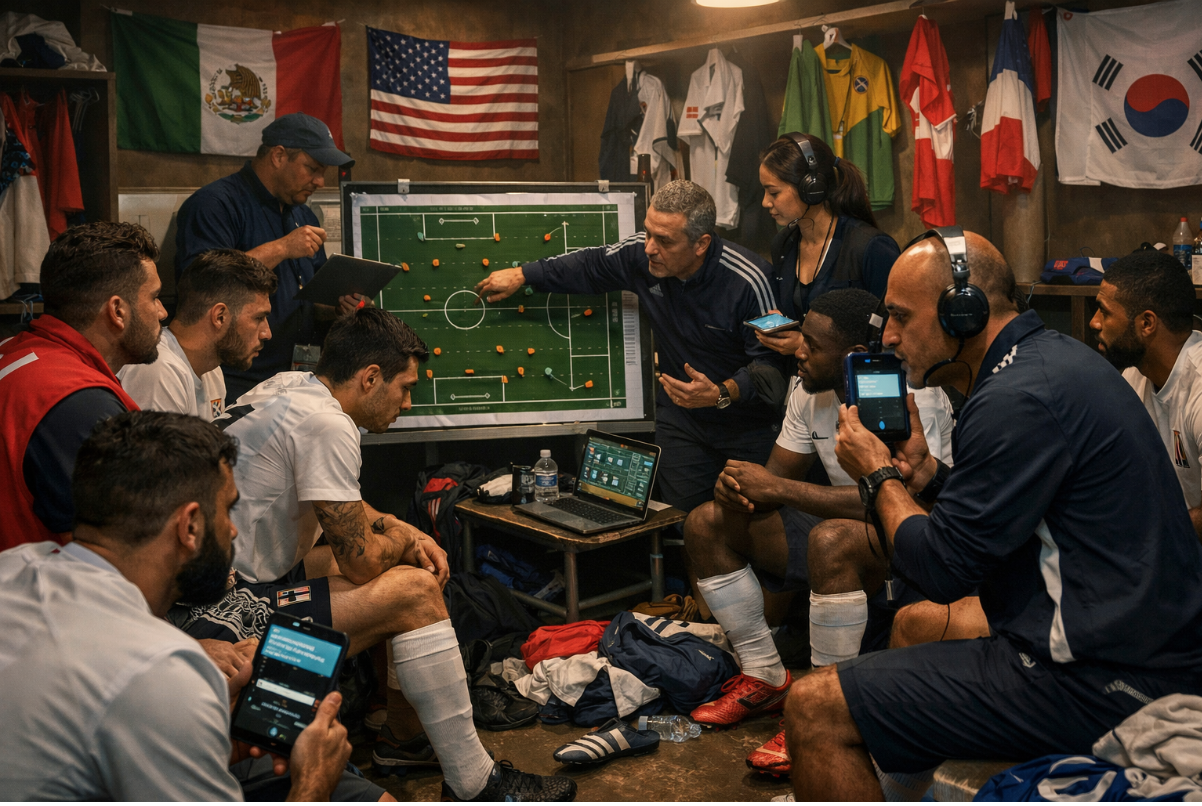
Image chatgpt
The Scale of the Problem
The numbers alone tell a story. Forty-eight teams mean representation from every confederation for the first time in World Cup history. Cape Verde, Curacao, Jordan, and Uzbekistan will make their tournament debuts. Iraq returns after decades away. The qualified nations collectively represent over 30 official languages and dozens more spoken within squads by players born or raised in diaspora communities.
Consider the group stage fixtures. On June 12 alone, Mexico will face South Africa while South Korea will play Czechia. The following day, Canada will play Bosnia and Herzegovina, and the USA will meet Paraguay. By June 14, Brazil will play Morocco and Qatar face Switzerland. Each of these matchups involves coaching staff, media teams, match officials, and stadium operations navigating at least two and often three or four languages simultaneously.
The Premier League offers a useful reference point. Around 57% of its players are non-English, representing over 66 nationalities. That diversity exists within a league where English is the dominant operational language and clubs have months or years to integrate players. A World Cup compresses that multilingual reality into a five-week sprint with no shared institutional language.
Inside the Multilingual Dressing Room
The language challenge inside national team squads is less discussed than at club level, partly because people assume shared nationality means shared language. That assumption falls apart quickly.
France’s squad includes players raised in francophone Africa, the Caribbean, and mainland France, each carrying different regional vocabularies and communication rhythms. Morocco’s 2022 World Cup run was built around a squad that operated in Arabic, French, Dutch, and Spanish depending on which player was speaking.
Canada’s team bridges English and French as a baseline, then adds the native languages of its growing number of players with roots in Africa, the Caribbean, and South Asia.
At club level, the consequences of miscommunication are well documented. When Eddie Howe signed Sandro Tonali from AC Milan for Newcastle United in 2023, he initially refused to assign the Italian midfielder a translator, hoping it would accelerate his English acquisition. Tonali struggled on the pitch.
After a poor performance against Brighton, where he was at fault for a goal, the club reversed course and brought in a dedicated interpreter for tactical briefings. The lesson was clear: forcing a player to absorb complex positional and tactical information in a language he is not yet comfortable with delays integration rather than accelerating it.
At a World Cup, coaching staff don’t have months to course-correct. A manager’s half-time instructions need to land immediately. A tactical shift in the 70th minute cannot be lost in translation between a coaching staff that thinks in one language and a player who processes in another.
The Press Conference Bottleneck
The public-facing side of the communication problem is equally fragile. World Cup press conferences are high-pressure events where managers and players address journalists from dozens of countries, all operating in different languages. The standard setup involves consecutive interpretation: the manager speaks, the interpreter pauses, then delivers the translation. It is slow, lossy, and vulnerable to the kind of error that reshaped Chelsea’s news cycle when Sarri’s interpreter confused midfield with defence.
When Sarri faced Arsenal in January 2019 and Chelsea lost 2-0, he chose to conduct his entire post-match press conference in Italian rather than his usual mix of Italian and English. His reasoning was explicit: he wanted his message to his players to be unmistakable. But the journalists in the room who didn’t speak Italian had to rely entirely on the interpreter’s compressed version of a long, emotionally charged critique of his squad’s mentality.
Multiply that scenario by 48 teams, 104 matches, and the global media apparatus covering all of it. Some of the richest tactical and emotional content in football lives in these post-match moments. Managers like Marcelo Bielsa, Sebastian Beccacece, and Walid Regragui give detailed, philosophically rich breakdowns of their approach. Most of that content never reaches fans or analysts who don’t speak the original language.
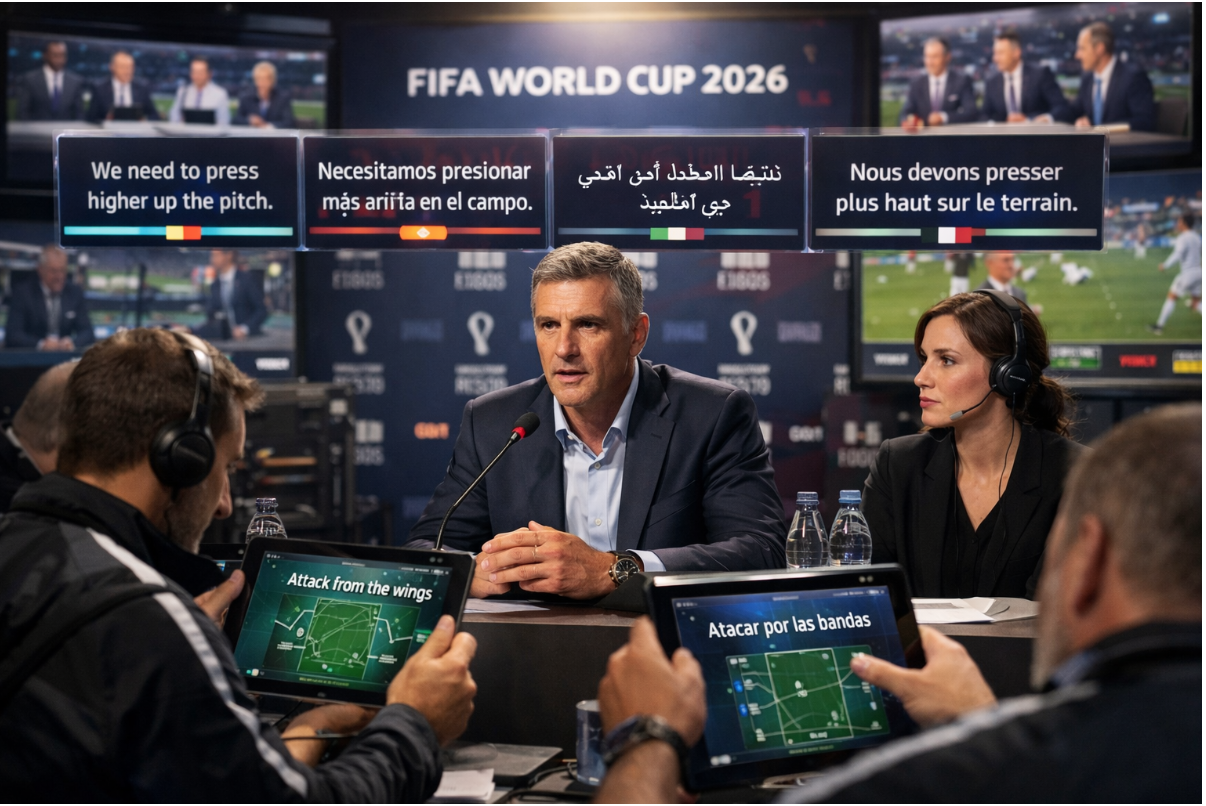
Image by chatgpt
Where AI Interpretation Fits
The infrastructure football relies on for cross-language communication was designed for a smaller, slower version of the game. Human interpreters remain essential for nuance and cultural context, but they are expensive, limited in number, and constrained by the consecutive format that halves the speed of every exchange.
AI-powered interpretation and multilingual translation can begin to bridge this gap. Instead of waiting for a human interpreter to relay a manager’s instructions or post-match comments one language at a time, AI systems can provide simultaneous output across multiple languages, preserving both the pacing and intent of the original speech.
The application extends beyond press conferences. Coaching staff preparing for opponents could use AI interpretation to understand tactical analysis from foreign-language broadcasts and scouting reports. Media teams covering the tournament could access real-time translation of interviews conducted in languages they don’t speak. And millions of fans watching from around the world could engage with commentary and tactical debates that were previously locked behind language barriers.
The Viewer Problem Nobody Mentions
Football’s language problem doesn’t end at the stadium gates. The 2026 World Cup is projected to attract over six million visitors to North America. But the vast majority of the tournament’s audience will experience it remotely, through broadcasts, social media, and post-match discussion in their own languages and communities.
A Japanese fan watching Brazil vs. Morocco wants to hear the post-match analysis. An Arabic-speaking viewer following the USA vs. Paraguay match wants to understand tactical debate on English-language football podcasts. A German analyst wants to read what the Uzbekistani coaching staff said about their historic group stage performance. Currently, much of this content remains locked behind language walls. The tactical depth that makes football the world’s most-watched sport is, paradoxically, inaccessible to most viewers.
AI-powered multilingual translation can address exactly this gap. Real-time translation doesn’t just serve the dressing room or the press room, it serves the global audience that makes football the most commercially valuable and culturally significant sport on the planet.
Football Has Outgrown Its Communication Tools
José Mourinho built his entire career on being Bobby Robson’s translator at Barcelona in the 1990s. He understood, before almost anyone in the sport, that the person who controls the language controls the information. Three decades later, football is a truly global industry, played and watched across every inhabited continent, generating billions in revenue from audiences speaking hundreds of languages.
Yet the communication infrastructure remains stubbornly local. A single interpreter whispering in a manager’s ear. A press officer issuing a correction after a mistranslation. A player performing below his ability because he cannot fully absorb a tactical brief in a language he’s still learning.
The 2026 World Cup, with 48 teams, three host countries, and the largest concentration of linguistic diversity in tournament history, will either expose that gap or begin to close it. The technology exists. The question is how quickly the sport decides to use it.