Card Counting in Blackjack: Legal Strategies to Reduce Casino Edge
Players who master blackjack strategy can burst the house advantage from 4-5% down to less than 1% through mathematical approaches and disciplined decision-making. Unlike games based purely on luck, blackjack rewards knowledge and…
Players who master blackjack strategy can burst the house advantage from 4-5% down to less than 1% through mathematical approaches and disciplined decision-making. Unlike games based purely on luck, blackjack rewards knowledge and calculation. Card counting represents one of the most effective legal methods to shift the probability in a player's favor when executed properly.
Understanding Card Counting as a Mathematical Approach
Harry Casino and other casinos operate with the understanding that most players make decisions based on habit rather than mathematics. Card counting changes this dynamic by using statistical principles to track the composition of remaining cards in the deck.
Card counting is not a single technique but a system of assigning numerical values to cards and keeping a mental tally as they are dealt. The fundamental principle relies on the fact that certain cards benefit the player while others favor the dealer. By knowing which cards remain in the shoe, a player can adjust their betting strategy and playing decisions with greater accuracy.
The core difference between counting and simple luck-based play lies in the operational mechanism. A basic counter tracks cards systematically using established methodologies, allowing them to identify when the deck composition favors higher payouts for blackjack or successful doubling strategies. This transforms blackjack from a game of chance into a game of incomplete information, where knowledge of previous outcomes improves future decisions.
The Hi-Lo Counting System
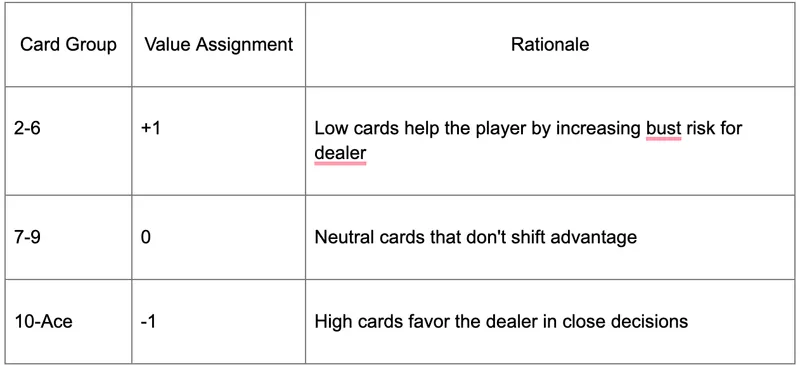
The Hi-Lo system stands as the most popular and practical counting method because it balances accuracy with simplicity. Here is how the card values work:
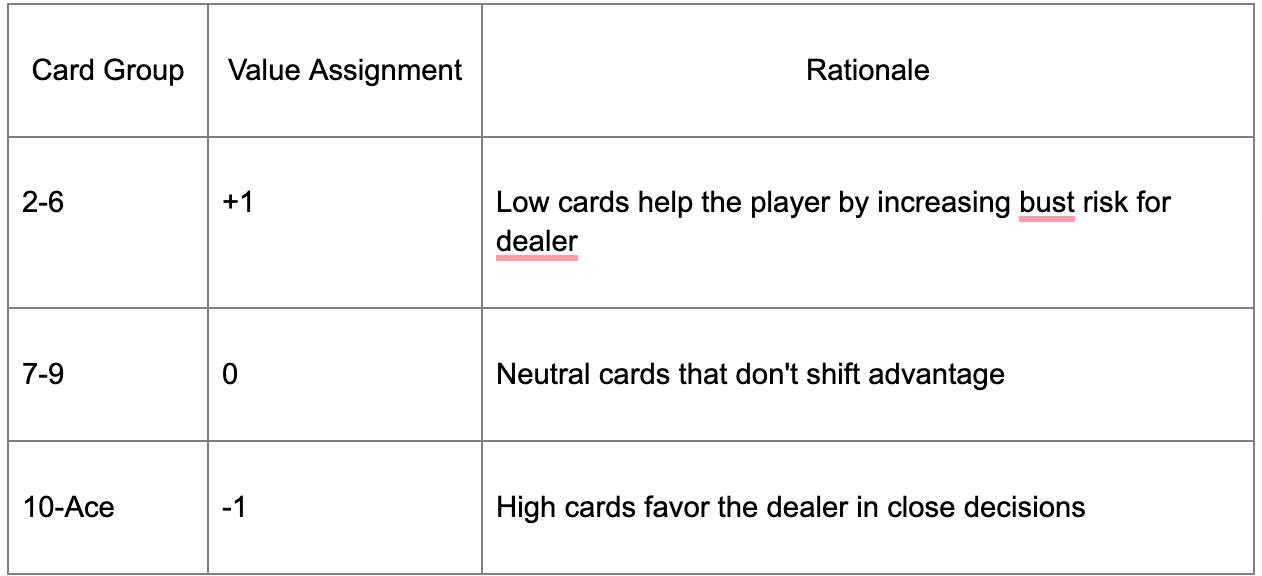
Players maintain a running count throughout the shoe, mentally adding or subtracting as cards are exposed. When the count surges positive, more high cards remain in the deck, which increases the probability of blackjacks and strong hands. At this point, players increase their bets. When the count crashes negative, the remaining deck contains more low cards, and players reduce their wagers.
Legal Methods Versus Prohibited Techniques
The distinction between legal and illegal card counting determines whether a player operates within acceptable boundaries or risks serious consequences. This separation is crucial because it affects casino response and legal liability.
Legal card counting relies exclusively on the player's memory and mental arithmetic. No external devices, written notes, or electronic assistance enters the picture. A skilled counter uses only their brain to track cards, making their advantage invisible to surveillance systems. This method remains legal in most jurisdictions because it involves no cheating or rule violation.
Illegal techniques include any form of external assistance. Here are the primary prohibited methods:
- Electronic devices hidden in clothing or watches that calculate counts automatically
- Marking cards with visible or invisible ink to identify values
- Collaborating with dealers who manipulate card placement
- Using hidden cameras to relay card information to teammates
- Writing notes or using paper to track the count
The legal line is clear: use your mind alone or face criminal charges and permanent casino bans. Memory-based counting, while difficult to master, remains your only completely legal avenue.
Bankroll Management and Bet Spreading Strategy
Card counting creates advantage only when betting decisions align with count information. Bankroll management determines whether a counter can capitalize on favorable situations without risking ruin during negative variance.
Bet spreading describes the practice of adjusting wager sizes based on the count. When the count surges, the player bets more. When it crashes, the player bets less. The spread ratio represents the difference between minimum and maximum bets. Here is how bankroll and betting work together:
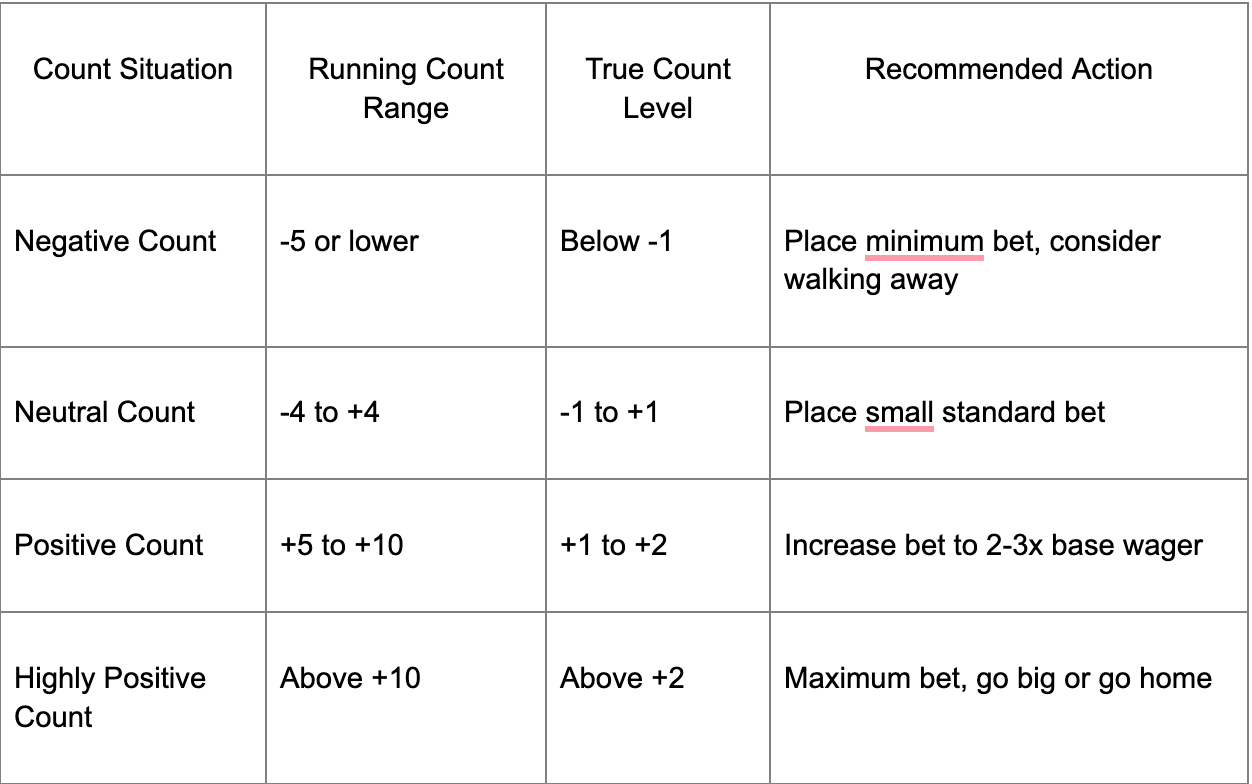
A proper bankroll should cover at least 300-500 times your minimum bet. This cushion protects against losing streaks that inevitably occur even with mathematical advantage. Without adequate bankroll, a skilled counter will go broke before advantage materializes.
True Count Calculation
Advanced counters convert the running count into a true count by dividing by estimated decks remaining. If the running count is +8 and approximately 4 decks remain in the shoe, the true count is +2. The true count matters more than the running count because it accounts for deck penetration. A +8 running count in an eight-deck game represents weaker advantage than the same count in a single-deck game.
Casino Countermeasures and Detection Avoidance
Casinos employ sophisticated systems to identify counters and protect their statistical advantage. Understanding these countermeasures helps skilled players avoid detection.
Surveillance operators watch for betting patterns that don't match decision patterns. A player who bets small during neutral counts, then suddenly increases bets before winning hands, shows the behavioral signature of a counter. This inconsistency triggers investigation.
Modern casinos implement these specific countermeasures:
- Continuous deck shufflers that eliminate the ability to count by resetting card composition constantly
- Frequent manual shuffles that reduce penetration and limit counting effectiveness
- Multi-camera surveillance that analyzes betting patterns against win rates
- Facial recognition databases that flag known or suspected counters
- Dealer training to spot inconsistent betting behavior
- Side bets and optional plays that distract from pure strategy
Successful counters avoid detection by maintaining consistent betting despite count changes, playing at different casinos rather than becoming a fixture at one location, and taking breaks to appear like casual entertainment players rather than serious advantage seekers.
Probability Edge and Realistic Expectations
Card counting doesn't guarantee wins. It provides a statistical edge that materializes over hundreds or thousands of hands. Understanding probability helps counters maintain realistic expectations and avoid overconfident decisions.
A well-executed Hi-Lo counting strategy with proper bet spreading fires approximately 0.5-1.5% player advantage over the long term, depending on rule variations and penetration depth. This edge is small but significant when compounded over time. A player betting 100 dollars per hand on average would expect to profit around 50-150 dollars per 100 hands played.
However, short-term variance remains substantial. A counter can lose money during their first 50 hands despite possessing mathematical advantage. This reality separates committed counters from casual interest. Success requires emotional discipline to continue despite temporary losses.
Training and Practice Requirements
Mastering card counting demands significant practice before entering a casino. Most professional counters spend 50-100 hours training with flashcards and software simulations before playing with real money.
Basic competency requires:
- Counting down a deck without errors in under 25 seconds
- Converting running counts to true counts instantly
- Maintaining count accuracy while making conversation or tracking dealer behavior
- Playing basic strategy without hesitation for every hand combination
- Managing emotions during losing streaks without deviating from strategy
Without this foundation, a counter makes mistakes that eliminate or reverse their advantage. The investment in training directly determines success probability in actual casino conditions.
Conclusion
Card counting represents a legitimate skill that transforms blackjack from a luck-based game into a game where knowledge creates measurable advantage. Legal, memory-based counting combined with disciplined bankroll management and proper training provides a path to consistent profits. The effort required separates serious players from casual visitors.
Credits
Words
Zach Lowy