

How Take-Back Programs Are Redefining Waste Management
There is a global waste crisis, and it’s getting worse. Rapid urbanization, growing consumption, and short product life spans have led to mountains of throwaways that existing systems are struggling to handle. From single-use plastics to e-waste and industrial scrap, we are simply generating too much and too diverse a range of materials for our traditional waste systems.
Traditional collect–dump–recycle is not enough now. Landfills are overflowing, recycling rates are poor, and precious resources are often polluted or poorly sorted. These linear systems may create end-of-life waste that has no value as a residue.
This is where take-back programs are a game-changer. Companies are not dealing with waste; they are managing resources.
What Are Take-Back Programs?
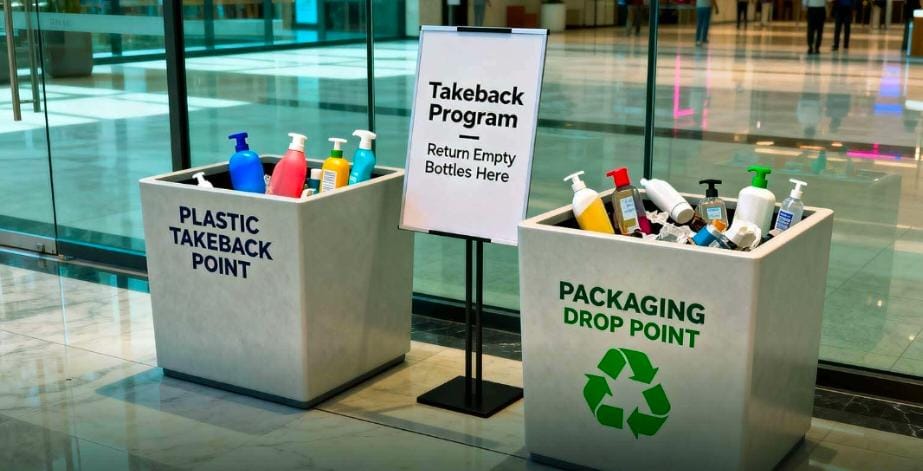
Take-back programs are structured procedures for the collection of products, packages, or components that come to the end of their useful life. At its simplest, they prevent materials from being discarded after just one use.
One of the most common of these programs can manage coordinated collection points, or reverse logistics, and sorting in logistical networks, including scientifically driven recycling or reuse.
Unlike typical recycling, which often relies on municipal systems and mixes waste streams, these programs are closer to a closed loop. They are based on accountability, traceability, and additional material recovery. The system is designed by producers, consumers contribute by returning materials, and recyclers ensure long-term performance and efficiency across the value chain.
Why Old Waste Management is No Longer Enough
Landfills around the world are filling up, and recycling rates for plastic, glass, and paper, among other materials, remain in the single digits. Responsible behaviour is not exactly stimulated by any linear economic models, as producers are not made accountable for the acts or consequences they engender with their products.
A further disadvantage when working with recycled and recovered materials is that this processing generates additional issues. However, recyclability is being diminished due to the intermixing and entangling of polymers, which leads to poor separation that has been the cause of downcycling or going into the landfill.
Meanwhile, governments are implementing stricter environmental legislation, and consumers are paying increasing attention to whether the brands they buy from act responsibly.
The pressures reveal the deficiencies of old systems and a pressing need for new ways that focus on recovery rather than disposal.
How Take-Back Programs Are Changing the Game
There are ways these programs are helping the industries with effective waste management:
Shifting Responsibility to Producers
EPR policies make manufacturers liable for the end-of-life management of their products. A good take-back scheme transfers responsibility away from the point of sale and actively manages the process throughout a product’s life.
Closing the Circle in the Circular Economy
A take-back system ensures that process materials are fed back into the life cycle. Waste is upcycled into a resource, thereby reducing or eliminating dependence on virgin resources and closing the loop in supply chains.
Improving Waste Collection & Segregation
This leads to less contamination as the materials are source-separated in advance and targeted. The result is that recycled materials can be produced at the highest possible quality, recycling ratios can be raised, and recycling products become predictable.
Environmental Benefits of Take-Back Programs
A successful program diverts trash from landfills, which lowers the rate of possible contamination in soil and water. Energy and carbon emissions in virgin raw materials can be saved when recycled materials are utilized.
Those efforts are focused on conservation of resources, recycling waste, and enabling companies to meet international sustainability benchmarks. And it builds real environmental value.
Business and Brand Impact
Apart from environmental benefits, take-back programs have strong business implications. Cost savings are also realizable from material recovery and less dependence on raw materials by companies. A good program also ensures that companies comply with shifting environmental regulations.
Reputational Benefits
Brands that invest in responsible waste solutions elevate their class, win over the consumer hearts, and take an edge in competition. Increasingly, sustainability-minded business approaches equate to durability and ingenuity for the long term.
Consumer Engagement: The Catalyst for Success
Whether a take-back system is effective or not largely depends on consumer involvement. Incentives, raise campaigns, and simple return systems are used to motivate participation. It’s good for confidence and trust to have visibility into what happens with materials that come back.
Businesses that are able to communicate what their take-back program adds value to often see higher participation. Consumers are also more likely to want to engage if they know that what they do will make a tangible difference for the world.
Industry Examples and Use Cases
The take-back systems are flourishing in FMCG, plastics, electronics, and textiles. In B2C, consumers bring back packaging or products, while B2B systems are based on industrial waste recovery.
Common features of successful programs are clear responsibility, thorough logistics, data tracking, and a strong recycling base. These takeaways show that take-back systems can be scaled, regardless of industry.
Challenges in Implementing Take-Back Programs
While these programs offer advantages, they also pose some challenges.
- Reverse logistics are not straightforward; infrastructure expenditure is likely to be significant, and consumer uptake cannot be guaranteed.
- Effective take-back programs need to include credible recyclers, transparency around the process, and a longer-term commitment.
- But there are some barriers that stand in the face of the long-term payoffs that can come from better complying with sustainability and resource efficiency.
The Future of Waste and Packaging with Take-Back Systems
Intersectoral collaboration is where the future of waste management lies. With digital tracking, material traceability, and data analytics, the take-back systems are efficient and transparent.
With new laws and sustainability as an inescapable standard, take-back programs won’t be a choice; they will just happen. The best program will be as central to good business practices as it already is for many providers.
Conclusion
Take-back programs are changing the way we handle waste, turning trash into precious resources. They illustrate the transition from ‘use-linear-dispose’ to circular, responsible, and sustainable methods that work for businesses, consumers, and the environment.
For a truly effective take-back solution, companies need to partner with experienced recyclers. Banyan Nation has a strong track record of operating efficiency in Plastic Recycling and Circular Economy Solutions, with sustained contributions to the quality of output materials and adherence to strict waste management norms. By utilizing such expertise, companies can go beyond just reducing waste and start seizing the value throughout waste.