
Tactics, Trends & Luck: What to Watch at the World Cup
The FIFA World Cup is the pinnacle of international football – the tournament which every player dreams of playing in when they are growing up. Some have even loftier ambitions of etching their names into the record books by lifting the…
The FIFA World Cup is the pinnacle of international football – the tournament which every player dreams of playing in when they are growing up.
Some have even loftier ambitions of etching their names into the record books by lifting the prestigious trophy or finishing as the tournament’s top goalscorer.
England’s Harry Kane has already achieved the latter feat, scoring six goals at Russia 2018. Spreadex rate him as one the betting favourites to top the charts this summer.
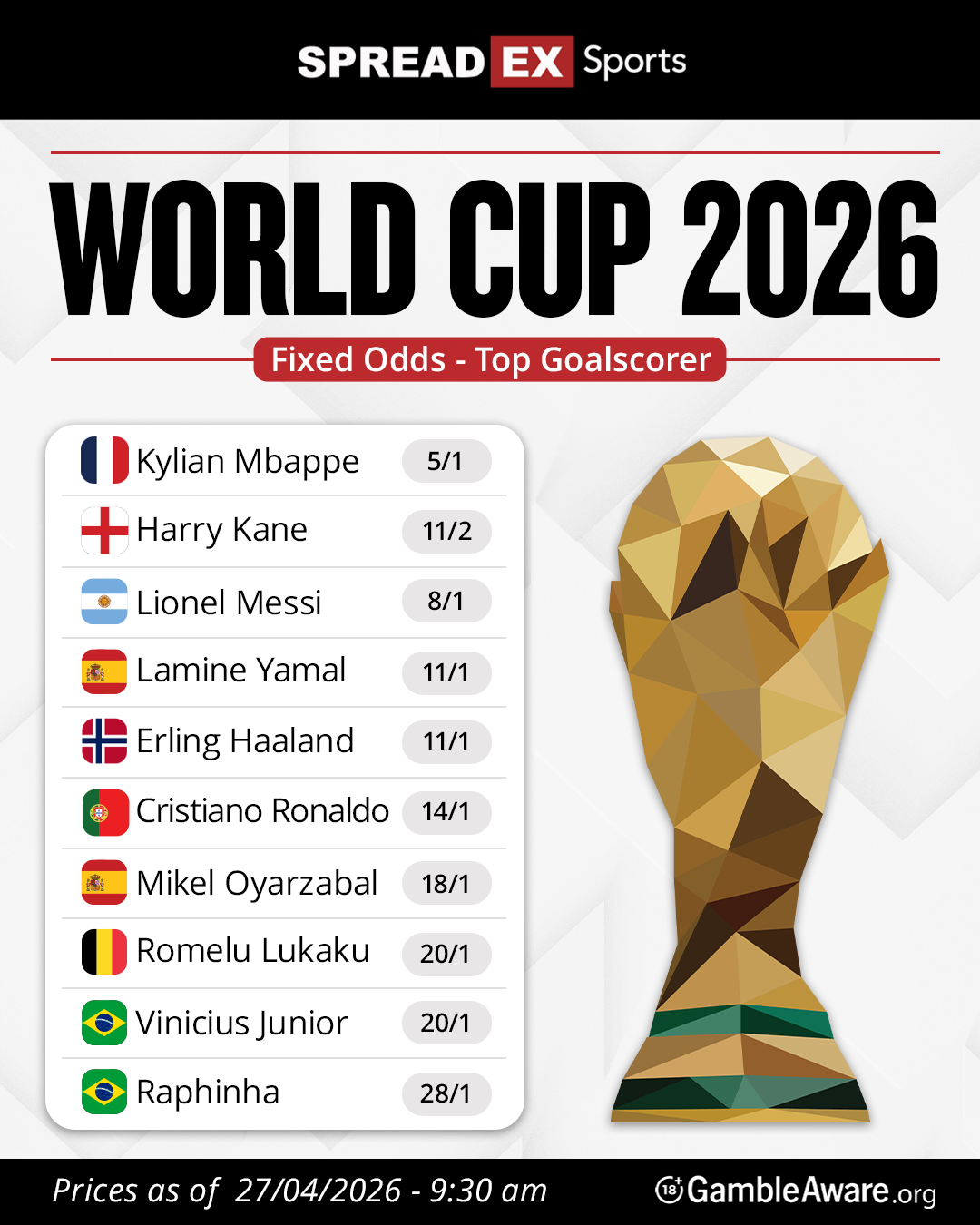
Goalscoring is only part of the equation at the World Cup, with teams relying heavily on their tactical systems to deliver the desired results.
Intriguingly, previous history and luck are undoubtedly key elements when trying to determine who will emerge victorious at the World Cup.
The Tactical Evolutions
Attacking systems were commonplace during the early World Cup tournaments, with many teams often lining up in a 2-3-5 formation.
Tactics evolved during the 1950s, with Hungary famously using the ‘total football’ system more commonly associated with the Netherlands teams in the 1970s.
Brazil continued the attacking theme in 1958, although their 4-2-4 formation was a sign that managers had started to recognise the importance of defending.
The trend continued during the 1960s before being ditched at Mexico 1970 when Brazil demonstrated the perfect way to implement the 4-4-2 system.
Teams largely favoured this system or 4-3-3 over the next few tournaments, before Mexico was once again the launch pad for something different in 1986.
Diego Maradona’s superb performances as a ‘number ten’ helped Argentina secure their second World Cup success, although he did also cause a kerfuffle along the way.
Italy 1990 was the catalyst for a more defensive approach to be adopted in international football and this trend continued until Spain broke the mould.
They won back-to-back European Championships (2008 & 2012) either side of a memorable success at South Africa 2010. ‘Tiki-taka’ was born and has remained in vogue since then.
The Winning Trends
The adage that ‘the cream rises to the top’ can be perfectly evidenced by the list of previous World Cup finals.
1930
1934
2-1 (aet)
Czechoslovakia
1938
1950
2-1
1954
West Germany
3-2
5-2
Sweden
1962
3-1
Czechoslovakia
1966
4-2 (aet)
West Germany
4-1
1974
West Germany
2-1
1978
3-1 (aet)
1982
3-1
West Germany
3-2
West Germany
West Germany
1-0
1994
0-0 (aet) (3-2 pen)
1998
3-0
2002
2-0
2006
1-1 (aet) (5-3 pen)
1-0 (aet)
2014
1-0 (aet)
3-3 (aet) (4-2 pen)
Just eight nations have won the World Cup – Brazil (5), Italy (4), Germany (4), Argentina (3), Uruguay (2), France (2), England (1) and Spain (1).
None of those successes could be described ‘shocks’ given that the teams in question were amongst the best during their respective eras.
It is a similar story where the runners-up are concerned, with only Croatia’s final appearance in 2018 coming remotely close to being a surprise.
While history shows that the best teams should dominate the 2026 World Cup, it is also worth noting that unusual things may happen during the tournament.
The Luck Factor
Luck plays a significant role in football. Deflected goals, officiating errors and the luck of the draw are amongst the elements which can impact the outcome.
Argentina’s success in 1986 is a perfect example. But for Maradona’s ‘Hand of God’ goal against England, they may not have progressed to the final.
Chris Anderson, an economics and politics professor at Warwick University, co-authored a book entitled ‘The Numbers Game’ which assesses outcomes in football.
Anderson believes that football is driven more by luck and chance than other team sport.
“There’s the 50 percent that can be controlled, like tactics, team selection and preparation,” Anderson said. “The other half is all chance.”
“In the World Cup, we play a relatively small number of matches and luck has an opportunity to influence outcomes more.
“The regression to the mean also favours the lesser teams. That’s why it’s so surprising that a weaker team has never made it.”
While several smaller nations have reached the World Cup semi-finals, including Morocco in 2022, history shows that the big guns are most likely to come out on top.
Seven of the eight previous winners will participate in North America this summer. Italy are the odd ones out having failed to qualify for the third consecutive World Cup.
Uruguay are no longer the force of old, while England generally fall short in major tournaments unless they are staged on home soil.
On that basis, Brazil, Germany, Argentina, France and Spain are the most likely winners this summer.
Credits
Words
Breaking The Lines