The Premier League in Three Clusters
Two charts. Twenty clubs. Three very different ideas about how to play football. The Premier League is one of the most competitive leagues in this world. We see a lot of talk about how some teams like to circulate the ball around, focus on…
Two charts. Twenty clubs. Three very different ideas about how to play football. The Premier League is one of the most competitive leagues in this world. We see a lot of talk about how some teams like to circulate the ball around, focus on patient build-up play and precision. Others get the ball, and immediately look vertical.
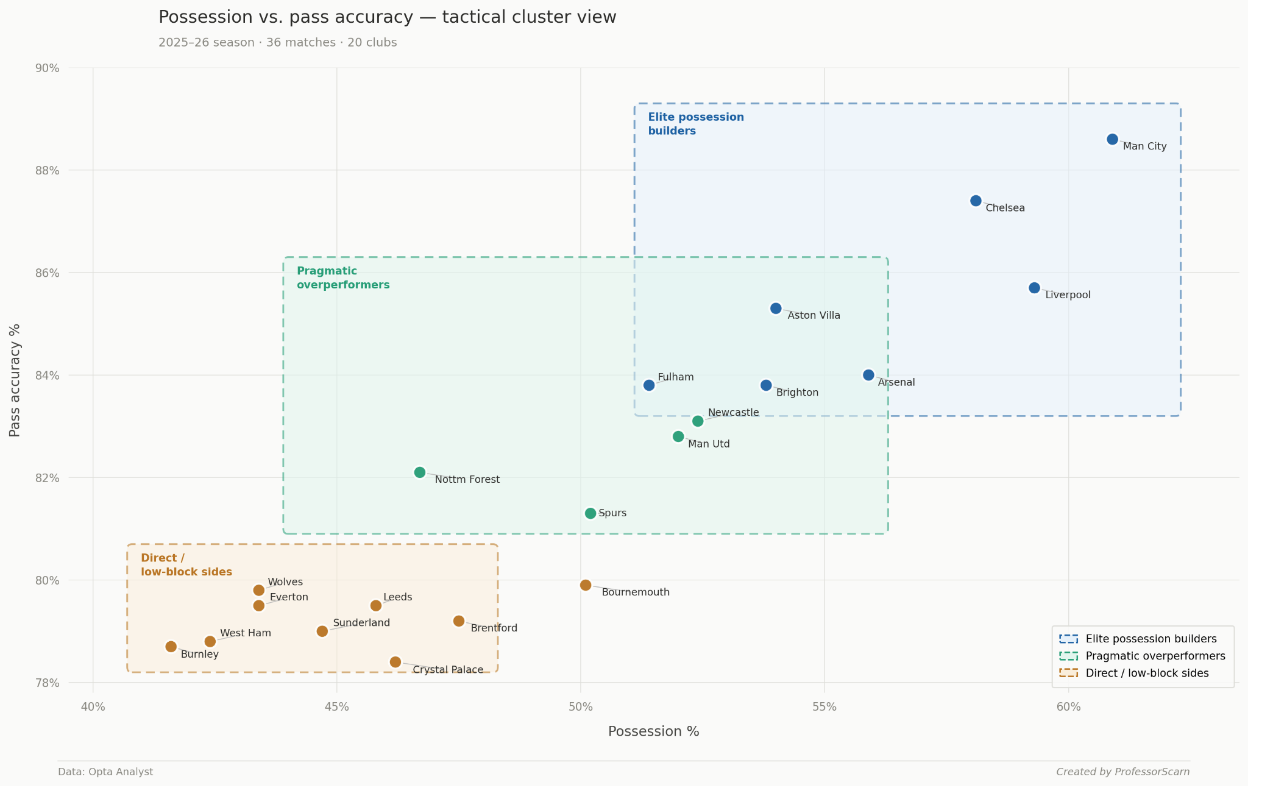
When you map all 20 clubs by possession and pass accuracy, distinct groups emerge. Each one has a different answer to the same question: what are we trying to do with the ball? Pass direction confirms these patterns.
Finding the clusters
The scatter plot does most of the work. Teams don’t need to be manually sorted or categorized. Three clusters emerge. Once you see these three groups, the pass direction data reinforces each cluster’s identity. Cluster One: Elite Possession Builders like Manchester City, Chelsea, Liverpool, and Arsenal.
These teams don’t just have the ball more, they have it more purposefully. High accuracy means very few wasted passes. And when you look at their pass directions, the confirmation is immediate: this cluster has the lowest forward passes in the league. Man City pass forward just 26.1% of the time. This sounds alarming, until you remember they win all the time.
These teams are not rushing. They are probing, shifting the defensive shape, waiting for the gap to open before committing forward. The pattern is to overload the final third, move the ball wide, pull defenders across, find a cutback, underlap or an overlap. It requires highly technically assured players at every position, including the goalkeeper (this is where Chelsea has struggled this season).
Cluster Two: Direct/Low-Block sides like Burnley, Crystal Palace, Sunderland, and West Ham. This is the bottom-left of the plot, less possession and less accuracy. That does not mean they are less technical, less ambitious or just lazy. What they are doing is different, not inferior. And occasionally they terrify teams in Cluster One.
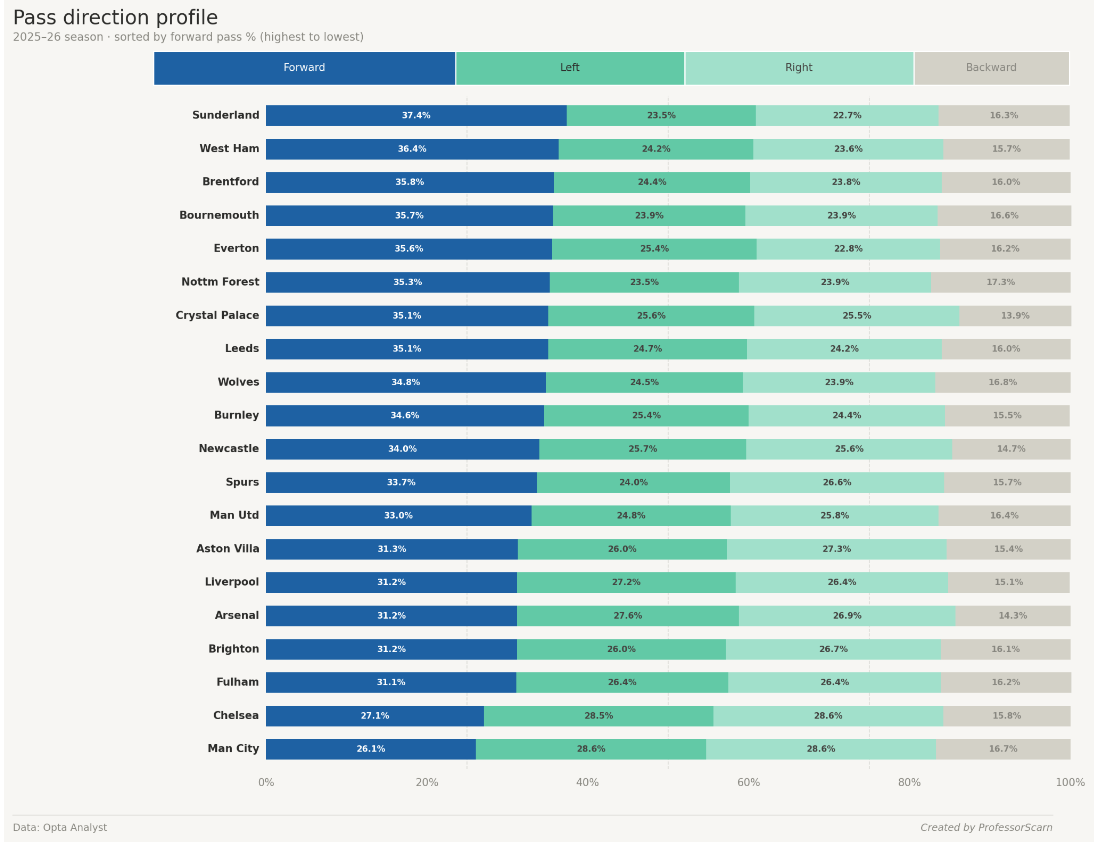
This cluster posts the league’s highest forward-pass rates. They accept they won’t dominate the ball and build their structure around that reality. A low or mid-block defensively, compact and hard to play through. Once they win it back, they move quickly, before the opposition can fall back and reorganize.
Sunderland is the best example. They lead the league in forward pass rate at 37.4%. That means close to 40% of their passes in the game are forward. Their total passes? 13,455. Man City’s? 21,325. Sunderland press aggressively, win the ball in dangerous areas and look forward. The directness is intentional and connected to a lot of out of possession work.
This cluster requires pace and physicality in forward areas, defensive discipline across the whole team and the mentality that they are going to spend large parts of the game without the ball.
Cluster Three: Pragmatic Overperformers like Nottingham Forest, Manchester United, Newcastle United, and Tottenham Hotspur. This is a varied cluster and really interesting. They are not dominant enough in possession to be elite builders, and not direct enough to low-block. This cluster is one with an identity problem and are wildcards. Pass direction reflects that in-between identity too. Their forward pass rates sit in the middle of the league.
/@btl/the-irony-of-mentality-talk-in-the-premier-league-title-race
United and Spurs have had a rocky season in exactly this. While Carrick swept in and brought life back to a struggling United team, Spurs went the opposite direction. This cluster is often where teams land when something breaks rather than where they choose to be. Unless you have a Bruno Fernandes who single-handedly rescues a team with record number of assists in one season.
The Premier League is very good at generating noise. Transfer rumors, managerial press conferences, injuries, VAR GOOF-UPS. Enough content to fill the week between games and keep everyone distracted from the actual question: does this club know what it's doing? A team’s position in these clusters isn’t just about passing patterns and accuracy, it’s a reflection of recruitment philosophy, managerial strength and ownership ambition. The elite possession builders didn’t land in the top right corner by accident.
They got there because someone made a series of decisions over several years, about which players to buy, manager to trust, and style to commit to. Not change managers once a season as a ritual. Data never lies, it just makes things more clear. What kind of team is yours actually trying to be?
Credits
Words
Sandipani Basu