

What is a Kirschner Wire (K-Wire)? Uses, Benefits & Orthopedic Applications
Introduction to Kirschner Wires
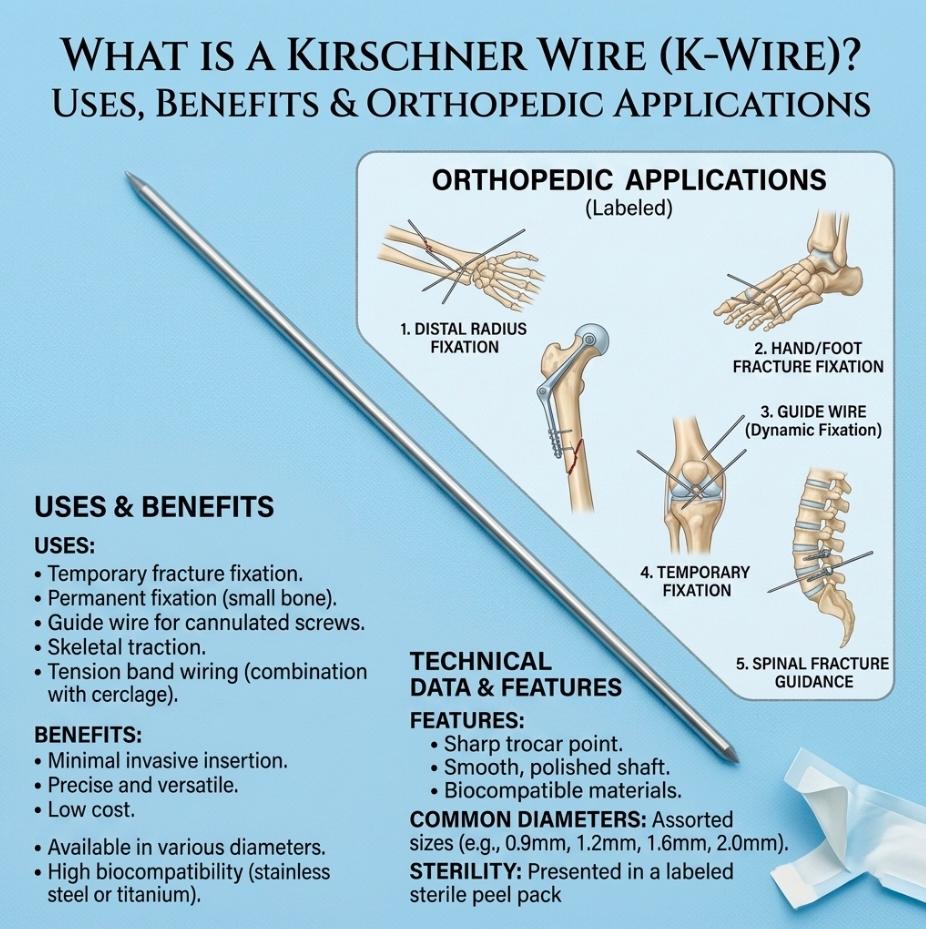
Kirschner wires—commonly known as K-wires—are one of the simplest yet most powerful tools in orthopedic surgery. These thin, sterile metal pins are used to hold bone fragments in place, ensuring proper alignment during the healing process. Originally introduced by Dr. Martin Kirschner, this technique has stood the test of time and continues to be widely used across modern surgical practices.
What makes K-wires so unique is their versatility. Whether it’s a minor finger fracture or a more complex orthopedic correction, these wires provide a quick, reliable, and minimally invasive solution. Think of them as the “temporary scaffolding” that keeps bones stable while the body does the real work—healing.
Structure and Design of K-Wires
K-wires are typically made from medical-grade stainless steel, ensuring durability and resistance to corrosion. They come in different diameters, usually ranging from 0.6 mm to 3.0 mm, making them adaptable for various anatomical regions.
There are two main types:
- Smooth K-wires – Ideal for temporary fixation and easy removal
- Threaded K-wires – Provide stronger grip and better stability
Some wires also feature specialized tips, such as trocar or diamond points, which allow smoother insertion into bone with minimal resistance.
Common Uses of K-Wires in Orthopedics
K-wires are incredibly versatile and are used in a wide range of orthopedic procedures.
For example, in fracture fixation procedures, K-wires are used to stabilize broken bones by holding fragments in proper alignment. This is especially common in wrist, hand, and finger fractures where precision is critical.
They are also used for:
- Temporary stabilization during complex surgeries
- Pediatric orthopedic procedures, where minimal invasiveness is preferred
- Joint alignment and correction, especially in small bones
Because they are easy to insert and remove, surgeons often rely on them as a first-line solution.
Orthopedic Applications Across Body Regions
Hand and Wrist Surgery
K-wires are widely used in hand surgeries due to their ability to stabilize small bones without adding bulk. They are ideal for delicate structures where larger implants would be impractical.
Foot and Ankle Procedures
In foot and ankle surgeries, K-wires help correct deformities and maintain alignment after fractures. Their slim design makes them perfect for tight anatomical spaces.
Long Bone Fixation
While less common, K-wires can also assist in stabilizing long bones, usually as supplementary support alongside other fixation methods.
Surgical Procedure Using K-Wires
The process of inserting a K-wire is relatively straightforward but requires precision.
- The fractured bone is carefully aligned
- The K-wire is inserted through the skin into the bone
- Imaging (fluoroscopy) is used to guide placement
- The wire is secured to maintain stability
This minimally invasive approach reduces surgical time and speeds up recovery.
Benefits of Using K-Wires
K-wires offer several advantages that make them a preferred choice in orthopedic surgery.
For surgeons and medical suppliers looking for high-quality Kirschner wires, choosing the right product ensures better surgical outcomes, durability, and patient safety.
Some key benefits include:
- Minimally invasive technique
- Cost-effective compared to plates and screws
- Quick and easy insertion
- Versatility across multiple procedures
- Simple removal after healing
These benefits make K-wires especially useful in emergency and outpatient settings.
When Do Surgeons Prefer K-Wires Over Plates or Screws?
This is where things get interesting—and where real surgical decision-making comes into play.
K-wires are often preferred in cases where minimal invasiveness is required, such as small bone fractures in the hands or feet. Surgeons choose them when they need a quick, efficient solution without the complexity of larger implants.
They are also ideal when:
- The fracture is simple and stable
- The patient is young (pediatric cases)
- Temporary fixation is needed before permanent implants
- Surgical time needs to be minimized
In contrast, plates and screws are used for more complex or load-bearing fractures. So it’s not about which is “better”—it’s about choosing the right tool for the job.
Limitations and Risks
Despite their advantages, K-wires are not perfect.
They can sometimes:
- Migrate from their original position
- Causes infection if not properly managed
- Provide less stability compared to rigid fixation systems
That’s why proper surgical technique and follow-up care are essential.
K-Wire vs Other Fixation Methods
MethodStabilityCostInvasiveness
K-wire Moderate Low Low
Plates High High Moderate
Screws High Medium Moderate
This comparison clearly shows why K-wires are often chosen for simpler, less invasive procedures.
Sterilization and Handling
K-wires are typically supplied in sterile packaging and are often single-use. However, reusable options must be properly sterilized using autoclaving.
Maintaining sterility is critical to prevent infections and ensure patient safety.
Choosing the Right K-Wire
Selecting the correct K-wire depends on several factors:
- Bone size and location
- Type of fracture
- Required stability
- Patient age and condition
Choosing the right specifications ensures optimal surgical performance and healing outcomes.
Conclusion
K-wires may look simple, but their impact on orthopedic surgery is massive. From stabilizing fractures to assisting in complex procedures, they remain one of the most versatile tools in a surgeon’s arsenal.
Selecting a high-quality K-wire not only improves fixation stability but also enhances surgical efficiency and patient recovery outcomes. That’s why both surgeons and clinics must prioritize quality when sourcing these essential instruments.
FAQs
- What is a K-wire used for?
It is used to stabilize and align broken bones during healing.
- Are K-wires permanent?
No, they are usually temporary and removed after healing.
- Is the procedure painful?
It is performed under anesthesia, so patients don’t feel pain during surgery.
- How long do K-wires stay in place?
Typically, a few weeks, depending on the fracture.
- What are the risks of K-wires?
Possible risks include infection, migration, and limited stability.