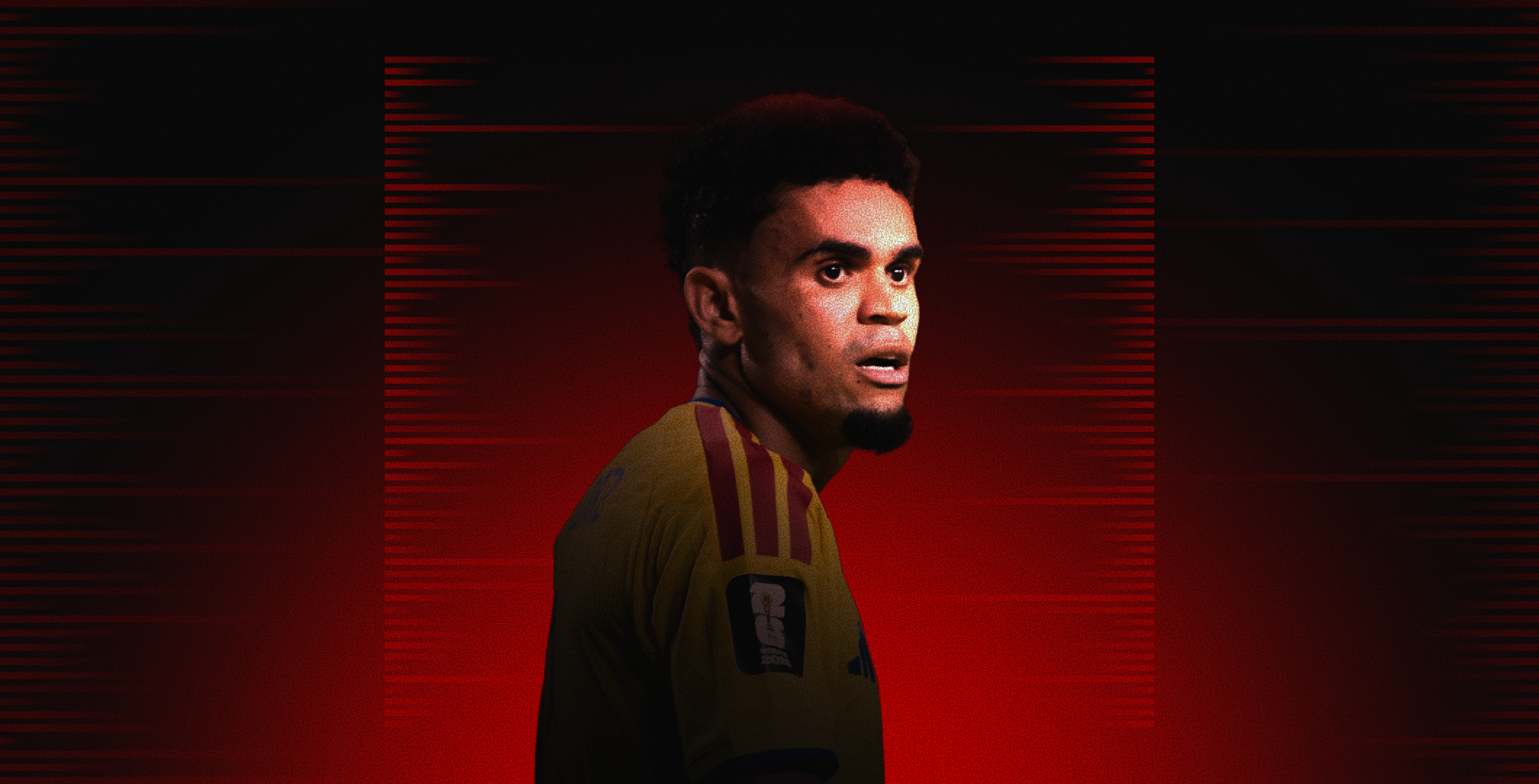
Illustrator Gabriel Foligno Publication David Ramos Photographer Getty Images Sport
Luis Díaz: The Timing of Chaos Inside Structure
There is a persistent tendency in football analysis to simplify players like Luis Díaz into a familiar set of descriptors. They are labelled instinctive, emotional, direct, or —perhaps most commonly —chaotic. This vocabulary is not…
There is a persistent tendency in football analysis to simplify players like Luis Díaz into a familiar set of descriptors. They are labelled instinctive, emotional, direct, or —perhaps most commonly —chaotic. This vocabulary is not entirely incorrect, but it is analytically insufficient.
It describes what the player appears to do without addressing the conditions that make those actions meaningful. In doing so, it reduces a relational phenomenon to an individual trait, isolating action from structure. Yet at the elite level, football is rarely decided by isolated actions. It is decided by the interaction between structures and the timing of deviations within them.
What appears as chaos is often something more precise: a non-linear decision-making process operating inside structured environments. And Díaz, in his current phase at FC Bayern Munich under Vincent Kompany, represents one of the clearest contemporary expressions of this paradox. A player who appears to break structure, while increasingly functioning as one of its stabilising components.
From Florida High School to Bundesliga Wunderkid: The Tactical Profile of Yan Diomande
Identity As Chaos: The Early Version Of Díaz
The earlier iterations of Díaz at Porto and in his first phase at Liverpool FC felt almost anti-structural in nature. He was not a player who appeared to calculate situations. He attacked them instinctively—receive wide, attack immediately, force separation, and accelerate into uncertainty.
There was very little delay in his game. His football was based on momentum and confrontation. He did not wait for the game to open. He attempted to tear it open himself. And in the right conditions, this was devastating. Particularly in transition-heavy matches, Díaz looked almost impossible to contain because transitional football naturally weakens structure.
Defensive distances expand. Cover shadows disappear. Timing becomes reactive rather than coordinated. In those moments, Díaz’s aggression aligned perfectly with the instability around him. The game became emotional, and Díaz was better at emotional football than most defenders were. Yet chaos has a ceiling when it exists without.
Against highly synchronised defensive systems, unpredictability alone becomes easier to absorb than many people realise. Elite defensive structures are not built to stop every dribble individually. They are built to survive sequences collectively. A defender can lose a duel while the system survives. The covering midfielder arrives. The centre-back adjusts. The distances compress. Possession is recycled widely again.
The False Narrative Surrounding ‘Bundesliga Tax’
The structure bends but does not collapse. This is where earlier versions of Díaz occasionally became inconsistent against compact opponents. Not because he lacked quality, but because he was often attempting to force instability against systems specifically designed to absorb forced instability.
In those situations, Diaz was at his most dangerous. Defenders were often retreating, the structure behind them wasn’t fully set, and there was space to attack directly. His acceleration and ability to change direction made him extremely difficult to handle in those moments.
However, against more compact and organised defences, his influence could fluctuate. Not because he lacked the ability to beat defenders, but because the situations in which he received the ball were less favourable. The defence was set, the cover was in place, and the distances between players were well managed. In those scenarios, even the best dribblers can appear less effective.
Bayern Munich: A More Controlled Framework
The move to Bayern introduces Díaz into a more structured attacking system. Under Vincent Kompany, there is a greater emphasis on positional discipline, spacing, and controlled build-up play. This changes the role of the wide player. Instead of simply receiving the ball and attacking immediately, Díaz is now more often required to hold his position, stretch the opposition, and contribute to the overall structure of the team.
Said El Mala – The Next Bundesliga Star In The Making
In practical terms, that means he spends more time maintaining width, offering a passing option, and helping to pin the opposition full-back in place. This might seem like a limitation, but in reality, it creates better conditions for his strengths to emerge. One of the most noticeable differences in Díaz’s game is the change in how often he attempts to beat his man. Previously, he would engage defenders regularly, often as soon as he received the ball. At Bayern, those moments are more selective.
He doesn’t always attack immediately. Instead, he tends to wait for the right situation. That might be when the opposition defence has just shifted across, when a midfielder has stepped out of position, or when the back line is still adjusting its shape. In other words, Díaz is now more likely to attack when the defence is slightly disorganised, rather than when it is fully set. This makes his actions more effective, even if they are less frequent.
Disruption Of Timing: Why Defenders Still Struggle
It is tempting to describe Díaz’s success simply in terms of individual skill. But that overlooks the importance of disrupting timing. This is where Díaz becomes particularly interesting from a tactical perspective. Rather than simply attacking space, he often disrupts the timing of the defensive structure. His touches, his pauses, and his changes of pace make it difficult for defenders to predict exactly what he will do next.
For example, he might delay slightly when a defender expects him to accelerate, or speed up when the defender is preparing to hold position. These small variations can be enough to disrupt the coordination between defenders. Once that coordination breaks down, the situation becomes much harder to manage collectively. So while it might look like a straightforward one-against-one, the reality is that the defensive system has already been compromised.
Angelo Stiller: The Diamond of the Bundesliga
The Harry Kane Partnership: Creating Instability Through Structure
The relationship between Harry Kane and Luis Diaz is not primarily about combinations in the traditional sense. It is about manipulating defensive structure. That distinction matters because attacking partnerships are often described too simply. One player drops deep, the other runs beyond. One creates, the other finishes. But the more interesting aspect is usually the effect those movements have upon the opposition’s defensive organisation.
Under Vincent Kompany at FC Bayern Munich, Kane and Diaz alter defensive reference points in very different ways, and those effects constantly interact with one another. Kane manipulates structure through occupation, and Diaz does it through timing. Together, they create a difficult problem for defenders because the defensive line is forced to deal with two contradictory threats at once. Kane’s influence begins before he even receives possession.
Most strikers occupy centre-backs vertically by threatening runs in behind. Kane does something different. He occupies defenders psychologically. His movement constantly forces centre-backs to reconsider their positioning within the defensive line. Against Bayern, defenders repeatedly face the same question: who follows Kane?
If a centre-back steps forward aggressively when Kane drops deep, the back line loses compactness. The distances between defenders increase, particularly between centre-back and full-back, and spaces begin to appear for diagonal runs. But if the centre-back stays in position, Kane receives freely between the lines, where he has the time and technical quality to dictate the next phase of the attack.
Speed, Skill and Resilience: Mohamed Amoura’s Bundesliga Breakthrough
Crucially, Kane’s movements are not random. They are coordinated with Bayern’s overall spacing. This is where Díaz becomes essential. When Kane drops toward the left half-space or into midfield, Díaz usually maintains very aggressive width on the outside. This is not passive positioning. It is designed to pin the opposition full-back and prevent the defensive line from shifting across quickly.
That delay is extremely significant. Modern defending depends heavily upon collective movement. When the ball moves centrally, defensive lines want to compress space immediately. Full-backs narrow inside, midfielders collapse toward the ball, and access to central areas becomes crowded.
But Díaz’s positioning prevents that compression from happening comfortably. If the full-back narrows too early, Díaz immediately becomes a threat on the outside. As a result, the defensive line becomes stretched between two priorities: protecting central access around Kane while also protecting space against Díaz.
This is the first destabilising effect of the partnership. The second comes from Díaz’s timing. When Kane drops deep and attracts pressure, the opposition defence briefly enters a reorganisation phase. One defender steps forward, another narrows, the holding midfielder adjusts position, and the back line shifts across.
For a short moment, the structure is unsettled, and Díaz attacks precisely during that moment. Díaz attacks these situations diagonally rather than vertically, and that detail is important. Traditional touchline wingers often drive straight down the outside, where the sideline can help defenders limit space.
What Happened the Last Time Bayer Leverkusen Were on the Brink of the Bundesliga Title?
Díaz instead curves his runs toward the gap between full-back and centre-back. That area is much more difficult to defend collectively because responsibility becomes unclear. If the full-back steps out aggressively, Díaz can attack outside. Should the centre-back shift across too quickly, central access opens elsewhere. In the event that neither defender commits fully, Díaz gains momentum running directly at the defensive line.
Kane’s passing ability makes the mechanism even more dangerous. Unlike many forwards who drop deep simply to link play, Kane threatens immediate progression. He can play first-time diagonals, clipped passes into wide areas, disguised vertical balls, or delayed through passes. As a result, the defence must protect multiple depths simultaneously.
Opponents cannot simply compress around Kane because they are also worried about Díaz attacking space behind the line. This increases the decision-making burden across the entire defence. Players are not just defending positions anymore. They are defending possibilities in a never-ending cycle for a duration of ninety minutes.
Conclusion: The Future Arrives Sideways
Perhaps the strangest thing about modern football is that the game has never been more organised, yet the players who decide it increasingly appear impossible to organise against. This is the paradox at the centre of Luis Díaz.
Analyzing Bayern Munich’s Start to the Vincent Kompany Era
For years, football believed control meant the elimination of chaos. Positional play emerged to regulate space. Pressing systems emerged to regulate time. Data emerged to regulate risk. Everywhere across elite football, the sport attempted to become more rational, more measurable, more repeatable.
And yet, as systems became more sophisticated, the value of players capable of disturbing those systems only increased. Not because they rejected structure entirely, but because they learned how to operate at the precise edge of it. That is what Díaz has become at Bayern Munich.
By: Tobi Peter / @keepIT_tactical
Credits
Words
Tobi Peter