
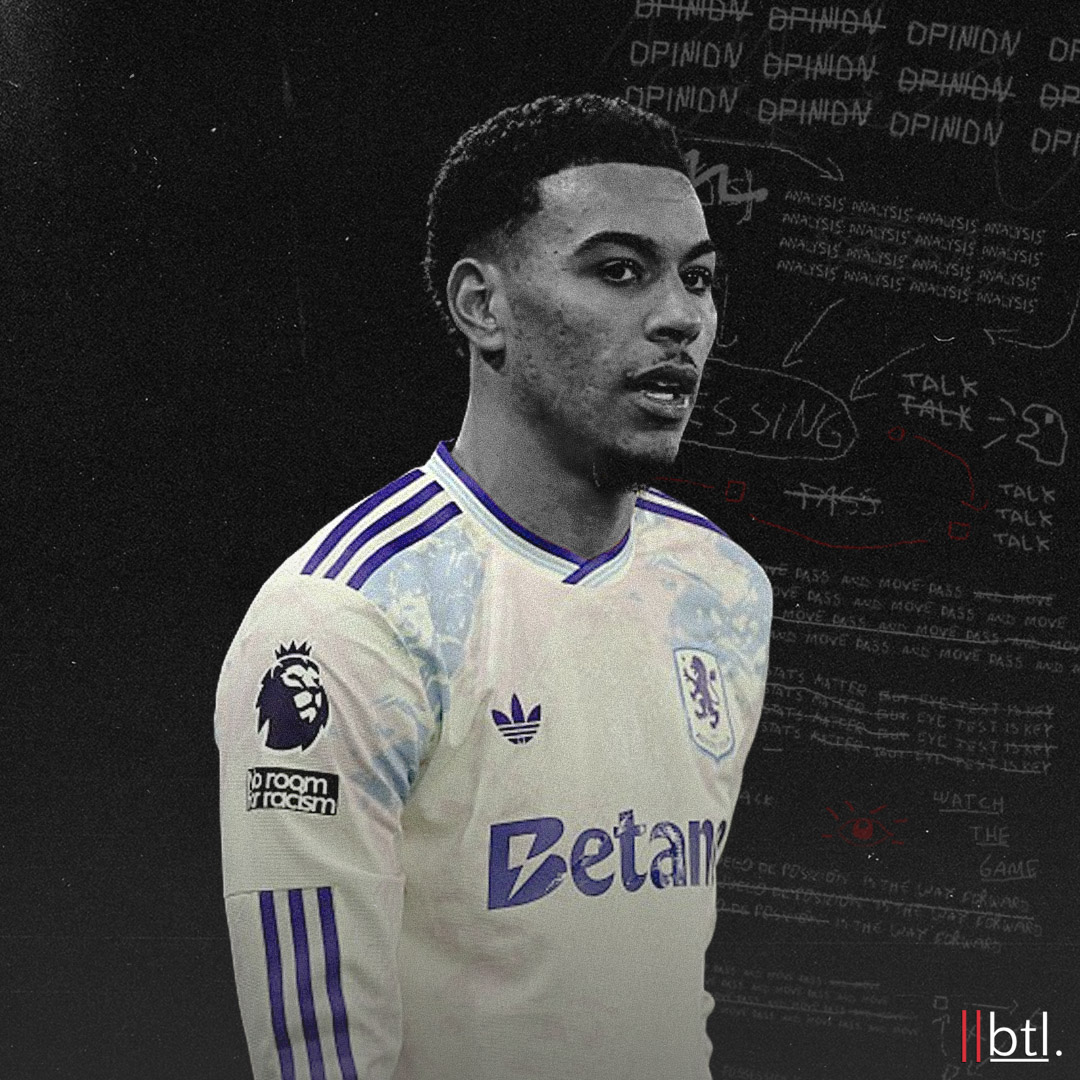
Morgan Rogers: The Unique Profile Redefining Aston Villa’s Forward Play
Morgan Rogers doesn’t fit neatly into any conventional attacking category, and that’s precisely what makes him such a fascinating proposition for Aston Villa. After 1,867 minutes in the 2025-26 Premier League season, the 23-year-old has emerged as one of the division’s most intriguing tactical puzzles, a player whose data tells a story of contradiction, but whose underlying qualities suggest a unique profile that Unai Emery is cleverly exploiting.
A Goal-Scoring Enigma
The most striking aspect of Rogers’ season is the interesting gap between his expected output and his actual returns. With 0.34 non-penalty goals per 90 minutes (86th percentile), he’s vastly outperforming his expected goals figure of just 0.16 npxG (45th percentile)—a +0.17 differential that places him in the 94th percentile for goal overperformance. This isn’t the profile of a player getting fortunate; it’s the signature of someone with genuinely elite finishing ability.
His goals-per-shot ratio of 0.18 (91st percentile) and 42.5% shots-on-target accuracy (82nd percentile) reveal clinical conversion that belies the modest volume of chances he generates. Rogers doesn’t need multiple opportunities; when he shoots, it matters.
Ian Maatsen: Aston Villa’s Versatile Fullback Destined for the Top
Rogers’ 0.41 goals per shot on target figure (74th percentile) suggests power and placement that goalkeepers struggle to handle—precisely what you’d expect from someone who, as observers note, generates powerful shots with minimal backlift.
However, his shot-creating actions sit at just 2.31 per 90 (21st percentile), and his npxG + xAG combined metric of 0.31 languishes in the 39th percentile. For an attacking midfielder or winger, these are puzzling numbers. Rogers isn’t creating chances at high volume, nor is he consistently finding dangerous positions. So what exactly is he doing?
The Carrier, Not the Creator
Frequently operating in the no.10, a position reserved for creators within a teams framework, Rogers applies his strengths to the role, rather than playing the last pass, more often than not he’s on the receiving end of those type of passes, leaving the passes the the deeper midfield players.
The answer lies in Rogers’ ball-carrying profile. With 2.36 progressive carries per 90 (39th percentile) and 80.60 meters of progressive carrying distance, he’s a player built to travel with the ball rather than distribute it. His 26.66 total carries per 90 (51st percentile) might seem modest, but the context matters: Rogers makes carries that penetrate defensive structures through sheer power and directness.
What’s notable is where these carries end up. He averages 4.10 touches in the attacking penalty area per 90 (61st percentile)—a respectable figure that speaks to his ability to arrive in dangerous zones. His 0.87 carries into the penalty area per 90 (41st percentile) combined with just 1.16 carries into the final third (14th percentile) paint a picture of a player who doesn’t dawdle in buildup zones. When Rogers gets the ball in midfield, he’s looking to drive diagonally into the box, not work combinations on the edge of the final third.
The through-ball statistics are particularly revealing: 0.67 per 90 minutes places him in the 93rd percentile. These aren’t the volume passes of a traditional creator, but rather the decisive, incisive balls that unlock defenses when Rogers identifies the right moment. Combined with his 1.40 passes into the penalty area per 90 (70th percentile), we see a player who may not attempt many passes, but who delivers them into the most dangerous zones when he does.
The Possession Trade-Off
Rogers’ passing numbers initially appear concerning: just 28.10 passes attempted per 90 (25th percentile) with a 71.9% completion rate (36th percentile). His total passing distance of 293.57 meters per 90 sits in the 21st percentile—extraordinarily low for an attacking player. Traditional metrics would flag these as significant weaknesses. But this misses the point entirely.
He isn’t trying to be a possession recycler or a midfield metronome. His 3.62 miscontrols per 90 (7th percentile) and 2.22 times dispossessed per 90 (11th percentile) might suggest poor technique, but more likely reflect a player constantly attempting high-difficulty actions. His 32.0% successful take-on rate (29th percentile) from 3.62 attempts (61st percentile) shows someone willing to take risks in congested areas, accepting failure as the price of occasionally creating something spectacular.
The key is what happens when Rogers receives the ball in dangerous areas. His 6.41 progressive passes received per 90 (48th percentile) indicates teammates recognize his ability to make things happen. More significantly, his goal-creating actions through take-ons (0.10 per 90, 83rd percentile) demonstrate that when he does beat his man, it often leads directly to goals.
The Defensive Reality
Rogers contributes modestly in the defensive phase—1.01 tackles per 90 (29th percentile), 0.43 interceptions (49th percentile), and just 1.45 combined tackles and interceptions (26th percentile). His 40.9% tackle success rate against dribblers (41st percentile) is functional but unremarkable. These aren’t numbers that scream defensive liability, but they confirm Rogers shouldn’t be relied upon as a primary ball-winner, and it tells a tale of tactical considerations and a room for improvement.
His 3.47 ball recoveries per 90 (32nd percentile) and positional discipline—with touches distributed across all thirds of the pitch—suggest intelligent positioning rather than aggressive pressing. He’s available to receive the ball after Villa regain possession, but he’s not the one forcing turnovers.
Tactical Deployment and Future Outlook
The assessment that Rogers functions best closer to goal, perhaps as the deeper member of a front two or as an inside forward with minimal creative responsibilities, is borne out by the data. His goal-scoring efficiency, diagonal carrying ability, and penetrative passing all suggest a player who should be positioned to *arrive* into dangerous spaces rather than being asked to orchestrate play from deeper positions.
Villa would be wise to utilize Rogers in roles where he can exploit the chaos of transitional moments and make late runs into the box. His 0.39 goal-creating actions per 90 (61st percentile)—better than his shot-creating actions percentile—indicates he’s more effective at the final moment than in the buildup. The 0.29 goal-creating actions from live-ball passes (74th percentile) suggests genuine playmaking quality when he does choose to pass in the final third.
His aerial presence is modest (0.63 aerials won per 90, 53rd percentile) but his physicality in carries and the power of his shooting suggest someone who can impose himself through strength and directness rather than technical finesse. The 18.90-meter average shot distance (30th percentile) confirms he’s getting close to goal before pulling the trigger—exactly what you want from a forward-minded midfielder.
Conclusion
Morgan Rogers represents a dying breed in modern football: the direct, goal-focused attacker who doesn’t particularly care about his pass completion statistics or his defensive actions per 90. In an era of hyper-specialized roles and possession-obsessed systems, Rogers is refreshingly straightforward.
If you give him the ball in the middle third, let him drive forward, and trust that when he shoots, something good will happen. His 0.53 goals plus assists per 90 (87th percentile) tells us the end product is there, even if the underlying process looks unconventional. For Aston Villa, the challenge is maximizing his strengths while minimizing situations where his limitations are exposed.
Deploy him as a penetrative runner who finishes attacks rather than constructs them, and Rogers could develop into one of the Premier League’s most effective, perhaps unorthodox, attacking threats. The data suggests a player still developing his all-around game, but one who has already mastered the most important skill in football: putting the ball in the net when it matters.
By: @free__flowing
Featured Image: @GabFoligno / Richard Pelham / Getty Images