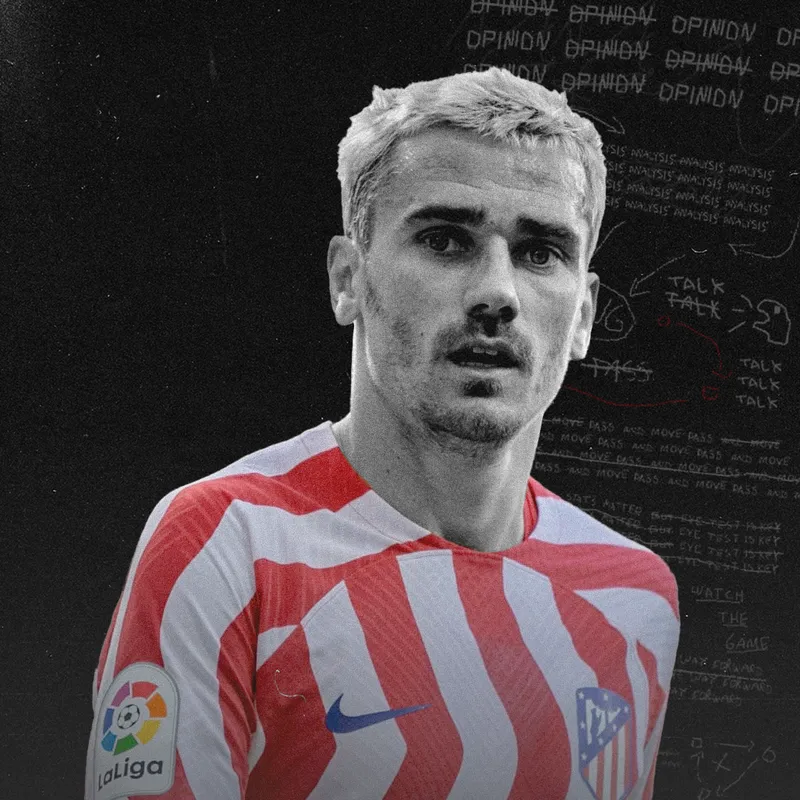
Atlético Madrid Without Griezmann: The End of Simeone’s Tactical Translator
Modern football can still manufacture stars. What it may never manufacture again is a player capable of translating an entire tactical universe. For most elite forwards, aging looks violent. The first thing to disappear is explosion. The…
Modern football can still manufacture stars. What it may never manufacture again is a player capable of translating an entire tactical universe.
For most elite forwards, aging looks violent. The first thing to disappear is explosion. The second is separation. Eventually, the spaces that once opened instinctively begin to close half a second earlier. The body slows down before the mind is emotionally prepared to accept it. Antoine Griezmann responded differently.
During the 2025–26 season, while the physical decline was increasingly visible, Griezmann evolved into something even more important than Atlético Madrid’s primary attacker. He became the team’s nervous system. His legs no longer dominated matches, so his mind started controlling them instead. That evolution is why his departure to Orlando City SC feels far larger than a normal transfer. Atlético Madrid are not simply losing a forward. They are losing the final translator of Diego Simeone’s football.
/@btl/the-ademola-lookman-effect-redefining-atletico-madrid-and-capturing-a-continent
The Evolution of Griezmann
The fascinating part of Griezmann’s career is that each phase of his football life feels like an entirely different player. At Real Sociedad and during his early Atlético years, he was a direct, explosive winger built on acceleration and verticality. He attacked fullbacks aggressively, hugged the touchline, and punished open space through raw speed. Simeone immediately recognized something more.
By the middle of Atlético’s peak years between 2016 and 2019, Griezmann had transformed into a complete second striker. He operated behind physical forwards like Diego Costa, feeding off second balls, launching counters, and functioning as both creator and finisher inside Atlético’s rigid 4-4-2 structure.
But the final version of Griezmann became the most fascinating. At 35 years old, he no longer survives through athletic superiority. He survives through interpretation. The 2025–26 version of Griezmann functions like a floating No. 8 disguised as a forward.
He drops into deep midfield zones to build play, manipulates pressing structures through positioning, and controls the emotional rhythm of matches through tempo regulation rather than physical domination. Young Griezmann reacted to space. Old Griezmann anticipates it. That cognitive trade-off defines his twilight years.
/@btl/giuliano-simeone-atleticos-rising-star-with-grit-and-flair
The Metronomic Quarterback
Statistically, Griezmann’s 2025–26 season does not initially look extraordinary. Across all competitions, he produced:
- 7 La Liga goals and 3 assists
- 2 Champions League goals and 3 assists
- 5 Copa del Rey goals
For most elite forwards, those numbers would suggest decline. But Griezmann stopped behaving like a normal forward years ago. The deeper statistical profile reveals the truth. Among European forwards, Griezmann ranked in the 99th percentile for touches. He averaged nearly 50 touches per 90 minutes, a ridiculous figure for an attacking player. His 84% pass completion rate reflected extreme composure despite constantly attempting progressive, line-breaking passes through pressure.
He ranked in the 97th percentile for shot-creating actions while simultaneously reducing his own shot volume. That trade-off matters. The younger Griezmann searched for finishing opportunities. The older Griezmann searches for structural control. Even physically, the adaptation became visible.
Griezmann averaged over seven kilometers covered per European match despite frequently being substituted around the 60th minute. The raw sprinting intensity declined, but his efficiency skyrocketed. He no longer wasted energy. Every movement carried tactical purpose.
The Invisible Details
To understand Griezmann in 2026, you have to stop watching the ball. The true masterpiece exists inside the invisible micro-details television cameras barely capture. Before receiving possession, Griezmann constantly scans away from the ball. He performs what Atlético staff privately describe as a “double-look” scan, checking the position of opposing midfielders before moving toward them intentionally.
Then comes the manipulation. He often steps toward defenders first, freezing their body orientation, before snapping backward into the space they just abandoned. Everything becomes deception. When operating in the left half-space, Griezmann frequently opens his hips toward the touchline, inviting defenders to anticipate a safe sideways pass. The instant their weight shifts wide, he slices a disguised vertical ball directly through the center.
Even his pauses became tactical weapons. During the Copa del Rey Final against Real Sociedad, Atlético were trapped inside a chaotic transition sequence. Griezmann collected a loose aerial clearance near his own defensive third while two opponents sprinted aggressively toward him. A younger player clears the danger immediately.
Griezmann stopped. He trapped the ball under the sole of his boot and stood completely still for two seconds. The defenders froze. The entire cadence of the pitch slowed down. That single pause allowed Atlético’s shape to reset before he calmly released possession to Rodrigo De Paul. Inside Atlético, they call it “La Pausa.” In reality, it is emotional control disguised as technique.
/@btl/julian-alvarez-to-atletico-madrid-the-start-of-the-protagonist-era
The Emotional Worker
Atlético Madrid supporters do not love players easily. The relationship between Griezmann and the club should have collapsed permanently in 2019 when he left for Barcelona. For Atlético fans, the betrayal felt symbolic. Their superstar had abandoned the struggle for glamour. When Griezmann returned in 2021, the reception was cold. But he rebuilt the relationship through suffering.
He did not ask for forgiveness publicly. He earned it physically. He slid into tackles against mid-table clubs. He tracked runners into his own penalty box. He accepted reduced status and a massive wage reduction simply to wear the shirt again. He chose the mud over the runway. That matters at Atlético. For a fan base emotionally built around suffering and resilience, Griezmann became the perfect embodiment of “Simeone-ismo.”
Modern football often treats defensive work as beneath elite attackers. Griezmann treated defensive sacrifice as part of artistic responsibility. He became a superstar willing to conduct anonymous labor. He possessed the vision of an artist while maintaining the mentality of a bricklayer.
/@btl/alexander-sorloth-the-norwegian-sharpshooter-headed-for-atletico-madrid
The Structural Brain
The most important thing about Griezmann’s final Atlético years is not what he produced individually. It is what disappeared whenever he left the pitch. Without Griezmann, Atlético Madrid immediately loses structural coherence. The build-up collapses first. When opponents press aggressively, Griezmann normally drops alongside Koke to create numerical superiority during the first phase.
Without Griezmann, a massive gap opens between Atlético’s midfield and attack. The result is panic football. Defenders stop progressing through midfield and begin launching desperate long balls toward Alexander Sørloth. The game transforms from controlled possession into aerial survival. Then the pressing structure collapses.
Griezmann dictates Atlético’s pressing triggers. He identifies which passing lane to close, which midfielder to isolate, and when the team should accelerate collectively. Without him, Atlético press emotionally instead of structurally. Players chase the ball individually. Passing lanes open. Compactness disappears.
The emotional void becomes equally obvious. During Atlético’s Champions League semi-final defeat against Arsenal, the absence of calmness became glaring once Griezmann’s physical stamina faded. Younger players began forcing actions. The game became frantic. That sequence captures Griezmann’s true value. He is not merely Atlético’s creator. He is the player responsible for translating Simeone’s emotional football into controllable structure.
/@btl/the-next-in-atletis-long-line-of-midfield-gems-pablo-barrios
The Match Scenes That Defined the Twilight
The final months of Griezmann’s Atlético career contained a series of tiny moments that perfectly explained his evolution. Against Barcelona in the Champions League quarter-final, Atlético struggled to escape an aggressive central press designed to suffocate Koke during build-up. Griezmann responded by dropping absurdly deep — almost into his own penalty area. The movement itself was bait.
The instant Barcelona’s midfielder stepped forward to follow him, Griezmann allowed the pass to roll through his legs untouched. That single decoy movement fractured Barcelona’s pressing structure and opened a clean central lane for Atlético to progress upfield. He manipulated pressure without touching the ball.
Against Athletic Club, he performed another invisible masterpiece. As Athletic overloaded Atlético’s left side, Griezmann sprinted diagonally toward the ball carrier. But he was never trying to tackle him. Instead, he used his body as a cover shadow, mechanically blocking the passing lane into midfield while never engaging physically. The hesitation forced Athletic backward.
Atlético’s shape recovered instantly. Even physically exhausted, his intelligence kept rescuing matches. During the second leg against Arsenal at the Emirates, Bukayo Saka broke through Atlético’s defensive structure and fired a dangerous cutback toward the six-yard box. While defenders focused on the ball, Griezmann recognized Declan Rice’s late arrival from midfield.
/@btl/robin-le-normand-analyzing-atletico-madrids-new-defender
At 35 years old, with visibly exhausted legs, he sprinted the length of the box and slid into a desperate interception that prevented a certain goal. His body was fading. His reading of football was not. But perhaps the most important moment came during his emotional farewell against Girona.
Pablo Barrios misplaced a simple pass under pressure, immediately triggering groans from a tense Metropolitano crowd desperate to protect a narrow lead. Griezmann abandoned his position and walked directly toward the young midfielder. He embraced him. Then he turned toward the stands, clapped emphatically, and pointed at himself. He publicly absorbed the pressure.
Instead of allowing the crowd’s anxiety to consume the younger player, Griezmann redirected the emotional burden onto himself. Minutes later, he assisted the winning goal. That sequence summarized his final Atlético version perfectly. Not merely a footballer. A stabilizer.
The Factory Model vs The Translator
Modern football increasingly produces specialists. Academies manufacture pressing forwards, ball-carrying wingers, possession midfielders, or isolated creators. The game is becoming hyper-specialized. Griezmann represents the collapse of those boundaries. On any given matchday, he functions simultaneously as: a No. 6 progressing possession, a No. 8 controlling tempo, a No. 10 creating chances, and a No. 9 attacking the box.
/@btl/johnny-cardoso-the-usmnt-midfielder-making-an-instant-impact-at-real-betis
Atlético surrounded him with runners like Rodrigo De Paul, Marcos Llorente, and Nahuel Molina because Griezmann no longer provided the physical engine. He provided the brain. That distinction explains why replacing him will be impossible. Atlético can buy goals. They can buy pressing intensity. They can buy progressive carries. But they cannot buy connective intelligence.
Modern scouting models will identify younger, faster, more explosive players. What they may never identify again is someone capable of translating an entire tactical system emotionally, structurally, and psychologically at the same time.
The Last Translator of Madrid
When Antoine Griezmann leaves Atlético Madrid this summer, European football does not simply lose an elite player. It loses one of the final links to a disappearing type of footballer. His greatness was never purely technical. It was interpretive. He solved football before other players even recognized the problem. He slowed chaos. He redirected emotion. He manipulated pressure.
He translated Simeone’s violent, emotional football into something sustainable enough to survive modern football’s tactical evolution. And perhaps that is why Atlético Madrid’s future suddenly feels so uncertain. The club can replace his production. It may never replace the player who taught the entire system how to breathe.
Credits
Words
Dhruv Kapoor