
Analyzing the Attacking Structures from AFCON 2025
The 2025 Africa Cup of Nations has been nothing short of absolute entertainment, with memorable moments already starting from day one. From Ayoub El Kaabi’s bicycle kick to Patson Daka’s backflip, to Mbekezeli Mbokazi hitting the crossbar with a shot that sounded like it destroyed the post from the halfway line, to Samuel Moutoussamy almost getting yellow-carded for refusing the stretcher, and many more. The exciting football has kept everyone on the edge of their seats, with only three matches, Zambia vs Mali, Ivory Coast vs Cameroon and Angola vs Egypt, ending in a draw.
However, for all the chaos, there has been a clear trend of teams looking to control their attacking structures and consistently generate chances from set positions. The one I’ve noticed the most has to be the 3-2-5 attacking shape. This structure gives you five attackers up front to stretch opposition backlines and keep them pinned back, two midfielders to help move the ball forward, create chances, shift possession across the pitch, and act as the first line of sweepers if the opposition tries to transition.
Lastly, it leaves three defenders at the back to provide defensive solidity and cover in case the first two lines are beaten. This works well as it provides width and usually outnumbers the opposition forwards 3v1 or 3v2, especially with bodies dropping deeper to support a low block.
How Morocco Shocked Portugal and Became the First African Team to Reach the World Cup Semifinals
This attacking structure saw Luis Enrique’s Paris Saint-Germain win the treble last season, including PSG’s first-ever UEFA Champions League title, capped off by a dominant display in the final where they thrashed Inter 5-0. Now we’re seeing it make its way into AFCON, with the likes of Morocco, Nigeria, Egypt, and even Benin using this structure in their opening fixtures, all with their own variations.
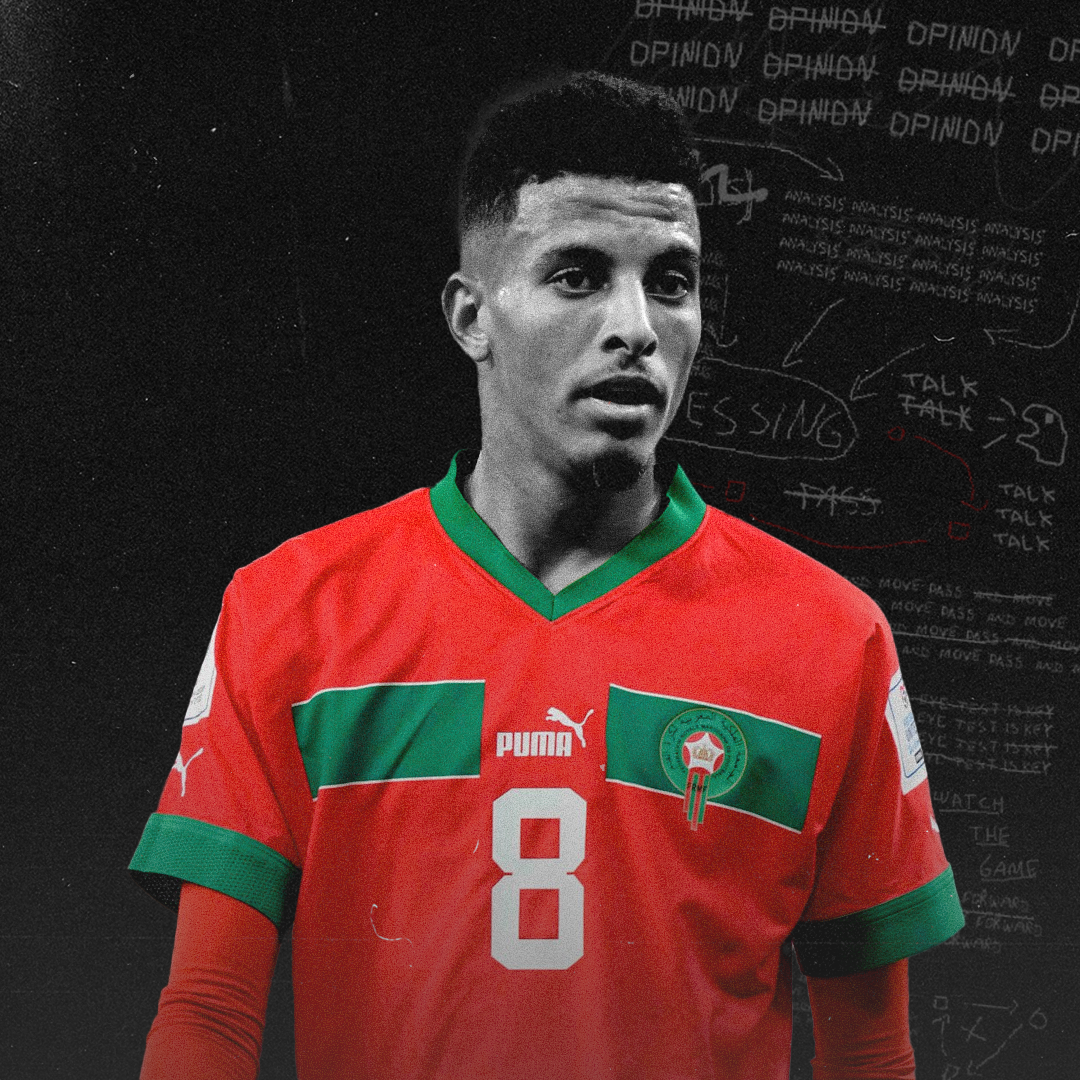
Firstly, I’d like to look at the opening match between Comoros and Morocco. On paper, Morocco deployed a 4-3-3, with both Brahim Díaz and Ismael Saibari starting in the front three. These are traditionally attacking midfielders, but they were deployed as wingers deliberately. Manager Walid Regragui looked to shift this into a 3-2-5 shape, with Sofyan Amrabat dropping into the backline and allowing the two centre-backs to cover wide areas, while the central midfielders stayed in position. This allowed the fullbacks to push high and provide width.
This caused major problems, especially on the right-hand side, where Brahim Díaz and Noussair Mazraoui routinely rotated to create issues. Brahim Díaz’s technical ability allowed him to attack the half-space and drive to the byline for cutbacks, which even saw him win a penalty in the first half. Alternatively, he could drift wide and whip in crosses, allowing Mazraoui to constantly switch between overlapping and underlapping runs. This movement led to Mazraoui delivering the cutback for Díaz to score Morocco’s first goal of the tournament.
Comoros were able to limit this threat somewhat due to their 5-4-1 low block and the fact that Morocco started with Soufiane Rahimi up front, who is more of a false nine than an out-and-out number nine. This meant that even when Morocco managed to get crosses in, of which they had around 30, they were mostly dealt with comfortably.
That changed with the introduction of Ayoub El Kaabi in the second half, who attacked the balls into the box and scored a spectacular bicycle kick for Morocco’s second goal. In summary, Morocco looked to attack the half-spaces and wide channels while maintaining a strong positional structure. Players largely kept their zonal roles, with some freedom to rotate, but without roaming completely freely.
If you want to see more fluidity within the system, Egypt is a better example. Both Mahmoud Trezeguet and Mohamed Salah are more natural wingers than attacking midfielders, and this led to a different approach in how Egypt controlled games. In Egypt’s match against Zimbabwe, they did get into a 3-2-5 attacking shape, but they applied different attacking principles.
Salah and Omar Marmoush looked to cross from wide areas whenever possible if the fullbacks inverted, but they also focused on cutting inside to get shots off. The fullbacks provided width, while the number 10, Emam Ashour, was tasked with occupying central spaces.
Zimbabwe, similar to Comoros, deployed a low block, but instead committed an extra body up front rather than in midfield, forming a 5-3-2 shape. This largely closed down space for Salah and Marmoush to get shots off, forcing Egypt to rely on crosses, which wasn’t ideal as Emam Ashour operates more as a false nine than a true striker.
You might not have expected Zimbabwe to pose such a threat going into this match, but the 5-3-2 played to their advantage. When they won the ball deep, they were able to launch it forward to two strikers who could support each other aerially, bring midfielders into play, and make runs in behind to push the Egyptian backline deeper.
As a result, this strategy created space for Zimbabwe’s midfielders, giving them a 3v2 advantage and allowing for quick transitions. It also saw Zimbabwe go into halftime leading after Prince Dube’s goal. Once again, the introduction of a physical number nine in Mostafa Mohamed helped Egypt. His presence allowed them to pose a consistent aerial threat and get crosses into the box from wide and deep areas.
This helped Egypt reach their attacking shape quicker and caused problems for the Zimbabwean backline, freeing space for Salah and Marmoush. Marmoush exploited this by running in behind from the left flank and blasting the ball into the roof of the net. The winner then came from a deep cross into Mostafa Mohamed, who won the aerial duel and laid the ball off for Salah, arriving centrally, to strike past the keeper and secure the win.
Nigeria arguably had the most interesting interpretation of the 3-2-5 shape. They played with three forwards up front in Ademola Lookman, Victor Osimhen, and Akor Adams, aiming to be direct when pinning the opposition back. Victor Osimhen and Akor Adams acted as constant runners to stretch and pin the backline, while Ademola Lookman found pockets of space to operate for the Super Eagles.
This worked well because the opposition couldn’t allow either Adams or Osimhen to run freely due to their pace and ability to exploit space in behind. Osimhen, in particular, is one of the best strikers in the world right now and not someone you want isolated one-on-one with your goalkeeper. The overall pace of the Nigerian attack caused major issues for the Tanzanian defence.
Alex Iwobi’s playmaking in this match was also excellent. He delivered a deep cross from a corner to find Semi Ajayi, who headed it past the keeper, and later played Lookman in for a one-on-one, which he converted for the winner. This made Iwobi only the second Nigerian player to register two assists in a single AFCON match since John Obi Mikel against Mali in February 2013.
Lastly, I want to look at the fixture between Congo and Benin. Benin used the 3-2-5 shape to pin Congo back but aimed to control the game without possession. This was evident from the opening kickoff, when Congo launched the ball deep into Benin’s half and pushed up to press immediately.
This has become a common trend in the Premier League, with teams like Crystal Palace, Newcastle, and Arsenal adopting similar approaches. As legendary manager Jürgen Klopp once said, “No playmaker in the world can be as good as a good counter-pressing situation.”
Teams use this tactic as a way of betting that their press is better than the opposition’s ability to play out. Congo consistently looked to draw Benin’s pressure and hurt them in transition, and this paid off. In the build-up to Congo’s goal, they retained possession from a set piece. Instead of Aaron Wan-Bissaka crossing from deep while Benin’s defence was still organised, he played the ball back to Arthur Masuaku, which caused Congo to drop slightly and bait Benin into pushing up.
This was exactly what Congo wanted, as it freed space for Masuaku to find Theo Bongonda running in behind. Bongonda found himself one-on-one with the keeper and finished to score the winner. Congo finished the match with 11 shots, three on target, created twice as many big chances as Benin, and did so with only 40% possession.
Overall, AFCON 2025 has been a tactically fascinating tournament. There’s still a lot I didn’t cover and plenty more to come, but Matchday One has already shown how tactically flexible teams are becoming. We’re seeing innovative ideas that allow underdogs to compete with bigger sides and give us the magical moments this tournament has produced for generations.
AFCON remains a uniquely entertaining competition, blending excitement off the pitch with action that consistently delivers on it. I’m genuinely excited for what’s to come and believe the tournament will only get better as it progresses.
By: Sekwila Mumba / Instagram: https://www.instagram.com/s3kwila
Featured Image: @GabFoligno / DeFodi Images