
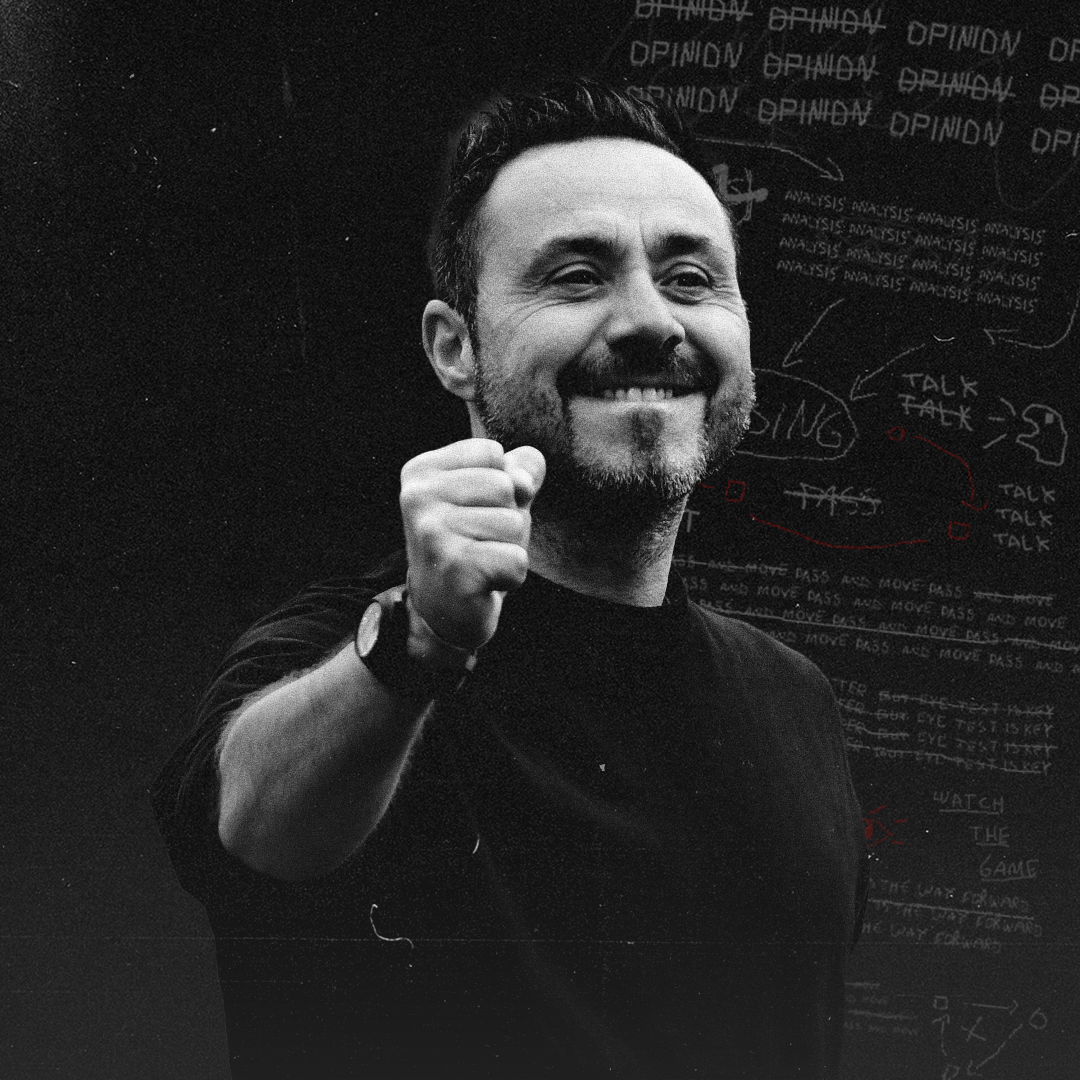
RobertoDe Zerbi: Sixteen, Seven Games, and the Refusal to Hurry
They tell us that in the beginning, there was a choice. A choice whispered through time, carried on the winds of myth, where gods watched and men trembled. A choice that stood before a boy named Achilles—glory without tomorrow, or tomorrow without glory. And he chose the fire. He chose the brief, blazing immortality of a name that would outlive his bones.
He chose to step toward the edge knowing the edge would one day step back. And somewhere, in the modern theatre of our game, another man has heard that same whisper. Not in armour, but in ideas. Not with a spear, but with a philosophy that hammers risk into something almost sacred.
Roberto De Zerbi has never been afraid of the flame. He has walked into fire before—Sassuolo, Brighton, Marseille—not to survive it, but to reshape it, to make disorder dance to his rhythm. But this feels different. Because this is not a project. This is not a climb. This is a fall waiting to happen.
Tottenham lie 16th. Seven games remain. Seven. And beneath them, the abyss does not whisper, it roars. This is not the promise of greatness. This is the threat of ruin. And still, he steps forward. Still, he chooses it. Because some men coach to avoid defeat. But a rare few—dangerous, defiant, almost mythological—coach to confront it. To dance with it. To stare into it long enough that it begins to blink first.
This is where the story should slow. Where caution should enter. Where reason should whisper: not now, not this. But Achilles did not turn back. And neither does De Zerbi. Because immortality, in football as in myth, is never given. It is taken—recklessly, beautifully, irreversibly. And sometimes it begins at 16th place.
The Tyranny of Urgency
There is a particular violence to relegation football.It is not always visible. It does not always explode into reckless tackles or desperate long balls. Sometimes, it lives quietly inside the players—in the way they receive the ball, in the way they release it, in the way they choose not to see what is in front of them.
Urgency becomes their master. Passes are played earlier than they should be. Runs are made before they are needed. Decisions are taken not because they are correct, but because they are immediate. The game speeds up. And in speeding up, it breaks. Because football, at its most essential level, is not about doing things quickly.
It is about doing things at the right time. And the closer a team moves toward relegation, the more that sense of timing dissolves into something frantic, something unstable, something almost desperate. This is the environment into which De Zerbi walks. A place where time is no longer a tool. But a threat.
Tottenham Hotspur’s Season of Conundrums: From High Hopes to Harsh Realities
The Man Who Does Not Hurry
What makes Roberto De Zerbi so unsettling—so provocative—is not simply that he plays out from the back, or that he invites pressure, or that he constructs elaborate positional structures designed to disorient opponents. It is that he refuses to hurry. In a sport increasingly obsessed with speed—faster transitions, faster decisions, faster executions—De Zerbi does something quite radical. He pauses.
His teams stand still when movement is expected. They delay when urgency demands action. They hold the ball not as an act of possession, but as an act of provocation. This is not hesitation. This is manipulation. Because in that pause, something begins to happen.
The opponent moves first. The opponent commits. The opponent reveals themselves. And in revealing themselves, they create the very space they were trying to deny. De Zerbi does not accelerate the game. He stretches it; creating time where none appears to exist.
Dominic Solanke to Tottenham: The Rebirth of One of England’s Finest Wonderkids
The Possibility That it Might
It’s tempting to assume that it rests on a particular reading of the problem—one that may not be entirely accurate. What makes this situation more complicated than it first appears is that the problem facing Tottenham Hotspur isn’t reducible to form, or confidence, or even quality in the usual sense. Those things matter, of course, but they don’t quite get at the underlying issue, which is structural in a less immediately visible way.
Their matches have developed a tendency to become stretched not just across the pitch but in timing, as if the game itself is slipping out of sync for them. You can see it in the way phases fail to connect. Possession doesn’t so much build as it dissolves.
A sequence begins with a degree of intention, but before it has time to take shape, it gives way to something else—usually a transition, often an uncontrolled one. Over the course of ninety minutes, this produces a kind of fragmentation, where the team is no longer operating as a coherent unit but as a series of loosely related responses to whatever has just happened.
This is the kind of environment in which struggling teams tend to suffer most, because it places a premium on isolated actions rather than collective organisation. When the game becomes a succession of moments rather than a continuous structure, the margin for error narrows, and those errors—inevitable, at this level—carry more weight. It’s not that Spurs are uniquely bad in these situations, but that they are repeatedly drawn into them.
Lucas Bergvall: The Swedish Wonderkid Headed for Tottenham Hotspur
The conventional response to this would be to simplify. Play earlier, play longer, reduce the number of decisions in sensitive areas. And there’s a certain logic to that, especially when confidence is low. But it doesn’t necessarily address the root of the problem, which is less about difficulty and more about timing. Players aren’t just making mistakes; they’re making them too quickly, before the situation has properly unfolded.
This is where Roberto De Zerbi’s approach begins to make a different kind of sense. His insistence on delaying progression—on holding possession, even under pressure—can be understood not as an added layer of complexity, but as a way of restoring continuity to the game. By extending possession phases, he effectively gives situations more time to develop, which in turn allows the team to remain connected for longer.
There are secondary effects to this. With more sustained possession, the distances between players tend to stabilise, simply because they are not constantly reacting to turnovers. Defensive organisation improves not through explicit instruction, but through the absence of repeated disruption. The game becomes, if not slower, then at least more manageable—less prone to the sudden swings that define transition-heavy matches.
It also changes the relationship with the opponent. Instead of reacting to pressure, the team begins to absorb it, which can have a subtle but important impact on how that pressure functions. Pressing relies on anticipation and timing; when the ball is held slightly longer than expected, those timings can be thrown off. The opponent commits, but not always in a coordinated way, and this can create openings that wouldn’t exist in a faster, more predictable sequence.
None of this eliminates risk. In fact, it probably introduces different kinds of risk, particularly in deeper areas of the pitch. But it does have the potential to redistribute that risk into situations that are at least structurally coherent. The game becomes less about surviving isolated moments and more about managing a continuous process.
And that, ultimately, is the point. Survival in this context isn’t just about improving performance in the abstract; it’s about shaping the conditions in which performance takes place. If Spurs can move even slightly in that direction—towards a game that feels more connected, more stable—then the margin between failure and survival may be narrower than it currently appears.
Redefinition of Pragmatism
We have been taught to understand pragmatism in a particular way. To be pragmatic is to reduce risk. To simplify. To abandon complexity in favour of clarity. But it’s possible that this understanding is incomplete. Because it assumes that risk is something external to be avoided, rather than something inherent to the game itself. And if risk cannot be removed—only displaced—then the question becomes less about whether to accept it, and more about how it is encountered.
From that perspective, pragmatism begins to look slightly different. Not as the elimination of complexity, but as a way of engaging with it more deliberately. A team might still simplify certain actions, but not out of fear—rather out of recognition, an awareness of where instability emerges and how it can be managed and used.
If Roberto De Zerbi keeps Tottenham Hotspur up playing this way, then something profound will have happened. It would suggest that, even in a context defined by urgency and constraint, a team is not compelled to abandon its ideas in order to survive. That adaptation does not have to mean simplification in the conventional sense, but can instead take the form of refinement, by adjusting the application of a principle without discarding it altogether.
In that case, survival would no longer be measured only by resistance, by what a team manages to avoid, but by how it chooses to confront what cannot be avoided. And in doing so, it will have changed what survival means.
Before Anything Has Happened
At the time of writing, none of this has actually occurred. No games have been played. No patterns have emerged. No conclusions can be drawn. Which makes all of this, in a sense, speculative. But football is full of these moments, points at which the outcome isn’t yet known, but the conditions are in place for something unusual to happen. Moments where the logic of the situation suggests one thing, but the presence of a particular idea introduces the possibility of another.
This might be one of those moments. Or it might not be. But if, over the course of the next seven games, a team that should feel rushed begins, instead, to look composed—then it won’t feel like a coincidence. It will feel like something that was already contained within the decision to make this appointment.
Because in the end, what De Zerbi brings isn’t just a style of play. It’s a different way of experiencing time. And in a situation where time feels like the problem, that might turn out to be the most practical thing of all.
By: Tobi Peter / @keepIT_tactical
Featured Image: @GabFoligno / Mike Hewitt / Getty Images