
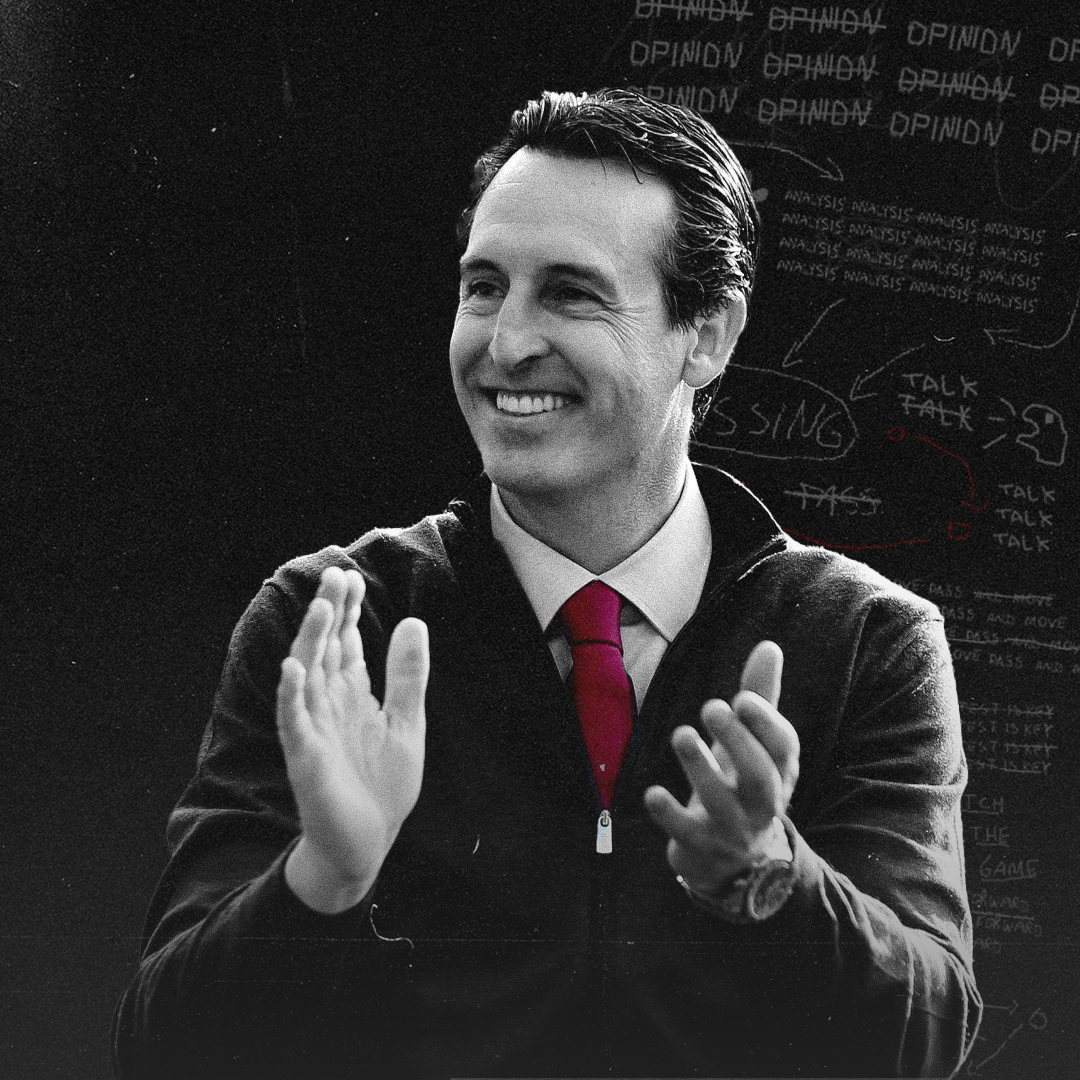
Unai Emery: The King of the Underdog Teams
The job of a coach, and soccer coaches in particular, is a nasty business to begin with. You are almost always guaranteed to lose. If you are successful, everyone wants you to be successful forever. If you fail, you will soon find yourself without a job. Coaches are often not credited enough for the team’s success and triumphs, but they are the first one to be blamed for their failures.
Coaches’ careers usually begin with small teams, and they climb the ladder to the bigger clubs. From that point there are two scenarios: they either find their glory in these clubs and stay in that realm of big teams for several years, or they fail miserably and go back to coaching smaller teams until they disappear.
But the story of Unai Emery fits a different scenario. From some reason, his forte was actually smaller football clubs, size and exposure wise. After a career-ending injury during the 2004-05 season, Emery began coaching Lorca Deportiva, a small team from the third division of Spain. At the end of the season, the team gained their first-ever promotion to the Second Division, where they almost gained a second promotion in a row, only to finish fifth and miss out by five points.
These achievements captured the eyes of other teams in the league, and Almería took the risk and signed him in 2007. Success followed him there too, and he helped Almería gain their first promotion too, but to the first division of Spain. During his debut season in the first division, Almería managed to secure an eighth-place finish, their highest ever position.
The next stop in Unai Emery’s career was the financially struggling Valencia , which he coached from 2008-2012. Despite the obstacles, during his four year spell at the club, Emery managed to restore a crown to its former glory, and bring Valencia to the top of the Spanish football. During this period, Valencia finished third in LaLiga three times in a row, falling beyond only to the great Real Madrid of José Mourinho and Cristiano Ronaldo, and Barcelona of Lionel Messi and Pep Guardiola.
At the end of the 2011-12 season, Unai Emery decided to find European glory, and he left Spain for the first time in his career. But he found the glory in a different way than expected. After a short and disappointing spell of six months with Spartak Moscow, Emery returned to coach Sevilla in Spain at the beginning of 2013, and coached the team for three and half years. Emery’s Sevilla managed to finish fifth twice, and seventh once in the Spanish league, but the major highlight of his time in Sevilla was the winning of three consecutive UEFA Europa League cups.
Inspired by his success, Paris Saint Germain (PSG) decided to sign him, as the coach of the team led by players like Angel Di María and Edinson Cavani, for two years in 2016. At the time, Unai Emery was known to be a coach that delivers success immediately, yet this time the script was different. PSG’s superstar team under Emery’s rule managed to finish only second in the league below Monaco, and in the European arena they become the only team in history to lose a 4-0 lead in the knockout stages of the Champions League, after losing 6-1 to Barcelona in an epic remontada.
Emiliano Martínez: The Goalkeeper Who Talks More Than He Saves (But Still Saves Everything)
PSG bounced back domestically, winning all four major trophies in France, but failed again in Europe afer losing in the UEFA Champions League Round of 16 to Real Madrid. Unai Emery decided to leave the club at the end of the 2017-18 season, and signed with Arsenal. Emery’s time in Arsenal was not so memorable or significant either. At the time, Arsenal was looking for a replacement to their legendary coach Arsène Wenger, who departed 22 years as the head coach of the team.
Emery had big shoes to fill, and unfortunately, he failed. Even though Emery has reached yet another UEFA Europa League Final, which was Arsenal’s first European final over 12 years, the team collapsed after losing 4-1 to London rivals Chelsea. It was worse in the league: despite an 11-game winning streak in the middle of the season, Arsenal managed to barely finish fifth due to a disappointing end to the season, and missed out a chance to play in the Champions League again.
The Basque coach was sacked at the beginning of the 2019-20 season after a streak of very poor results both domestically and in Europe, while playing unattractive style of football. After failing to leave his mark overseas, Emery decided to return to coach in Spain at Villarreal. Emery coached the team for two full seasons, in which he managed to finish twice in the seventh place of the Spanish league, and get Villarreal’s first major and European trophy in the form of his fourth UEFA Europa League title, making him the record holder for the most titles as a coach of this tournament.
He did even better the following year, leading Villarreal past Bayern Munich and Juventus and into the 2021/22 UEFA Champions League semifinals while demonstrating tactical discipline and impressive resilience. Eventually they lost to Liverpool 5-2 on aggregate, leaving the tournament with widespread acclaim for an amazing campaign.
In October 2022, Emery’s career took another turn as he was appointed as the head coach of Aston Villa. Aston Villa was sitting 16th in the Premier League when Emery arrived at Villa Park, a point from the relegation zone. From that point on, Aston Villa was a different team, winning 15 out of 25 games in the league, securing the seventh place and a spot at the UEFA Conference League in the following season, prompting Emery to be nominated for the Premier League Manager of the Year.
And yet, the best was ahead of both Aston Villa and Unai Emery. In the 2022-2023 season, the team reached the 4th place in the league, which secured the team Champions League football for the first time since the 1980s, whilst they also made it to the UEFA Conference League semifinals.
In the following seasons, Aston Villa managed to stay at the top half of the league, finishing sixth, while also getting to the quarter finals of the Champions League, losing to the eventual champions, PSG 5-4 on aggregate. Today, Emery has Aston Villa on course for yet another remarkable season. Villa currently sit third in the Premier League, three points behind the leaders Arsenal, and third in the UEFA Europa league, only due to inferior goal difference to Lyon and Midtjylland.
The obvious question to ask, after analyzing his career accomplishments, is why Emery succeeded in smaller teams like Aston Villa and Villarreal, but failed miserably in bigger clubs such as PSG and Arsenal. The answer for this question can be found in his tactics and style of coaching.
Unai Emery’s philosophy puts a lot of emphasis on the mental aspect of the game. He demands from his players to be mentally tough and have team spirit, where there is no room for star players, but rather a collective effort towards the achievement of the team goals. Emery is also known for being a perfectionist and demanding high standards from his players, putting a lot of effort towards positive communication with his players.
Emery is very meticulous in his planning for games, utilizing video analysis, and breaking down the opposition teams to the smallest details in order to identify potential weaknesses, and exploit them in the right moment of the game, while also tailoring systems to opponents and his squad strengths. As for the on-field tactics, Unai Emery has several principles he sticks with in every team he coaches.
One of his core principles is the idea of “Balance and Control” of the game, through compact and tight structures, such as defensive mid-blocks positioned in the opposition halves, or dynamic build-up from the back, that in turn will attract pressure that will expose the oppositions to swift counter attacks.
Emery also puts emphasis on tactical adaptability both defensively and offensively. His teams are known for having pragmatic attackers that can shot from distance in order to break compact defenses. Defensively speaking, he will often transition from high lines of pressure to mid-blocks in order to maintain control and balance of the midfield while frustrating his opponents.
Ian Maatsen: Aston Villa’s Versatile Fullback Destined for the Top
Lastly, Emery’s on-the-field tactics are marked by quick transitions from defense to offense, in order to create effective goal scoring opportunities and maintaining strong defensive shape. Emery’s tactical philosophy and principles works best with smaller clubs, and usually “underdog” teams, because his soccer style is more reactive rather than proactive, meaning his teams respond to the opponents rather than being actively creative.
When applying this style to teams like Arsenal and PSG, that aspire to be at the top all the time, it’s hard to achieve consistent success. Their football must be attractive, active, and creative to attract bigger crowds and stay at the top consistently, and winning league titles (something that Unai Emery produced once in his career with PSG), and the Champions League. Emery’s style of football is more effectively used in knockout tournaments such as the UEFA Europa League, where you can play reactive football, and win games with small margins, and advance through to the next rounds.
In league competitions, it is far more difficult to play and win consistently in all competitions using this type of style, because teams would need to have a longer rotation to preserve the players’ energy and avoid injuries, and playing for draws will not help you on the long run. Moreover, Emery’s system requires a longer period of time in order to be implemented fully, something that can be more easily achieved with smaller teams, since bigger clubs will usually have stressful environments with pressure from management, the players, and the fans to be successful from the first moment.
Unai Emery’s football style is exactly what smaller clubs need in order to restore their former glory and achieve it again over a long period of time, making him the king of the ‘smaller’ teams. Whilst he will ultimately be regarded as a failure at Arsenal and PSG, there’s no doubt whatsoever that he’s earned himself club icon status at quite a few stadiums — the latest of which is none other than Villa Park.
By: Ronen Bangiev
Featured Image: @GabFoligno / Barrington Coombs – PA Images