
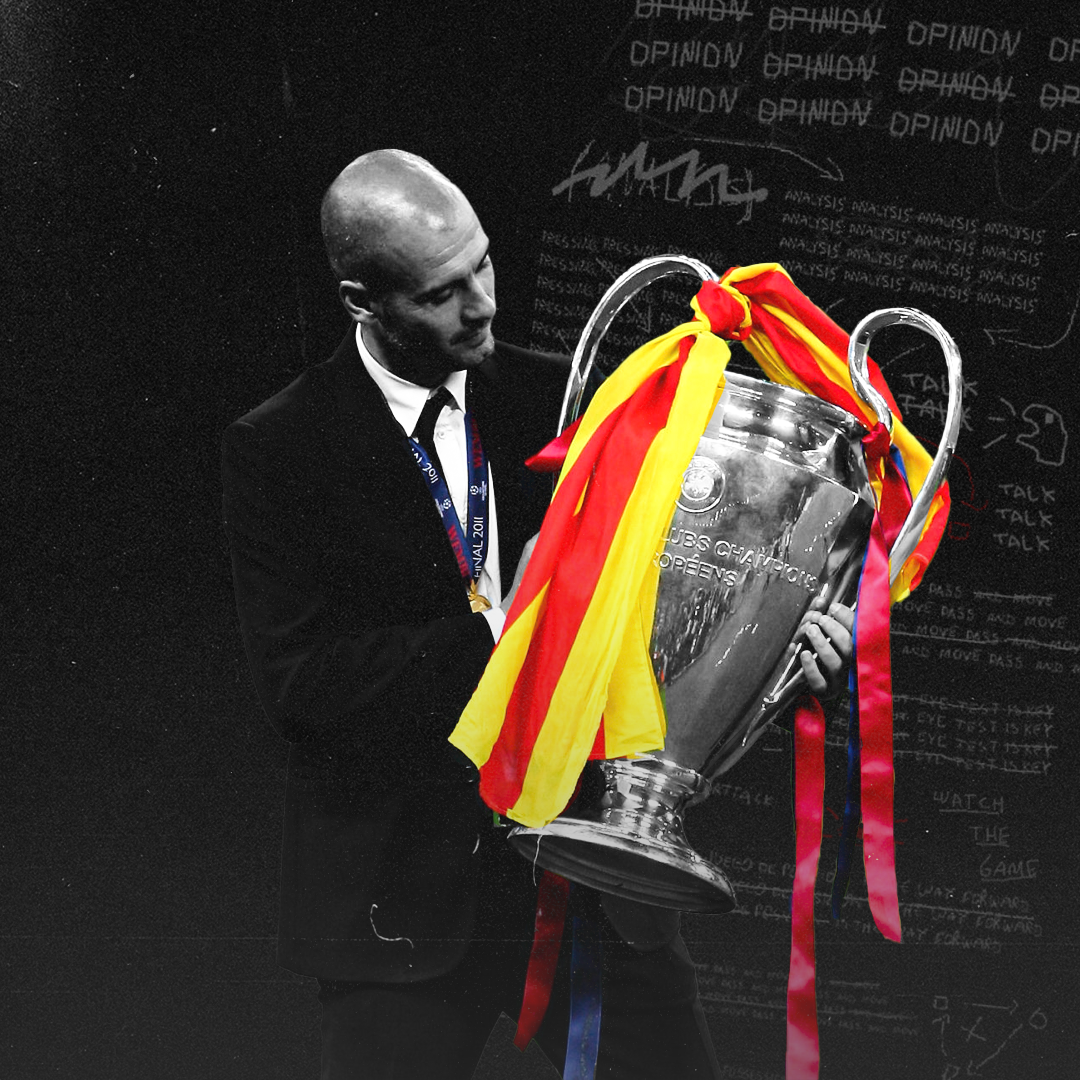
Pep Guardiola’s Barcelona: A Religion
On the second of May, 2009, at the Santiago Bernabéu, in front of eighty thousand people who had come expecting a contest and received instead a sermon, Barcelona beat Real Madrid six goals to two. The scoreline is the least interesting thing about what happened that night.
Real Madrid were not a bad team. They were not disorganised or unprepared or unfortunate. They had Sergio Ramos and Pepe and Iker Casillas. They had Arjen Robben and Gonzalo Higuaín and Raúl González. They had a manager in Juande Ramos who understood defensive structure and had spent the week building a specific plan for the specific problem Barcelona presented. They were, by any reasonable measure, one of the best teams in Europe at that moment.
Barcelona dismantled them so completely, so methodically, so almost cheerfully, that by the end of the evening the scoreline felt like an understatement. Not because the goals were so many, but because of what the goals represented. Each one arrived not as a moment of individual brilliance or fortunate circumstance but as the logical conclusion of a process.
A process so clear, so repeatable, so structurally inevitable that watching it felt less like watching a football match and more like watching a proof being demonstrated. A theorem being solved on a blackboard in front of a class that had not yet understood the mathematics involved.
The Bernabéu crowd understood before the final whistle. The silence that fell over the stadium in the second half was not the silence of shock. It was the silence of recognition. Of people encountering something so complete and so foreign to anything they had seen before that the usual responses, the jeers, the whistles, the desperate noise of a crowd trying to alter the momentum of a game, simply did not arrive. There was nothing to say. There was only the watching.
That silence was the moment Pep Guardiola’s Barcelona stopped being a football team and became something else entirely. It became a doctrine. A set of beliefs so fundamental, so non-negotiable, so total in their demands on every player who held them, that to play inside this system was not merely to follow instructions. It was to profess a faith.
The Scripture
Every religion begins with a text. A foundational document that contains the truth as it has been received and must be transmitted. For Guardiola’s Barcelona, that text was not written in the years between 2008 and 2012. It was written decades earlier, in the mind of a Dutch philosopher who arrived at Camp Nou in 1973 and looked at the club he had joined and saw not what it was but what it could be made to mean.
Johan Cruyff did not merely introduce a style of football to Barcelona. He introduced an epistemology. A way of knowing the game, of understanding what it was for, of answering the question that every football club must eventually answer: what are we trying to do when we play?
Most clubs answer that question pragmatically. We are trying to win. We are trying to score more goals than the opponent. We are trying to be hard to beat and dangerous in transition. These are reasonable answers. They produce reasonable football. They win trophies and lose trophies and leave no particular mark on the history of the game.
Cruyff’s answer was different. We are trying to control. Not to react but to dictate. Not to respond to what the opponent does but to impose a reality on the game so complete and so suffocating that the opponent’s intentions become irrelevant. We are trying to play football in which the outcome of the match is decided not by moments of individual quality or fortune but by the sustained, collective imposition of an idea.
That idea had a name. It had been developed at Ajax in the early 1970s and it would eventually be called Total Football, though that name does not quite capture what it was. Total Football suggests something about the players, about their ability to occupy any position, to interchange fluidly across the pitch.
What Cruyff was really building was something about the space. About the idea that a football pitch, properly understood, is not a contested territory where two teams fight for the same ground but a set of geometric relationships that can be manipulated, expanded, compressed, and exploited by a team that understands them deeply enough.
Tactical Analysis: Inter Milan 4-3 Barcelona (AET) UEFA Champions League Semi-Final, Second Leg
The ball, in this understanding, is not a means to an end. It is not something you use to create chances and score goals and win games. The ball is the instrument through which you impose your geometry on the opponent’s. You keep it not merely to prevent them from scoring but to force them into the positions that make your next action easier and their next action harder. Possession is not a tactic. It is a statement of intent. It is the visible expression of a belief about what football is.
Cruyff installed this belief at Barcelona. Not just in the first team but in the academy, La Masia, where children as young as seven were taught not how to kick a ball but how to think about where to put it. Where the first question was never can you do it? but should you do it here, in this moment, with the pitch in this shape? Where technique was always in service of cognition and cognition was always in service of the idea.
By the time Guardiola arrived as manager in 2008, the idea had been growing in the walls of the club for thirty-five years. It was in the language the players used to describe the game. It was in the instincts they had developed since childhood. It was in the specific way a La Masia graduate received the ball differently to a player developed anywhere else in the world, already turning to face the direction that the idea demanded, already scanning for the position the idea required.
Guardiola did not invent the religion. He became its most devout and most brilliant practitioner. The difference between what he inherited and what he built is the difference between a faith that is held privately and a faith that is lived publicly and completely, that shapes every decision and every action and every moment of every day, that becomes indistinguishable from the self.
The Congregation
A doctrine requires believers. And the specific believers Guardiola had at his disposal in the summer of 2008 were perhaps the most theologically prepared group of footballers any manager has ever inherited. Xavi Hernández had been at La Masia since he was eleven years old. He had been receiving the Cruyffian gospel since before he understood it as a gospel, absorbing it into his muscle memory and his decision-making at an age when the brain is most receptive to permanent instruction.
Arsenal vs PSG: A Study of Tactical Flexibility, Structure, and Exploitation
By the time Guardiola arrived, Xavi did not think about the idea. He was the idea. His passing was not a skill he deployed in service of a system. It was the physical expression of a philosophical position about what football is for. Every pass Xavi played was an argument. Every touch a proposition. He moved through a football pitch the way a theologian moves through a text, with the complete confidence of someone who has read it so many times that the meaning is no longer something they look for but something they simply carry.
Andrés Iniesta was something different and something complementary. Where Xavi was the doctrine made articulate, Iniesta was the doctrine made beautiful. He played football with a quality of touch that existed in a different sensory register to everyone else on the pitch. When Iniesta received the ball in a tight space, which he did constantly and deliberately, the ball seemed to adhere to his foot in a way that violated the normal relationship between a human being and a spherical object moving at speed.
He did not control the ball. He received it, the way you receive a word in a language you have spoken since birth, without translation, without processing, with pure and immediate understanding. And then there was Lionel Messi, who was, in the context of this religion, both the greatest of the faithful and a figure who complicated the theology simply by existing.
The doctrine demanded selflessness. It demanded the subordination of individual instinct to collective truth. It demanded that every player, in every moment, ask not what I can do here but what the idea requires here. For ten of the eleven players in Guardiola’s starting lineup, this was the work. This was what training was for. This was the daily discipline of a practising believer.
Messi was the exception that the doctrine could not fully contain and did not need to. Because what Messi did in those years was not contrary to the doctrine. It was the doctrine operating at a frequency so high that it became something the doctrine itself had not anticipated. When Messi received the ball and drifted inward from the right and made five defenders irrelevant in the space of three seconds, he was not breaking the rules of the system. He was expressing them at a level of intensity that the system’s original architects had not imagined possible.
Guardiola understood this instinctively. He did not try to contain Messi within the doctrine. He built the doctrine around Messi’s specific genius and then surrounded that genius with believers so complete and so technically gifted that the space Messi needed was always there, always created, always available, as if the pitch itself had been configured for him in advance.
The result was a team that functioned, in its best moments, as a single organism with eleven moving parts and one nervous system. A congregation so unified in its belief that the individual disappeared into the collective without losing anything. In which Xavi’s pass to Iniesta and Iniesta’s touch to Messi and Messi’s finish were not three separate actions by three separate players but one continuous expression of one continuous idea. This is what the Bernabéu saw that night in May 2009. Not six goals. One idea, expressed six times.
The Heretics
Every orthodoxy produces its heretics. Not because the heretics are wrong, necessarily, but because the existence of a total belief system creates the conditions for total opposition. You cannot have a doctrine without the possibility of apostasy. Real Madrid under José Mourinho, who arrived in the summer of 2010, were not merely opponents. They were a theological counter-argument. A deliberate, systematic, philosophically considered rejection of everything Guardiola’s Barcelona represented.
Mourinho understood the doctrine better than almost anyone outside the Camp Nou. He had worked under Louis Van Gaal and Bobby Robson. He had studied the idea from the inside. And what he concluded, having studied it, was that the idea was vulnerable in a specific and exploitable way. The doctrine depended on space. It depended on the opponent being drawn forward, being persuaded to engage, being encouraged to press high and thus leave the spaces behind their defensive line available for Barcelona’s movement.
Joan Garcia is the transformational signing Barcelona desperately needed
It depended, in other words, on the opponent doing something. On the opponent having an attacking intent that Barcelona could redirect and use. But what happened if the opponent did nothing? What happened if, instead of engaging, instead of trying to play, the opponent simply refused? Sat in two compact defensive lines, made themselves as narrow as possible, denied every passing lane into the central areas, and waited?
This was Mourinho’s answer to the doctrine. Not a counter-theology but a deliberate, aggressive negation of theology itself. His Real Madrid did not try to outpossess Barcelona. They did not try to press higher or move faster or find the technical solutions to the problems Barcelona set. They tried to make the problems irrelevant by refusing to acknowledge them.
The results of the four Clásicos in the 2010-11 season remain among the most intellectually fascinating fixtures in the history of the game, precisely because they were not really football matches. They were philosophical arguments conducted at high speed by very fit men. Guardiola’s side won the Champions League semifinal across two legs. Mourinho’s side won the Copa del Rey final. The league encounters were brutal and occasionally unwatchable, full of cynicism and tactical theatre and the specific kind of violence that attends every encounter between a total belief system and its most committed opponent.
What Mourinho proved, across those months, was not that the doctrine was wrong. He proved that it was human. That it could be frustrated. That it had limits. That a sufficiently organised, sufficiently committed, sufficiently cynical opposition could deny it expression, not every time, not forever, but often enough to matter. This was the first crack in the orthodoxy. Not a fracture. A hairline. But visible, for those looking closely enough.
The second crack came from within. Guardiola left in the summer of 2012. He did not leave because the doctrine had failed. He left, by his own account, because he was exhausted. Because maintaining the total belief, the daily discipline of a practising theologian, the relentless demand for perfection in every training session and every press conference and every tactical decision, had cost him something he could not replace in the short term. He needed silence. He needed distance. He needed, in his own words, to stop.
When the prophet walks away, the faith he leaves behind is never quite the same faith he carried. It is transmitted through intermediaries now, through people who believed deeply but who are not the source. And transmission always involves some loss. Some compression. Some simplification of what was, in the original, irreducibly complex.
The Reformation
Tito Vilanova, who had been Guardiola’s assistant for four years and who understood the doctrine as well as anyone alive, took over in 2012 and was diagnosed with cancer before his first season was complete. He won La Liga with a record 100 points. He did it playing the football Guardiola had built, with the believers Guardiola had shaped, in the system Guardiola had refined.
But there was already something different in the texture of it. A slight rigidity where there had been fluency. A slight hesitation where there had been automatic certainty. The doctrine was being followed rather than lived. Gerardo Martino arrived in 2013 and lasted one season. His Barcelona were recognisable as the same team but the recognition was uncomfortable, the way a cover version of a song you love is recognisable but wrong in ways you can hear but not always name.
Martino tried to introduce more directness, more verticality, more willingness to bypass the midfield and attack in behind. These were not heresies in the theological sense. They were pragmatic adaptations to a specific problem, the problem that opponents had by now spent four years studying the doctrine and developing partial answers to it. But the congregation noticed. The believers in the stands noticed. This was not the faith as it had been received.
Luis Enrique won the treble in 2015 with a Barcelona that had moved, consciously and deliberately, away from the strictest interpretation of the orthodoxy. The MSN attack, Messi, Luis Suárez, Neymar, was built on individual brilliance and the specific chemistry of three extraordinary attackers operating in close proximity. It was devastating and beautiful and it produced the treble. But it was not the doctrine. It was something new, something that used the doctrine’s infrastructure while quietly replacing its soul.
More Than a Club, More Than a Game: FC Barcelona, Kurdistan, and the Hope League
And then came the years that the faithful do not speak of easily. The years of Ernesto Valverde’s pragmatism, of Quique Setién’s confused attempt at revival, of the 8-2 against Bayern Munich in Lisbon in 2020, which was not merely a defeat but a public humiliation so total that it felt like a theological event. Like the moment a faith that has been quietly losing its adherents for years finally loses something it cannot recover.
The 8-2 was not a football result. It was a reckoning. A brutal, public demonstration of what happens when a doctrine is retained in language but abandoned in practice. When a club says the words of the faith without living the faith. When the scripture is quoted but the belief is gone.
The Roots That Remained
And yet. In the autumn of 2023, a seventeen-year-old boy began playing for Barcelona’s first team with a specific quality of touch and a specific manner of receiving the ball and a specific way of seeing the pitch that felt, to anyone who had watched the doctrine in its full expression, deeply and unmistakably familiar.
Lamine Yamal had been at La Masia since he was seven years old. He had been learning, since before he could fully understand what he was learning, the specific language that Cruyff had brought to that institution half a century earlier. The language of space and geometry and the ball as the instrument of a collective idea.
Navigating the Ups and Downs: Barcelona’s Season of Promise and Peril with Hansi Flick
Pedri González, born in 2002, a midfielder with a quality of temporal perception that Guardiola’s Xavi would have recognised immediately. He finds the pause inside the chaos. He receives in tight spaces and exits them without apparent difficulty, not because he is faster than the defenders around him but because he has already processed what they are about to do before they have decided to do it.
He is, in the truest sense, a product of the doctrine. A living proof that the scripture, however imperfectly transmitted across decades of managerial change and tactical drift and institutional crisis, retained enough of its original power to produce another generation of believers.
Pablo Paéz Gavi, before his injury, played with a ferocity and a directness that updated the doctrine for a generation that plays at higher intensity and shorter distances than Guardiola’s side did. Fermín López carries the same instinct into the final third. Pau Cubarsí, nineteen years old and already playing centre-back with a composure that belongs to a much older man, organises the defensive line with a positional intelligence that could only come from La Masia, from thirty-five years of teaching children not just how to play but how to think about where to be.
The doctrine was never in the trophies. Trophies are the visible evidence of something invisible. The doctrine is in the institution, in the walls of La Masia, in the coaching manuals and the training sessions and the conversations between youth coaches and eight-year-olds about why you should receive the ball facing forward and why you should always have three options before the ball arrives and why the space you occupy when you don’t have the ball matters as much as what you do when you do.
Cruyff put it there. Guardiola expressed it at a level of intensity and brilliance it had never reached before and may never reach again. And it survived both of them, the way a great faith survives its greatest prophets, not unchanged, not in the same form, but recognisably itself. Still present in the instincts of the players it produces. Still audible, for those who know how to listen, in every touch Pedri takes and every pass Yamal delivers and every position Cubarsí occupies.
What the Bernabéu Heard
There is a word in theology called kerygma. It means the proclamation. The announcement of the central truth of a faith to those who have not yet heard it. The moment when the doctrine goes public, when it ceases to be a private belief held by a small community and becomes a statement addressed to the world. The 6-2 at the Bernabéu was Barcelona’s kerygma. Not because it was Barça’s best performance under Guardiola, though it was extraordinary. Not because it was their most important result, though it mattered enormously to the title race. But because of where it happened and what it said to the people watching.
It happened in the cathedral of their greatest rival, on a night when the stakes were as high as a league match can produce, against a team that was organised and prepared and genuinely good. And Barcelona played the doctrine so completely, so without compromise or adaptation or pragmatic concession, that the result was not in doubt for most of the second half. The Bernabéu crowd went quiet. Not because their team was losing, though that was part of it. But because they were watching something that demanded a response beyond noise.
Something that asked to be understood rather than reacted to. Something that operated at a level where the usual currencies of football, the contested duels, the uncertain moments, the possibility that any individual action might change the trajectory of the game, simply did not apply. Eighty thousand people sat in something close to silence and watched a football team play football as if it were a form of prayer.
Marc Casado: The Latest La Masia Gem Making a Name for Himself at Barcelona
That is what a religion looks like when it is working. That is what Guardiola built. That is what Johan Cruyff began. That is what La Masia still teaches, imperfectly, incompletely, but recognisably, to every child who walks through its doors and learns to ask, before they ask anything else about what to do with a football: where should I be, and why, and what does the space around me make possible?
The doctrine is not dead. It never dies. Doctrines do not die. They get corrupted and diluted and argued over and occasionally abandoned by entire generations of practitioners. But they persist in the institution that holds them and the individuals who embody them and the moments when you watch a player from La Masia receive the ball in a tight space and turn into the correct corridor before any normal human being could have identified that the corridor existed.
Those moments are the doctrine speaking. Still, after everything. Still saying the same thing it said on the night of the second of May, 2009, in the silence of the Santiago Bernabéu, while the scoreboard read six to two and the crowd could find no words because the argument had already been won.
The ball is everything. The space is the game. The idea is larger than the players who carry it. And if you believe that, if you really believe it, all the way down, in your feet and your first touch and the direction you face when the ball is coming to you, then you do not merely play football. You practise a faith.
By: Shawal Hossain / @itadorinotyuji
Featured Image: @GabFoligno / Matthew Ashton