
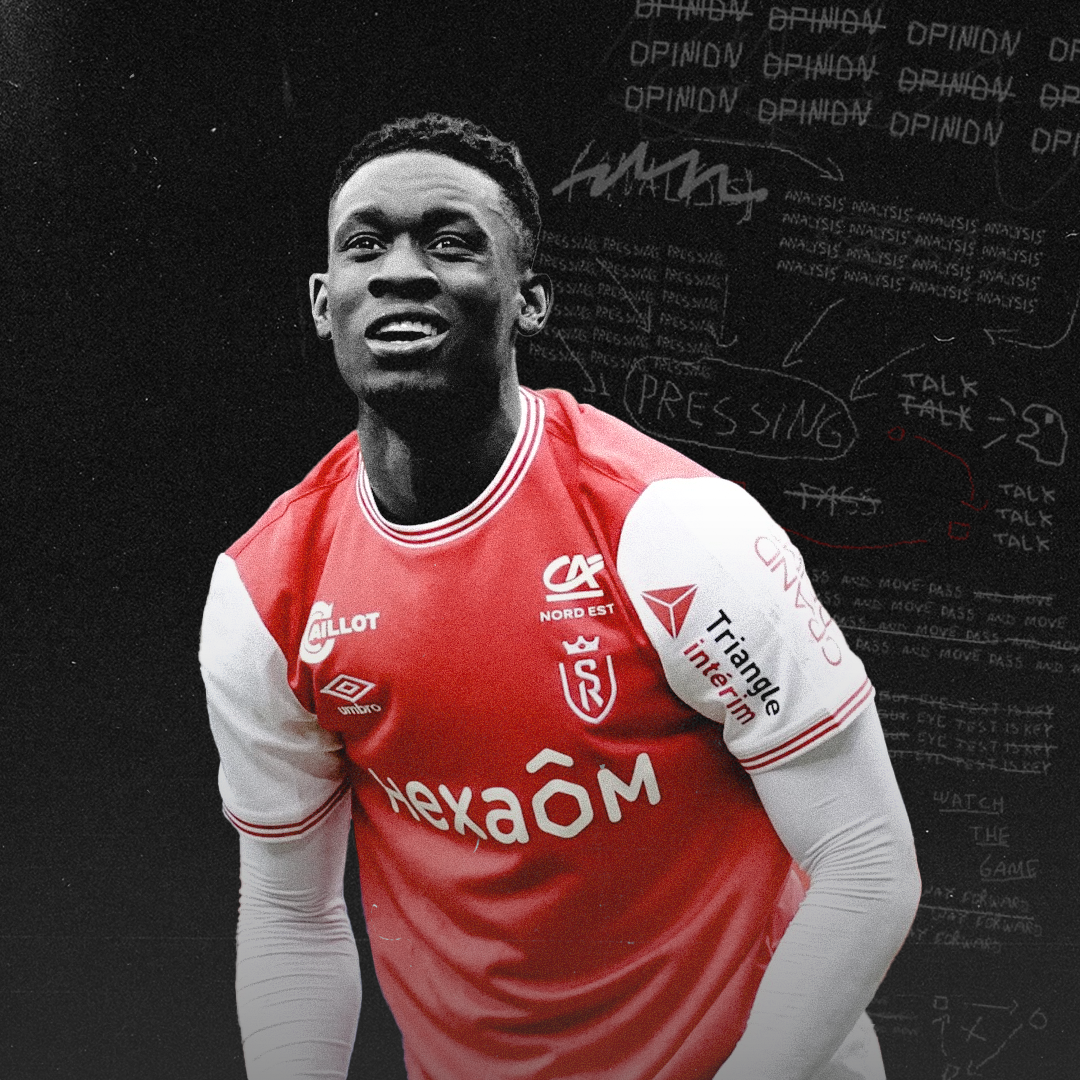
Folarin Balogun: Raised in The Hale End, Made for the USA
Folarin Balogun’s career has never really followed the easiest route. Born in Brooklyn, raised in London, and developed through Arsenal’s Hale End academy, his footballing identity has always had different influences pulling together. He came through in England, broke out in France, chose to represent the United States, and now finds himself as one of the more intriguing attacking pieces in the USMNT’s build towards a home World Cup.
That journey matters when looking at him as a player. Balogun has had to adapt quickly, whether that was leaving Arsenal for regular senior football, proving himself during his loan at Reims, moving permanently to Monaco, or stepping into international football with expectation attached. There is a clear theme running through his development: pressure, independence, and decision-making. For a striker, those are not just personality traits. They show up in the moments that decide games.
At his best, Balogun is not a static centre-forward who wants the game played into his feet for long spells. His strongest work comes on the last line, where he can test centre-backs with sharp movement, attack the space behind, and arrive in the box before defenders can fully adjust. He is a forward built around timing, separation and penalty-area instincts.
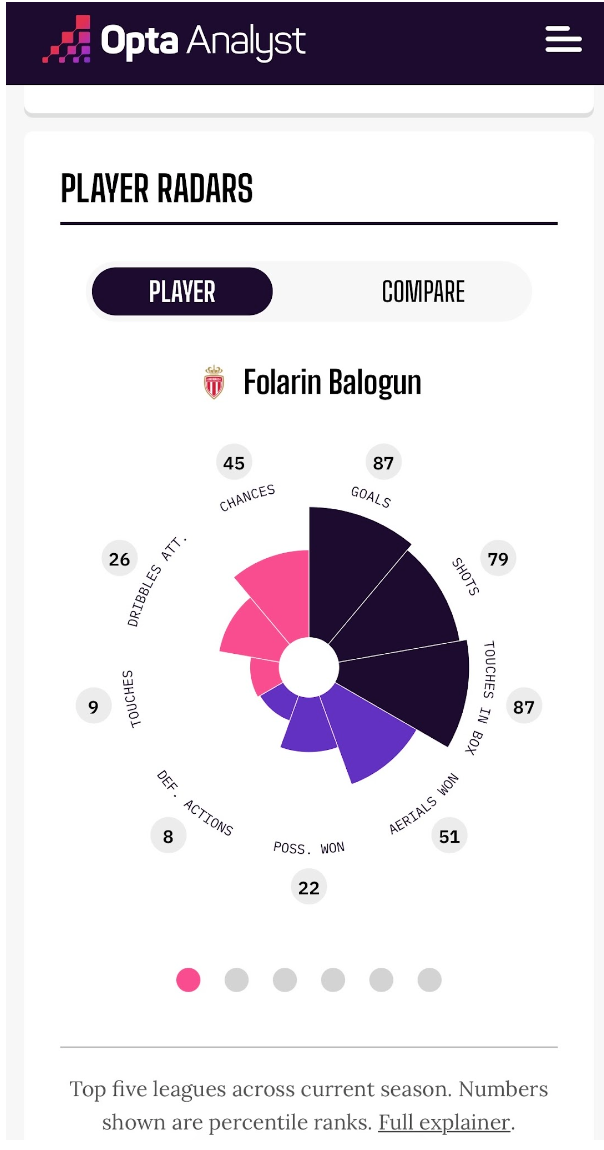
The numbers from his current-season Opta profile support that view. Balogun ranks in the 87th percentile for goals and touches in the box, while also sitting in the 79th percentile for shots. That gives a clear picture of his attacking value. He is not just drifting through games waiting for one moment. He is consistently getting into the areas where centre-forwards are judged.
Radar from Opta Analyst
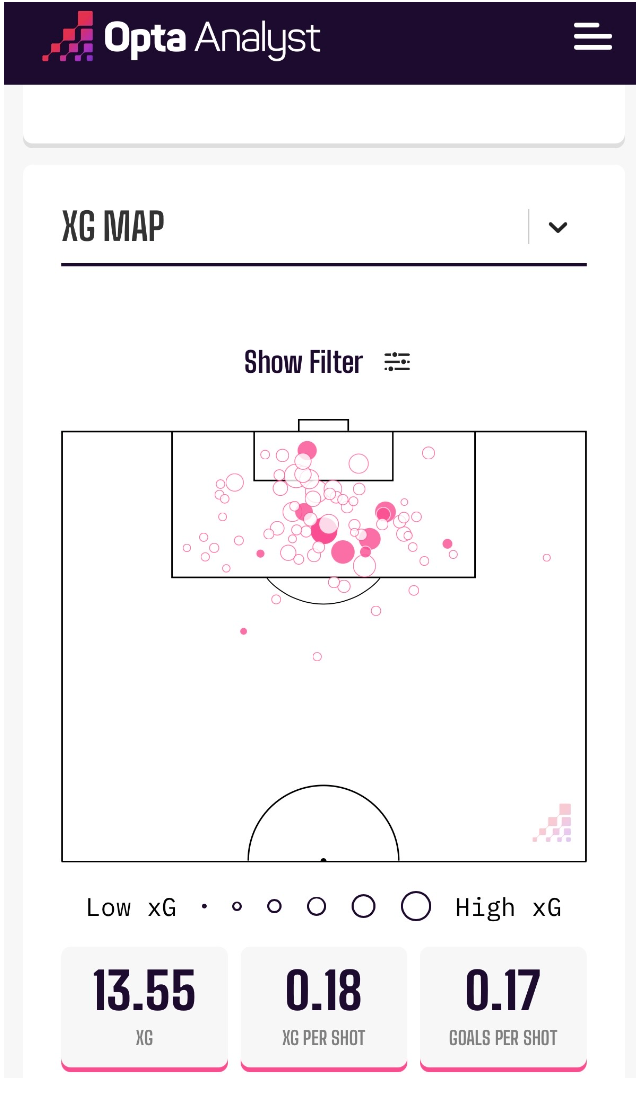
His xG map adds more detail to that picture. With 13.55 xG, 0.18 xG per shot and 0.17 goals per shot, Balogun’s shot profile suggests a striker who gets into valuable scoring positions rather than relying on hopeful efforts from distance. The majority of his chances are clustered centrally inside the box, particularly between the six-yard box and the penalty spot. That is usually the sign of a forward who understands where the ball is likely to arrive.
xG Shot map From Opta Analyst
This is where his movement becomes his biggest weapon. Balogun is good at playing on the blindside of centre-backs, staying out of their direct eye-line and adjusting his position as the ball moves across the pitch. When attacks develop in wide areas, he does not always attack the first ball straight away.
He can hold his run, drift away from the nearest defender and position himself for the cutback or second phase. Those details are important because they show a striker who is not just quick, but intelligent with how he uses that pace. He is especially dangerous when the game opens up. Balogun’s profile is naturally suited to transition football, where he can stretch the pitch, run into space and turn early forward passes into shooting opportunities.
Balogun’s pace allows him to threaten behind, but his timing is what makes those runs difficult to defend. He does not simply sprint in straight lines. He curves runs across defenders, attacks diagonal spaces and gives the passer a clear target between centre-back and full-back.
That transition threat has been one of the most consistent parts of his development. At Reims, much of his best work came from direct attacks, where he was used as the forward outlet for quick vertical passes. He could either chase the space himself, hold the ball long enough to bring runners into play or attack the final action. That remains a key part of his value for the USA, particularly in games where they may not dominate possession for long periods.
Promise, Pressure, and Pochettino: Between Optimism and Doubt, Where the USMNT Stands
There is also more to his game than just running behind. Balogun can move into wider channels, receive on the move and help attacks progress through the final third. He is comfortable drifting left, carrying into space and linking with supporting runners. He does not profile as a natural creative forward, but he has enough variety to avoid becoming one-dimensional. His 45th percentile ranking for chances created is not elite, but it does suggest he can contribute beyond simply finishing moves.
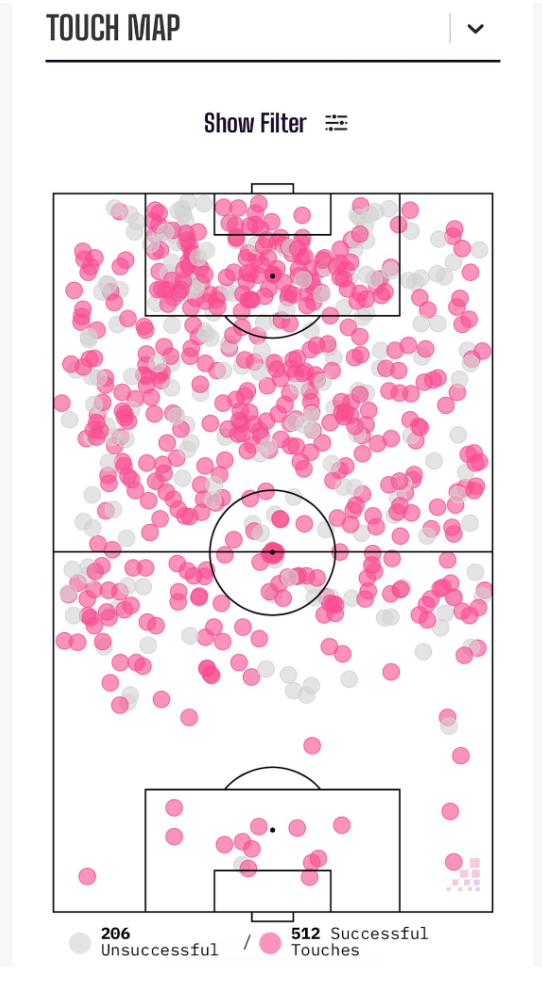
The touch map also shows a player who is involved across different zones of the pitch. His 512 successful touches compared with 206 unsuccessful touches point to a forward who gets regular involvement, but the location of those touches is the important part. He is active around the box, between the lines and in the channels, yet his best work still comes when he can turn that involvement into penalty-area actions.
Touch map from Opta Analyst
The main development point is his all-round link play. Balogun can combine quickly, play wall passes and use his body to hold off defenders, but he is not yet a complete back-to-goal striker. His passing can be uneven, especially when the game slows down and he has to connect play in tighter, more controlled possession. That is the area where he still needs to add more polish if he wants to become a top-level international number nine.
His radar reflects that balance. The attacking threat is clear: goals, shots and touches in the box all stand out. But the lower rankings for general touches, defensive actions and possession won show that his influence is still heavily weighted towards the final action. That is not necessarily a criticism. It simply frames what type of striker he currently is. Balogun is at his best when the team creates conditions for him to threaten the box, not when he is asked to be the main connector for every attack.
Aerially, he sits around the middle range, with a 51st percentile ranking for aerials won. That feels about right for his profile. He can compete, but he is not a dominant target man. His value is not built around backing into centre-backs and winning repeated direct balls. It comes from movement, timing and the ability to arrive onto chances before defenders can react.
For the USMNT, that makes him a particularly interesting forward. The USA have athleticism, wide threats and players who can attack quickly into space. Balogun fits naturally into that environment because he gives them a striker who can stretch the back line and occupy central defenders. His presence creates room for others, even when he is not directly involved in the final action.
The key question is how he continues to develop when opponents sit deeper. Against open defensive structures, his strengths are obvious. He can run channels, attack depth and turn transitions into high-value chances. Against compact blocks, the challenge becomes different. He has to be sharper with his first touch, cleaner in tight combinations and more consistent when receiving with his back to goal.
That next step will decide how high his ceiling is. Balogun already has the core ingredients of a dangerous modern striker: pace, movement, penalty-box instinct and a strong understanding of where chances are created. What he still needs is the extra layer of control that allows him to influence games when space is limited.
Even so, his current profile is highly valuable. Strikers who consistently get shots inside the box are difficult to find. Strikers who can also threaten in transition, stretch centre-backs and carry the pressure of decisive moments are even harder to replace. Balogun is not yet the finished article, but his strengths are clear and repeatable.
For the USA, he gives them something they need: a forward who lives in the most valuable areas of the pitch. His game is built on sharp movement, direct running and the ability to turn small windows into chances. As the World Cup approaches on home soil, Balogun does not just offer potential. He offers a defined attacking identity.
He is not just a striker who scores. He is a striker who constantly asks defenders uncomfortable questions. Can they hold the line? Can they track the blindside run? Can they stop him from arriving in the box? For a USMNT side looking for a reliable central threat, that may be exactly what makes him so important.
By: Declan Haywood / @Declan3013
Featured Image: @GabFoligno / FEP / Icon Sport