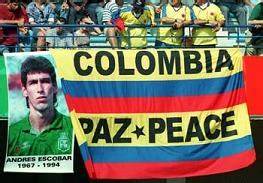
Colombia 1994: A dream that turned dark
Introduction
In the early 1990s, Colombian football stood at a rare moment of possibility. The national team was not merely competitive; it was widely regarded as one of the most technically gifted sides in world football. Their qualification campaign for the 1994 World Cup included a result that still carries symbolic weight in South American football: a 5–0 victory over Argentina in Buenos Aires. That performance, combined with a generation of players including Carlos Valderrama, Faustino Asprilla, Freddy Rincón and Andrés Escobar, created the belief that Colombia were not travelling to the tournament as outsiders, but as genuine contenders capable of challenging the traditional powers.
Yet within days of the tournament beginning, that promise had evaporated. The team that had dazzled South America looked hesitant and disjointed. Instead of mounting a serious challenge for the World Cup, Colombia failed to progress beyond the group stage, losing to Romania before a damaging defeat to the United States sealed their elimination. What had begun as a tournament of immense expectation ended in disbelief, with the defining image becoming not Valderrama's artistry or Asprilla's flair, but an own goal by Escobar that would take on a significance far beyond football.
Decades of underachievement before a flowering
For much of the twentieth century, Colombian football existed in the shadow of South America's established powers. While Brazil, Argentina and Uruguay amassed World Cup titles and forged global reputations, Colombia struggled to make a comparable impact. Qualification for the World Cup was an achievement in itself. The national team reached the finals for the first time in 1962, famously holding defending champions Brazil to a 4–4 draw, but it would be another 28 years before they returned to football's biggest stage. Their appearance in 1990 reflected a nation beginning to emerge from decades of relative obscurity rather than one with a long tradition of international success.
The signs of that emergence became unmistakable during the late 1980s and early 1990s. A remarkable generation of players matured together, combining technical excellence with an adventurous style of football that was both effective and entertaining. Carlos Valderrama became the team's creative heartbeat, his vision and composure complemented by the pace of Faustino Asprilla, the intelligence of Freddy Rincón and the calm authority of defender Andrés Escobar. Nicknamed El Caballero del Fútbol ("The Gentleman of Football"), Escobar was admired for his composure, sportsmanship and intelligence both on and off the pitch.
Under coach Francisco Maturana, Colombia developed an identity built on patient possession, movement and confidence on the ball, challenging many of the stereotypes associated with South American football.
The defining moment
The defining moment came on 5 September 1993 in Buenos Aires. Needing only a draw to qualify automatically for the 1994 World Cup, Colombia instead produced one of the greatest performances in South American football history, dismantling Argentina 5–0 in front of a stunned home crowd. It remains Argentina's heaviest home defeat in a competitive international match and transformed perceptions of the Colombian team overnight.
The performance attracted worldwide attention.
No longer viewed as talented outsiders, Colombia arrived at the World Cup in the United States carrying the weight of expectation. Some bookmakers ranked them among the favourites, while even Pelé predicted they could go all the way. For a nation that had spent decades looking up to its illustrious neighbours, Colombia had finally earned a place among football's elite.
The group stage
Colombia were drawn in Group A alongside Romania, hosts the United States and Switzerland. Although it was by no means an easy group, most observers expected them to progress comfortably to the knockout rounds.
Instead, the tournament unravelled almost immediately. Romania produced a disciplined and clinical display to secure a 3–1 victory in Colombia's opening match. Colombia looked nervous and unusually disjointed, a shadow of the confident side that had dazzled during qualification. The defeat transformed what had promised to be an impressive campaign into a precarious one, leaving little room for error.
Four days later, Colombia faced tournament hosts the United States at the Rose Bowl in Pasadena in a match they simply could not afford to lose. The Americans, largely dismissed before the tournament, played with discipline and intensity, while Colombia appeared weighed down by expectation. Midway through the first half came the defining moment. Attempting to intercept a dangerous cross from the left, Andrés Escobar stretched to clear the ball but instead diverted it beyond his own goalkeeper. The own goal gave the United States the lead, and although Colombia responded after a second American goal, they eventually lost 2–1. The defeat guaranteed their elimination before the final round of group matches.
A 2–0 victory over Switzerland in their final game offered only limited consolation. By then, the damage had already been done. A team that had travelled to the United States with genuine ambitions of lifting the World Cup finished bottom of the group after only three matches. The collapse was one of the tournament's greatest shocks, and in Colombia disappointment quickly gave way to recrimination and, ultimately, tragedy.
Returning home
The early exit triggered consequences that extended far beyond disappointed supporters.
When the squad returned home, the atmosphere was not simply one of heartbreak. It was tense, volatile and shaped by forces well beyond football itself. Players were reportedly advised not to go out alone. In some circles, where money and reputation were at stake, admiration quickly turned to anger.
A fateful night
Escobar returned to Medellín, a city where football, nightlife and criminal influence often overlapped in uneasy proximity.
On the night of his death, he was in a car park outside a nightclub. Although accounts differ in some details, they agree on the essentials. An argument broke out involving men linked to illegal gambling. Words were exchanged. Tempers flared. Then a gun was drawn.
Escobar was shot multiple times.
The gunman reportedly shouted "Goal!" after each shot, turning a footballing mistake into a grotesque symbol, as though events on the pitch had spilled over into real life.
He died shortly afterwards.
This was never just about football
The footballing failure was only the surface of a much deeper problem. Colombia's World Cup collapse took place within a country where sport, politics and organised crime frequently intersected. Football was not merely entertainment; it formed part of a wider social landscape shaped by influence, money and instability.
During the early 1990s, Colombia remained deeply affected by the power of the drug cartels, particularly in Medellín and Cali. While the national team represented hope and national pride on the international stage, the environment surrounding it was far more complex. Colombia's matches attracted enormous attention not only from supporters and the media, but also from illegal betting networks. Large sums of money were reportedly wagered on the team's World Cup campaign, meaning expectations extended well beyond sporting success.
There is, however, no evidence that Escobar was involved in match-fixing or that he deliberately scored the own goal. Nor has any proof emerged to support allegations that his murder formed part of a premeditated conspiracy.
Arrest and conviction
The gunman, Humberto Muñoz Castro, was arrested, tried and convicted of Escobar's murder. He received a 43-year prison sentence, although this was later reduced under Colombian law, and he was released after serving approximately 11 years.
At the time, Castro worked as a bodyguard and chauffeur for the powerful Gallón Henao brothers, wealthy businessmen with links to illegal gambling and criminal networks in Medellín. He was accompanying them on the night the confrontation with Escobar took place outside the nightclub.
The central unresolved question has always been whether Castro acted alone or on the instructions of others.
During the investigation, the Gallón Henao brothers were arrested on suspicion of involvement but were ultimately acquitted after prosecutors failed to produce sufficient evidence that they had ordered the killing. Consequently, the official legal conclusion remains that Muñoz Castro was the sole person criminally responsible.
Many journalists and historians remain unconvinced that the full truth ever emerged. Nevertheless, despite decades of scrutiny, no evidence has surfaced to justify further prosecutions.
The aftermath
For Colombian football, the impact was immense. Escobar's death became a national trauma and forced a painful reckoning with the relationship between football and organised crime.
Several members of the 1994 squad later spoke openly about the fear and pressure surrounding the tournament and its aftermath. Valderrama and Asprilla both reflected in later interviews that the tragedy fundamentally changed their understanding of representing their country. Football had ceased to be simply a game; failure, they realised, could carry consequences far beyond the pitch.
The tragedy also shaped how Colombia was viewed internationally. For many outside the country, Escobar's murder became synonymous with the violence associated with the Medellín and Cali cartels. Within Colombia, however, it came to symbolise the moment when football's relationship with criminal money reached its moral breaking point.
The last words
Perhaps it is fitting that the final words should belong to Escobar himself—a player who made an honest mistake during a football match and paid the ultimate price for it.
Shortly before his death, he wrote a newspaper column reflecting on Colombia's early World Cup exit, urging his fellow countrymen to reject both despair and anger. He concluded with the simple words:
"Life doesn't end here."
Author Bio:
Andy Dalziel is a sports author with extensive experience writing about the games, teams, rivalries, and stories that capture the imagination of global fans. He has published three non-fiction sports books, with the latest “Football and War” exploring how international football carries the weight of deeper historical tensions between nations.
More from Andrew Dalziel coming soon.
Visit the profile to follow and get notified when the next piece lands.