The 2026 World Cup: FIFA's Most Controversial Tournament Ever? led
Introduction
The dust will soon settle on the 2026 World Cup, and whilst it has produced some great moments, brilliant individual goals, and some fine performances and storylines, that may not be how it is remembered by historians.
Every FIFA World Cup has been controversial in some way. Since the tournament began in 1930, football’s greatest competition has rarely existed separately from the political, economic and social realities of the world around it.
The World Cup has been used as a symbol of national power, a stage for political messaging, a source of diplomatic tension and, increasingly, a global entertainment product worth billions of dollars. The question surrounding the 2026 tournament is not whether it has controversy—it clearly does—but whether it represents something unprecedented in FIFA’s history.
There is a strong argument that it does.
Not because it has the darkest political circumstances of any World Cup. That distinction belongs elsewhere. The 1934 and 1938 tournaments took place during the rise of European fascism. Argentina 1978 was held under a brutal military dictatorship, which saw political prisoners tortured hundreds of metres away from where matches were being held.
And the award of the tournament to Russia in 2018 and then Qatar in 2022 generated years of debate over human rights, labour conditions and the granting of hosting rights.
Rather, 2026 may be unique because the controversies have converged around FIFA itself.
The tournament has become a debate not only about where football is played, but about what FIFA has become: a sporting organisation, a political actor, a commercial giant, or all three at once.
Football as Political Theatre: Italy 1934 and France 1938
Any discussion of the most controversial World Cups must begin with the tournaments held before the Second World War.
The 1934 World Cup in Italy was the first edition in which football became unmistakably intertwined with state propaganda. Benito Mussolini’s fascist government understood the power of sport as a way to project national strength and political legitimacy.
The tournament was carefully presented as a demonstration of Italian modernity and organisation. Stadiums were built, infrastructure was improved and the competition became a showcase for the fascist state.
But the political influence went far beyond hosting.
The Italian national team was supported by a regime that viewed victory as a matter of national prestige. Players were recruited from overseas Italian communities, and questions have remained about the atmosphere surrounding several matches, particularly the quarter-final against Spain and the final against Czechoslovakia.
There has never been conclusive proof that Mussolini directly controlled refereeing decisions, but the context is impossible to ignore. The tournament was played in a country where political pressure was absolute and where football success was treated as a demonstration of ideological superiority.
The famous image of Mussolini’s Italy was not simply of a nation hosting the World Cup.
It was that of a regime using the World Cup.
The 1938 World Cup in France unfolded under an even darker shadow. Europe was moving towards war, Nazi Germany had annexed Austria, and the Austrian national team disappeared after being incorporated into the German side.
The tournament became another stage upon which authoritarian governments attempted to project power. Italy, again the champions, wore black shirts associated with fascism and performed fascist salutes during matches.
Within a year, Europe was at war.
The 1934 and 1938 tournaments remain among the clearest examples of football being used as a political instrument. If the measure of controversy is the extent to which a government exploited the World Cup, these tournaments are difficult to surpass.
From State Propaganda to FIFA Under Pressure
The controversies of 2026 are different.
The criticism is not that football has been captured by one authoritarian regime. Instead, it is that FIFA itself appears increasingly entangled with political relationships, commercial interests and the demands of the modern entertainment industry.
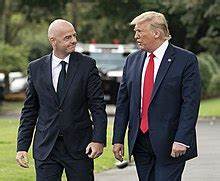
The most visible example has been FIFA president Gianni Infantino’s relationship with Donald Trump and the political environment surrounding the United States as a host nation.
FIFA has historically presented itself as politically neutral, often insisting that football should transcend national disputes. Yet critics argue that the organisation’s public closeness to political leaders has made that neutrality increasingly difficult to maintain.
The creation of a FIFA Peace Prize and its award to Trump became a particularly controversial moment last December. Supporters saw it as recognition of diplomatic efforts. However, critics reacted with something closer to moral repugnance, arguing that FIFA had appropriated the language of peace for a political figure whose record and rhetoric have been deeply polarising.
For many opponents, the issue was not merely that FIFA had entered political territory; it was that the organisation had chosen to associate football's global reputation with a figure whom they believed contradicted the values of tolerance, inclusion and international cooperation that FIFA frequently claims to represent.
The controversy exposed a deeper tension. FIFA has long insisted that football stands above politics and that the World Cup belongs to everyone. Critics argued that awarding such a symbolic honour to a controversial political leader made that claim increasingly difficult to sustain.
When Borders Interfere With Football
That question became even more significant when immigration issues affected tournament participation.
FIFA had repeatedly emphasised that the World Cup would be open to all qualified teams, officials and supporters. However, when Somali referee Omar Artan was denied entry to the United States, critics argued that FIFA had failed to protect one of its own officials.
The incident raised a fundamental question: how much control does FIFA actually have when its tournament meets national border policies?
For decades, FIFA has projected itself as a global organisation capable of bringing together countries otherwise divided by politics. Yet the 2026 tournament has demonstrated the limits of that influence.
The episode was significant not only because of the individual involved, but because it challenged FIFA’s promise that football could operate independently of political restrictions.
The Iranian Issue and the Limits of Neutrality
Similar questions emerged regarding Iran.
Relations between Iran and the United States have been tense for decades, and when those tensions erupted into outright military conflict earlier this year, the World Cup inevitably became affected by those broader geopolitical realities.
Questions around visas, supporters and the treatment of the Iranian delegation highlighted a recurring challenge for FIFA: it promotes football as a universal language, but it operates within a world of governments, sanctions and diplomatic conflicts.
Critics argued that FIFA needed to do more to ensure that political disputes did not determine who could fully participate in football’s biggest tournament.
Supporters of FIFA would respond that the organisation cannot override national laws and international diplomacy.
That tension sits at the heart of the 2026 controversy.
The Commercial World Cup
Perhaps the biggest criticism of 2026 concerns not politics but commercialisation.
Football has always been a business. The World Cup has always attracted sponsors, broadcasters and enormous financial investment.
However, many supporters believe FIFA has moved into a new era where entertainment and revenue increasingly influence decisions traditionally governed by footballing culture.
The introduction of hydration breaks during matches was justified by player welfare concerns, particularly given the conditions in North American summer temperatures.
Few questioned the medical reasoning.
The controversy came from what happened around those breaks, with critics arguing that they increasingly resembled television advertising opportunities as much as sporting necessities.
The debate became even louder with plans for a major halftime entertainment show during the World Cup final.
To some supporters, this represents harmless modernisation. To others, it symbolises a fundamental change in football’s identity.
The World Cup final has traditionally been built around the drama of the match itself. Extending the interval to create a Super Bowl-style spectacle suggests, to critics, that FIFA is adapting football to the demands of global entertainment rather than protecting football’s traditions.
And the fact that the planned break of 30 minutes is twice as long as that currently permitted by the laws of a game points to an organisation hell bent on breaking its own rules.
Pricing the Fans Out
Ticket prices have added another layer of criticism.
The World Cup has never been inexpensive to attend, but many supporters believe 2026 has accelerated a trend towards treating the tournament as a premium product rather than a global celebration.
Dynamic pricing and extremely expensive tickets for the biggest matches have fuelled concerns that ordinary fans are being replaced by corporate guests and wealthy spectators.
The argument is not simply about money.
It is about ownership.
The World Cup has historically been powerful because supporters from every background could feel that it belonged to them. If attending becomes realistic only for the wealthiest fans, the tournament risks losing part of its cultural meaning.
How Does 2026 Compare With History?
Describing 2026 as the most controversial World Cup ever is a contentious call.
If the standard is political exploitation, the 1934 and 1938 tournaments are more extreme. Football was used directly by fascist regimes as propaganda.
If the standard is human rights concerns, Argentina 1978 and Qatar 2022 remain stronger examples. Argentina hosted while thousands disappeared under military rule, while Qatar faced years of criticism over labour conditions, social restrictions and questions surrounding the bidding process.
But 2026 occupies a different category.
Its controversy is not centred on one regime, one human rights issue or one hosting decision.
It is a collection of controversies that repeatedly return to FIFA’s own choices.
That makes it unusual.
The World Cup That Became About FIFA
The strongest argument, therefore, is not that 2026 is the darkest World Cup in history.
It is that it may be the most controversial World Cup of FIFA’s modern commercial era.
The organisation has become the subject of the tournament’s biggest debates: its political relationships, its handling of access and participation, its approach to broadcasting, its relationship with supporters and its willingness to reshape football for global audiences.
The football itself may eventually be remembered for great matches, unexpected results and sporting achievements.
But the wider story of 2026 may be about something else.
It may be remembered as the moment when FIFA stopped being merely the organiser of the World Cup and became the central character in the debate surrounding it.
The 1930s showed the danger of football being used by states.
Argentina 1978 showed the consequences of ignoring authoritarianism.
Qatar 2022 showed the risks of controversial hosting decisions.
The question raised by 2026 is different.
Has FIFA itself become too powerful, too political and too commercial for the game it governs?
That may ultimately be the defining controversy of this World Cup.
Author Bio:
Andy Dalziel is a sports author with extensive experience writing about the games, teams, rivalries, and stories that capture the imagination of global fans. He has published three non-fiction sports books, with the latest “Football and War” exploring how international football carries the weight of deeper historical tensions between nations.
More from Andrew Dalziel coming soon.
Visit the profile to follow and get notified when the next piece lands.