The headbutt that defined a World Cup final - and career
Introduction
Few moments in football history have become as instantly recognisable as Zinedine Zidane’s headbutt on Marco Materazzi during the 2006 FIFA World Cup Final. It lasted only a few seconds, but it changed the atmosphere of the biggest match in international football, overshadowed one of the greatest players of his generation’s final appearance, and became one of the most debated incidents in sporting history.
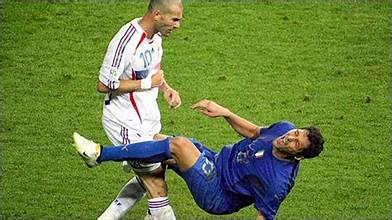
The image of Zidane walking away from Materazzi after striking him with a headbutt remains one of the defining pictures of the modern World Cup. It represented a dramatic collision between brilliance and controversy: a legendary player producing moments of extraordinary skill while also displaying a flash of anger that would follow him long after his playing career ended.
For Zidane, it was supposed to be the perfect ending to an extraordinary career. Instead, it became a night remembered as much for his loss of control as for his achievements.
A glittering career
By the time of the 2006 World Cup, Zinedine Zidane was already considered one of football’s greatest artists. His elegant style, exceptional vision, and ability to control the rhythm of a match had made him a global icon. He had won the World Cup with France in 1998, scored twice in the final against Brazil, and achieved success at club level with teams such as Juventus and Real Madrid, whilst he had a string of glittering awards to his name.
However, entering the tournament in Germany, Zidane was nearing the end of his career. He had announced that the World Cup would be his final professional appearance. Many believed that France’s chances depended heavily on whether their captain could rediscover the magic that had defined his career.
Early in the tournament, France struggled. But, as the knockout stages arrived, Zidane appeared transformed. He delivered outstanding performances against Spain and Brazil, creating chances, controlling games, and reminding, once again, the rest of world why he had been regarded as one of football’s finest talents.
The semifinal victory over Portugal placed France into the final, where they would face Italy. For Zidane, the match represented the final chapter of a remarkable international career. A victory would have provided a fairytale ending: lifting the World Cup trophy as captain before retiring from football.
Instead, the final became remembered for a completely different reason.
The final
The final against Italy at the Olympiastadion in Berlin was a tense and closely fought contest. France took the lead early when Zidane converted a penalty, but Italy responded through defender Marco Materazzi, who equalised with a powerful header.
The match remained level after 90 minutes and moved into extra time. Both teams had chances, but neither could find a winning goal. The pressure increased as the possibility of a penalty shootout approached. But then in the 110th minute, almost out of the blue, an incident occurred that shook the world.
After an exchange of words between Zidane and Materazzi, Zidane suddenly turned and drove his head into Materazzi’s chest. The Italian defender fell to the ground, and play stopped. After consulting with his officials, referee Horacio Elizondo showed Zidane a red card.
The French captain walked past the World Cup trophy on his way off the pitch. It was a symbolic and heartbreaking image: one of football’s greatest players leaving the field during the most important match of his career.
France eventually lost the final on penalties, with Italy winning their fourth World Cup title. But the controversy surrounding Zidane’s dismissal dominated discussions around the match.
What was said between the pair
Immediately after the incident, much of the attention focused on what Materazzi had said to provoke Zidane. Although he admitted that the Italian defender’s words played a role in his reaction he has never said explicitly the exact nature of what was said to him.
Instead it has been left to conjecture and urban legend to fill in the gaps. Early reports claimed that Materazzi had insulted Zidane’s mother, who was ill at the time. There were also suggestions that he had referred to Zidane’s sister.
Materazzi later revealed that he had insulted Zidane, although he denied that the comments were related to Zidane’s family or religion, as some early reports suggested. He explained that the exchange was a typical heated moment between players during a match, though he acknowledged that his words were inappropriate.
Although the two men had faced each other before at club level, mainly during Zidane’s time at Real Madrid and Materazzi’s time at Inter Milan, there was no famous feud between them. They were not known to have a long-running dispute, personal dislike, or history of serious confrontations.
And they did not even share the same language. Zidane is of French-Algerian descent and primarily spoke French, whilst Materazzi’s native language is Italian.
However, both played at the highest level of European football and would have understood common football insults, gestures, and phrases, even without being fluent in each other’s language. Materazzii later suggested the exchange was understood between them despite the language difference.
A Moment That Changed Zidane’s Legacy
Before the headbutt, Zidane’s career had been defined by greatness. He was admired for his intelligence, creativity, and ability to produce unforgettable moments on the biggest stages. The incident did not erase those achievements, but it became permanently attached to his public image.
For some fans, the headbutt represented a tragic flaw in a brilliant player: a moment where emotion overcame discipline. For others, it showed the human side of an athlete who had carried enormous pressure for years.
Zidane’s career had always contained moments of controversy. He had received red cards before, including during his club career, but was not known as a violent player. But because the headbutt happened in a World Cup Final, with millions watching around the world, it became something far larger than a normal football incident.
The contrast made it even more memorable. Zidane had been dominating the tournament and appeared ready to end his career as a hero. Instead, his final competitive act as a player was one of aggression and regret.
The Cultural Impact of the Headbutt
The Zidane headbutt quickly moved beyond football. It became a symbol used in advertising, comedy, art, and discussions about anger and pressure. The image appeared everywhere, from television programmes to internet culture, and it became one of the most recognisable sporting moments of the 21st century.
Part of the reason it remained so powerful was its simplicity. Anyone could understand the image: a famous player, the biggest match in the world, an unexpected act of violence, and a career-defining consequence.
It also created conversations about the psychological demands placed on elite athletes. Footballers are expected to perform under extraordinary pressure while remaining calm in situations filled with physical contact, verbal provocation, and intense emotion. Zidane’s reaction showed how even the most experienced professionals can have moments of vulnerability.
Zidane’s Response and Life After Football
After retiring as a player, Zidane moved into coaching and eventually became one of the most successful managers in football. His achievements with Real Madrid, including three consecutive UEFA Champions League titles, helped reshape the way many viewed his legacy.
As time passed, the headbutt became just one chapter in a much larger story. Zidane remained respected as one of football’s greatest figures, and his influence on the sport continued through his coaching career.
He has spoken about the incident with regret, acknowledging that he made a mistake while also explaining the emotions behind it. He has never denied the seriousness of his actions, but he has also emphasised that one moment should not define an entire career.
For his part, Materazzi described the exchange between the pair as the sort of “trash talk” that often occurs in football, and, whilst he accepted that the words he used were “stupid” he has also argued that they did not merit a physical attack.
Why the Zidane Headbutt Still Matters
Nearly two decades later, the headbutt remains one of football’s most discussed moments because it contained everything that makes sport compelling: drama, emotion, conflict, pressure, and unforgettable personalities.
It was a moment of failure from a player known for excellence. It was a reminder that even legends are human. It showed how a single decision, made in seconds, can influence how history remembers someone.
But Zidane’s story is not only about that headbutt. It is also about the thousands of moments that came before it: the goals, the assists, the trophies, and the performances that established him as one of the greatest footballers ever.
The headbutt may have been the final image of Zidane’s playing career, but it was never the complete picture. It was a dramatic ending to a remarkable journey — a reminder that football history is shaped not only by perfection, but also by moments of emotion, controversy, and humanity.
Author Bio:
Andy Dalziel is a sports author with extensive experience writing about the games, teams, rivalries, and stories that capture the imagination of global fans. He has published three non-fiction sports books, with the latest “Football and War” exploring how international football carries the weight of deeper historical tensions between nations.
More from Andrew Dalziel coming soon.
Visit the profile to follow and get notified when the next piece lands.