The most stupid, appalling, disgusting and disgraceful exhibition of football
Introduction
In June 1962, BBC viewers were preparing to watch highlights of a World Cup group match between Chile and Italy. The game had been played several days earlier, but in an era before live television broadcasts, footage had to be flown back to London before being edited for transmission.
Before the match was shown, commentator David Coleman delivered a stark warning, describing it as “the most stupid, appalling, disgusting and disgraceful exhibition of football, possibly in the history of the game.”
The match would later become known as the “Battle of Santiago” and is widely regarded as one of the most notorious fixtures in football history. It also indirectly contributed to the introduction of yellow and red cards into the modern game.
The awarding of the 1962 World Cup
After the 1954 and 1958 tournaments had been hosted in Europe by Switzerland and Sweden respectively, FIFA considered it appropriate for the World Cup to return to South America. Uruguay had hosted the inaugural tournament in 1930, and Brazil followed in 1950, leaving Argentina as a natural candidate for 1962.
However, Argentina’s relationship with FIFA had been strained following boycotts of the 1938, 1950 and 1954 tournaments for political and sporting reasons, placing them out of favour. Instead, Chile—one of the continent’s less affluent nations—was awarded hosting rights in 1956.
Four years later, in May 1960, Chile was struck by the Valdivia earthquake, measuring 9.5 on the Richter scale, the most powerful ever recorded instrumentally. It triggered tsunamis that reached as far as Japan, Hawaii and the west coast of the United States.
The devastation was immense. At least 1,600 people were killed, though the true figure remains uncertain, and millions were left homeless. Infrastructure across the country, including railways, bridges, ports and entire towns, was severely damaged.
While many expected FIFA to relocate the tournament, the chairman of the Chilean World Cup organising committee, Carlos Dittborn, famously declared: “Because we have nothing, we shall do everything.”
Chile scaled back its plans and reduced the number of host cities, but the tournament went ahead as scheduled in 1962.
Italian journalists cause outrage
On the eve of the World Cup, two prominent Italian football journalists travelled to Chile to assess preparations for the tournament. Antonio Ghirelli, based in Rome and writing for Corriere della Sera, and Corrado Pizzinelli of Florence-based La Nazione, both published critical reports shortly before the competition began.
Their descriptions of Santiago were highly inflammatory. The city was portrayed as “backward”, “sad” and a “poverty-stricken dump”, while entire districts were said to be associated with prostitution. More broadly, Chile was described as a country afflicted by “malnutrition, illiteracy, alcoholism and poverty”, where “taxis are as rare as faithful husbands” and international communication was prohibitively expensive. The journalists concluded that awarding the World Cup to Chile was “pure madness.”
The articles were quickly circulated among Chilean expatriates and relayed back to Chile, where they were translated and widely published. They were interpreted as a national insult, particularly so soon after the 1960 earthquake.
Public outrage was intense. Ghirelli and Pizzinelli received threats and were forced into hiding before being discreetly escorted out of the country prior to the start of the tournament.
Build-up to the match
Chile and Italy were drawn in Group 2 alongside West Germany and Switzerland. Their meeting was only the second match of the group stage, but it carried enormous significance. Chile had already beaten Switzerland, while Italy had lost to West Germany. A Chilean victory would almost guarantee progression, while defeat would leave Italy on the brink of elimination.
Tensions were already high by the time of kick-off in Santiago on 2 June. In an attempt to show respect, the Italian players walked onto the pitch carrying bouquets of flowers, intended as a gesture acknowledging Chile’s recovery from the earthquake.
Instead, the gesture was widely misunderstood. Many in the crowd perceived it as patronising, and the Italians were met with jeers, whistles and hostility rather than appreciation.
The match
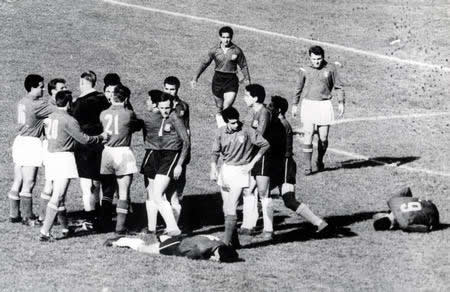
From the opening whistle, the game descended into chaos. Fouls, retaliation and confrontations quickly became constant, while the referee, Englishman Ken Ashton, struggled to impose control after adopting a lenient approach that soon backfired.
Off-the-ball incidents were frequent, including repeated pushing, late challenges and retaliatory actions away from the ball that often went unpunished. Within minutes, the match had shifted from competitive contest to open hostility.
Adding to the disorder were press photographers, who were positioned unusually close to the action. When confrontations broke out, they rushed onto the pitch to capture images, further complicating the officials’ ability to manage proceedings and adding to the sense of confusion.
The first major flashpoint came after just nine minutes when Italy’s Giorgio Ferrini was sent off for a late, dangerous foul on Leonel Sánchez, who had already been involved in several physical exchanges. Ferrini initially refused to leave the field, resulting in a lengthy interruption before police intervened and escorted him off.
Rather than calming the match, the dismissal only increased tensions.
Soon afterwards, Sánchez and Italian defender Mario David became involved in another confrontation. Sánchez struck David with a punch that went unseen by the officials, while the linesman failed to intervene. Later in the match, David retaliated with a high kick to Sánchez’s head, an incident that was seen by the referee and resulted in his dismissal.
Italy, reduced to nine men, held out until the 73rd minute when Héctor “Chico” Barrera broke the deadlock. Sánchez later added a second goal to secure a 2–0 victory for Chile.
Chile ultimately went on to finish third at the tournament, their best-ever World Cup result, while Italy exited in disappointment at the group stage.
The aftermath
In Chile, the match was widely portrayed as a hard-fought and emotionally charged victory that reflected national resilience and pride. Much of the local media framed the violence as a consequence of Italian provocation and the intensity of a high-stakes encounter. Despite his involvement in key incidents, Leonel Sánchez was celebrated by many as a national hero.
In Italy, the reaction was markedly more critical. The press described the match as a humiliation, highlighting perceived refereeing failures and a lack of control over the violence. The sense of injustice became deeply embedded in Italian football discourse, with the match frequently cited as an example of unfair treatment in international competition.
The invention of red and yellow cards
Ken Ashton did not officiate another World Cup match after the “Battle of Santiago”, although he went on to have a distinguished career, later becoming head of FIFA’s Referees’ Committee.
It was in this role that he began to reflect on incidents such as Chile–Italy and the 1966 World Cup match between England and Argentina. He recognised a recurring problem: communication barriers between referees and players from different linguistic backgrounds often led to confusion over cautions and dismissals.
While stopped at traffic lights in London, Ashton drew inspiration from road signals, where red universally means stop and yellow indicates caution. He developed the idea of a simple, universally understood system that did not rely on language and could be communicated instantly.
His wife helped create the first physical versions of the coloured cards, which could be carried in a referee’s pocket and displayed clearly during matches. This prototype eventually evolved into the system used in football today.
Today’s Laws of the Game
Although only two players were sent off during the match itself, modern interpretations of the Laws of the Game suggest that a fixture played under current standards would likely have produced far more dismissals and cautions, given the frequency of violent conduct and sideline involvement.
The “Battle of Santiago” remains widely cited whenever discussions arise about the dirtiest matches in football history, and it continues to stand as one of the sport’s most infamous encounters.
Author Bio:
Andy Dalziel is a sports author with extensive experience of writing about the games, teams, rivalries, and stories that capture the imagination of fans around the world. He has published three non-fiction sports books, contributed extensively to three others, and written numerous articles for sports websites and blogs.
In his latest book “Football and War” he explores how international football often carries the weight of deeper historical tensions between nations. The book traces how the modern game—spread globally from its codification in 19th-century England—has become both a shared language and a stage on which historical conflicts are replayed. Matches between certain nations often carry meaning that extends far beyond sport, shaped by colonial histories, wars, and long-standing geopolitical tensions.