The World Cup's most controversial collision
The World Cup’s most controversial collision
Introduction
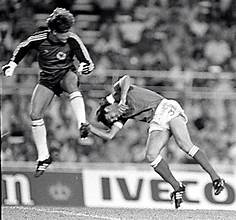
Few moments in football history have provoked as much outrage as Harald “Toni” Schumacher's collision with Patrick Battiston during the 1982 FIFA World Cup. What should have been remembered as one of the greatest matches ever played instead became synonymous with a challenge that left a French defender unconscious and a referee who allowed play to continue without awarding a foul.
More than 40 years after the event, it remains a defining moment in discussions about player safety, refereeing and sportsmanship.
The semi-final
The semi-final of the 1982 World Cup between France and West Germany was eagerly anticipated as a clash between two well-matched footballing nations, and it did not disappoint. After 90 minutes the score stood at 1–1, forcing extra time. France then appeared destined for the World Cup final after goals from Marius Trésor and Alain Giresse established a 3–1 lead. Yet West Germany refused to surrender. Substitute Karl-Heinz Rummenigge reduced the deficit before Klaus Fischer scored a spectacular overhead kick to level the match at 3–3.
With neither side able to find another goal, the contest became the first World Cup match to be decided by a penalty shootout.
West Germany prevailed, winning 5–4 on penalties after French defender Maxime Bossis saw his effort saved and Horst Hrubesch converted the decisive kick.
However, the Germans’ remarkable comeback was completely overshadowed afterwards by discussions over Schumacher’s challenge – or, in the eyes of some, assault - on Battiston.
What happened
Midway through the second half, and with the scores level, Michel Platini spotted Battiston making a run behind the German defence. His pass was perfectly weighted, allowing Battiston to break free, with only Schumacher to beat.
The goalkeeper raced out of his goal, only for Battiston to poke the ball past him. Although the effort drifted past the post, Schumacher made no attempt to check his momentum and launched straight into the French defender, who was knocked unconscious immediately. He collapsed onto the turf, whilst distraught team-mates urgently summoned medical assistance.
Meanwhile, television viewers were treated to multiple angles of the incident, which suggested that Schumacher had made no real attempt to play the ball. As spectators inside the stadium realised the seriousness of what had happened, the mood changed from one of excitement to concern.
Battiston had lost two teeth, broken three ribs, had a damaged vertebrae and was suffering from a severe concussion. Reports later revealed that he briefly lost consciousness and required oxygen while receiving treatment on the field before being carried away on a stretcher.
For several anxious moments, football became secondary.
The referee and Schumacher’s reaction
The only two people who did not seem overly concerned by what happened were Dutch match referee Charles Corver and Schumacher himself.
Corver awarded West Germany a goal kick because Battiston's shot had gone wide. He neither penalised Schumacher for the challenge nor produced a yellow or red card.
Meanwhile, Schumacher showed little interest in Battiston's condition and reportedly offered little sympathy while medical staff treated the unconscious French player. He later claimed this was because he could not see the prostrate body, which was surrounded by French team-mates directing threatening looks in his direction.
Afterwards, Schumacher became infamous for comments suggesting that if Battiston's only problem was the loss of a few teeth, he would personally pay for his dental treatment. Whether quoted precisely or paraphrased over the years, the remarks reinforced an image of indifference that attracted widespread condemnation.
What Corver said later
Under today's interpretation of the Laws of the Game, a goalkeeper who charges into an opponent with excessive force after the ball has gone would almost certainly be dismissed for serious foul play or violent conduct. Video Assistant Referee (VAR) would almost certainly intervene to recommend a review.
But, in 1982, refereeing standards were laxer. Goalkeepers often received greater protection from officials, and physical challenges that would now result in immediate dismissals were sometimes overlooked. Even so, many observers considered Corver's decision indefensible.
Referee Corver did attempt to justify his actions on that fateful night, even though his explanations have never fully satisfied his many critics. He maintained that he did not see the collision clearly enough to judge it as a foul, and that his attention was primarily on the ball, not on the aftermath of the two players coming together.
He also admitted that, had he had access to the same pictures as television viewers, he might have reached a different conclusion, although he stopped short of saying that he would have sent Schumacher off.
The controversy also highlighted the limitations of officiating in the pre-VAR era, when assistant referees had a much narrower role than they have today, communication systems between match officials were rudimentary at best, and dangerous collisions were easier to miss if the referee's angle was poor.
Even so, many observers—including former referees—have argued that the collision was so obvious that Schumacher should have been penalised regardless of the technological limitations. The decision remains one of the most criticised non-calls in World Cup history.
Ironically, the Battiston–Schumacher incident is now frequently used in discussions about why video review was eventually introduced into elite football—not because it directly led to VAR, but because it illustrates how a single missed decision can define a match and remain controversial for decades.
It is also worth pointing out that, had Schumacher been sent off, the result of the semi-final might have been very different, as West Germany would have been forced to play the rest of the second half, and extra time, with only ten men, and they would have had a substitute goalkeeper in goal to face the French penalties.
The aftermath
The incident quickly became front-page news across Europe. French newspapers condemned the lack of punishment, while many neutral commentators described it as one of the worst refereeing decisions ever witnessed at a World Cup.
And even in West Germany, what happened occasioned some discomfort and debate. Although some German commentators defended Schumacher, arguing that it was a fast-moving collision and that the goalkeeper was attempting to challenge for the ball, others criticised his lack of immediate concern for Battiston.
The debate reflected a broader tension in German football culture at the time: the admired qualities of strength, discipline and determination could sometimes be viewed negatively when they appeared to cross into brutality.
Battiston recovers and their later careers
Although there were fears about the initial extent of Battiston’s injuries, he later made a full recovery and returned to competitive football a few months after the World Cup. Under legendary coach Aimé Jacquet, he won multiple French league titles with FC Girondins de Bordeaux during the club’s golden era.
He also won 56 caps for France and was part of the side that won the 1984 European Championship, their first major international title. He also played in the 1986 World Cup, helping France finish third.
Schumacher remained one of Europe’s top goalkeepers for a number of years, although his public image, particularly in France, was permanently damaged by what had happened.
Ironically, in his native Germany it was the publication of his autobiography in 1987, Anpfiff ("Kick-Off"), which proved far more harmful to his career and reputation. In it he alleged widespread doping, drug use, heavy drinking and other misconduct in German football. The revelations caused an uproar. Schumacher was stripped of the West Germany captaincy, dropped from the national team, and his long association with FC Köln came to an abrupt end.
He continued playing abroad, most notably with Fenerbahçe in Turkey, where he won the Turkish league title. Later, he returned to Germany with Bayern Munich as an experienced backup goalkeeper and, in 1996, made a late-season appearance that made him the oldest player to win the Bundesliga at the time. After retiring, he worked as a goalkeeping coach, briefly managed Fortuna Köln, and later returned to FC Köln in an executive role.
Mellowing with age, Schumacher revised his opinions about the collision with Battiston. For years he defended his actions as a deliberate attempt to play the ball. But he did admit that he was in the wrong with the way he behaved afterwards, and that he should have shown more sympathy to his opponent whilst the Frenchman was receiving treatment.
Later in life the two men were reconciled. The German apologised both for the collision and his insensitive remarks afterwards, and Battiston accepted his apology.
Author Bio:
Andy Dalziel is a sports author with extensive experience writing about the games, teams, rivalries, and stories that capture the imagination of global fans. He has published three non-fiction sports books, with the latest “Football and War” exploring how international football carries the weight of deeper historical tensions between nations.
More from Andrew Dalziel coming soon.
Visit the profile to follow and get notified when the next piece lands.