
Arif Kovac: The Emerging Striker Making His Mark at Atlanta United II
The United States continues to produce an increasingly interesting pool of attacking talent, with MLS Next Pro providing an important platform for young players to go on and establish themselves in the professional game.
Atlanta United II is one of the clubs operating within this pathway, and Arif Kovac is beginning to attract attention with his performances throughout the 2026 campaign. The 20-year-old finished the regular season with 20 goals in 26 appearances, winning the MLS NEXT Pro Golden Boot in the process.
In this report, we will take a closer look at Kovac’s profile, examining the qualities that have made him such a productive forward while also identifying the areas of his game that will need to develop as he continues his progression.
Player Profile and Data Analysis
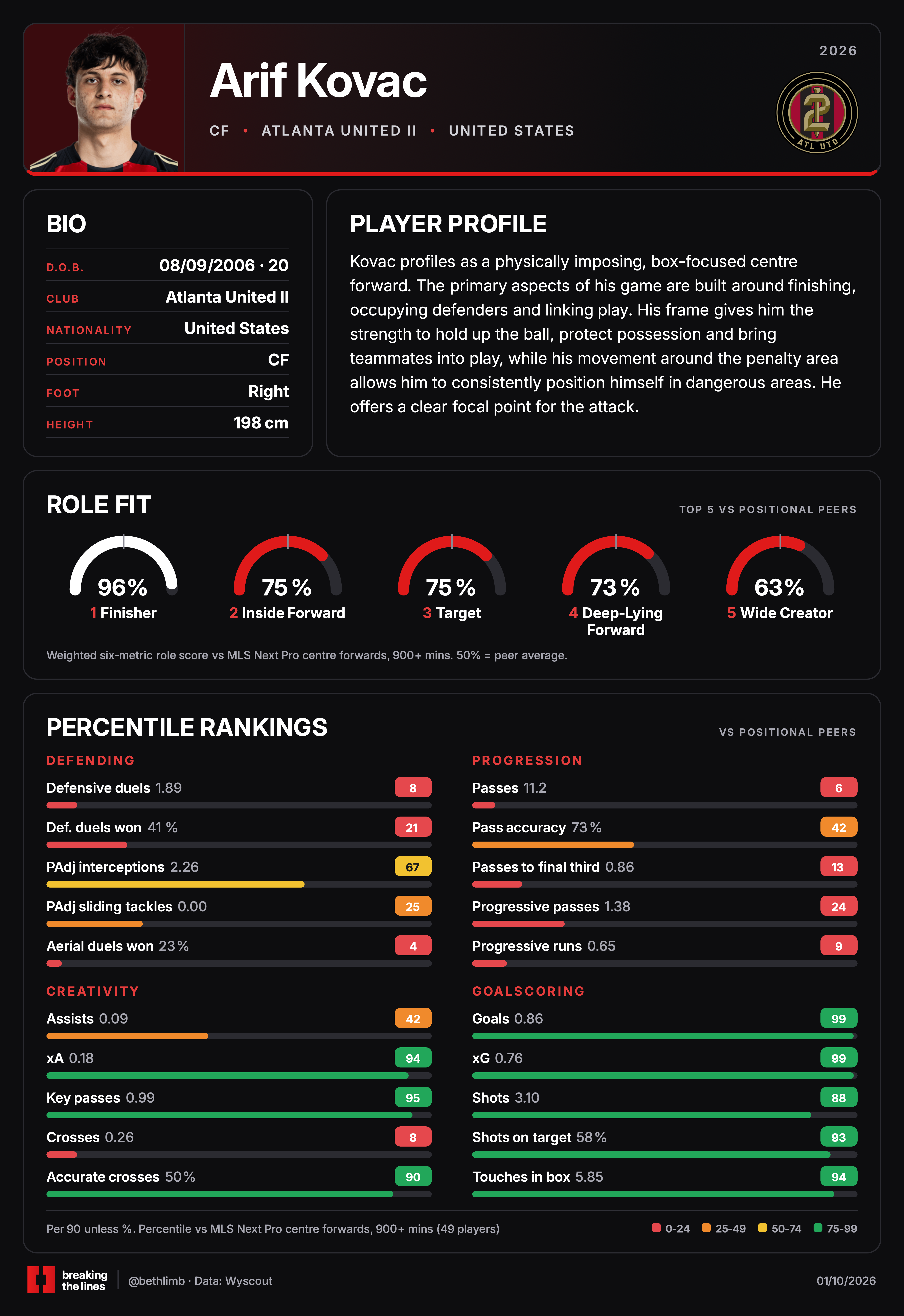
Looking at the numbers, we can get a very clear picture of Kovac as a striker. Compared to his position peers, his strongest numbers are concentrated around goal involvement and penalty-box activity. His goals per 90 (0.86) and xG per 90 (0.76) both sit in the 99th percentile. His 3.10 shots per 90 combined with 5.85 touches in the penalty area support the idea that he is a forward whose main value comes from consistently occupying dangerous areas and finishing attacks.
His 0.18 expected assists per 90 ranks in the 94th percentile and key passes in the 95th, suggesting that although finishing is his primary strength, he is capable of contributing to chance creation when involved around the box.
His lower progression numbers appear more reflective of the role he occupies within Atlanta United II’s structure, where he is primarily tasked with staying high, occupying defenders and providing a focal point in the final third rather than dropping deep to progress possession.
Physical Profile
Physically, Kovac has an imposing frame at 198cm, with a tall and slim build that gives him a strong presence as a centre forward. Despite his lean frame, he is capable of holding off defenders and using his body effectively when playing with his back to goal. He's also comfortable using his frame to protect the ball and absorb contact, which means he can then bring teammates into play, making him a useful outlet when his team needs to progress up the pitch.
He's not particularly explosive over longer distances, but he can still create separation through short bursts of acceleration. When receiving with an opponent close by, he can use these quick bursts to move away from pressure, while his size makes it difficult for defenders to simply step through him and win the ball. This combination of strength and short-distance movement allows him to link play effectively without needing to rely purely on pace.
Tactical Role
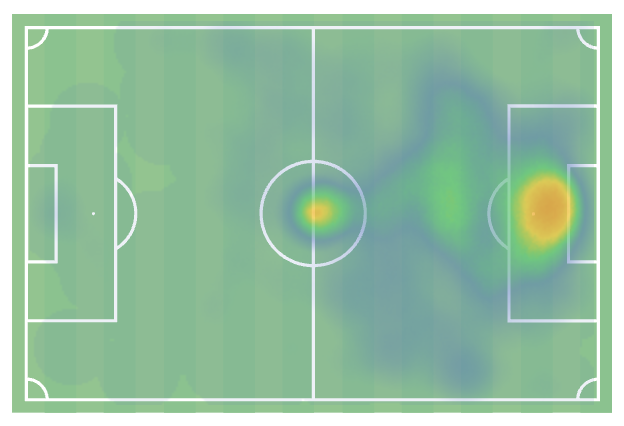
Kovac primarily operates as the central striker in Atlanta United II’s 4-2-3-1, with his positioning largely centred around the opposition’s defensive line and penalty area. If we look at his heatmap, we can see a strong concentration through central areas, particularly around the box, reflecting his role as the main focal point of the attack.
From this position, the young striker can utilise his physical presence to pin defenders and create space for the attacking midfielders and wide players around him. He is also able to move across the front line in shorter movements, finding pockets away from his marker before looking to receive or attack the box. His positioning therefore allows Atlanta United II to maintain a high focal point in possession, while giving the players behind him space to operate between the lines.
Attacking the Box
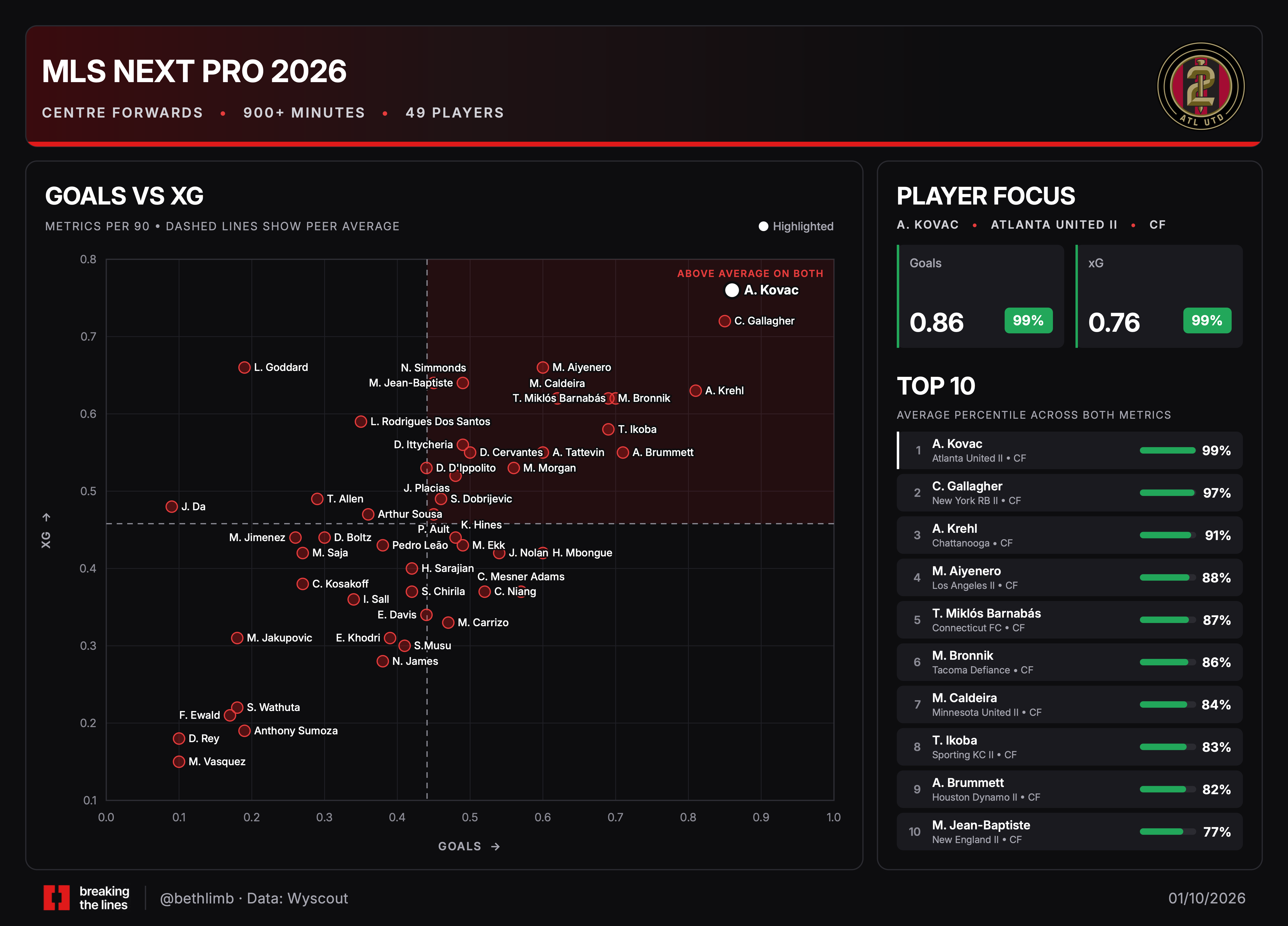
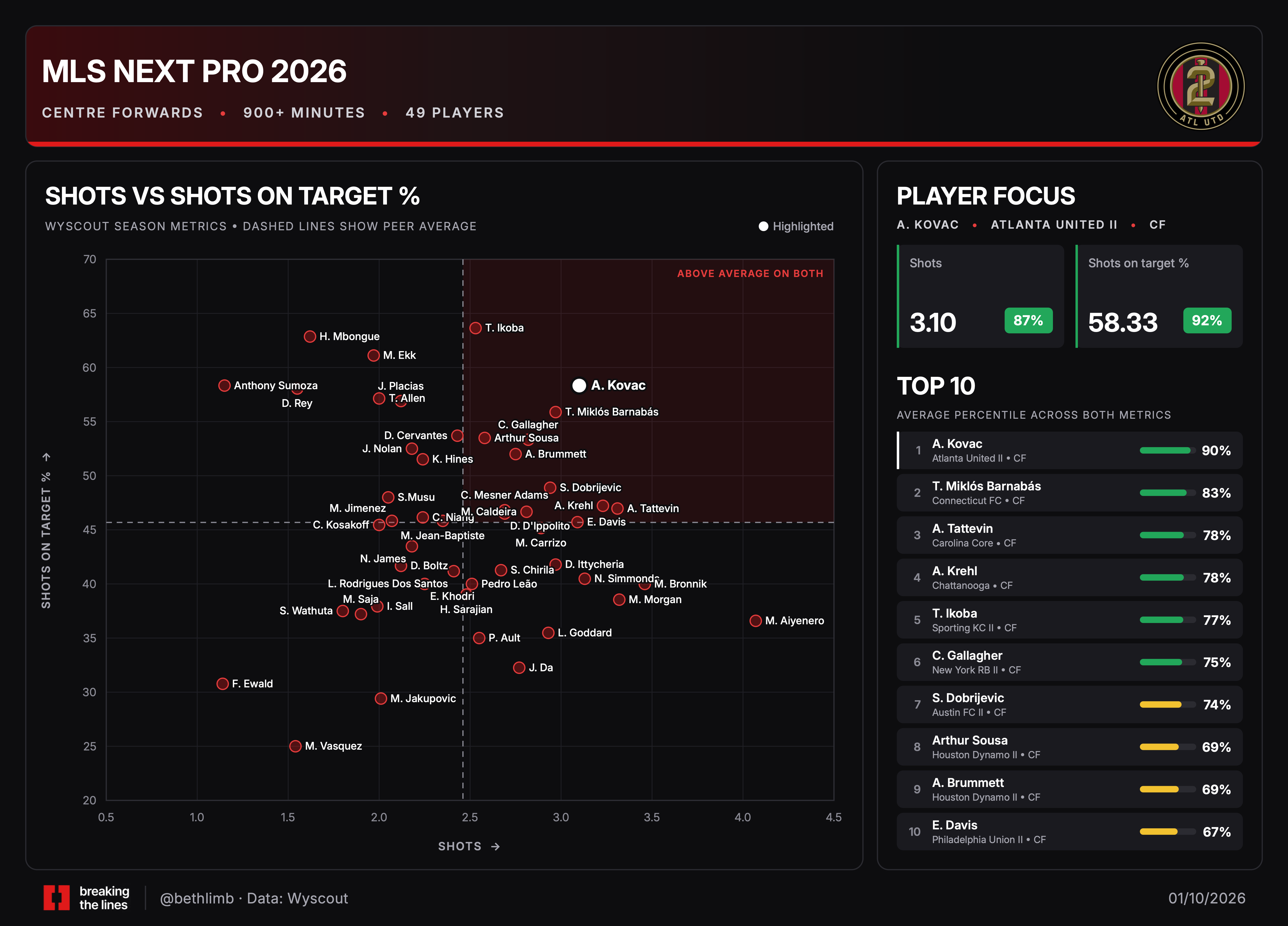
Here, we can see just how much Kovac stands out compared to his MLS Next Pro counterparts. The Atlanta United II centre forward is among the most productive scorers in the competition, ranking at the very top among his positional peers for both goals and xG per 90. His shot volume is also strong, and the quality of his shooting stands out, with 58.3% of his attempts finding the target.
This tells us that he is a forward who takes a high number of shots per game, but he also consistently tests the goalkeeper when those opportunities arrive.
When watching the 20-year-old in games, it's clear to see that he has the instincts of an out-and-out goalscorer.
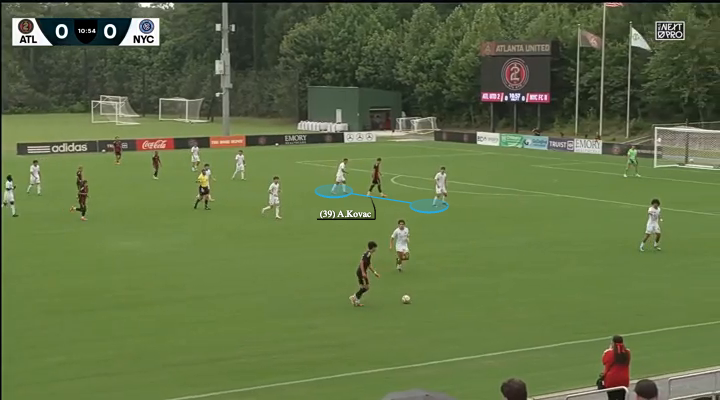
Kovac's effectiveness in and around the box begins with his positioning. As Atlanta United II build the attack, he positions himself between the two central defenders, maintaining optimal distances from both. This makes it difficult for either player to engage him without creating space for the other attackers to potentially exploit, while also allowing Kovac to react quickly to whichever side the attack develops on.
He remains connected to the defensive line without becoming static, constantly scanning and adjusting his position as the ball progresses towards the final third.
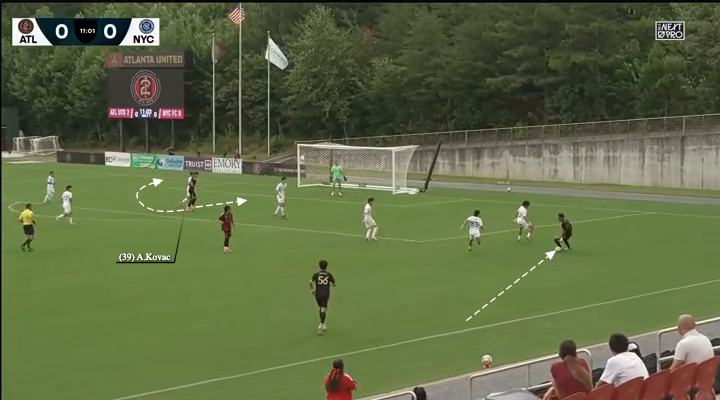
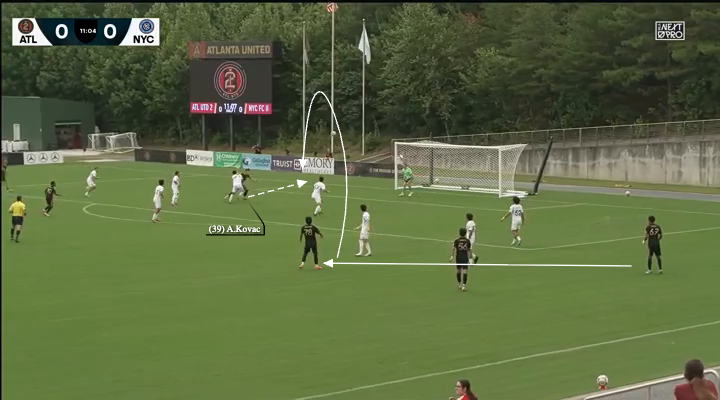
Here, we can see how Kovac initially stays close to the defender, positioning himself in a way that allows him to attack the front post if the ball is worked across. As the ball is played back towards the midfielder, he recognises that the delivery is likely to come from a different angle and adjusts his position accordingly.
He uses his physical strength to get back across the defender and establish himself on the other side, creating the separation needed to attack the incoming delivery. His teammate hangs the ball towards the far post, where the Atlanta United man meets it on the volley from close range to finish the move.
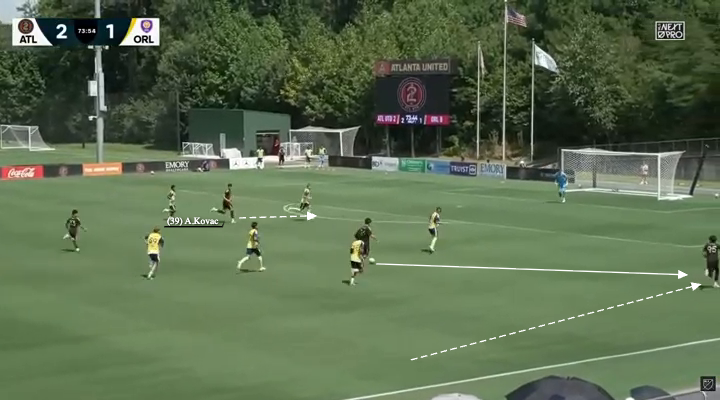
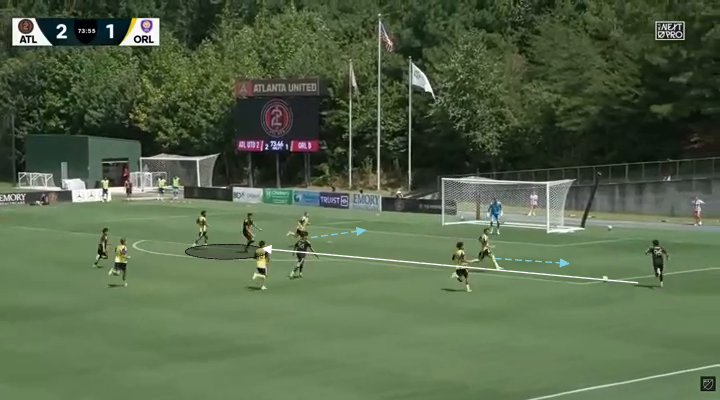
We can see a different side of Kovac’s movement here, particularly his ability to recognise when to slow his run rather than simply continuing towards goal. As Atlanta break forward, he immediately looks to run into the space ahead which forces the defenders to retreat. As he reaches the edge of the box, he opts to hold his run and waits for the right moment, maintaining his position in space rather than becoming too close to the defensive line.
As his teammate plays a low cross towards the edge of the area, he is in an ideal position to meet it first time, sweeping the ball into the net. This is a great example of his understanding of timing and space; the decision to hold his run provides him with enough time and space to ensure the ball ends up in the back of the net.
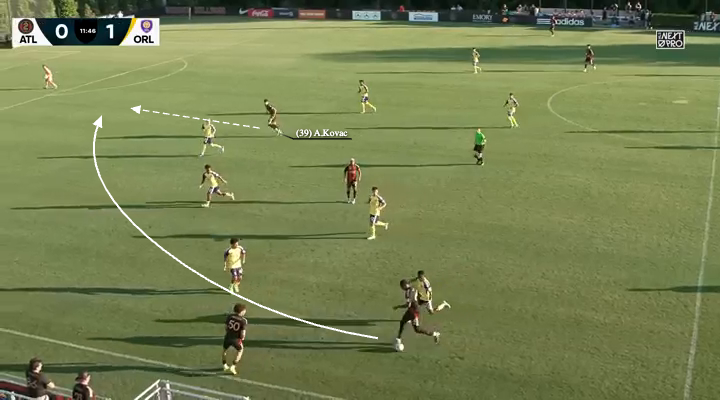
His movement is not limited to finding space inside the penalty area. Kovac can also recognise opportunities to attack the space in behind, particularly when the opposition defensive line is exposed as we can see here. Atlanta United II often look to make the pitch as wide as possible, which means the opposition backline is often stretched and gaps start to appear between the centre back's for Kovac to exploit.
His timing is important in this scenario as he waits for the right moment to break through the defensive line before accelerating into the space and creating a 1v1 opportunity.
Overall, Kovac’s threat in the final third comes from more than his finishing. His positioning allows him to consistently occupy dangerous areas, while his awareness of space and timing enables him to adjust his movements as the attack develops.
He also understands how to use his physical strength to create separation from defenders, hold his run to arrive at the right moment and attack space in behind when the defensive line is exposed. These are all qualities that make it difficult for defenders to track him and allow him to create optimal goalscoring opportunities in a variety of situations.
Link-Up Play
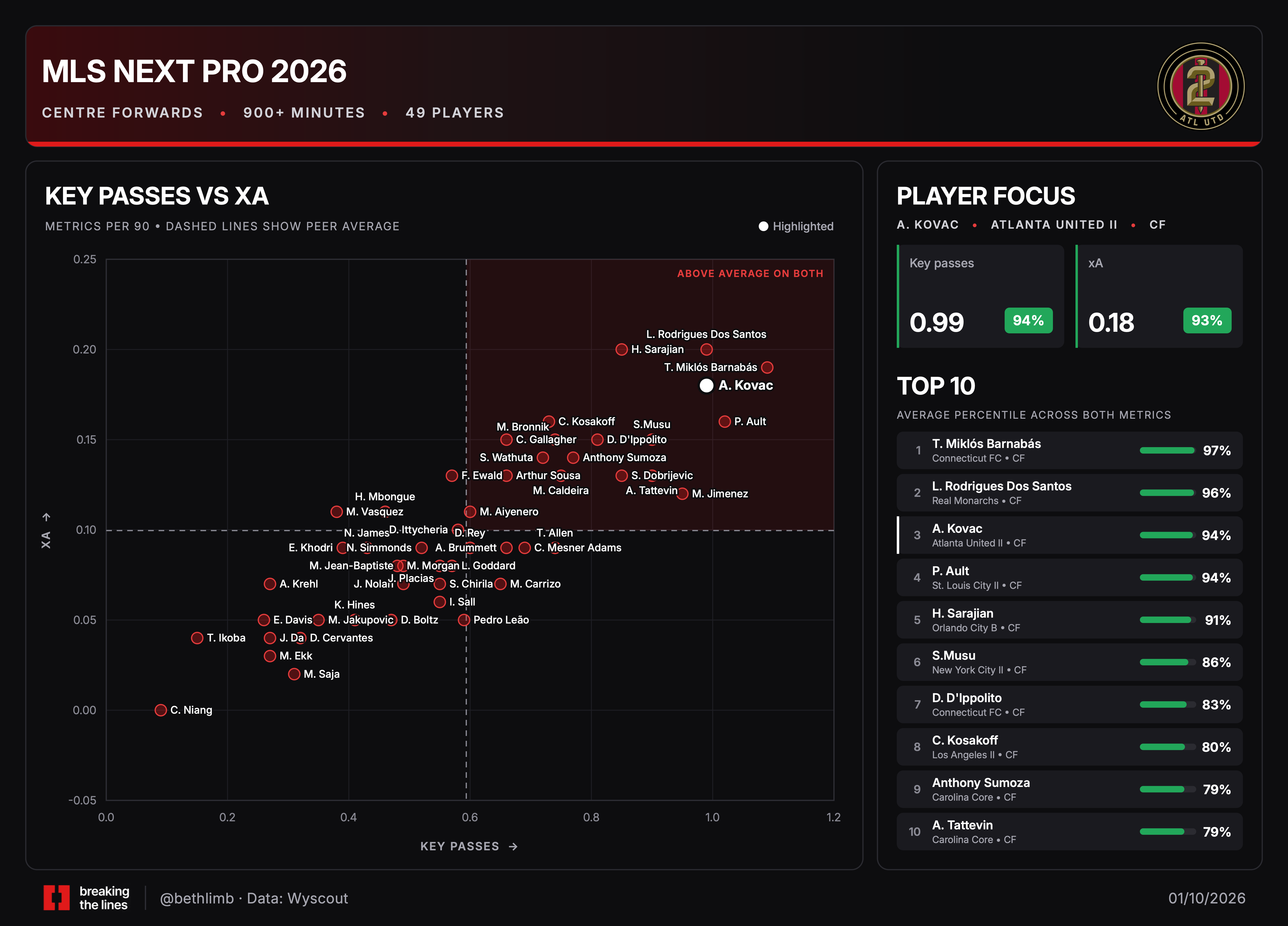
Although Kovac’s primary threat comes in front of goal, he is also capable of contributing to the creation of chances. His key passes (pass leading to a shot) and expected assist numbers place him among the strongest centre forwards in MLS Next Pro, demonstrating his ability to influence attacks beyond the final shot.
This is particularly interesting given his role as a high focal point. His contribution doesn't come from dropping deep, instead, it stems from how effectively he can link with teammates and create opportunities once he receives the ball in advanced areas.
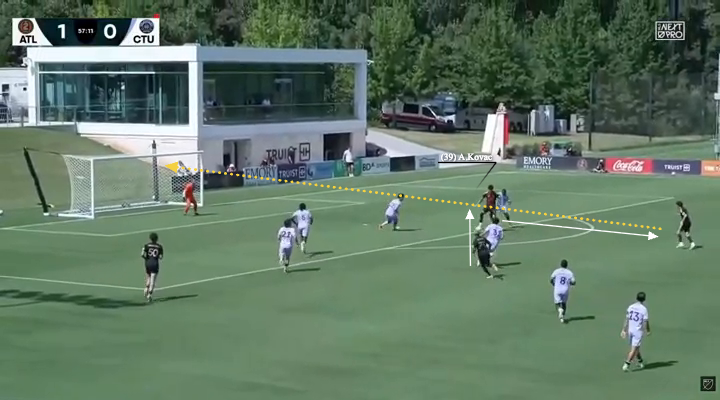
In this example, we can understand more about his value as a reference point. He receives the ball under significant pressure and rather than trying to turn away from the defender, he uses his strength to shield the ball, protecting possession long enough for a teammate to show as an option. He then lays the ball off into the path of the supporting player, allowing the attack to continue and creating the opportunity for a shot from distance.
The action is a very simple one, but it highlights an important part of Kovac’s game. His physical presence allows him to receive under pressure and absorb contact before bringing teammates into play without needing to turn and carry the ball himself.
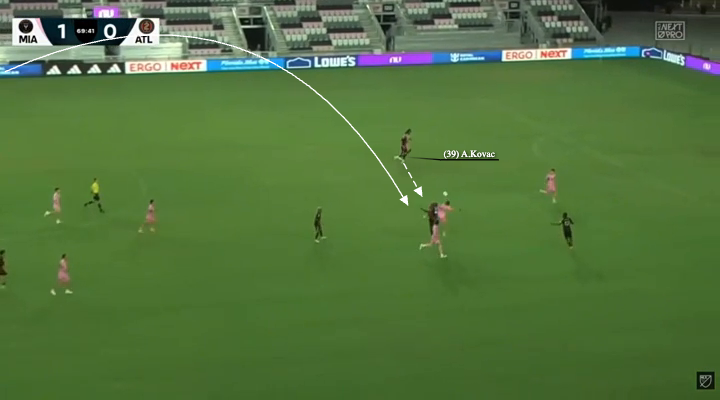
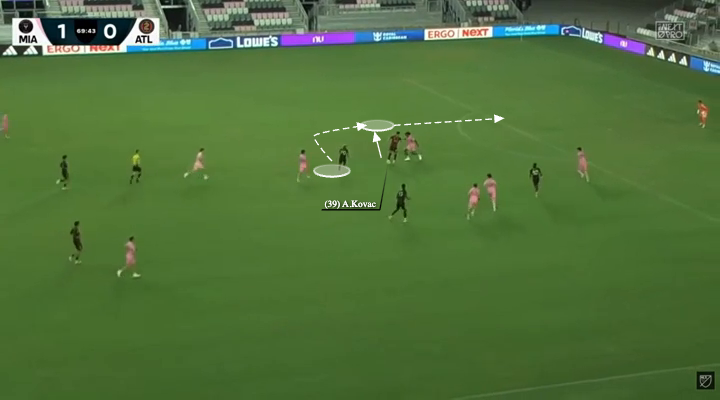
There's also an element of flair to his play meaning Kovac can also contribute through more inventive combinations. In this instance, a long ball is played forward and, after his teammate nods it down, Kovac immediately recognises the run being made beyond him. So, rather than taking a touch or attempting to turn, he uses a well-weighted backheel to guide the ball into his teammate’s path, allowing him to run into the space ahead without breaking stride.
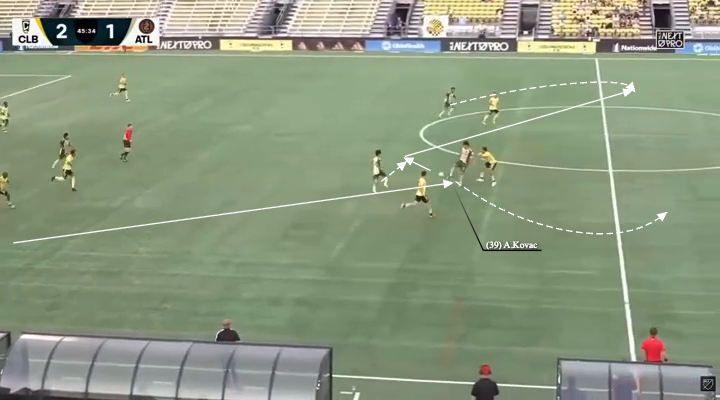
We can also see how Kovac’s link-up play can be particularly valuable during transitions. In this instance, when the ball is played into him, he brings a teammate into the attack with a short lay-off before immediately spinning away to attack the space in behind. His movement then creates an additional problem for the defence, as the teammate on the opposite side draws the other centre back away, opening a channel through the middle for the supporting attackers to exploit.
This shows his awareness and ability to link play at speed. He recognises the movement around him early and executes the pass first time, helping his teammate progress the attack while maintaining its momentum. Again, this is a simple but intelligent piece of link-up play that further demonstrates his awareness, firstly, to contribute creatively and secondly, to ensure the attack continues to flow.
Defending from the Front
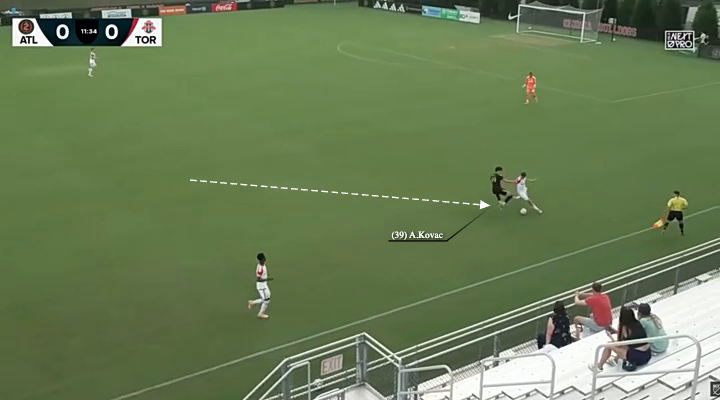
Kovac’s contribution without the ball is another interesting aspect of his profile. He is capable of applying pressure through short bursts of acceleration, quickly closing the space between himself and the ball carrier.
His body shape is well controlled when engaging opponents, allowing him to stay balanced while showing the attacker away from the central areas. His long frame also gives him an advantage when attempting to regain possession, with his reach allowing him to stretch out and get a foot to the ball even when the opponent appears to have created separation.
We can see this here as the young forward moves across to close down the defender. He uses a short burst of acceleration to reduce the space before positioning his body in a way that prevents the opponent from carrying the ball beyond him. As the defender attempts to move away, he uses his long stride and reach to get a foot in and disrupt the opponent's movement.
His reaction after losing possession is equally encouraging. He doesn't switch off once the ball has gone. He immediately looks to regain possession, reacting quickly to the turnover and often chasing back, putting pressure on the ball carrier. There's a real tenacity to his actions; he's willing to make repeated efforts to win the ball back rather than just retreating into shape and waiting for his teammates to step in.
Conclusion
Arif Kovac presents as an exciting centre forward. He provides Atlanta United II with a strong focal point in attack, capable of holding off defenders, bringing teammates into play and creating separation through his movement rather than relying solely on explosive pace.
His finishing is arguably the standout feature of his game, but as the footage shows, his goalscoring threat comes from a combination of intelligent positioning, timing and sheer physicality. He is capable of attacking space in behind, adjusting his movement inside the box and finding different ways to finish.
Of course, as a young player, there are still areas for Kovac to develop, particularly in becoming more consistent in his contribution without the ball and continuing to refine his game when operating outside the final third.
However, his current profile provides a strong foundation. If he can continue developing the different aspects of his game while maintaining his effectiveness in front of goal, he has the tools to become an increasingly complete centre forward as he progresses through the professional game.