
TACTICAL ANALYSIS | MANCHESTER UNITED: Offensive Analysis
HIGH SHOT VOLUME, LITTLE DAMAGE: MANCHESTER UNITED’S ATTACKING PARADOX
Manchester United lead the Premier League in shot volume, but their attacking output is not translating into goals at the same rate. The problem cannot simply be reduced to “poor finishing”: it lies in the relationship between shot selection, penalty-area occupation, the timing of the final pass, rest-defence structure, and the quality of the chances being created.
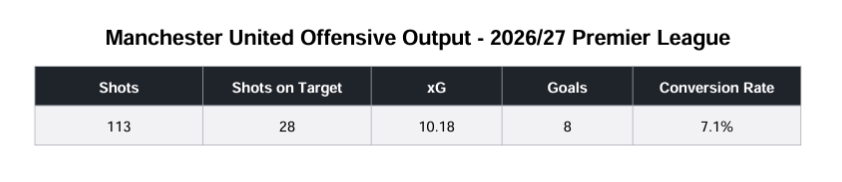
The initial picture is striking: 22.6 shots per match, but only 5.6 on target. Just 24.8% of United’s attempts have tested the goalkeeper, while each shot has been worth approximately 0.09 xG on average. In other words, the team is generating an enormous volume of shots, but a significant proportion of them are not being taken under optimal conditions.
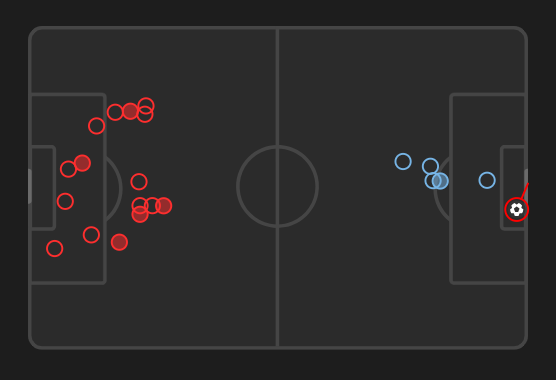
- THE PARADOX: UNITED ARE GETTING THERE, BUT NOT ALWAYS IN THE RIGHT WAY
At first glance, 113 shots across five matches should describe a dominant attack. And, in one sense, they do: Manchester United are able to establish possession near the opposition penalty area, collect second balls, and generate enough attacking sequences to consistently finish possessions with a shot.
However, a shot is merely the end of a possession; it is not proof that the possession itself was effective. Counting shots without examining their context can easily lead us to confuse activity with genuine threat.
The statistic that changes the interpretation is the relationship between volume and quality. With 10.18 xG from 113 shots, the average value is approximately 0.090 xG per attempt.
In tactical terms, many attacking moves are ending before United manage to improve the shooting angle, pin the last defender, find a receiver in the channel between centre-back and full-back, or create a clean reception in the central corridor of the penalty area. United are finishing moves; they are not always allowing those moves to fully develop.
Furthermore, 28 shots on target from 113 attempts represent approximately 24.8%. That figure alone does not prove poor shooting technique — blocks and shot type must also be considered — but it does fit the profile of an attack that frequently reaches the final third and, once there, accepts too many medium- or low-value endings to its possessions.
xG PREVENTS AN OVERLY SIMPLISTIC EXPLANATION
United have scored eight league goals from 10.18 xG, a difference of -2.18 goals. There is therefore some underperformance relative to the aggregate quality of the chances created.
Five matches, however, remain a small sample. The most useful conclusion is not that the team “cannot finish,” but rather that two issues are currently coexisting: conversion below expectation and a shot profile that still has room for optimisation.
The victory over Ipswich accounts for almost half of United’s league goals and produced an exceptional 5.02 xG. Remove that match and the overall attacking picture becomes considerably less impressive.
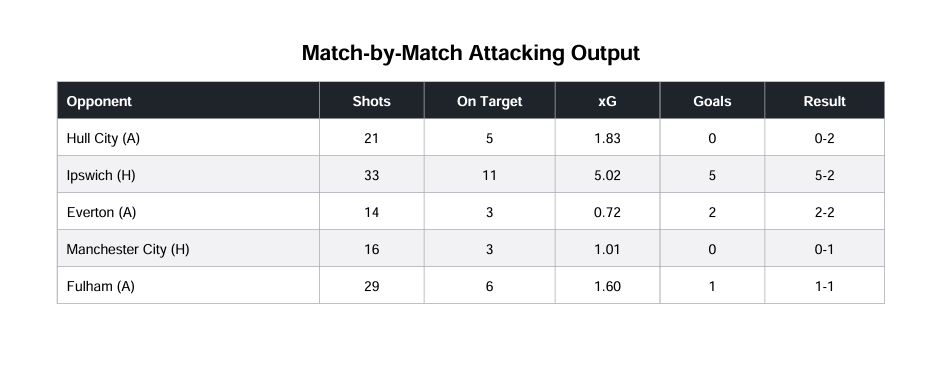
The 1–1 draw against Fulham provides the clearest contrast: 29 shots for 1.60 xG, equivalent to just 0.055 xG per shot. That ratio describes volume without sufficient quality. The opposition allowed United to shoot, but did not necessarily concede high-probability attempts.
- WHY ARE UNITED GENERATING SO MUCH? FIVE MECHANISMS DRIVING SHOT VOLUME
2.1. High Possession and Repeated Attacking Sequences
United’s 59.8% average possession in the league helps explain their high number of shots. They spend more time on the ball than their average opponent and therefore have more opportunities to restart attacks after rebounds, clearances, or passes back from advanced areas.
Their shot volume comes not only from the initial progression up the pitch, but also from their ability to recover second balls and immediately pin the opposition back again.
2.2. More Players Ahead of the Ball
When the full-backs or wing-backs push higher and one of the midfielders moves towards the edge of the penalty area, United can create a broad attacking structure around the opposition block.
That presence increases the number of crosses, recycling passes towards the edge of the box, recovered clearances, and second-phase shots. The benefit is territorial dominance. The risk is that simply committing more players ahead of the ball does not necessarily create numerical or positional superiority inside the penalty area.
2.3. Bruno Fernandes as an Accelerator
Bruno remains the player most capable of transforming neutral possessions into attacks. His tendency to look for vertical passes, early switches of play, or balls into space reduces the number of passes United require to reach finishing positions.
That creative aggression raises United’s attacking ceiling, but it can also accelerate possessions that might have benefited from one additional pass to further disorganise the opposition block.
2.4. Mbeumo, Cunha and the Supporting Attackers: Threat from Different Channels
The squad contains players capable of receiving between the lines, attacking diagonally and carrying the ball towards the penalty area.
Problems emerge when several players attempt to operate at the same height or when the striker drops away from the opposition’s last line too early. In those situations, United can progress relatively easily but arrive in the penalty area with less ability to pin the centre-backs, eventually settling for shots from wide positions or from the edge of the box.
2.5. The Rebound Effect
A team that attacks for long periods inevitably generates shots resulting from an initial action that has already been defended: a cleared cross, a block, a rebound or a loose ball.
Statistically, they all count as shots. Tactically, however, they do not carry the same value as a chance deliberately constructed to leave the finisher facing the goalkeeper. This distinction is essential to understanding why the headline figure of “113 shots” appears more impressive than the actual damage produced.
- WHY ARE UNITED NOT SCORING AT THE SAME RATE? A DEEPER DIAGNOSIS
3.1. Shot Selection: Finishing the Move Too Early
The clearest symptom is the frequency with which possessions end as soon as a shooting window appears, even when that window is narrow.
Against low blocks, the first available shot is often exactly the one the defender is willing to concede: from distance, from a wide angle, with a defender blocking the shooting lane, or after a first touch that gives the defence time to recover.
The solution is not to eliminate those shots altogether. It is to distinguish between moments when shooting represents a genuine advantage and moments when it simply provides the defence with a comfortable way to end the attack.
3.2. Limited Body-Position Advantage at the Point of Execution
Chance quality is not determined solely by where the shot is taken. Two shots from exactly the same coordinates can be radically different.
If the attacker receives the ball facing goal, with the defender behind him and enough time to set himself, the opportunity is clean. If he receives the ball from a static position, needs an additional touch to set it, and has two defenders closing the shooting lane, the probability of scoring falls considerably.
United are reaching useful areas, but too often the final receiver still has a problem to solve before being able to shoot.
3.3. Penalty-Area Occupation: Presence Is Not the Same as Staggering
To effectively attack a cross or cutback, a team needs complementary positioning at different depths: near post, penalty spot, far post and edge of the box.
When two attackers occupy the same line, a defender can control both with a single reference point. When nobody attacks or pins the near-post zone, the centre-back can defend while simultaneously watching both the ball and the penalty area.
The feeling that United are “missing a number nine” is therefore often, in reality, a collective problem of occupation and timing.
3.4. A Cutback Needs a Run That Clears the Space
Cutbacks are valuable because they attack defenders who are running towards their own goal. But they become much more effective when one deep run drags a centre-back away and another player arrives into the space behind.
If everyone waits for the pass at the same depth, the penalty area becomes crowded with shirts without creating a clear passing lane.
United need their wide combinations and central occupation to be coordinated, rather than simply occurring at the same time.
3.5. Tempo: Accelerating Before Pinning the Opposition
One of the paradoxes of highly talented teams is that they can sometimes play too quickly.
A vertical pass is a strength when it breaks a defensive line. It becomes rushed when it is played before the receiver has supporting options or before the opposition has been pinned to one side.
United generate many attacking entries because they accelerate play. They also waste some of those attacks because they accelerate before creating the advantage that would justify doing so.
“The problem is not that United fail to reach the penalty area. It is that too many possessions end when the first shot appears, rather than when the best shot appears.”
- THE HISTORICAL CONTEXT: 2026/27 DID NOT COME OUT OF NOWHERE
The current paradox has recent precedents, although with important differences.
In 2024/25, United produced approximately 1.53 xG and 13.0 shots per match, but finished the season with 44 goals and a conversion rate of around 8.9%. It was a campaign in which a lack of goals coincided with chance creation that was itself some way below elite level.
In 2025/26, the improvement was significant: 69 goals, 1.89 xG per match, 14.9 shots per game and a 12.2% conversion rate, alongside a third-place league finish.
The current season partially reverses that formula. Shot volume has risen beyond 22 attempts per match, while conversion has fallen towards 7%.
The comparison highlights an important lesson: increasing shot volume does not automatically produce more goals. From 2025/26 to the beginning of the current campaign, United have added an enormous number of attempts without maintaining the same level of efficiency.
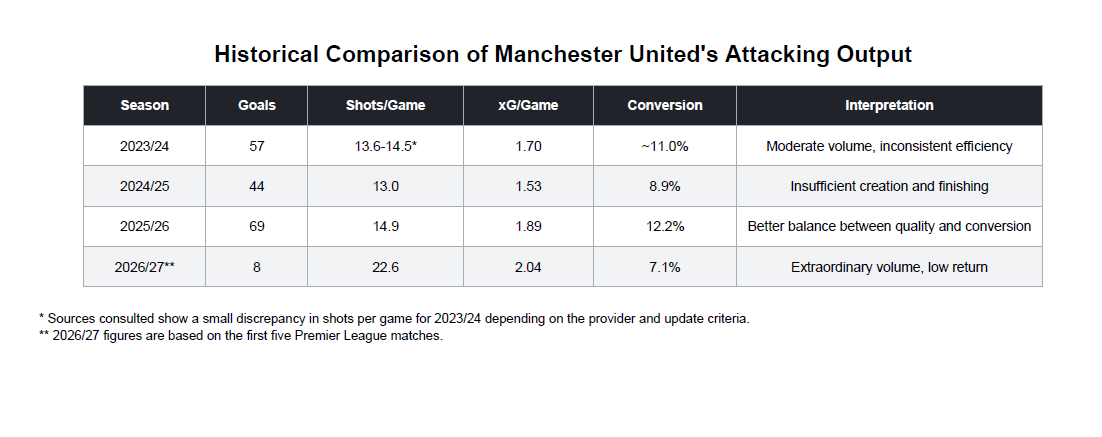
The tactical objective should therefore not be to “shoot more” — they already do that. Instead, the aim should be to transform some of those marginal attempts into cleaner receptions, cutbacks, advantageous one-v-one situations, or shots from central areas.
- THE FULHAM MATCH AS A CASE STUDY
The 1–1 draw on 20 September encapsulates the dilemma. United attempted 29 shots and generated 1.60 xG. That works out at only 0.055 xG per shot — a very low average for a team that attempted almost 30 shots.
This does not mean that every chance was poor. Rather, the overall shot profile was heavily diluted by low-probability attempts.
Tactically, this type of match often occurs when a team dominates territory without dominating the heart of the penalty area. The opposition protects the central channels, accepts crosses or shots from less dangerous areas, and trusts that the sheer volume of attempts will not translate into clear-cut chances.
The attacking team feels as though it is laying siege to the opposition goal; the defending team, by contrast, may feel that it is successfully controlling the type of shots it is conceding.
Matheus Cunha’s late goal, which benefited from a deflection according to match reports, also serves as a reminder that volume does have value: persistence creates rebounds, second balls and favourable accidents.
But relying on that mechanism is not a sustainable solution. An elite attack wants to preserve its ability to apply constant pressure while simultaneously increasing the proportion of chances that do not require a rebound or deflection to become dangerous.
- WHAT NEEDS TO CHANGE WITHOUT DESTROYING WHAT ALREADY WORKS
6.1. Maintain the Volume, Raise the Quality Threshold
The solution is not to turn United into a passive team. Generating 20 or more shots demonstrates an ability to reach attacking areas, regain possession and sustain pressure.
The required adjustment is qualitative: a player receiving the ball 20 metres from goal must recognise when shooting is genuinely the best option and when one additional pass could transform a 5% chance into a 20% or 30% chance.
6.2. Pin the Defensive Line More Effectively
The centre-forward must be more than a finisher. His positioning pins centre-backs, opens spaces for attacking midfielders and determines the depth of the opposition defensive block.
When the number nine drops away from the last line without a compensating run in behind, United gain a passing option but lose a source of threat.
The balance lies in alternating between dropping short and threatening in behind, rather than permanently choosing one or the other.
6.3. More Automated Movements on the Weak Side
If the ball progresses down the right, the winger or wing-back on the opposite side should attack the far post with the correct timing. If the ball reaches the byline, the furthest midfielder should occupy the edge of the box rather than crowding the penalty spot.
These are repeatable patterns. Attacking efficiency tends to improve when the third-man run no longer depends entirely on improvisation.
6.4. One More Pause Before the Final Pass
Against organised defences, a pause can be just as aggressive as a vertical pass. Holding the ball for an extra half-second forces the defender to make a decision: step forward or protect the space in behind. That moment creates the gap.
United have players capable of executing difficult actions. What they need is to create more situations in which an extraordinary action is not required to generate danger.
6.5. Rest Defence as a Tool for Better Attacking
The defensive structure maintained while attacking also influences offensive quality. If the players behind the ball are positioned correctly, the attackers can occupy more aggressive positions without fearing transitions to the same extent.
Furthermore, an effective counter-press can recover possession against an opponent whose structure has opened up — precisely the moment when the best chances often emerge.
Defending the attack well can therefore become a direct way of improving the attack itself.
- THE PSYCHOLOGICAL AND STATISTICAL DIMENSION: DO NOT CONFUSE A RUN OF FORM WITH IDENTITY
Five matches are enough to identify behavioural patterns, but not enough to make definitive judgments about a team’s finishing ability.
A team can underperform its xG for several weeks because of variance, goalkeeper interventions, shots hitting the woodwork, or isolated technical decisions.
It is therefore useful to separate two questions.
First: are United creating enough value? Yes. Their accumulated xG and shot volume are high.
Second: is the way they are creating that value sustainable and efficient? This is where questions arise: the percentage of shots on target, the low average xG per attempt in matches such as Fulham, and the reliance on an extraordinary attacking performance against Ipswich all suggest that there is room for structural improvement.
Regression towards a more normal conversion rate could bring additional goals without requiring major systemic changes. But simply waiting for the shots to “start going in” would be an incomplete interpretation.
The best attacks do not merely survive variance: they design possessions to reduce it, moving the point of execution closer to goal, removing defenders from the shooting lane, and delivering the ball to the finisher with both a positional and temporal advantage.
- CONCLUSION: UNITED DO NOT NEED MORE ATTACKS; THEY NEED BETTER ENDINGS
Manchester United have begun the 2026/27 season as a team characterised by massive attacking output but modest efficiency. Their 113 shots and 10.18 xG demonstrate that there is a genuine attacking platform in place. Their 28 shots on target, eight goals and approximate 7.1% conversion rate, however, show that this platform is still not being translated into goals consistently enough.
The contrast with 2025/26 is particularly revealing. That United side needed fewer shots to produce more goals because it achieved a better combination of chance quality and conversion.
The current team are accumulating attempts at an extraordinary rate, but part of that volume functions as statistical noise: blocked shots, rushed attempts, finishes from tight angles, or situations in which the receiver has not yet established a clear advantage.
The next step, therefore, is not to demand greater aggression, but greater collective precision. Better occupation of the penalty area. More runs that pin defenders. Greater patience to move the final defender. Better coordination of cutbacks. And shot selection that rewards genuine advantage rather than merely the opportunity to shoot.
If United can preserve their ability to pin opponents back while converting a fraction of those low-probability attempts into clear chances, the gap between “creating” and “scoring” should begin to narrow.
The raw material is there. The challenge is to refine it.