1,000 Tool Calls Over 24 Hours: Muse Spark 1.2 as a Long-Horizon Agent Model
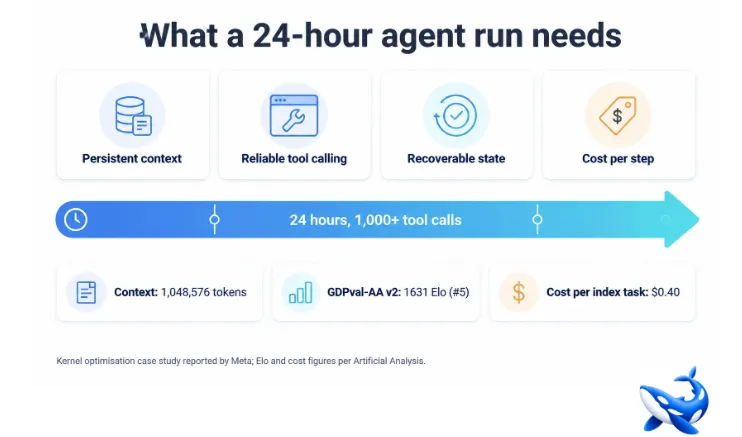
Muse Spark 1.2 is a long-horizon agent model, and the most revealing thing in Meta's launch material isn't a benchmark but a case study: the model spent more than 1,000 tool calls across 24 hours optimising KDA and MLA GPU kernels for NVIDIA Hopper hardware. Meta packaged it with an agent for a reason — a packaging decision we examined against a very different product in Muse Code vs Qoder Cantus.
No reproducible numbers accompany that case study, so treat it as a demonstration rather than evidence. But the *shape* of the demonstration tells you what Meta thinks the model is for, and it lines up with the independent data better than the coding-first marketing does.
What a day-long agent run actually demands
Four things, and most models are good at one or two of them.
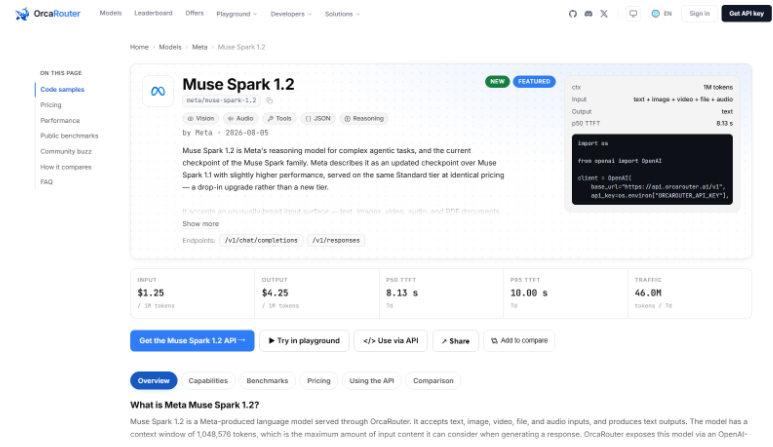
Persistent context. After six hours the run has accumulated tool outputs, failed attempts, partial results and its own earlier reasoning. If that falls out of the window, the agent re-derives conclusions it already reached, or worse, contradicts them. Muse Spark 1.2's 1,048,576-token context window is the relevant spec here, and it's genuinely large enough to matter.
Reliable tool calling. A 3% failure rate on a single call is invisible. Across 1,000 sequential calls it is close to certain disaster. Long runs need a model that formats calls correctly, handles unexpected tool output without derailing, and recovers from its own mistakes.
Recoverable state. Something will fail during a 24-hour run — a network blip, a rate limit, a process restart. Without recovery, hour 23 is worth the same as hour 0.
Cost per step that survives multiplication. At 1,000 calls, a per-call cost you'd ignore becomes the dominant line item.
Where the independent evidence actually points
This is where the story gets more interesting than the marketing.
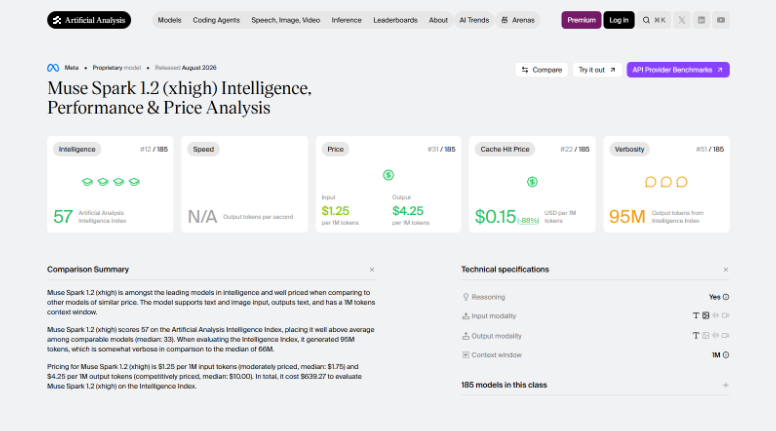
Artificial Analysis recorded the model's largest generational movement in agentic evaluations, not coding ones. On GDPval-AA v2 it jumped 260 Elo points to 1631, ranking 5th. Terminal-Bench v2.1 on AA's own implementation moved 78% → 80%; τ³-Banking moved 25% → 27%. Its overall Intelligence Index sits at 57, #12 of 185.
Vals AI, running everything through one common harness, puts it 5th of 45 overall at 71.88% — and its top domain results are all agent benchmarks in professional fields: #1 of 44 on Finance Agent (v2), #1 of 136 on TaxEval v2, #1 of 31 on Harvey's Legal Agent Benchmark. On Terminal-Bench 2.1 under that same harness it ranks #14 of 50.
Read those together and a consistent profile appears. The thing this model does unusually well is *sustained, multi-step, tool-using work over a large body of material* — regardless of whether that material is source code, tax filings or contracts. The coding framing was the training target; long-horizon agency is the capability that came out.
The co-training caveat you have to price in
Meta trained this model together with Muse Code, its terminal agent, on trajectories sampled from that agent's own harness plus long-horizon whole-repository tasks.
That's a legitimate and probably effective technique. It also means the model's demonstrated agentic strength was demonstrated inside a specific harness — one you likely aren't using. Expect some regression toward the mean when you run it in your own framework, and treat Vals' fourteenth-place common-harness coding result as a reasonable estimate of how much regression to expect on tasks like that.
The practical implication: don't budget a project around Meta's numbers. Run a representative long-horizon task in your own harness first. The gap between vendor conditions and your conditions is the single largest source of disappointment with agent models.
The economics of a long run
Here the arithmetic gets uncomfortable, and it's worth doing before you launch a 24-hour job.
Artificial Analysis measured $0.40 per Intelligence Index task — up from $0.29 for the previous version at identical list pricing — with the full index consuming 95 million output tokens against a tier median near 70 million and costing $639.27. This is a verbose model, and reasoning tokens bill at the output rate of $4.25 per million.
Multiply that across a thousand-call run and the number is not trivial. Three levers help:
• Cached input at $0.15 per million, an 88% saving. In an agent loop the stable prefix — repository, instructions, tool definitions — repeats on every call, which makes this the single biggest lever available.
• The effort dial, `minimal` → `xhigh` with `medium` default. Not every step in a long run is a hard reasoning step; many are mechanical. Varying effort per call rather than globally is the sophisticated version of this optimisation.
• Model routing within the run. The planning steps and the mechanical steps don't need the same model. Sending the bulk to something cheap and fast while reserving the deliberate model for the hard decisions is how most cost-effective agent systems are actually built.
Building it without betting on it
Two engineering notes specific to running this model in an agent.
Set your timeouts properly. OrcaRouter's seven-day production telemetry shows a p50 first token of 7.73 seconds and p95 of 10.00 seconds; Vals' independent runs averaged around 610 seconds per test. Frameworks with a default timeout under ten seconds will fail against this model in ways that look like bugs.
Keep a fallback. This model is four weeks old, from a lab shipping three versions in four months, co-trained with an agent still in public beta. A long-running job that can only be served by one model from one provider is a long-running job that fails completely when that provider has a bad hour. Routing through a platform that carries alternatives on the same OpenAI-compatible key — OrcaRouter passes Meta's list price through at 0% markup and fails over automatically — means a mid-run provider problem degrades to a retry instead of a lost day of work.
The takeaway
Meta demonstrated this model working autonomously for a full day across a thousand-plus tool calls, and the independent evidence — a 260-Elo agentic jump, fifth place overall on a neutral harness, and first-in-class results on three professional agent benchmarks — supports that framing better than the coding headline does. If you're building something that runs for hours rather than seconds, this belongs on your shortlist. Just cache your prefix, vary the effort per step, set timeouts that expect seven seconds, and keep a second model reachable, because a day-long job is exactly the thing you don't want depending on a single four-week-old endpoint.
Sourcing note: the kernel-optimisation case study, co-training description, pricing and context window are Meta's own published claims; the case study includes no reproducible figures. Elo scores, index rank, cost per task and token counts are from Artificial Analysis; Vals Index and domain ranks from Vals AI; first-token latency is OrcaRouter's own seven-day production telemetry. Checked August 7, 2026.