Best Shampoo for Hair Fall Without Harsh Ingredients: What to Look For
Hair on the pillow, strands caught in a comb and a clogged shower drain can quickly make people reconsider their haircare routine. This is often when the search for the best shampoo for hair fall without chemicals begins.
There is one problem with that phrase: no shampoo is literally chemical-free. Water, botanical extracts and natural oils are all made of chemical compounds. What most people actually want is a gentle formula that cleans the scalp without leaving the hair excessively dry, rough or prone to breakage.
Key Takeaways
- No shampoo is truly “chemical-free”; look for gentle formulas that cleanse without leaving hair excessively dry or brittle.
- Ingredients such as amla, rosemary and bhringraj may support a haircare routine, but shampoo alone cannot treat every cause of hair fall.
- Persistent, sudden or patchy hair loss should be assessed by a dermatologist rather than managed only with cosmetic products.
What is the Difference Between Hair Fall, Hair Loss and Breakage?
Normal shedding is part of the growth cycle. Cleveland Clinic notes that losing roughly up to 100 hairs a day can be normal, although the amount varies between people. Hair loss is different: fewer strands grow back, which may eventually cause thinning, a wider parting or bald areas.
Breakage is different again. Instead of falling from the root, the hair shaft snaps. Frequent heat styling, rough brushing, chemical processing, tight hairstyles and excessive dryness can all make strands easier to break.
What Makes a Shampoo Suitable for Hair Fall?
A better approach is to judge how the complete formulation behaves on your scalp and hair.
- Gentle Cleansing
A shampoo needs to remove sweat, excess sebum, dirt and styling-product residue without making the scalp feel tight or leaving the lengths unusually rough.
The American Academy of Dermatology recommends gentle shampoo for people experiencing thinning or hair loss because fragile hair can be damaged more easily.
Extremely strong cleansing is not automatically better. If every wash leaves the lengths tangled and straw-like, repeated friction during drying and combing may contribute to further breakage.
- Moisture Retention
People worried about shedding sometimes focus entirely on the scalp and forget the condition of the hair shaft.
A moisturising formula can reduce excessive dryness, while conditioner helps coat the strands and reduce friction, split ends and breakage. Cleveland Clinic specifically recommends moisturising shampoo and conditioner when hair is fragile.
- Scalp Compatibility
Burning, persistent itching, redness or excessive dryness should not be accepted simply because a product is labelled herbal or natural.
Botanical ingredients can still cause sensitivity in some people. Likewise, synthetic ingredients are not automatically irritating. The entire formulation, ingredient concentrations and an individual's skin response matter more than whether an ingredient originated in a plant or laboratory.
This is also why terms such as “natural” should not be treated as a guarantee of safety. Even the US FDA notes that it has not established a regulatory definition of “natural” for cosmetic labelling.
Ingredients Commonly Found in Herbal Hair-Fall Shampoos
Traditional Indian haircare uses several herbs and plant oils. Modern Ayurvedic shampoos often combine these ingredients with contemporary cleansing and conditioning systems.
- Amla
Amla has a long history of use in Indian haircare preparations. It is commonly included in oils, masks and shampoos intended to condition the scalp and support stronger-looking hair.
- Rosemary
Rosemary has become especially popular in contemporary haircare. Most research attracting attention, however, concerns rosemary oil rather than rinse-off shampoo formulations.
- Bhringraj and Other Ayurvedic Herbs
Bhringraj, hibiscus, mulethi, neem and fenugreek are also frequently found in Ayurvedic hair products. They are generally used as part of broader herbal blends for scalp and hair conditioning.
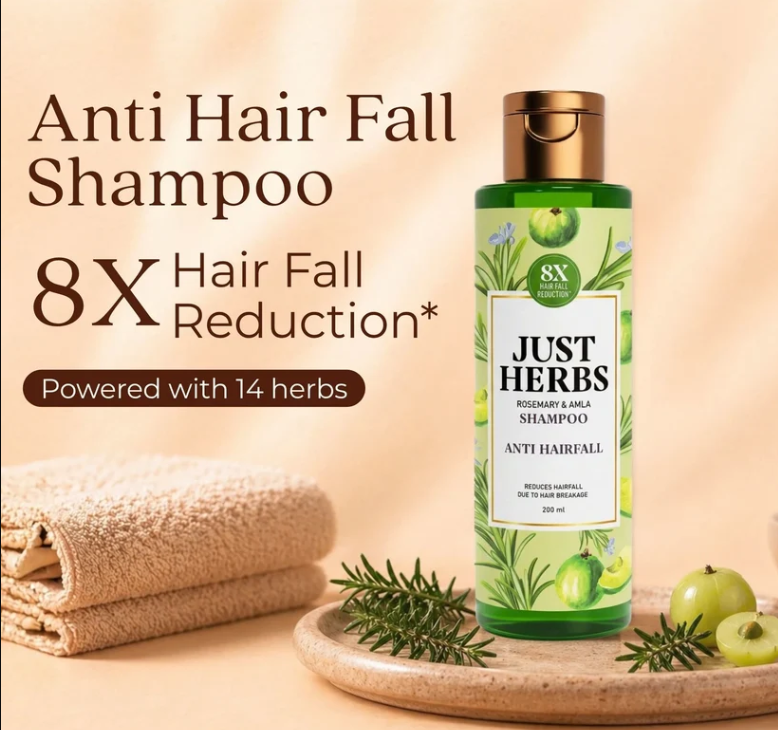
For example, the current Just Herbs Anti Hairfall Shampoo combines rosemary and amla with a wider blend of Ayurvedic herbs including bhringraj and mulethi. It is positioned as mildly foaming and non-drying, which is relevant to consumers looking for gentler cleansing rather than a harsh, heavily stripping wash.
Ingredients to Evaluate
Searches for “chemical-free shampoo” often lead to long lists of ingredients people are told to avoid.
- Sulfates
Sulfates are effective cleansing surfactants. Some people tolerate them perfectly well, while stronger formulations may feel drying on already fragile hair or sensitive scalps.
If your hair consistently becomes rough after cleansing, a milder surfactant system may suit you better. That is more useful than assuming every sulfate-containing shampoo is harmful.
- Fragrance
Fragrance makes no difference to how well a shampoo cleans hair, but it can be a consideration for people with known fragrance sensitivity or an easily irritated scalp.
- Preservatives
Preservatives are sometimes portrayed negatively in natural-beauty discussions, yet water-based cosmetic products require appropriate preservation to control microbial growth.
Choosing a Better Shampoo for Hair Fall
Instead of searching for a completely “chemical-free” bottle, look for a shampoo that cleans effectively without repeatedly leaving the scalp irritated or the hair brittle.
Check the complete ingredient list, consider whether the formula suits your scalp and hair texture, and pay attention to how the hair behaves over several washes. Herbal ingredients such as amla, rosemary and bhringraj can form part of a well-designed formula, but their presence does not replace good formulation or proper diagnosis.
Most importantly, keep expectations realistic. Shampoo is one part of haircare. When excessive shedding is coming from inside the body or from a medical condition, finding the cause matters far more than finding another bottle for the bathroom shelf.