England vs Spain: Tactical Preview of the Nations League Clash
Tuchel recalls Palmer and Alexander-Arnold, Spain arrive as world champions. The systems, the duels, and what decides Matchday 1.
A sold-out Wembley, world champions in the away dressing room, and a Tuchel squad that finally includes the players his earlier selections left out. Saturday at 7.45 pm is the clearest test yet of whether England can control a game rather than survive one.
What Both Camps Showed in Their Squad Announcements
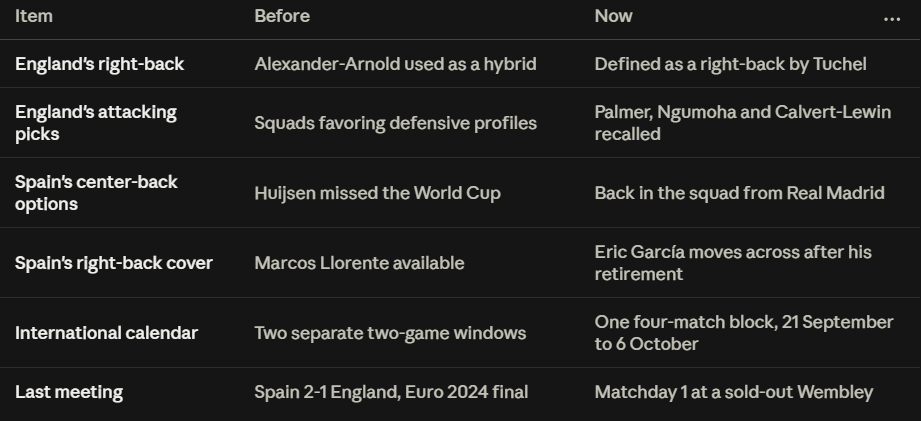
Both federations named squads on 18 September for a reshaped calendar. The old pair of two-game windows has become one four-match block running from 21 September to 6 October, which changes how each manager treats Matchday 1 of the League of Nations campaign.
England Recall Trent Alexander-Arnold and Cole Palmer
Tuchel picked 27 players and used the list to reverse a pattern. Cole Palmer and Trent Alexander-Arnold both return, alongside Dominic Calvert-Lewin, Lewis Hall, Rio Ngumoha, Jarrad Branthwaite, Myles Lewis-Skelly and Alex Scott. Earlier squads leaned towards defensive reliability; this one restores the creators.
The head coach was direct about the right-back. "He comes as a right back for us," Tuchel said of Alexander-Arnold, closing off the midfield experiment that followed him through the World Cup cycle. England arrive off their best World Cup finish since 1966, beaten 2-1 by Argentina in the semi-final before taking third place against France.
Spain Bring Back Dean Huijsen With Lamine Yamal Retained
De la Fuente changed four names from the group that won the World Cup in New Jersey. Dean Huijsen returns after missing the tournament, Fermín López is back from injury, and Josep Martínez and Roberto Fernández are the new faces. Lamine Yamal, Rodri, Pedri and Nico Williams all stay.
The individual honors tell you how settled this side is. Rodri took the Golden Ball, Pau Cubarsí was named Young Player of the Tournament, and Unai Simón won the Golden Glove. One structural note: Marcos Llorente's international retirement means Eric García now competes at right-back rather than in the center.
The Tactical Systems Both Managers Are Likely to Use
Tuchel has spent his England tenure trying to make the team look like the Premier League: high tempo, direct, physically demanding. The World Cup semi-final exposed the cost, because England struggled to slow a game once Argentina took the momentum. His fix is explicit rather than implied.
He told reporters he wants his side to be "for 10 minutes, a little bit more like Spain", meaning capable of starving an opponent of the ball for a spell rather than only counter-punching. Whether a squad assembled for intensity can do that on demand is the question the evening answers.
Spain's 4-3-3 and the Shape It Becomes in Possession
De la Fuente's nominal 4-3-3 stops being a 4-3-3 the moment Spain have the ball. A full-back steps inside, the single pivot drops between the center-backs, and the structure resolves into a back three with two controllers ahead of it and five players across the final line. Rodri is the axis of that rotation, and Pedri is the player who finds the pass once the shape has pulled an opponent apart.
The width is deliberate and asymmetric in effect. Yamal holds the right touchline and waits for isolation; Nico Williams does the same on the left with more direct running. Spain does not rush, because the shape is designed to make the opponent's press arrive late and out of position.
The Personnel Battles That Decide the Matchup
Two duels carry disproportionate weight, and both sit on England's right. Anyone studying the Spain national football team vs England national football team lineups will look there first, because that is where Spain aim their best player.
Alexander-Arnold's Positioning Against Yamal
Yamal's threat is not speed in a straight line but the pause before he commits, which punishes a full-back who steps early. Alexander-Arnold's instinct is to advance and influence play, and Tuchel has now defined him as a right-back rather than as a hybrid. The likely compromise is a nearside midfielder tucking across to make the first contact, leaving the full-back to hold his line rather than duel alone.
Watch these five things from the opening whistle:
- England's press triggers: whether they jump on a backward pass to Spain's pivot or sit and wait for the ball to reach a full-back.
- Spain's midfield rotations: which of Rodri, Pedri and the third midfielder drops, and whether England follow the man or hold the zone.
- The Yamal and Williams isolations: how often either winger gets a genuine one-against-one rather than a doubled-up defender.
- England's transition speed: the number of passes between winning the ball and the first shot, which is where this side is at its best.
- The set-piece battle: England's height advantage against a Spanish side that concedes few chances in open play.
What This Means for the Rest of Group A3
Group A3 puts England, Spain, Croatia and Czechia together, with the League A knockout stage following in March 2027 and the finals set for 9 to 13 June. Six league-phase matches are compressed into the September and November windows, so a Matchday 1 result carries weight in the nations' league table that a friendly never would.
Rotation Before the Czechia Trip Three Days Later
England fly to Prague to face Czechia at the Fortuna Arena on Tuesday 29 September, 72 hours after kick-off at Wembley. They stay abroad for Croatia in Rijeka on 3 October, a match scheduled behind closed doors under existing UEFA sanctions on the hosts, before returning to Wembley for Czechia on 6 October.
Four matches in eleven days is a squad exercise rather than a selection one. Expect Tuchel to treat Saturday as the game to load his strongest eleven into, then rotate heavily in Prague, because the fixture that decides qualification is more likely to be one of the away trips than the one against the world champions.
The stat comparisons circulating this week, including the Spain national football team vs England national football team stats from the Euro 2024 final, flatter Spain, and this Aviator Game guide covers how multiplier timing works if second-screen habits fill the half-time break.
Final Verdict
Spain's identity is finished, and England's is still being assembled, which is the whole contest in one line. La Roja beat Argentina 1-0 in extra time to win the World Cup and have changed four names since; England have changed their entire attacking emphasis in one squad announcement.
FAQ
What formation does Thomas Tuchel use with England?
He has no fixed shape, but a consistent principle: defensive structure first, then speed in transition, with a Premier League tempo he has spoken about repeatedly. The September squad softens that by restoring creators such as Cole Palmer, which points towards a more possession-minded setup than his earlier selections.
What formation does Spain play under Luis de la Fuente?
A 4-3-3 on paper that becomes a back three with two controllers and five forward players in possession. Rodri drops to build, a full-back steps inside, and the wingers hold maximum width. The aim is to pull the press apart before playing through it rather than around it.
Are Cole Palmer and Trent Alexander-Arnold playing against Spain?
Both are in the 27-man squad announced on 18 September, which is not the same as a starting place. Tuchel confirmed Alexander-Arnold is selected as a right-back rather than a midfielder. The eleven is announced roughly an hour before kick-off.
Where and when is England vs Spain being played?
Wembley Stadium on Saturday 26 September 2026, kicking off at 7.45 pm BST, with the ground sold out. UK coverage is on ITV1. It opens the 2026-27 Nations League league phase, which runs until 17 November before the knockout rounds in March.