Fiber Bragg Grating Technology: Why Optical Sensors Matter in Industrial Systems in Malaysia
Industrial plants in Malaysia often have to monitor temperature, strain, vibration, and other process conditions around equipment where conventional electrical sensors can become difficult to use. High electromagnetic interference, high voltage, long cable runs, and limited installation space can all affect sensor selection.
This is where fiber bragg grating sensors can offer a different approach. Instead of transmitting an electrical measurement signal from the sensing point, an FBG sensor uses changes in the reflected wavelength of light. That makes the technology particularly useful for applications where electrical isolation and immunity to electromagnetic interference matter.
What is Fiber Bragg Grating Technology?
A Fiber Bragg Grating (FBG) is a periodic variation in the refractive index within the core of an optical fiber. It acts like a filter that's picky about wavelength: it reflects one narrow band of light and lets everything else pass right through.
The measurement principle itself isn't complicated once you see it laid out.
Light travels down the fiber. When it hits the grating, one particular wavelength, called the Bragg wavelength, gets reflected back.
Now here's the part that matters for measurement. When temperature changes, or the fiber experiences mechanical strain, the grating period and the refractive index shift slightly. That shift changes the reflected wavelength. An optical interrogator picks up on this change and translates it into a temperature or strain reading, depending on how the sensor's built.
This distinction matters in industrial plants. The sensor isn't simply producing an electrical resistance or voltage at the measurement point. The information is encoded optically.
Multiple FBGs can also be installed along a single fiber and interrogated individually, creating a quasi-distributed measurement system.
Benefits of Using Fiber Bragg Grating Technology in Malaysian Industry
The value of fiber bragg grating sensors depends heavily on the application. They're not a universal replacement for RTDs, thermocouples, or other conventional instruments.
1. Immunity to Electromagnetic Interference
Optical fibers don't carry electrical signals along the sensing path. As a result, FBG systems can be useful around environments with strong electromagnetic interference.
This is relevant to high-voltage equipment, electrical substations, power generation assets, and industrial machinery where large electrical loads are present. Technical references on fiber-optic sensing identify electromagnetic interference immunity as a major advantage of optical sensors.
2. Electrical Isolation
An optical fiber is electrically insulating. That's useful when the measurement point is located near high-voltage equipment or where electrical isolation is a design requirement.
For example, consider temperature monitoring around a high-voltage switchgear installation. Using an optical sensing arrangement can separate the sensing element from the electrical measurement circuitry, reducing the need to place conventional electrical conductors directly at the measurement location.
3. Multiple Measurement Points on One Fiber
One of the practical strengths of FBG technology is multiplexing.
Several gratings can be placed along one optical fiber, with each grating assigned a different wavelength range. An interrogator can distinguish the individual sensors by their wavelength response. Technical literature describes quasi-distributed FBG systems in which multiple discrete sensing points are interrogated through one fiber.
For a plant engineer, that can simplify the architecture when many measurement locations need to be monitored.
Imagine a transformer or industrial asset with temperature monitoring required at several points. Rather than treating every measurement point as an entirely separate electrical circuit, an FBG arrangement can place multiple sensing points along an optical path.
4. Lightweight and Compact Construction
Optical fibers are small and lightweight compared with many conventional sensing arrangements. This becomes useful where access is restricted, cable routing is difficult, or sensors need to be attached to structures without adding much mass.
5. Temperature and Strain Measurement
FBGs respond to both temperature and mechanical strain. That can be an advantage, but it also needs careful engineering.
If an FBG is being used specifically for temperature measurement, the installation needs to account for strain effects. Similarly, when measuring strain, temperature compensation may be necessary because temperature can also shift the Bragg wavelength.
That's one detail engineers shouldn't overlook when specifying the system.
6. Suitability for Harsh Industrial Areas
Fiber-optic sensing can be considered for applications involving electromagnetic interference, high voltage, and demanding industrial conditions. For Malaysian facilities, the right question isn't simply, "Can an FBG sensor measure temperature?" It can. The better question is whether its optical architecture solves a specific measurement problem better than the available electrical alternatives.
Choosing Fiber Bragg Grating Sensors for Malaysian Industries
Selecting fiber bragg grating sensors should start with the process requirement, not the sensor catalogue. A plant team should first define what needs to be measured, where the measurement will be taken, and what environmental conditions the sensor will face.
Start With the Measurement Parameter
FBG technology can support measurements such as temperature and strain, while specialized arrangements can address other parameters.
For temperature work, nail down:
- Required temperature range
- Accuracy and resolution you actually need
- Number and location of measurement points
- Response time
- How the sensor will be mounted
- Whether temperature compensation is required
For strain work, define the expected strain range, the direction of strain, how the sensor attaches, and what temperature swings it'll see.
Check the Operating Environment
The sensor package matters as much as the FBG itself.
A sensor installed on a transformer, pipeline, furnace structure, or industrial machine won't experience the same conditions as one installed inside a laboratory. Engineers should consider vibration, mechanical stress, moisture, chemicals, installation temperature, and physical protection.
The fiber may be optically suitable but still require an appropriate protective construction for the actual installation.
Evaluate the Interrogator
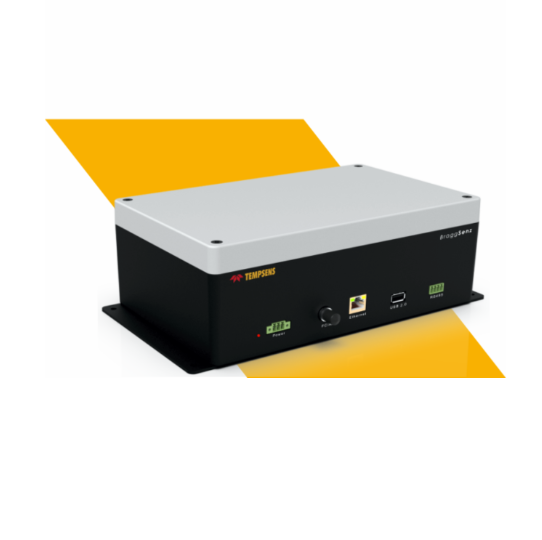
An FBG sensor doesn't work as a standalone electrical transmitter. The optical interrogator supplies the optical signal and measures the wavelength response.
That means the interrogator's wavelength range, number of channels, sampling characteristics, communication interfaces, and required resolution should be reviewed along with the sensor.
Consider Multiplexing Requirements
If a plant needs measurements at several locations, ask how many FBGs will be connected to each optical channel and how they will be addressed.
This is particularly relevant when monitoring several points on a single asset. A well-planned system can reduce the amount of individual sensing infrastructure required, while still providing location-specific measurements.
Match the Sensor to the Installation
A good specification should include the mounting arrangement, sensing range, environmental conditions, fiber routing, connector requirements, calibration needs, and interrogator compatibility. FBG technology is an architecture, not a single standard sensor specification.
Final Words
Fiber bragg grating sensors make the most sense when conventional electrical measurement creates a specific engineering challenge, such as electromagnetic interference, high-voltage isolation, restricted installation space, or the need to monitor multiple points through an optical sensing network.
For Malaysian industrial facilities, the selection process should therefore begin with the asset and operating conditions. Tempsens Malaysia provides industrial temperature measurement solutions, including fiber-optic sensing technologies designed for demanding applications.