Football Analytics Teaches Australian Punters
Say “football” in Melbourne and you mean the AFL. Say it in Sydney and half the room hears NRL. Say it at an Adelaide social club on a Sunday night and it's the A-League, or whatever's on from Europe at 3 am. Three codes, three sets of betting habits, one shared vocabulary that doesn't fit any of them properly.
You can see the confusion in search. Australians type “what is line betting”, “what is handicap betting”, “what is draw no bet” and “what is a multi bet” in steady numbers all year, and the answers they land on are mostly written for American or British punters. This is the Australian version. It also goes one step past the definitions, into the number that decides whether you're a winning bettor or a paying customer.
Four terms Australians keep googling
“Sports betting” on its own pulls about 1,200 searches a month in Australia and barely moves between seasons. The mechanics queries around it are smaller but say more. “What is line betting” and its variants add up to roughly 600 a month; the others sit close behind.
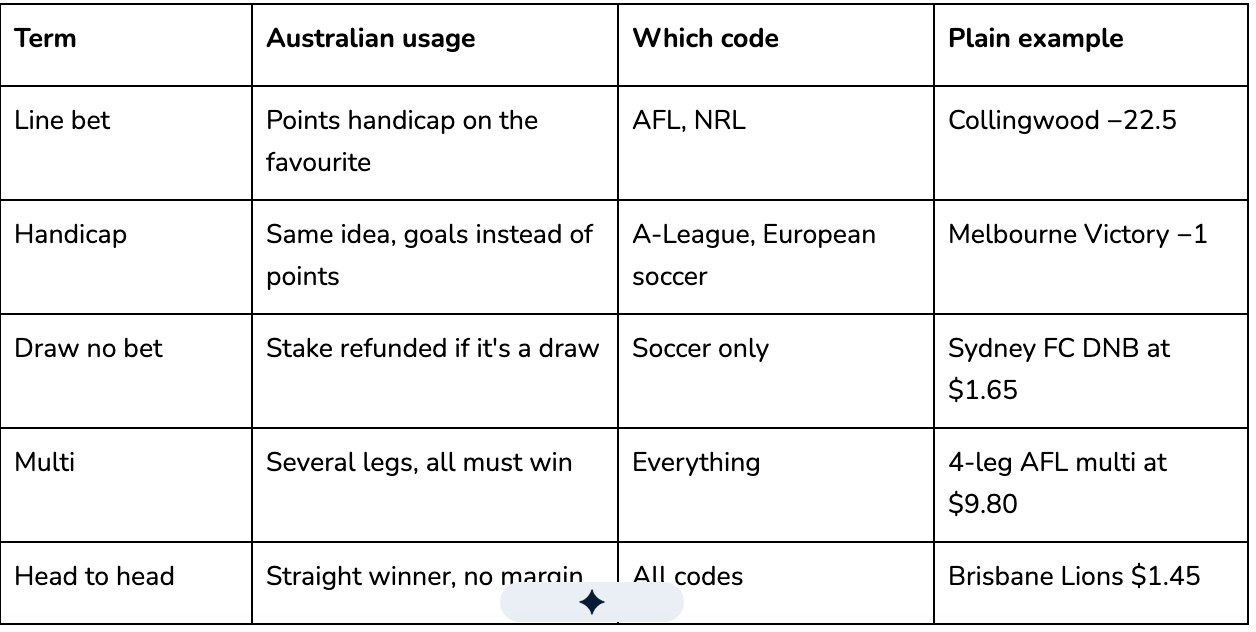
Two of those rows describe the same bet. “Line” came from American sport, “handicap” from the UK, and Australians ended up using them by code rather than by meaning. Nobody decided this. It just happened, the way “footy” means a different thing depending on which side of the Barassi Line you grew up on.
Line betting in the AFL — how the bookmaker flattens a mismatch
A line bet exists because head-to-head odds on a lopsided game are useless. If Geelong is $1.08 to beat a bottom-four side, nobody wants the favourite, and the underdog is a coin flip on a miracle.
So the bookmaker gives the weaker team a head start. Geelong −22.5 means Geelong has to win by 23 or more for your bet to land. The other side, the underdog +22.5, pays if they lose by 22 or fewer, or win outright. Both sides get priced around $1.90, and the market looks balanced again.
Why the half point? Because a line of −22.5 can't push — nobody wins by exactly 22.5. A whole-number line of −22 can, and most Australian bookmakers refund the stake on an exact-margin push.
The people who actually make money on lines watch one thing: the gap between the bookmaker's number and the modelled margin. Your own model, or one of the public ones aggregated at Squiggle, says Geelong wins by 30 on average? Then −22.5 has value. Says 15? Walk past it. That single comparison is most of the discipline, and it's a lot less glamorous than the tipping segments make it sound.
Handicap and draw no bet in the A-League
Soccer complicates everything because draws happen. In the AFL a draw is a once-a-season curiosity. In the A-League it's roughly one match in four, and that breaks the two-way logic of a line bet.
Soccer handicaps use whole goals, half goals, and the quarter goals borrowed from Asian markets that trip up nearly everyone. Western Sydney −0.5 is easy: they need to win. Western Sydney −1 means win by two; win by exactly one and the stake comes back. Western Sydney −0.75 splits your money between −0.5 and −1, which is roughly where most people give up and google it.
Draw no bet is the friendlier tool. Back a team, and if the match ends level you get your stake back. The price is lower than a straight win — Perth Glory at $2.40 to win might be $1.70 draw no bet — but you've removed the outcome that kills most soccer punters. Under the hood, DNB is identical to a −0 handicap. Same product, two labels.
Expected value — the only number that matters long-term
This is the part the glossary sites leave out.
Every price implies a probability. Divide 1 by the decimal odds. A $2.00 price implies 50 %. $1.50 implies about 67 %. Add both sides of any market together and you'll get more than 100 % — the overrun is the bookmaker's margin, usually 4 to 6 % on a big AFL game and higher on an obscure A-League fixture nobody in Canberra is watching.
Expected value is what you get when you set that implied probability against your own honest estimate.
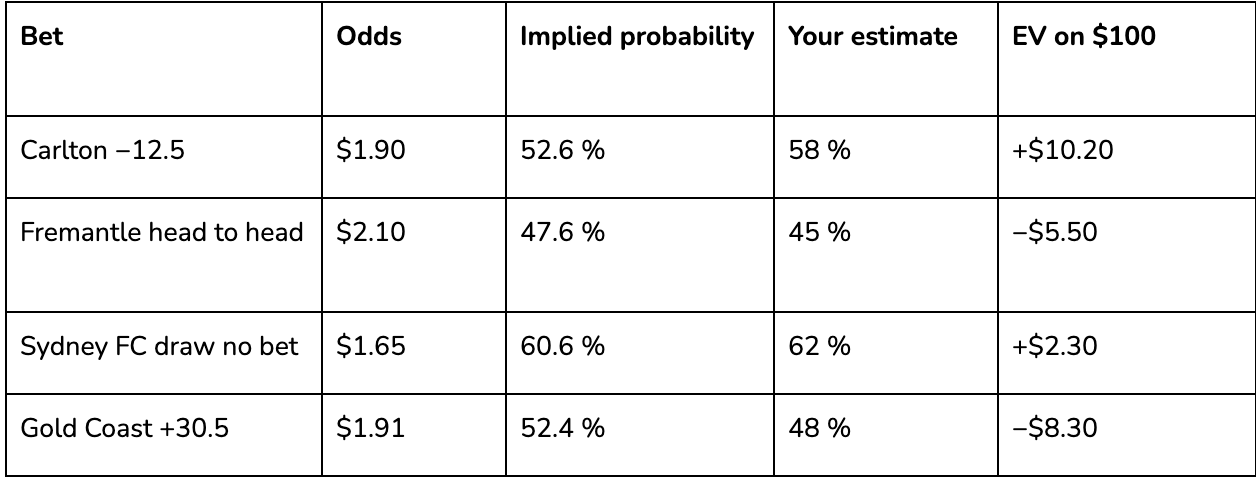
The arithmetic is (your probability × odds × stake) − stake. Carlton at $1.90 with a 58 % estimate: 0.58 × 1.90 × 100 − 100 = +$10.20. You won't see ten dollars on any single bet — you'll win $90 or lose $100. Across a few hundred bets where your estimate holds up, though, that's the average.
Two caveats, and they're big ones. Your estimate has to actually beat the market's, and for most people it doesn't. And a positive-EV bet still loses often. EV describes the long run, and the long run is longer than most bankrolls in Hobart or Darwin.
Why multis feel smart and usually aren't
A multi multiplies the odds, which is why a four-leg AFL multi at $9.80 looks like a bargain next to four singles.
It multiplies the margin too. If each leg carries a 5 % edge for the bookmaker, four legs compound to roughly 19 %. That's the reason every app in Brisbane pushes multis on a Friday night and never pushes singles — the maths tilts further toward the house with every leg you add.
Analytically a multi only makes sense when every leg is individually positive EV. If you wouldn't take each bet on its own, bundling them doesn't fix anything. It hides the bad leg inside a bigger number.
Between rounds — where the money sits
There's a practical question that the analytics side rarely gets to. Football betting is weekend work. The AFL runs Thursday to Sunday; the A-League and Europe fill the gaps. Between rounds, money sits in accounts doing nothing, and a fair number of punters move some of it into casino games during the week.
For anyone doing that from Australia, two things matter more than the games. Whether the site runs in Australian dollars without a conversion fee on every deposit, and whether PayID works both ways. LuckyElf is one of the operators that handles both — accounts in AUD, PayID for deposits and withdrawals, withdrawal windows stated in the terms rather than left vague. It's offshore, so it sits outside Australian licensing, and that trade-off is one each reader weighs for themselves.
The full terms and payment page: LuckyElf Casino Australia
The football logic doesn't carry over, and it's worth saying so before anyone tries. Pokies carry a fixed house edge — the RTP is published and it's below 100 % by design. There is no “your estimate versus the market” on a slot. If money moves there between rounds, it's entertainment with a known cost, not another bet with a possible edge. LuckyElf, like any casino, is a place to spend a margin. Not to beat one.
What football analytics actually teaches
Less a system than a habit. Convert every price to a probability, set it against your own number, bet only when the gap favours you. Lines and handicaps just make that comparison possible in lopsided games; draw no bet does the same for soccer's third outcome. Multis mostly make it possible for the bookmaker.
The punter in Perth who runs that arithmetic every week won't win every bet. They'll know exactly what each one costs, and that's more than most.
FAQ
What's the difference between a line bet and a handicap?
None in mechanics. Australians say “line” for AFL and NRL points margins and “handicap” for soccer goal margins. Both give the weaker side a head start so the two prices sit close to even.
What does draw no bet mean?
You back a team; if the match is drawn your stake comes back. The price is lower than a straight win, and it's the same product as a −0 handicap.
Why is there a half point on AFL lines?
So the bet can't push. A line of −22.5 has to be won by 23 or more; nobody wins by exactly 22.5. Whole-number lines can tie, and most Australian bookmakers refund the stake when they do.
How do I work out expected value?
Divide 1 by the decimal odds for the implied probability, compare it with your own honest estimate, and only bet when yours is higher. The formula is (your probability × odds × stake) − stake.