Liverpool’s press must survive Manchester City’s first pass
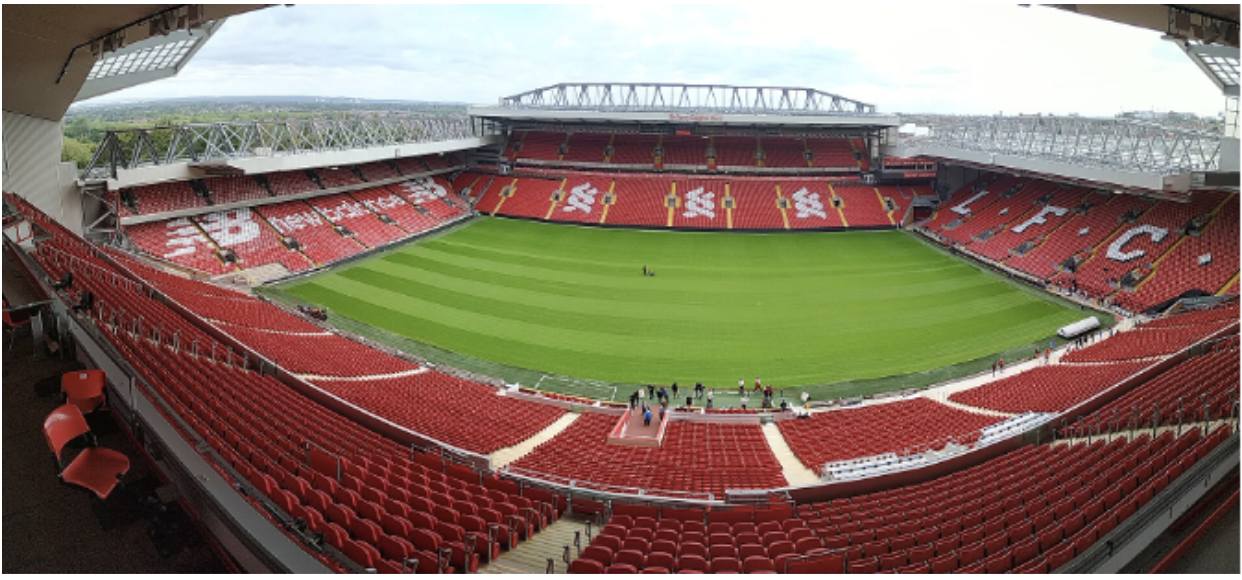
Anfield viewed from the Main Stand, 2019. Archive photograph. Photo:
Yurificacion / Wikimedia Commons
·
Anfield viewed from the Main Stand, 2019. Archive photograph. Photo: Yurificacion / Wikimedia Commons · CC BY-SA 4.0
Liverpool’s meeting with Manchester City at Anfield on 11 October poses a question that a formation graphic cannot answer. How aggressively can Andoni Iraola’s side pursue the ball without opening the route City want to use next?
In his pre-match interview with Liverpool’s official website this week, Iraola identified the balance between vertical attacking and control as unfinished work. His assessment gives Sunday’s game a clear tactical focus. The success of Liverpool’s press should be judged by what happens after the first challenge, especially when that challenge fails.
The player behind the pressure
A forward sprinting towards a centre-back is only the visible part of a press. Behind him, midfielders must decide whether to follow an opponent, protect a passing lane or prepare to contest a longer ball. If those decisions pull the team in different directions, the first sprint can make the defending side more vulnerable.
Breaking The Lines’ analysis of Jack Grealish’s positioning and ball carrying at Everton offers a useful example of how receiving positions change the options around a player. The same principle applies to escaping pressure. A receiver who can turn forces the next defender to make a decision.
Liverpool should therefore prioritise the direction in which they send City. A pass towards the touchline can be useful if the winger closes from inside, the full-back is ready to engage and the nearest midfielder protects the return ball. Without that support, the touchline is simply where City begin their next combination.
Winning the second action
The most revealing moment may come when City play beyond the initial pressure. Liverpool’s nearest midfielder then needs to delay the receiver while the rest of the side recovers. Diving into a challenge could produce a turnover. It could also remove the last obstacle between possession and a run at the back line.
An intercepted pass is not automatically an attacking opportunity either. If Liverpool recover the ball with their forwards already running away from it, the sensible first action might be a short pass that restores the team’s spacing. Vertical football does not require every possession to travel towards goal immediately.
That distinction matters when interpreting the match’s betting categories. A team can press effectively and improve its chance of winning without creating a high-scoring contest, because the same structure can restrict both sides’ transitions. The match-result and goals markets within Betway's Premier League odds therefore address different consequences of Liverpool’s approach. Any assessment of them needs to distinguish controlled recoveries from an exchange of open-field attacks.
What the midfield must protect
Watch the position of Liverpool’s deepest midfielder when a wide player jumps forward. If he moves towards the ball too early, a City attacker may appear in the space he has left. If he remains too deep, Liverpool can lose the ability to keep an attack alive after recovering possession.
The answer depends on the ball carrier’s body position. A player facing his own goal offers a different pressing opportunity from one who has received on the half-turn. Liverpool’s distances should change with that information, rather than with a fixed instruction to push everyone higher.
City will also have opportunities to tempt Liverpool out. Circulating possession across the defensive line can look harmless while gradually separating the forwards from their midfield support. The relevant measure is the space gained through the sequence, not the number of passes completed.
PlaybookWire’s introduction to sports analytics distinguishes event data from the positional information that helps explain it. That distinction is particularly useful here. Counting recoveries tells us what happened, but the location of Liverpool’s supporting players explains whether those recoveries were repeatable.
A useful test at Anfield
A strong Liverpool performance would include moments when the team chooses to wait. Dropping into a compact shape after the first press has been beaten is a way of preserving the next opportunity to attack.
Sunday should reveal whether Liverpool can make those decisions collectively. The first runner can start the pressure. The players behind him will decide whether it becomes control.