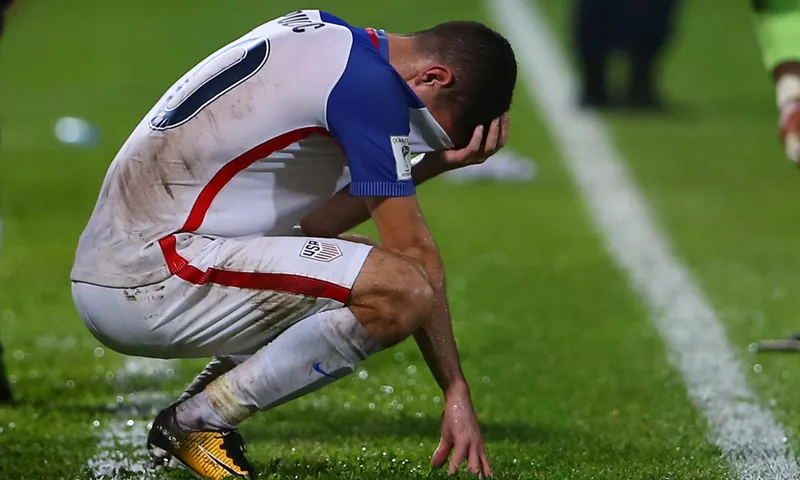
Photographer Ashley Allen/Getty
One Year On: How the USMNT can finally rebuild from the failure in Couva
A few months ago, I was explaining to a Colombian classmate the topic of this paper — how key stakeholders can push aside the wreckage of U.S. soccer’s World Cup qualification failure, and stimulate meaningful soccer development in…
A few months ago, I was explaining to a Colombian classmate the topic of this paper — how key stakeholders can push aside the wreckage of U.S. soccer’s World Cup qualification failure, and stimulate meaningful soccer development in America. She laughed at the premise that soccer could ever become a major sport in America, noting that America simply does not have the cultural context to embrace soccer the way that Latin American countries do. While I agree with her that there are certain historical aspects of Latin American culture that facilitate soccer’s popularity in that region which the United States will never be able to replicate, there are many other cultural aspects that the United States can and should aim to emulate and adopt. I went to Russia for the World Cup, and interviewed 40 attendees—many of whom hailed from Latin American countries—on several topics, namely, how they got hooked on the beautiful game.
It has been said that nobody goes crazy for their soccer quite like Latin Americans, and anecdotal evidence from this year's World Cup backs up this claim: the five most popular jerseys I observed in Russia were of Peru, Mexico, Colombia, Argentina, and Brazil. The stats also support this claim — other than Russia, the countries with the most ticket sales, as of April 30, were 1) United States, 2) Brazil, 3) Colombia, 4) Germany, 5) Mexico, 6) Argentina, 7) Peru. Many of the fans I spoke with in Russia who were wearing Colombia, Mexico, Brazil, and Peru shirts actually lived in the United States, which perhaps explains why the U.S. led in ticket sales after Russia. Even though they live in America, even though they may not be first-generation or second-generation immigrants, these fans still cheer for the national teams of their ancestors and will travel across the world to cheer them on.
In response to the survey question “Please rate how important each of the following factors were to you when making the decision to attend the World Cup,” the response most frequently marked as “1-Very Important” was “Once in a lifetime experience." Of course, the very experience of going to a World Cup is extremely special and rare; for many, it is a once-in-a-lifetime experience. Interestingly though, when asked “Please rate how important the following attractions were to you when making the decision to attend the World Cup,” the response that was the 2nd most frequently marked as “1-Very Important” was “Wanting to support national team.” While 49.69 percent of recipients marked the “Opportunity to watch world class football” as “1-Very Important,” 47.96 percent of recipients marked "Wanting to support national team” as “1-Very Important.” Many of those people who ranked both “Wanting to support national team” and “Once in a lifetime” as very important came from countries like Panama, who played in the first World Cup in their nation’s history, and Peru, who played in their first World Cup since 1982. For fans of these nations, merely qualifying for the World Cup was a unique opportunity that may only come to pass once in their lifetime. This comes in sharp contrast to the United States, which, before their qualifying disaster last November, had qualified for every World Cup since 1990. American fans are used to qualifying for the World Cup, but they are also used to their teams in other sports winning “World Championships” and being crowned “World Champions.” When you are accustomed to being number one in certain sports, it is hard to get excited about a sport that your country ranks #25 in.
While Americans may never be able to shake their sense of entitlement towards being #1 in sports, and while they may never be as excited about qualifying for a World Cup as Peruvians or Panamanians were, there is still potential to grow soccer’s popularity in America by emulating an aspect of Latin American “football socialization.” When asked on the survey, “Which of the following best describes how you developed an interest in football (soccer)?” the most common answer recipients gave was “playing the sport.” If key stakeholders want to stimulate the growth of soccer as a spectator sport in America, if they want to increase the percentage of soccer fans in America, they should focus on increasing the percentage of youth and adolescent soccer players in America. However, with so many barriers hindering American soccer from becoming the most-played sport in America, this is easier said than done.
Credits
Words
Zach Lowy