The Second Life of Failed Crypto Projects: How Dead Tokens, Abandoned Blockchains and Forgotten Ideas Return
Most abandoned crypto projects stay abandoned, but a handful come back. Here's what separates a genuine revival from a coin that's just still technically tradable.
Over six and a half million cryptocurrency projects have been created since 2021. Of those, 3.7 million crypto projects have been delisted and can no longer trade at all, according to data compiled by GeckoTerminal, a mechanism that applies just as easily to a crypto casino platform as it does to a struggling DeFi protocol. This is over half of all the projects ever made, lying dormant in wallets and forgotten websites, alive on the blockchain, but useless. Most of these cryptocurrencies will not trade ever again, though a small number do get relaunched.
What Actually Counts as a Dead Project
All trackers that maintain a list of abandoned cryptocurrencies consider a coin dead based on the following parameters: less than $1,000 in trading volume within a three-month span, an offline or redirected website, and lack of development. By this definition, approximately six in ten low-volume cryptocurrencies have already been deserted by their developers.
However, there is another classification of cryptocurrencies: zombie currencies do not die completely but have ceased to grow in terms of value, trading volume, and so on, usually because of bad tokenomics and governance rather than outright abandonment. There is a third type of coin called a rug pull, which implies a project whose developers deserted it after having gained funds from investors.

The Projects That Actually Came Back
Genuine resurrections are rare, but they can be identified by following the same pattern. An example of this is Ethereum Classic; it arose from a controversial fork back in 2016, it was dismissed by many people in the cryptocurrency industry back then, and yet it remains one of the more durable players in the market to this day. A handful of conditions tend to show up whenever a dead or fading project actually returns:
- A new team formally adopts the abandoned codebase rather than simply forking it without any real development plan.
- The project's website and community channels get relaunched under active, visible management.
- Regular, verifiable development activity resumes, rather than vague promises about a future roadmap.
- A community forms around the revival independently, rather than the comeback being manufactured entirely by the new team's own marketing.
The example of the Terra Classic, which is the token left behind by the Terra chain that collapsed in 2022, demonstrates the messy middle ground between death and revival. Despite losing almost all of its value and developer community, a community of people continues trying to revive the project.
Comparing the Categories
Here's a quick side-by-side of how these categories actually differ, since the labels get thrown around loosely:
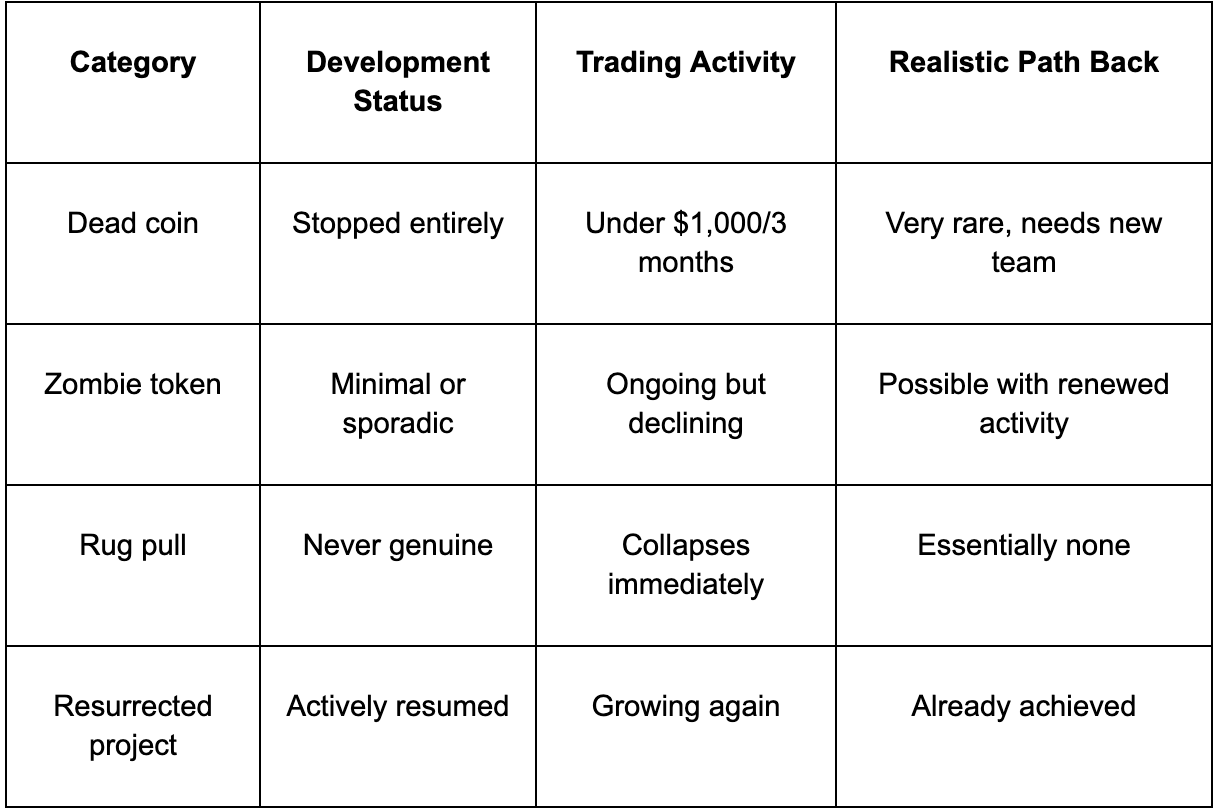
The sites that track abandoned cryptocurrencies have a common theme when it comes to dealing with dead or zombie coins: they always need to be considered high risk no matter what their background is, and you need to see signs of recent and reliable development if you think the project could actually get revived. Nostalgia for the earlier buzz around the coin isn't going to be an indicator.
Most of the projects listed as dead would continue being right where they are, having zero or close to zero value with no updates made to the smart contract ever since the project was abandoned. There are exceptions, and they would have some common features – the willingness of the team to claim responsibility for the abandoned project and people from the original community who notice them.