Who Will Win the 2026 Ballon d’Or?
Who will win the 2026 Ballon d’Or? We rank the leading contenders after the World Cup and compare Rodri, Lamine Yamal, Kylian Mbappé, Lionel Messi and more.
The race for the 2026 Ballon d’Or remains unusually difficult to call. The European club season produced several outstanding candidates, while the 2026 World Cup significantly changed the picture just months before the award ceremony.
Spain's World Cup triumph strengthened the cases of Rodri and Lamine Yamal. Kylian Mbappé finished the tournament as its leading goalscorer, Lionel Messi led Argentina to another final, and several other candidates can point to major club achievements.
At this stage, Rodri is our narrow favorite, but there is no overwhelming frontrunner. The central question is how voters balance individual performance, club achievements and the impact of the World Cup.
Who Is the Favorite to Win the 2026 Ballon d’Or?
Rodri is our current favorite to win the 2026 Ballon d’Or, narrowly ahead of Lamine Yamal and Kylian Mbappé.
His strongest argument is the World Cup. Rodri helped Spain become world champions and received the FIFA Golden Ball as the tournament's best player. However, an injury-disrupted club campaign prevents him from becoming an obvious choice.
Yamal has a more complete combination of club and international success, while Mbappé possesses the strongest goalscoring case. Messi's exceptional World Cup also keeps him in contention.
Our current ranking is:
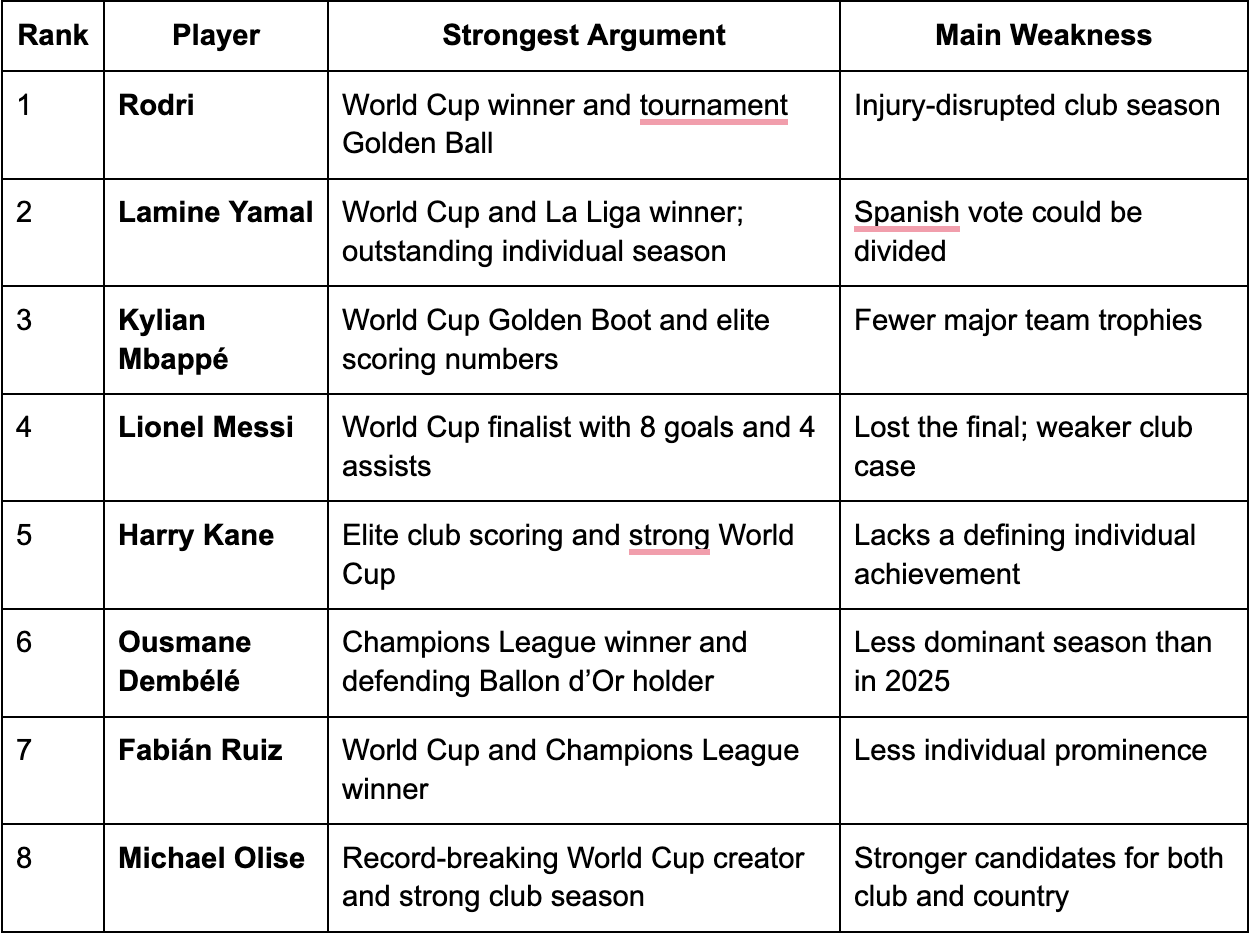
This is not an official Ballon d’Or ranking. The final 30-player shortlist had not yet been announced as of mid-August, so the order reflects the strength of each player's current case.
How Is the 2026 Ballon d’Or Winner Decided?
The Ballon d’Or is not decided simply by counting goals or trophies.
For the men's award, an international jury of specialized journalists votes on a 30-player shortlist. Each voter ranks ten players, with points awarded according to their position on the ballot.
The official criteria are considered in this order:
- Individual performances and how decisive or impressive the player has been;
- Team performances and achievements;
- Class and fair play.
The order is particularly relevant to the 2026 race. Winning the World Cup significantly strengthens a player's case, but it does not automatically make that player the Ballon d’Or winner.
Mbappé, for example, can challenge the Spanish candidates through individual production even without winning the tournament. Similarly, Rodri's World Cup Golden Ball matters because it provides evidence of individual excellence alongside Spain's collective success.
When Is the 2026 Ballon d’Or Ceremony?
The 2026 Ballon d’Or ceremony will take place in London on 26 October 2026 and will mark the 70th edition of the award.
It will be the first Ballon d’Or ceremony held in the British capital.
The winner will succeed Ousmane Dembélé, who claimed the men's award in 2025. The official 30-player men's shortlist had not yet been announced as of 14 August, with further details on the nominees still to come.
Until the shortlist and voting are completed, any ranking of the contenders remains an assessment rather than an official indication of the final result.
2026 Ballon d’Or Favorites: Who Has the Strongest Case?
Four candidates currently stand out from the rest of the field, but their arguments are built on very different types of achievement.
1. Rodri — World Cup Success and the Golden Ball
Rodri's case begins with the biggest team achievement available in football: winning the World Cup.
Spain defeated Argentina 1–0 after extra time in the final to become world champions for the second time, and Rodri received the FIFA Golden Ball as the tournament's best player.
His influence was not primarily reflected through goals or assists. Rodri controlled possession, linked defence and attack, recovered the ball and gave Spain the structure required to dictate matches.
In the World Cup final, FIFA recorded him completing 101 of 105 passes, winning 80% of his duels and creating two chances. Spain conceded only one goal across the entire tournament.
Those performances give Rodri both collective and individual recognition from the year's biggest international competition.
The main argument against him is his club campaign. Injuries disrupted his season with Manchester City, leaving him without the same complete body of club work as several of his rivals.
That is why Rodri leads our ranking, but only narrowly.
2. Lamine Yamal — The Most Complete Trophy Case
Lamine Yamal has perhaps the most balanced case among the leading candidates.
Like Rodri, he became a World Cup winner with Spain, but his club campaign was significantly stronger. Yamal also won La Liga with Barcelona and was named the league's best player for the season.
That combination gives him major achievements at both club and international level.
His age adds historical significance to the season, although it should not determine the vote. Ballon d’Or criteria reward actual performance rather than potential, so Yamal's argument has to stand on what he produced on the pitch.
One potential complication is the number of Spanish candidates. Rodri, Yamal and Fabián Ruiz all emerged from the same World Cup-winning team with credible cases for recognition.
If voters divide their support between several Spanish players, Yamal could lose votes to his own teammates.
3. Kylian Mbappé — The Strongest Goalscoring Case
If individual scoring output becomes the decisive factor, Kylian Mbappé may have the strongest case in the field.
He finished the World Cup with 10 goals, earning the Golden Boot despite France failing to reach the final.
The tournament also took his career World Cup total to 22 goals, establishing a new record.
His club numbers strengthen the argument. Mbappé finished as La Liga's leading scorer with 25 goals, giving him elite production across both club and international football.
The weakness is collective success.
Rodri and Yamal can combine outstanding performances with the World Cup trophy, while Mbappé finished the year without comparable team achievements.
His chances may therefore depend heavily on how voters interpret the first Ballon d’Or criterion. If individual performance carries greater weight than trophies, Mbappé could still finish above both Spanish candidates.
4. Lionel Messi — Another Exceptional World Cup
Lionel Messi's performance at the 2026 World Cup unexpectedly returned him to the Ballon d’Or conversation at the age of 39.
Argentina reached another final before losing 1–0 to Spain after extra time. Messi finished the tournament with eight goals and four assists and received the FIFA Silver Ball as its second-best player behind Rodri.
Those numbers would be remarkable in any circumstances. Producing them at 39 adds another exceptional chapter to Messi's international career.
Had Argentina won the final, his case for a ninth Ballon d’Or would have been considerably stronger. Instead, the result creates a direct disadvantage against Rodri, who combines elite individual recognition with the World Cup trophy.
Messi therefore remains a serious contender, but his overall case is less complete than those of the top three.
Other 2026 Ballon d’Or Contenders
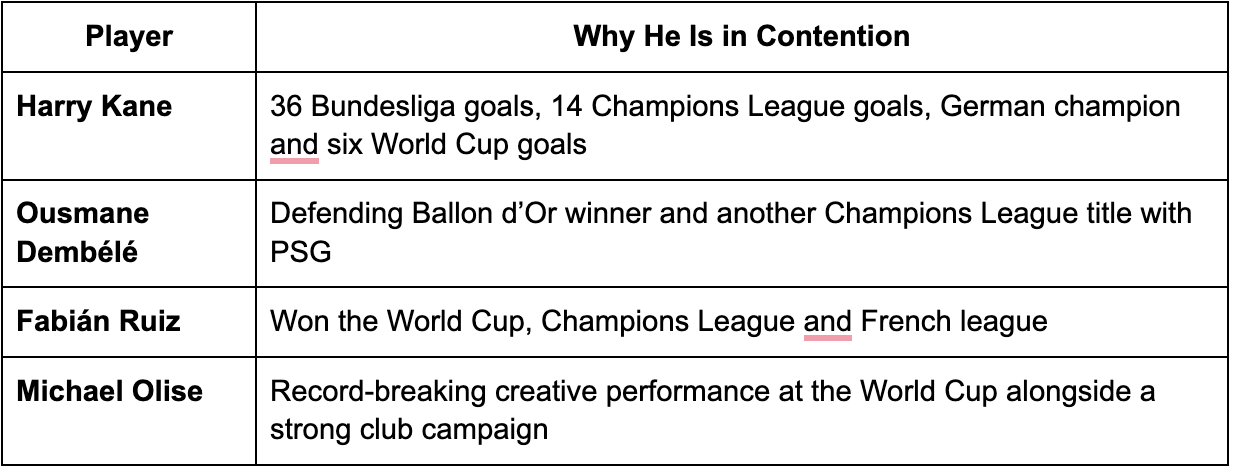
The leading four are not the only players with credible cases. Harry Kane, Ousmane Dembélé, Fabián Ruiz and Michael Olise all have achievements that could earn substantial support from voters.
How Much Will the 2026 World Cup Affect the Ballon d’Or?
The World Cup is likely to have a major influence on the 2026 vote, but there is no official rule giving World Cup performances a separate or predetermined weighting.
Its importance comes from context. The tournament places many of the world's best players on the same stage, playing high-pressure matches over a relatively short period. A decisive performance can therefore change how an entire season is perceived.
But winning the World Cup does not automatically make someone the world's best individual player.
That distinction is particularly important in 2026. Spain's success strengthens Rodri, Yamal and Fabián Ruiz, but the official Ballon d’Or criteria still place individual performance first. Mbappé's 10 World Cup goals can therefore be weighed against Spain's collective success even though France did not win the trophy.
Messi presents a similar case. Argentina lost the final, but his eight goals, four assists and Silver Ball provide a substantial individual argument.
The same principle applies to broader match analysis. Headline statistics can inform correct score tips, but tactical matchups, team strength, player availability and the circumstances behind those numbers provide essential context when assessing how a match may unfold.
The World Cup should therefore be viewed as an exceptionally important part of the 2026 Ballon d’Or race rather than a result that determines the award by itself.
Who Should Win the 2026 Ballon d’Or?
Rodri is our current choice to win the 2026 Ballon d’Or, narrowly ahead of Lamine Yamal and Kylian Mbappé.
The World Cup Golden Ball gives him the strongest individual distinction from the year's biggest tournament, while Spain's title adds the most important collective achievement. What prevents him from becoming a clear favorite is his disrupted club season.
Yamal has the more complete club campaign, while Mbappé has the strongest goalscoring argument. With no candidate dominating every Ballon d’Or criterion, Rodri should therefore be considered the current favorite rather than an inevitable winner.