Andy Diouf and art of versatility in Football
Football is a demanding sport; you can either endure the intensity of trying out different positions or stay on the bench. It typically starts with a conversion to left-back, despite joining the team as a left winger. The conversion aims to improve the player's tactical adaptability, offering multiple solutions in the attacking and defensive phases of transition. This story illustrates Diouf's career path as a footballer.
THE BEGINNING
It began at Nanterre, a Western suburb of Paris. At age 6, Diouf began his football journey in La Garenne de Colombes, a place called the warren of doves, literally, and it is also known as "La Garenne". He was born to a Senegalese father and French mother, and grew up in Nanterre. His father and two older brothers, Jules and Waly Diouf, influenced his development as a footballer. His prodigious talent attracted the attention of the Paris Saint-Germain academy. Diouf played for the youth teams of Paris Saint-Germain (PSG) and Boulogne-Billancourt, and spent two years at the INF Clairefontaine before joining the Rennes academy in 2015. In 2018, Diouf moved to Stade Rennais' academy. A significant injury interrupted his progress, but his return in 2019 marked an important turning point. He began attracting attention with his performances for Rennes' youth teams and was subsequently introduced to the French youth international setup. In December 2019, he made his first appearance for France U17 against Italy. He also featured for Rennes in the UEFA Youth League against Inter Milan.
Diouf signed his first professional contract with Rennes in December 2020. His quest to become a professional began at Rennes on 9 May 2021, when he came on as a substitute in a 1–1 Ligue 1 home draw against his former club, PSG; He was 18 at the time. However, breaking into Rennes' midfield permanently was difficult. Competition from established players limited his league opportunities, and the club eventually decided a loan move would give him the senior football he needed.
BASEL BREAKTHROUGH
Diouf joined Basel on loan from Rennes in 2022; it proved a breakthrough in his early career. At Basel, he played primarily as a No. 8, although he could also operate deeper in midfield. He made 34 Swiss Super League appearances, starting 26, while becoming one of the team's most energetic midfielders.
His performances became particularly impressive in the 2022/23 UEFA Europa Conference League. Basel reached the semi-finals, with Diouf playing a major role in their run.
UEFA subsequently named him Young Player of the Season. Across 14 Conference League appearances, he recorded:
- 14 appearances
- 3 goals
- 2 assists
- 80.7% passing accuracy
- 39 ball recoveries
UEFA specifically highlighted his defensive and offensive contributions. One of the defining moments of that campaign came against Fiorentina, when Diouf carried the ball over a considerable distance before creating space for himself and finishing with his left foot. It demonstrated one of his defining characteristics: turning ball recovery or possession into immediate forward momentum.
Why Lens saw something different
His Basel season changed his status. He was no longer simply a promising Rennes academy midfielder; he had demonstrated that he could perform consistently in senior European football. In June 2023, RC Lens signed Diouf on a five-year contract. The club described him as an intense, versatile central midfielder whose profile suited Franck Haise's system.
At Lens, his development became more tactical. Rather than simply being an energetic box-to-box midfielder, he increasingly demonstrated his ability to:
- receive possession under pressure;
- carry the ball through midfield;
- break lines with forward movement;
- contribute defensively;
- cover large spaces;
- combine with another midfielder;
- arrive around the opposition penalty area.
His physical profile is particularly useful. Lens described him as approximately 1.87m and 82kg, yet possessing the agility to dribble and accelerate with the ball.
The change of Dynamism at Inter Milan
Inter signed Diouf from Lens in August 2025. The move was significant because he entered an environment with intense midfield competition. Inter possessed established midfielders such as Nicolò Barella, Hakan Çalhanoğlu and Henrikh Mkhitaryan, while other options included Piotr Zieliński, Davide Frattesi and later Petar Sučić. For a young midfielder arriving from Lens, establishing himself immediately in central midfield was difficult.
This is where Chivu's tactical experimentation became important.
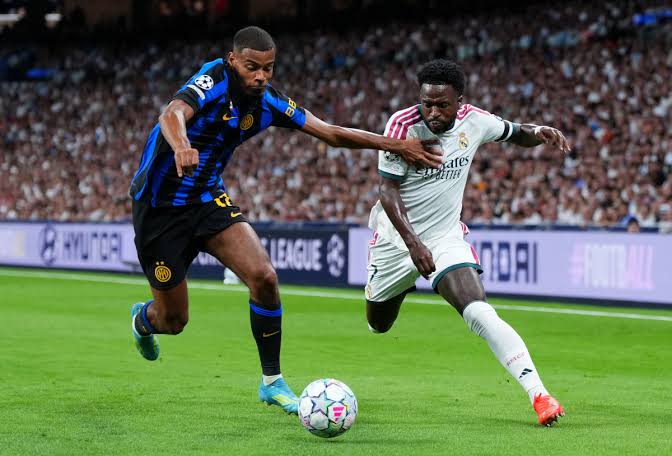
For most of his career, Diouf has been a midfielder. He developed as a left-footed central midfielder, particularly as a No. 8, where his physicality, ball carrying, ability to cover ground and capacity to break lines made him an attractive modern midfield profile. Yet at Inter Milan, Cristian Chivu has discovered another dimension to his game. Diouf has increasingly been used as a wing-back, particularly on the right side of Inter's 3-5-2, despite being naturally left-footed. What began as an experimental solution after Denzel Dumfries' departure has become a regular tactical role. Diouf admitted he never expected to play in such a position and still regards midfield as his natural home.
That transformation has now attracted the attention of France coach Zinedine Zidane, who has said he wants to assess Diouf on the left side of the defence. This creates an intriguing tactical evolution: a midfielder originally valued for his ability to dominate space through the centre is now being explored as a wide player who can contribute at both ends of the pitch.
https://x.com/Inter_Xtra/status/2081416723345908158?s=20
The Chivu Experiment
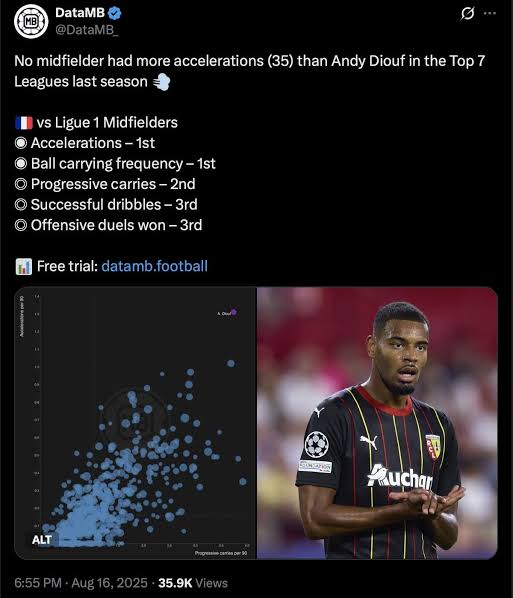
Diouf's positional transformation began during the 2025/26 season. He initially competed for opportunities in midfield, but Chivu discovered that his physical qualities could be used differently. Diouf's acceleration, stamina, ball-carrying ability and willingness to defend made him suitable for the enormous demands of the wing-back role.
The turning point came after the Milan derby. Diouf came off the bench and performed effectively in the wide position. According to Diouf himself, that was when the experiment began to become something more permanent. The positional change became particularly relevant after Denzel Dumfries moved to Real Madrid in the summer of 2026.
With Inter needing solutions on the right side of the 3-5-2, Diouf became one of Chivu's options. And instead of simply being an emergency replacement, he began establishing himself.
What changes when Diouf plays as a wing-back?
This is where the tactical analysis becomes particularly interesting. As a central midfielder, Diouf's primary reference points are around the centre of the pitch. He receives between the lines, turns, carries the ball through midfield and helps connect defensive and attacking phases.
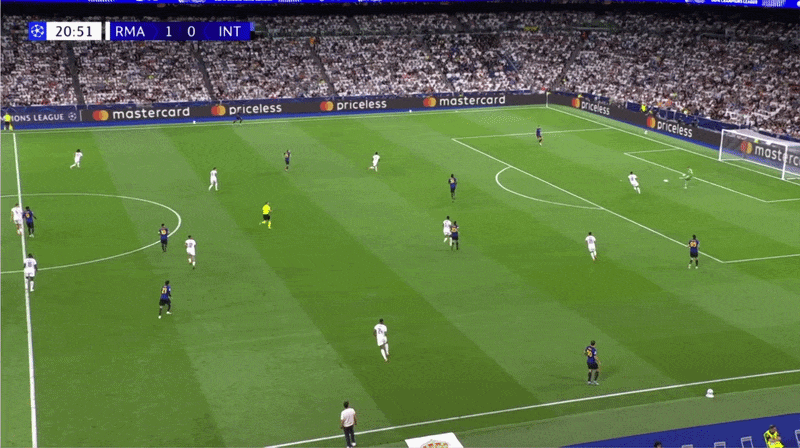
As a wing-back, his responsibilities become much broader. When Inter have possession, he effectively becomes a winger. When Inter lose possession, he must retreat into the defensive line.
Diouf himself explained the position's physical and tactical demands: with the ball, he operates like an attacking player; without it, he must recover into the defensive block. That means he has to perform two very different jobs repeatedly.
With the ball:
Diouf must provide width, attack space, advance possession, combine with forwards and arrive in attacking positions.
Without the ball:
He has to track runners, defend the flank, recover into the back five and protect the space outside the centre-backs.
This makes his role substantially different from that of a conventional midfielder.
Why his midfield qualities translate
The interesting thing is that many of Diouf's midfield characteristics remain useful: his ability to carry the ball allows him to escape pressure on the flank; his physicality helps him compete in defensive duels; his acceleration allows him to attack space behind the opposition full-back.
His stamina enables him to move between defensive and attacking phases repeatedly.
His left foot also gives him an unusual profile when operating from the right.
Instead of being a traditional right-sided wing-back who constantly receives on his right foot and crosses, Diouf can receive on his left foot and manipulate the ball inside.
This can create a different attacking angle.
He can move inside rather than simply remaining on the touchline.
He can also carry the ball diagonally towards the centre, effectively recreating some of the movements he previously made as a midfielder.
This is arguably the most important tactical reason why Chivu's experiment makes sense.
He has not stopped being a midfielder simply because he is playing wide.
Rather, Inter are finding ways to move some of his midfield qualities into a wider starting position.
The defensive transformation
However, there is a difference between being a midfielder who helps defend the flank and being a genuine full-back.
Diouf is still learning the defensive details of the position.
A midfielder usually thinks about space in relation to the centre.
A wing-back has to constantly monitor the touchline, the opposing winger, the overlapping full-back, the inside runner, and the space behind him.
The defensive orientation is therefore completely different.
Diouf has acknowledged this himself. He has said that he does not naturally identify as either a full-back or a winger and that midfield remains his preferred position.
Yet he has also accepted the opportunity because it gives him a route into the Inter team.
That attitude is significant.
Rather than resisting the tactical experiment, he has embraced the learning process.
From right wing-back to potential left-back
This is where the story becomes even more intriguing.
While Chivu has primarily used Diouf on the right, France's new coach, Zinedine Zidane, has expressed interest in seeing him on the left side. Gazzetta dello Sport reported in September 2026 that Zidane wants to see Diouf as a left-back. This does not mean Diouf has suddenly become a traditional left-back.
Instead, Zidane appears to be exploring whether the midfielder's technical and physical characteristics can translate into a different defensive role.
And there's interesting logic behind that experiment.
Diouf is left-footed.
That means playing him on the left would allow him to receive naturally on his stronger foot.
He could potentially receive the ball facing forward, drive up the flank and deliver from a more natural angle.
But there is another possibility.
Because he has been developed as a midfielder, Diouf could step inside from left-back and create an extra midfielder in possession.
That would turn his positional history into an advantage.
Rather than being a midfielder learning to imitate a full-back, he could become a midfielder who understands how to perform the functions of a modern full-back.
The inverted possibility
Modern football increasingly blurs positional boundaries.
A full-back doesn't necessarily have to stay on the touchline.
An inverted full-back can move inside to create numerical superiority in midfield.
A wing-back can attack almost like a winger.
A midfielder can drop into defensive positions during the defensive phase.
Diouf's development potentially gives him access to all three concepts.
At Inter, he is learning the wing-back role.
With France, the left-back experiment could allow him to explore a more conventional defensive starting position while still retaining his midfield instincts.
This versatility could become a defining characteristic of his career.
The paradox of Andy Diouf
A fascinating paradox sits at the centre of Diouf's development.
He is becoming increasingly valuable as a wide player precisely because he is not a conventional wide player.
He does not possess the traditional development pathway of a winger.
He was not raised primarily to isolate full-backs one-versus-one.
He was developed as a midfielder.
As a result, when he moves wide, he brings midfield behaviours.
He understands central spaces.
He can carry the ball inside.
He can recognise passing lanes.
He can support the midfield.
He can recover defensively.
He can move from the flank into central areas.
This gives him a different tactical identity.
A new chapter at Inter
Diouf has already acknowledged that he would prefer to return to midfield eventually.
In September 2026, he explained that he does not consider himself a full-back or winger and that his objective remains to play in midfield, where he feels most comfortable. At the same time, he made it clear that he is willing to continue playing wide if that is what allows him to establish himself at Inter.
That is perhaps the most revealing part of his transformation.
The positional change has not necessarily changed his identity.
It has expanded his toolbox.
He is learning how to defend wider spaces, attack from deeper positions, understand the timing of overlapping movements and cope with the enormous physical demands of the wing-back position.
Inter's official account has already described him as a physical, dynamic midfielder who can cover different areas of the pitch.
Now, Chivu is testing exactly how far that versatility can take him.
Conclusion
Andy Diouf's story at Inter Milan should therefore not simply be described as a midfielder being converted into a full-back. It is better understood as a midfielder's tactical expansion.
He arrived at Inter as a powerful, mobile and progressive No. 8 whose principal strengths were ball carrying, physicality and dynamism. Competition for midfield places complicated his pathway.
Chivu subsequently found another route. By placing Diouf on the right side of Inter's 3-5-2, he has transformed the Frenchman into a player who must combine the responsibilities of a midfielder, winger and defender. Now Zidane's interest in using him at left-back opens another chapter.
The fascinating question is no longer what position Andy Diouf plays. It is whether his future will be defined by a single position at all. His development suggests the emergence of a modern hybrid player: a midfielder who can defend like a wide player, attack like a wing-back and carry the ball with the power of a No. 8.
For Inter, that versatility gives Chivu another tactical weapon. For France, it gives Zidane another player whose positional flexibility could be used on both the left and right sides.
And for Diouf himself, the transformation represents something even more significant: a player who once needed regular minutes to establish himself in midfield is now finding a way into one of Europe's most demanding teams by redefining what his position can be.