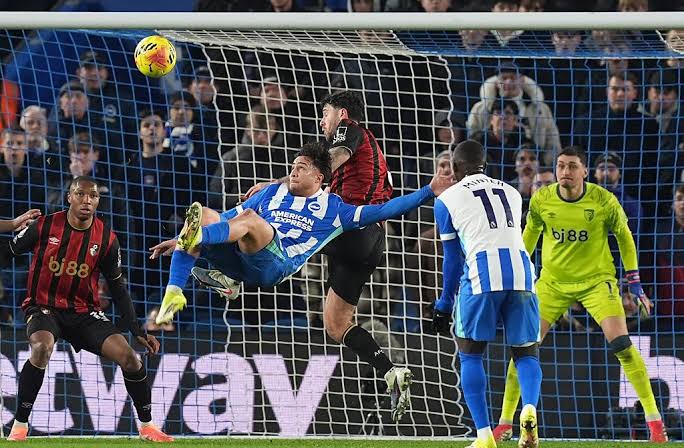
Charalampos Kostoulas: From Olympiacos Prodigy to Premier League Contender — The Making of a Modern Forward
Some young forwards announce themselves with a spectacular goal. Others do it through a series of performances that gradually change how people view their potential. For Charalampos Kostoulas, the recent evidence has been particularly compelling.
The Greek forward's performances against Manchester United and Arsenal in September 2026 offered two different demonstrations of his development. At Old Trafford, Kostoulas played 81 minutes as Brighton recovered from two goals down to defeat Manchester United 3–2 in the Carabao Cup. Three days later, he started against Arsenal and scored in Brighton's emphatic 3–0 Premier League victory. Across those two matches, the teenager showed why Brighton increasingly see him as more than a future investment.
The Arsenal performance was particularly revealing. His goal was not simply the product of being in the right place at the right time; it was another example of a forward increasingly comfortable finding space, receiving between defensive lines and influencing the game away from the conventional No.9 position.
That is the central theme of Kostoulas' development.
He is a striker, but not a static one.
He can act as a reference point, drop into midfield, move into channels, carry the ball, combine with teammates, press defenders, and attack the penalty area. That mixture of movement and technical ability is gradually transforming him into the forward modern possession-based teams increasingly value.
At only 19, Kostoulas is still a work in progress. But his trajectory — from the Olympiacos academy to senior football, European competition, a major Premier League transfer and increasingly important performances for Brighton — provides the foundation for a fascinating scouting profile.
The Beginning — Kostoulas and the Olympiacos Academy
Kostoulas was born on 30 May 2007 and joined the Olympiacos academy in 2019.
His development at one of Greece's biggest clubs mattered because Olympiacos gave him an environment that matched technical development with exposure to competitive football.
He progressed through the academy system and eventually signed his first professional contract in September 2022.
The significance of that pathway should not be underestimated.
For young forwards, academy football often allows them to dominate physically or technically against players of a similar age. Senior football is different. Defenders are stronger, spaces disappear more quickly, and mistakes are punished.
Kostoulas' development was therefore ultimately measured by how successfully he could transfer his qualities into senior football.
The answer arrived relatively quickly.
The Youth League — The First Major Statement
A defining stage in Kostoulas' development came through Olympiacos' UEFA Youth League campaign.
The competition provided an important bridge between academy football and the senior European game. Olympiacos eventually won the tournament, giving Kostoulas experience in high-pressure matches against some of Europe's strongest youth sides.
For a forward, those experiences are particularly valuable.
European academy football exposes attackers to different defensive structures and tactical approaches. Some opponents defend aggressively and leave space behind; others protect their penalty area and force attackers to break down a compact block.
A forward who can only operate in one type of game can quickly become predictable.
Kostoulas' development moved in the opposite direction.
He increasingly demonstrated an ability to adapt his movements according to the demands of the match.
That adaptability would later become one of his most interesting characteristics.
Breaking Into Olympiacos' First Team
Kostoulas made his Olympiacos senior debut against Volos on 17 August 2024.
His first senior season was the real beginning of his transformation from promising academy attacker into professional forward.
In the 2024/25 Greek Super League campaign, he made 22 appearances, starting 13, and scored seven goals. Across the league and Europa League, he registered seven goals and one assist according to FBref. In comparison, Brighton's official profile records seven goals and two assists in 35 appearances across domestic competition and the Europa League.
The numbers look impressive in context.
Kostoulas was only 17.
He wasn't simply coming on as a late substitute in already decided matches. He accumulated 1,200 league minutes and started 13 league matches.
That gave him genuine exposure to senior football.
More importantly, the experience showed his game wasn't dependent solely on youth-level physical advantages.
He could contribute against experienced defenders.
He could find scoring positions.
He could operate within a structured attacking system.
And he could do so while still developing physically and tactically.
Olympiacos eventually won the Greek league and cup double, giving Kostoulas a major piece of senior silverware before his 18th birthday.
Brighton — The Next Stage of the Experiment
Brighton's decision to sign Kostoulas in July 2025 represented a major escalation in his career.
The club handed him a five-year contract after bringing him from Olympiacos, reflecting the belief that his potential extended well beyond his immediate production.
His first Premier League season was necessarily transitional.
Kostoulas made 21 Premier League appearances but started only two, accumulating 369 minutes and scoring twice with one assist.
Those numbers should not be interpreted as failure.
For an 18-year-old arriving from Greek football, the Premier League represented a substantial tactical and physical jump.
The important question was not whether he immediately became Brighton's leading striker.
It was whether the foundations of his game could survive the transition.
The answer appears increasingly positive.
The Breakthrough — From Prospect to Attacking Reference Point
The 2026/27 campaign has offered a different picture.
Kostoulas has increasingly earned significant minutes and responsibility. Brighton's official statistics currently list him with four goals and two assists across ten appearances, with 597 minutes played.
The statistical progression is significant, but the underlying development is arguably more interesting.
He is becoming more involved in the game.
Rather than simply waiting for opportunities inside the penalty area, Kostoulas is influencing attacks earlier.
He drops into midfield.
He receives with his body open.
He carries the ball.
He links with attacking players.
He presses defenders.
Then, when the opportunity appears, he returns to the penalty area.
That movement creates a more complete attacking profile.
Manchester United — Composure in a Comeback
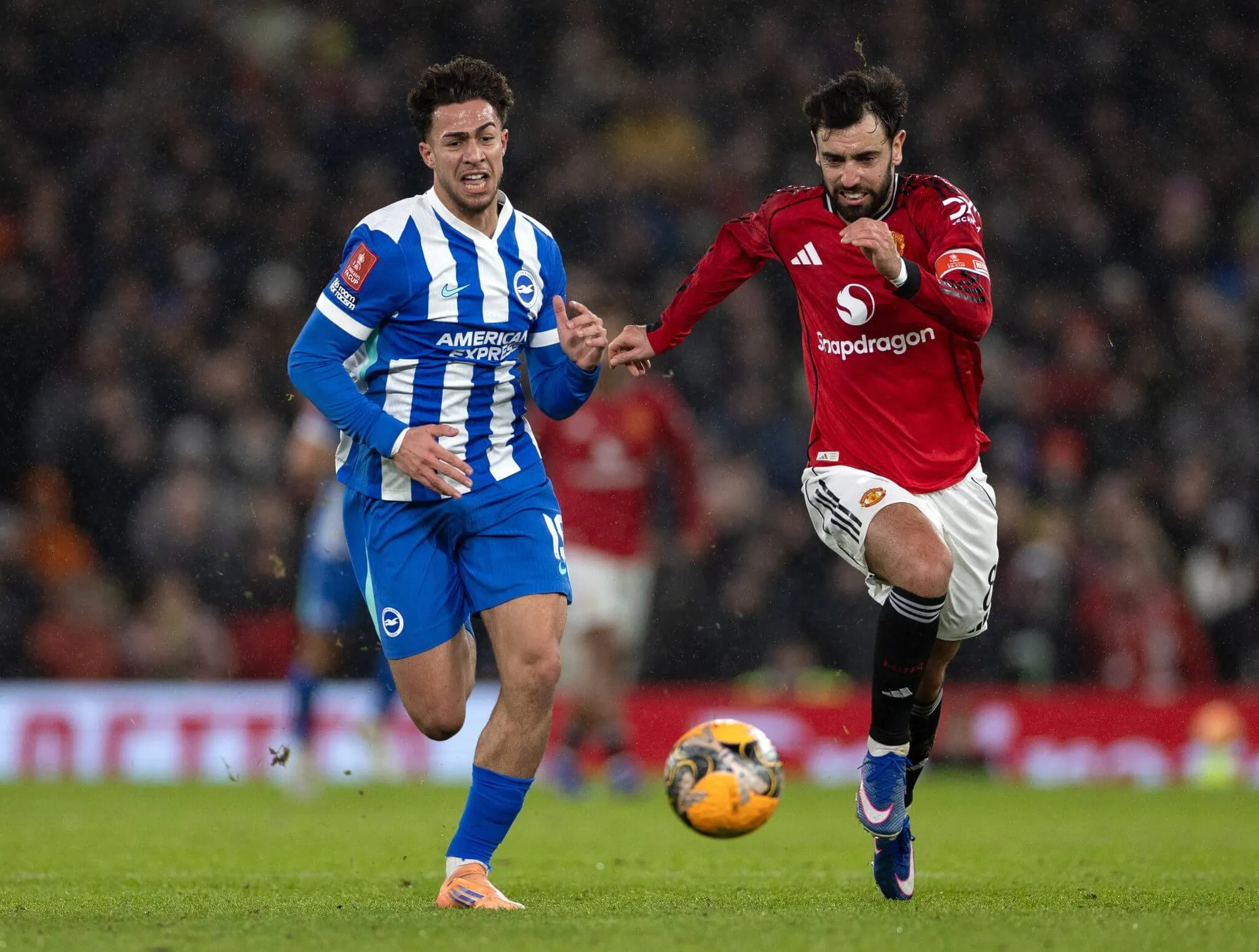
The Carabao Cup meeting with Manchester United offered a fascinating examination of Kostoulas' mentality.
Brighton travelled to Old Trafford and found themselves 2–0 down, yet eventually produced a dramatic 3–2 comeback.
Kostoulas started and played 81 minutes. His performance stood out for keeping Brighton in the attack despite the difficult game state.
This match matters for more than the result.
It is the environment.
Old Trafford is one of the most recognisable stadiums in English football. A young forward attempting to lead the line there has to deal with an intense atmosphere, aggressive defenders and the psychological pressure of playing for a team trying to recover from a deficit.
Kostoulas did not disappear.
He remained involved.
He kept himself available between the lines and offered Brighton a route forward.
That resilience matters.
Young forwards frequently struggle when the team around them is under pressure because their touches become increasingly disconnected from the game.
Kostoulas' willingness to stay involved is one reason his development deserves attention.
Arsenal — The Performance That Changed the Conversation
If the Manchester United match demonstrated resilience, the Arsenal game demonstrated attacking maturity.
Brighton defeated Arsenal 3–0, with Kostoulas scoring after starting as the central forward. He played 75 minutes and recorded four shots, two on target.
Against a side renowned for controlling possession and defending spaces intelligently, Kostoulas repeatedly looked for opportunities to manipulate the defensive structure.
This is where his profile becomes particularly interesting.
A conventional No.9 might remain between the centre-backs, waiting for crosses or through balls.
Kostoulas does more.
He can move away from the centre-backs.
He can appear in the pockets.
He can receive facing goal.
He can then accelerate back towards the defensive line.
That movement forces defenders into uncomfortable decisions.
If the centre-back follows him, space can appear behind.
If the centre-back stays deep, Kostoulas can receive and turn.
The result is a tactical dilemma.
And good forwards create dilemmas.
What Type of Forward Is Kostoulas?
The label No.9 is technically correct but tactically incomplete.
A better description would be a mobile No.9 or 9.5.
Recent scouting analysis has similarly highlighted his ability to operate between the lines, drop into pockets, drift into the left channel and carry the ball forward.
His game contains elements of several forward profiles.
He has a striker's finishing instincts.
He has the movement of a second forward.
He has enough technical security to function as a connector.
And he has the physical profile to compete centrally.
That combination makes him difficult to classify.
And that is a strength.
Technical Profile
First Touch
Kostoulas' first touch is fundamental to the way he plays.
Because he often receives with defenders close, his first touch has to create the next action.
He often uses the first touch to shift the ball away from pressure rather than simply stopping it.
This is especially valuable when receiving between the lines.
A clean first touch allows him to turn.
A poor one allows the defender to recover.
His ability to keep the ball close while accelerating is therefore an important part of his attacking profile.
Ball Carrying
Kostoulas is not simply a forward who receives and immediately passes.
He can carry.
This becomes particularly dangerous when he drops into midfield and finds himself facing the opposition goal.
Instead of playing backwards, he can drive forward.
That forces defenders to step out.
Once a defender leaves the defensive line, another space is potentially created.
His ball carrying therefore has tactical value beyond simply advancing possession.
Finishing
The next stage of his development is becoming a more consistent finisher.
His seven league goals for Olympiacos showed an early ability to convert chances, while his goal against Arsenal showed he can find decisive moments against elite Premier League opposition.
The challenge now is volume.
A top-level Premier League striker must consistently generate and convert chances.
Kostoulas has demonstrated the finishing ability.
The next question is whether he can maintain that output over a full season.
Combination Play
This may eventually become one of his greatest strengths.
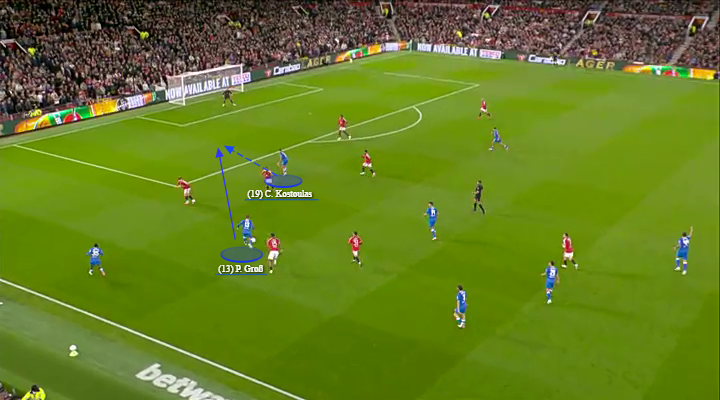
Kostoulas is comfortable coming towards the ball and connecting with midfielders.
That makes him useful in short-passing combinations.
For example:
Centre-back → midfielder → Kostoulas → advancing midfielder
or:
Kostoulas drops → winger attacks inside → Kostoulas turns → winger receives into space.
The forward becomes part of the mechanism rather than simply the final destination.
Off-the-Ball Intelligence
Attacking the Space Behind
Despite his tendency to drop deep, Kostoulas isn't a forward who wants to stay there.
He can alternate between coming short and running beyond.
That variation is crucial.
If he only came short, defenders could follow him.
If he only ran behind, defenders could drop.
By alternating the two movements, he keeps the defensive line uncertain.
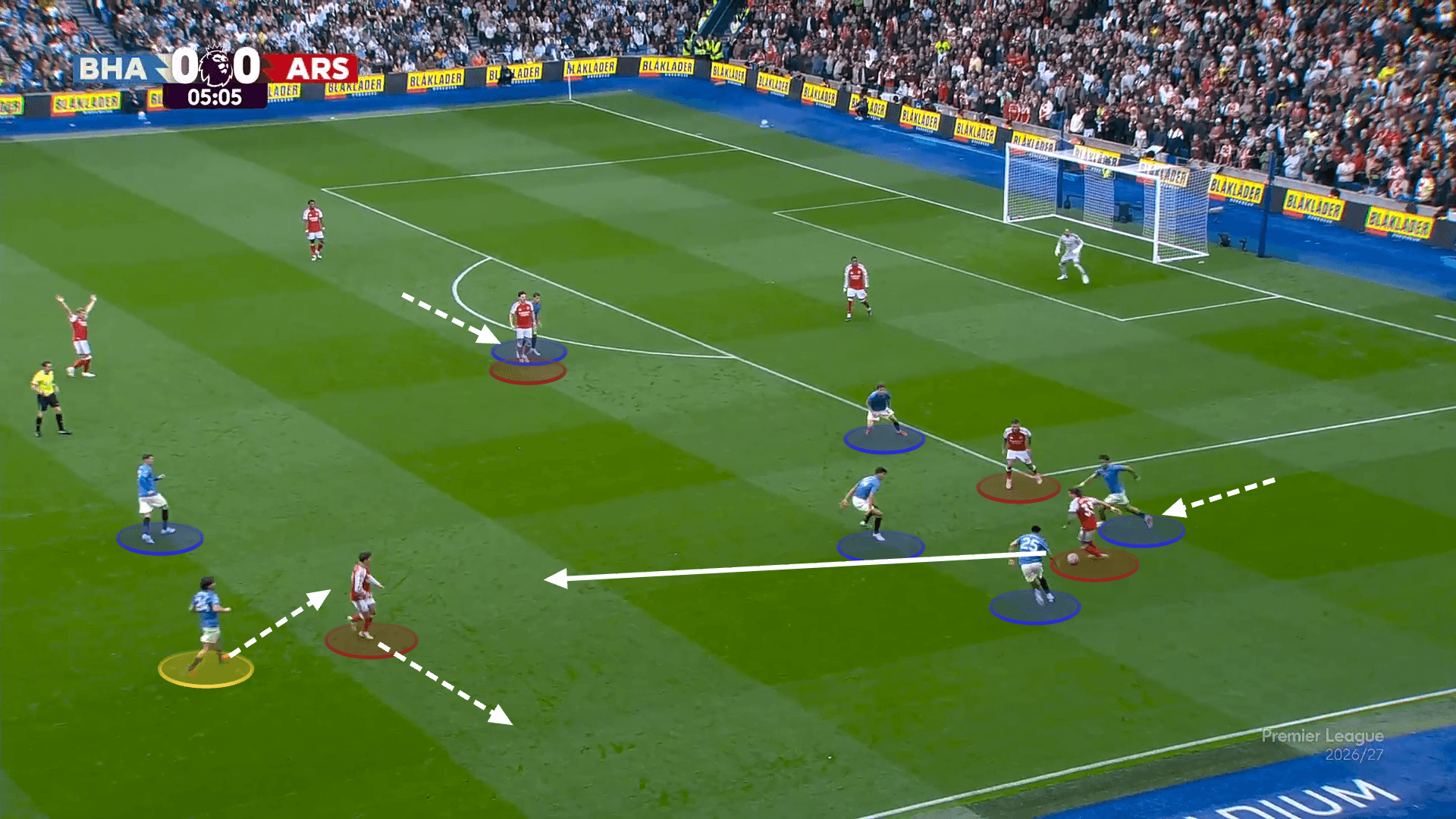
Between-the-Lines Movement
This is arguably his most exciting tactical characteristic.
Kostoulas understands that the space between midfield and defence can be as dangerous as the space behind the defence.
When he receives there, he can turn and attack.
The defender then has to decide.
That decision is exactly what the attacker wants
.
Pressing
Kostoulas' mobility also makes him useful defensively.
The modern No.9 is often the first pressing trigger.
Rather than simply sprinting towards a centre-back, the striker has to close the passing lane while approaching the ball.
Kostoulas has shown a willingness to press and compete defensively, and Brighton's tactical structure gives him opportunities to make pressing central to his identity.
This means his value isn't limited to possession.
He can influence the match immediately after Brighton lose the ball.
Physical Profile
Kostoulas possesses the physical foundation required for Premier League football.
At approximately 6'1", he has sufficient height to compete centrally, while his long stride allows him to cover ground quickly. Scouting analysis has highlighted his vertical speed, two-footedness and ability to accelerate after manipulating the ball around a defender.
The important point, however, is that he does not appear to rely exclusively on physical power.
His physical attributes support his technical game.
His acceleration allows him to exploit the space he creates.
His strength allows him to compete in duels.
His stride length helps him carry the ball over distance.
That combination could become even more valuable as he gets stronger.
Tactical Fit at Brighton
Brighton can use Kostoulas in several structures.
4-2-3-1
As the central striker, he can drop into the No.10 space while the wide players attack the channels.
His movement can create opportunities for the attacking midfielders.
4-3-3
He can remain central and occupy centre-backs while Brighton's wingers attack the half-spaces.
When he drops, the wingers can exploit the space behind him.
3-4-2-1
This could be particularly interesting.
Kostoulas can operate as the central striker with two attacking midfielders underneath.
When he drops, one of the attacking midfielders can attack the vacated central space.
This gives Brighton a rotating front three rather than a fixed attacking structure.
Why His Versatility Matters
The modern game increasingly rewards forwards who can perform multiple functions.
Kostoulas is developing into that type of player.
He can be:
A finisher.
A connector.
A pressing forward.
A ball carrier.
A space creator.
That does not mean he is already elite in all five areas.
It means the foundations exist.
His development will be about turning those foundations into consistent high-level production.
Strengths
Movement
His ability to alternate between dropping short and running beyond makes him difficult to track.
Technical security
He can receive under pressure and maintain possession.
Ball carrying
He can turn, accelerate and carry possession through midfield areas.
Combination play
He is comfortable linking with midfielders and wide players.
Pressing
His mobility makes him suitable for an aggressive defensive structure.
Versatility
He can operate centrally while also drifting into wider and deeper areas.
Mentality
His willingness to remain involved in difficult matches, particularly at Old Trafford, is encouraging for his development.
Areas for Development
Kostoulas' ceiling is exciting, but development should not be confused with completion.
His first challenge is consistency.
The Premier League is unforgiving. A young forward can produce an outstanding performance against Arsenal one week and then encounter a compact defence that gives him almost no space the next.
His ability to influence those difficult games will be important.
He also needs to continue improving his efficiency in front of goal.
His movement may consistently create chances, but elite forwards must eventually convert them at a high rate.
His decision-making in the final third is another area that will develop with experience.
When should he shoot?
When should he combine?
When should he carry?
When should he attack the space behind?
Those decisions separate talented forwards from elite ones.
What Brighton Can Unlock
Brighton have already demonstrated that they are willing to invest heavily in Kostoulas' development.
The next challenge is turning his versatility into a consistent attacking identity.
They do not need to turn him into a traditional target man.
Instead, they can develop his ability to move between roles.
The ideal version of Kostoulas could become a forward who begins centrally but constantly changes the geometry of the attack.
He can drop.
He can rotate.
He can press.
He can run.
He can combine.
Then he can arrive inside the penalty area at the right moment.
That is the essence of a modern forward.
Greece's Next Attacking Generation
Kostoulas' development is also important for Greek football.
He has already progressed through Greece's youth setup and has represented the country at several age levels. His pathway from Olympiacos' academy into the senior national team illustrates the potential of the country's emerging generation.
His international development will now become another important part of his career.
The challenge is different from club football.
At Brighton, he can develop within a consistent tactical structure.
With Greece, he will have to adapt to different opponents, teammates and match scenarios.
That experience could further improve his tactical flexibility.
The Bigger Picture
What makes Kostoulas particularly fascinating is not that he has already arrived.
He has not.
At 19, he is still developing.
The more interesting story is the direction of travel.
At Olympiacos, he demonstrated that he could score in senior football.
At Brighton, he initially had to adjust to the Premier League.
Now, he is beginning to look like a forward capable of influencing matches against some of England's biggest clubs.
The numbers show the progression as well.
His 2024/25 Olympiacos league campaign produced seven goals in 1,200 minutes, while his first Premier League season produced two goals and one assist in 369 minutes. Brighton's current 2026/27 statistics show four goals and two assists from 597 minutes across ten appearances.
The sample remains relatively small, but the trajectory is encouraging.
More importantly, his role appears to be expanding.
He is not merely receiving more minutes.
He is being trusted with greater responsibility.
Conclusion — The Making of a Modern Forward
Charalampos Kostoulas' story is no longer simply about a Greek teenager who moved from Olympiacos to Brighton.
It is becoming a story about the evolution of a forward.
The performances against Manchester United and Arsenal offered two different glimpses of that evolution.
Against United, he experienced the pressure of Old Trafford during a dramatic comeback.
Against Arsenal, he scored in a comprehensive Brighton victory and demonstrated how his movement and positioning could unsettle a high-level defensive structure.
Those performances matter because they show his development is beginning to translate to a bigger stage.
But the most exciting element is not one goal or one performance.
It is the combination of qualities underneath them.
Kostoulas can receive.
He can turn.
He can carry.
He can combine.
He can press.
He can create space.
And he can finish.
The next step is consistency.
If Brighton can keep developing his technical decision-making, physical robustness, and tactical understanding, Kostoulas has the ingredients to become much more than a promising young striker.
He could become the forward modern football increasingly demands: mobile without being positionless, technical without being lightweight, aggressive without being reckless, and intelligent enough to change his function to match the demands of the game.
From the Olympiacos academy to European youth success, from senior football in Greece to Brighton, and now from promising substitute to increasingly important Premier League forward, the journey is still being written.
But the early chapters already suggest that Charalampos Kostoulas is not simply learning how to play as a modern forward.
He is learning how to become one.