Ismaëlo Ganiou: The Defensive Architect Behind Lens’ New Dawn
There are victories that announce a team, and there are victories that redefine the way a team is perceived. RC Lens’ 1–0 victory over Paris Saint-Germain in the Trophée des Champions was the latter.
Lens had already established themselves as a serious force by winning the Coupe de France for the first time in their history in May, beating Nice 3–1 in the final. But defeating PSG in the opening major fixture of the new season carried a different significance. This was not simply another trophy.
It was a statement that Lens’ rise was not a one-off cup story. Florian Thauvin supplied the decisive goal, but the real story of the evening was what happened afterwards. Lens were reduced to ten men when Kyllian Antonio was dismissed in the 39th minute, meaning they had to defend their lead for more than 50 minutes against a PSG side accustomed to controlling games through possession and territorial dominance.
Lens survived. And at the centre of that defensive resistance was Ismaëlo Ganiou. For a 21-year-old centre-back, this was precisely the kind of match that reveals more than statistics ever can.
It tests concentration.
It tests positioning.
It tests decision-making.
Most importantly, it tests whether a young defender can remain calm when the structure around him is under constant pressure. Ganiou passed that examination.\
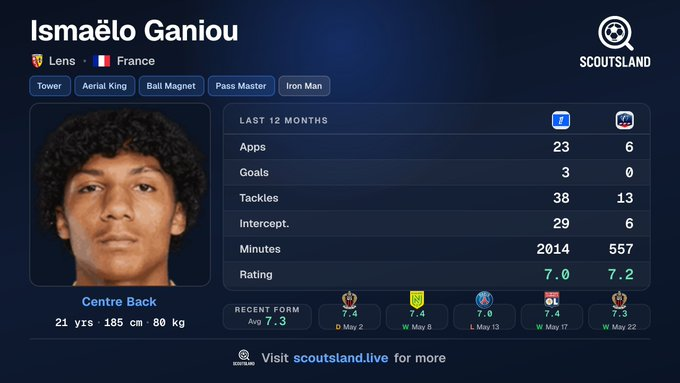
Ganiou completed the full 90 minutes against PSG. StatMuse currently lists Ganiou’s 2025/26 Ligue 1 season rating at 6.71, but that is his season rating, not his rating from the PSG match.
- PlaymakerStats rated him 7.0 in Lens’ 0–2 defeat to PSG on 13 May 2026.
- StatMuse has him at 6.8 in that same PSG match.
- Other databases show ratings such as 7.3 against Nice and 7.0 against Nantes, demonstrating that the 6.7–7.3 range exists across his recent matches, but not as a verified rating for yesterday’s Trophée des Champions game. The more important aspect was how his role changed once Lens went down to ten men.
The young centre-back was not required to produce spectacular attacking moments. His job became one of distance management, defensive positioning, anticipation and controlled aggression.
That is where Ganiou looked increasingly mature.
Once Antonio was dismissed, Lens could no longer defend with the same attacking ambition. The defensive line had to become more compact, midfield spaces had to shrink and the centre-backs had to constantly monitor PSG’s rotations.
Ganiou’s value in that situation was his ability to remain connected to the defensive structure.
He did not need to chase every movement.
He needed to recognise which movement mattered.
That distinction is crucial for a modern centre-back.
Against PSG, Ganiou showed an understanding of when to step towards the ball, when to hold the line and when to protect the space behind him. PSG’s attackers thrive when defenders are dragged away from their positions, creating gaps for third-man runners. Ganiou’s discipline helped Lens avoid repeatedly opening those spaces.
His performance was therefore less about individual heroics and more about defensive intelligence within a collective structure.
And that is arguably the most encouraging aspect of his development.
The Bigger Story: Lens Did Not Discover Ganiou Yesterday
Ganiou’s emergence is not a sudden phenomenon.
He is a genuine product of the RC Lens academy.
Born in Lille on 14 March 2005, Ganiou began his youth football with Lille OS Fives before moving to ES Wasquehal. He joined RC Lens in 2015, aged around ten, and subsequently progressed through the famous La Gaillette academy.
What immediately separated him from many players in his age group was his physical development.
Lens themselves described him as a rapid, athletic and promising centre-back, noting that he was regularly playing above his age category. He reached the U19 level unusually early and was already appearing for the reserve side at just 16.
His progression through the academy was accelerated rather than linear.
He was not simply waiting for his age group.
He was continually being moved upwards because his physical and tactical maturity allowed him to compete against older players.
By 2022–23, he had become an important player for the Lens reserve side, making 19 appearances in National 3. At the same time, he continued contributing for the U19 team and scored three goals in ten matches. His performances earned him exposure to the first-team environment and eventually a senior debut on the bench before his first professional minutes.
The trajectory tells us something important about Ganiou.
His development has always been built around adaptation.
He has repeatedly been asked to compete against stronger, older and more experienced opponents.
That experience has helped shape the defender we see today.
The Detour That Accelerated His Development
Ganiou’s story became even more interesting in 2025.
Despite being a Lens academy product, he temporarily left the club structure to gain senior experience. He moved to Calcio Padova before joining FC Annecy on loan, where he played in Ligue 2.
This was an important stage of his development.
Academy football can teach positioning, technique and tactical principles, but senior football exposes a defender to something different: consequences.
A mistake against an experienced forward can immediately produce a goal.
A poor body position can be punished.
A mistimed challenge can change the outcome of a match.
Annecy therefore gave Ganiou the opportunity to experience senior football in a competitive environment.
And Lens were watching.
When he returned in 2025, the club did not view him as simply another academy graduate returning from a loan. Jean-Louis Leca, Lens’ sporting director, explained that Ganiou had developed significantly and returned with the profile of a player capable of competing for a starting position in Ligue 1.
That decision has subsequently been vindicated.
The Strange Story Behind His Departure From Lens
The most fascinating part of Ganiou’s development came when he temporarily left the club that had developed him. In 2025, he moved to Italian side Padova before immediately joining FC Annecy on loan in Ligue 2. His time in Italy was brief, while Annecy became the important developmental chapter because it exposed him to regular senior football.
This was not necessarily a case of Lens giving up on their academy graduate.
Quite the opposite.
The move gave Ganiou something that youth football could not provide:
minutes against experienced professionals.
At Annecy, every defensive decision carried consequences.
A poor body orientation could allow a forward to turn.
A mistimed step could open the channel.
A misplaced pass could immediately put his team under pressure.
That experience accelerated his understanding of senior football.
And when he returned to Lens, he was no longer simply an academy prospect.
He had become a defender who had experienced the demands of professional football.
From Academy Prospect to First-Team Player
Ganiou’s emergence at Lens was therefore the result of several stages rather than one sudden breakthrough. He developed in the academy ans played for the reserve football team.
He stepped into senior football.
He left temporarily.
He gained Ligue 2 experience.
Then he returned to the club with a much clearer understanding of what was required.
That is why his current development is particularly interesting.
Lens are not throwing an inexperienced academy defender into the deep end.
They are gradually building on a player who has already experienced different tactical environments.
The club subsequently extended his contract, with his current deal running until 2030, another indication of the importance Lens place on his development.
https://x.com/BenBocsak/status/2084663085143339121?s=20
Source: @BenceBocsak
What Type of Defender Is Ismaëlo Ganiou?
Ganiou is a modern centre-back whose game is built around three interconnected qualities:
Athleticism.
Aggression.
Reading of the game.
But it is the combination of those attributes that makes him interesting.
He is not simply a physical defender.
He uses his physical qualities to support his anticipation.
1. Defensive Duels
Ganiou enjoys defending forwards aggressively.
He is comfortable stepping into duels rather than constantly retreating.
That is important in a team such as Lens, where the centre-backs can be asked to defend large spaces depending on the team’s positioning.
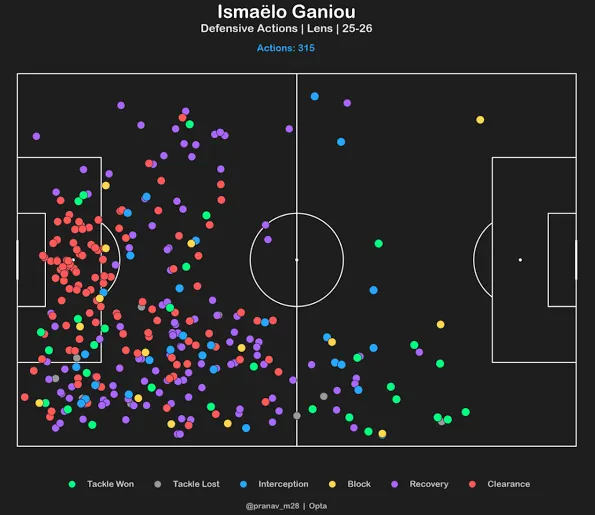
His career statistics illustrate the strength of this part of his game. Lens’ official profile records him at around 61% of duels won, with 121 successful duels from 199 attempts in the listed season statistics. He also recorded 39 tackles, 29 interceptions, 112 clearances and 117 recoveries.
Those numbers describe a defender who is consistently involved.
He does not simply wait for the ball to arrive inside the penalty area.
He actively seeks to influence the action.
2. Anticipation Rather Than Just Reaction
One of the most encouraging characteristics of Ganiou is his ability to read attacking movements.
A centre-back who reacts after the attacker has received the ball is already behind the action.
A centre-back who recognises the pass before it is played can eliminate the danger before it develops.
Ganiou increasingly falls into the second category.
His interception numbers are evidence of that tendency, but the tactical value goes beyond statistics.
He is particularly useful when opponents attempt to play between the lines because he can recognise when a forward is trying to receive on the blind side of the midfield.
That allows him to step forward and attack the receiving player.
The risk is obvious: if the timing is wrong, the space behind him becomes vulnerable.
But Ganiou’s athleticism gives him an important safety net.
His Athleticism Is a Tactical Weapon
At approximately 1.82–1.85m depending on the database, Ganiou is not the biggest centre-back in European football.
But he compensates through acceleration, explosiveness and timing.
This is particularly useful when defending transitions.
If Lens lose possession high up the pitch, Ganiou has the ability to cover ground quickly and recover his defensive position.
That allows the team to take more calculated risks.
It also means he can defend forwards who attempt to attack the space behind the defensive line.
His athleticism therefore isn’t simply a physical attribute.
It changes what Lens can do tactically.
Ganiou With the Ball
This is perhaps the area where his development could take him from promising defender to elite modern centre-back.
Ganiou is not merely a clearance-first defender.
Lens’ official statistics show a pass completion rate of approximately 87%, with more than 1,100 successful passes in the listed dataset.
His first instinct is generally to make the safe pass, but there is enough evidence of technical confidence for him to become increasingly influential during build-up.
He is comfortable receiving possession under pressure.
He can carry the ball forward when space opens.
And because he is right-footed, he can naturally open his body towards the right side of the pitch while playing from the central position.
This becomes particularly valuable in a back three.
Why the Back Three Suits Him
The tactical structure Lens used during their Coupe de France final victory over Nice was a 3-4-3, with Ganiou operating centrally between Malang Sarr and Kyllian Antonio.
This structure accentuates several of his strengths.
When playing as the central defender in a back three, Ganiou does not necessarily have to defend the entire width of the pitch.
Instead, he can concentrate on:
- protecting the central corridor;
- covering behind the outside centre-backs;
- attacking aerial balls;
- stepping into midfield when necessary;
- organising the defensive line;
- and distributing possession into midfield.
That environment allows his athleticism to become an advantage rather than forcing him to constantly defend wide spaces.
His Role Off the Ball
Ganiou’s off-ball game may ultimately become his defining characteristic.
He is increasingly comfortable defending in three different situations:
High defensive line
Here, he uses anticipation and recovery pace to protect the space behind the defence.
Mid-block
Here, his positioning becomes more important. He has to maintain the correct distance from the midfield while monitoring opposition forwards between the lines.
Deep block
This is where his physicality and aerial timing become particularly valuable.
Yesterday’s match against PSG required Lens to spend long periods in the latter two structures after Antonio’s red card.
Ganiou therefore had to constantly adjust his defensive reference points.
The game stopped being about controlling possession.
It became about controlling space.
And that is an important developmental milestone for a young centre-back.
The Coupe de France Final: His Quiet Contribution
Although yesterday’s Super Cup was the immediate headline, Ganiou had already demonstrated his ability to perform on the biggest domestic stage in May.
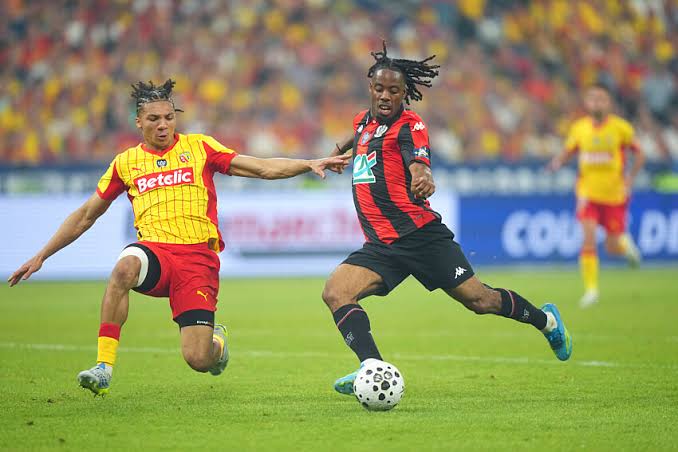
In the Coupe de France final against Nice, he started in the centre of Lens’ back three and played the entire 90 minutes as Lens won 3–1.
One moment particularly illustrates his defensive value.
With Nice increasing the pressure in the second half, Elye Wahi threatened the Lens penalty area. Ganiou reacted quickly, tracking the danger and making an authoritative intervention to prevent the attack from developing. Lens themselves highlighted his return and defensive intervention around the 63rd minute.
That was Ganiou’s game in miniature.
He was not necessarily the player attracting the headlines.
But he repeatedly prevented the situation from becoming dangerous.
For a centre-back, that can be more important than spectacular statistics.
What Ganiou Adds to Lens
Ganiou gives Lens something every ambitious side needs:
a young defender who can grow with the team’s ambitions.
He adds athleticism to the defensive line.
He adds aggression in duels.
He adds recovery speed.
He adds composure in possession.
He adds versatility because he can operate centrally or move towards the right side of the defence.
Most importantly, he adds developmental upside.
Lens have already demonstrated that they can develop defenders and eventually sell them at significant value. Ganiou now appears to be the latest product of that system.
His recent contract extension until 2030 is another indication of how highly the club values him.
The Next Step: Becoming a Defensive Leader
The biggest question is no longer whether Ganiou has the physical tools to play at a high level.
He does.
The question is whether he can develop the consistency and authority required to become the leader of a top-level defensive unit.
That means improving several areas:
Decision-making under pressure.
He must continue reducing unnecessary risks when opponents press aggressively.
Progressive passing.
His strong passing completion provides a foundation, but the next step is increasing the number of passes that genuinely break opposition lines.
Defensive communication.
As his responsibility grows, he will need to become increasingly vocal in organising those around him.
Consistency.
Young defenders can produce outstanding performances and then suffer concentration lapses. Eliminating those fluctuations is what separates promising centre-backs from elite ones.
A Defender Built for Lens’ Ambition
There is something fitting about Ganiou’s story.
He joined Lens at ten.
He progressed through La Gaillette.
He played above his age.
He moved into senior football.
He went away to gain experience.
He returned stronger.
And now he is playing in major finals for the club where his football education began.
That journey has given him something that cannot be purchased in the transfer market: an understanding of what Lens represents.
The club’s first Coupe de France triumph in May was historic. Yesterday’s first Trophée des Champions victory over PSG demonstrated that the achievement was not simply an isolated cup run. Lens are building a side capable of competing with France’s dominant force.
And Ganiou is increasingly central to that project.
At 21, he already possesses the physical profile, defensive aggression and tactical intelligence required of a modern centre-back.
What makes him particularly exciting is that his game is still evolving.
He is no longer merely a product of La Gaillette.
He is becoming one of the defenders around whom Lens can build their next generation.
What He Adds to Lens
Ganiou adds something that is becoming increasingly valuable in modern football:
Physical security
He can compete with powerful forwards and recover quickly when the defensive line is exposed.
Defensive aggression
He is willing to step forward and attack situations rather than endlessly retreat.
Tactical flexibility
He can operate in different defensive structures and adapt his positioning according to the system.
Ball progression
He provides Lens with another player capable of starting attacks from deep.
Youth and upside
At only 21, his best football should still be ahead of him.
And perhaps most importantly:
A connection to Lens’ identity
Ganiou is a product of La Gaillette.
He understands the club.
He understands the environment.
He has grown within its football culture.
That gives his development an additional dimension.
The Defender Lens Can Build Around
There is still work to do.
Ganiou must become more consistent.
He must continue improving his progressive passing.
He must learn when aggression becomes excessive.
He must improve his decision-making against technically gifted forwards who deliberately manipulate defensive positioning.
And, above all, he needs to accumulate more high-level experience.
But these are developmental questions, not fundamental concerns.
The tools are already visible.
He has the athleticism.
He has the defensive aggression.
He has the recovery speed.
He has the tactical awareness.
He has experience beyond his age group.
And now he is beginning to demonstrate those qualities on the biggest stages.
Lens’ New Defensive Reference Point?
The significance of yesterday’s victory goes beyond the trophy.
Lens have now won the Coupe de France and Trophée des Champions within a few months, with the latter coming against PSG and despite playing a large portion of the match with ten men.
That tells us something about the team’s evolution.
They are becoming difficult to break down.
They are becoming comfortable in high-pressure matches.
And they possess players capable of absorbing pressure without losing their structure.
Ganiou embodies that evolution.
His journey from a ten-year-old academy player to a centre-back trusted in a major final is a story of development, patience and adaptation.
But his story is not finished.
In fact, it may only be beginning.
Ismaëlo Ganiou is no longer simply a promising defender coming through Lens’ academy. He is becoming a defender capable of defining how Lens defend, how they build and ultimately how far this new era can go.
The Coupe de France proved Lens could win a major trophy.
The Trophée des Champions proved they could withstand PSG.
And in the middle of that defensive resistance stood a 21-year-old centre-back whose game is beginning to look increasingly complete.
Ganiou may not yet be the finished product. But he is rapidly becoming one of the most intriguing defensive projects in French football.