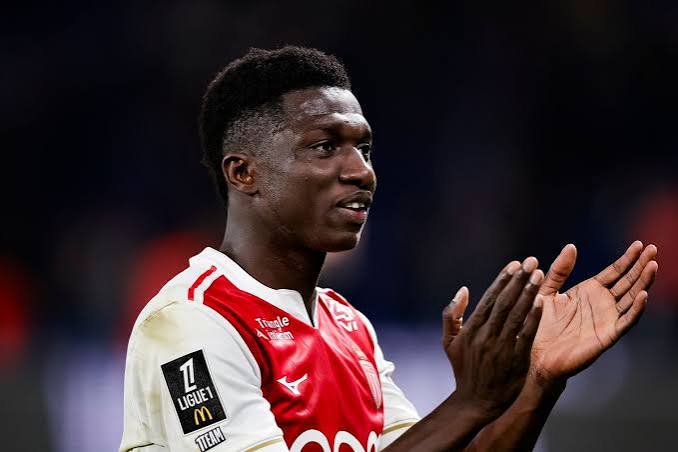
Lamine Camara: The Senegalese Midfielder Turning Defensive Actions into Attacking Weapons
There is a particular type of midfielder that modern football increasingly demands: a player capable of defending without becoming disconnected from possession, progressing the ball without sacrificing positional discipline, and understanding that winning the ball is only the beginning of the action rather than its conclusion.
Lamine Camara belongs to that category.
Modern midfielders are increasingly being asked to do more than simply occupy space between the defensive and attacking lines. They must be able to recover possession, resist pressure, progress the ball, cover ground, manipulate opponents with their positioning and, perhaps most importantly, turn defensive actions into attacking opportunities.Lamine Camara represents this evolution particularly well.
Football has gradually moved away from the idea that midfielders should be defined by one fixed responsibility. The modern midfielder is expected to defend, build, progress, press, cover, create and, increasingly, determine what happens in the few seconds immediately after possession changes hands. It is within this evolving landscape that Lamine Camara has begun to establish his identity.
The Senegalese midfielder is not simply a ball-winner. Neither is he a conventional deep-lying playmaker or a traditional box-to-box No. 8. His game sits somewhere between these definitions, built around an ability to connect defensive intervention with immediate progression.
He can step out to challenge.
He can intercept a pass.
He can recover a loose ball.
But the important part of his game begins immediately afterwards.
What does he do with the ball once he has won it?
That question provides perhaps the clearest route into understanding Camara.
His instinct is often to look forward. He can carry possession beyond the first line of pressure, attempt a vertical pass, switch play or use his long-range shooting to threaten the opposition from distance. His defensive work therefore has an attacking consequence.
A recovery can become a transition.
A transition can become progression.
And progression can become an opportunity.
That is what makes Camara such an intriguing modern midfielder.
From Génération Foot to the European stage
Camara's development began at Génération Foot, one of Senegal's most important football academies and an institution responsible for producing players capable of making the transition from Senegalese football to Europe's elite leagues.
He joined the academy in 2019 and signed his first professional contract in 2021 before moving to FC Metz in February 2023. His transition to France represented more than a geographical change. It exposed him to a considerably faster tactical and physical environment, where midfielders have less time to receive, scan and execute.
Metz became the environment in which Camara's raw qualities began to acquire structure.
He was no longer simply a talented young midfielder capable of producing moments of individual brilliance. He had to learn how to operate within a team, understand positional responsibilities and make decisions against opponents capable of closing space quickly.
That process accelerated his development.
One of the earliest demonstrations of his technical confidence came against Monaco in October 2023, when he scored from distance after recognising the goalkeeper's advanced position. The goal was spectacular, but the more interesting component was the decision-making that preceded it.
Camara saw the situation.
He processed it.
He acted.
That sequence—perception, decision and execution—has become increasingly important to his identity.
Monaco eventually completed his transfer in July 2024, signing him on a five-year contract. The move elevated his development into another environment, one in which he would be tested not only in Ligue 1 but also in European competition.
And it was at Monaco that his tactical profile became even more interesting.
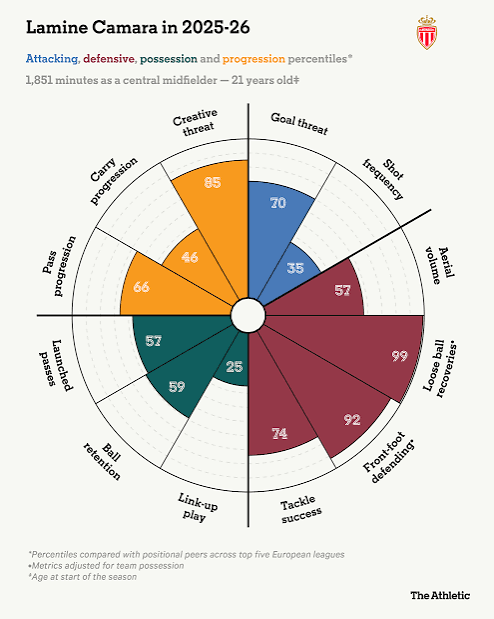
Camara is not a traditional No. 6 or No. 8
The temptation with a midfielder such as Camara is to search for a simple positional label.
Is he a No. 6?
Is he a No. 8?
Is he a defensive midfielder?
Is he a box-to-box midfielder?
The answer is that he can exhibit characteristics of all four without being completely defined by any of them.
That versatility is one of his greatest assets.
As a No. 6, Camara can provide defensive coverage, participate in build-up and protect the central areas.
As a No. 8, he can advance, press higher, carry the ball and arrive in attacking zones.
In a double pivot, he can operate alongside a more positionally disciplined midfielder and receive greater freedom to press and progress.
In a three-man midfield, he can become the more aggressive ball-winning and transitional component;
The crucial point is that his role should be determined by the structure around him. Camara does not necessarily need to be the midfielder who does everything, he needs a structure that allows his best qualities to become more influential. That is a fundamentally different way of evaluating him.
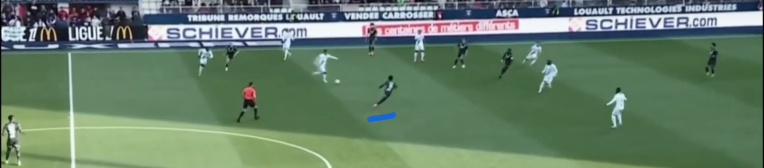
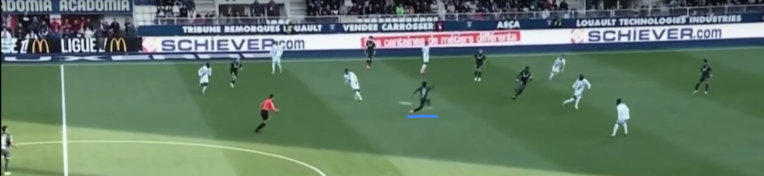
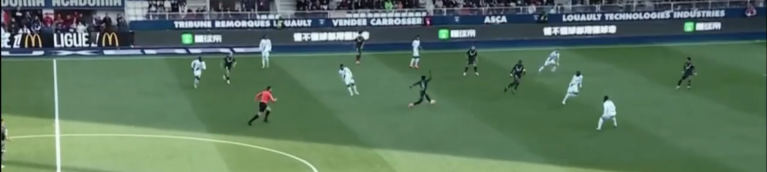
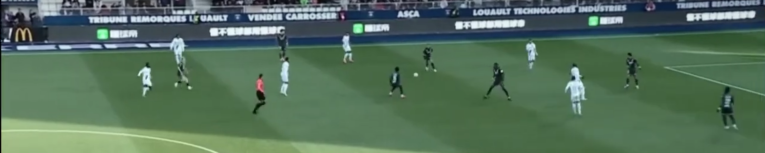
The defensive midfielder who wants to attack
The most interesting aspect of Camara's game is that his defensive and attacking qualities are interconnected.
Many midfielders can win possession.
Far fewer can consistently turn that recovery into an attacking advantage.
Camara's instinct is to do exactly that.
When he wins possession, he does not automatically treat the action as complete. He scans for the next opportunity.
Can he play vertically?
Can he carry?
Is there space on the opposite side?
Has the opposition midfield been pulled out?
Is a forward available between the lines?
These questions determine his next action.
This gives his defensive work an attacking dimension.
Rather than viewing defending and attacking as two separate phases, Camara can function as the bridge between them.
Defending becomes the first action of the attack.
That is a particularly valuable quality in modern football, where transition moments can be more dangerous than settled possession.
1. Defensive intelligence: anticipation before aggression
Camara's defensive value should not be judged simply by how many tackles he makes; The more interesting question is why he is able to make those interventions. Good defensive midfielders understand that positioning can eliminate the need for a tackle. They close passing lanes, They occupy dangerous spaces, They anticipate where the next pass is going and They recognise when an opponent is receiving with limited options.
Camara possesses many of these characteristics.His mobility allows him to move laterally across midfield, while his aggression enables him to step forward when the opportunity to regain possession appears.This combination is particularly useful in an aggressive defensive structure.
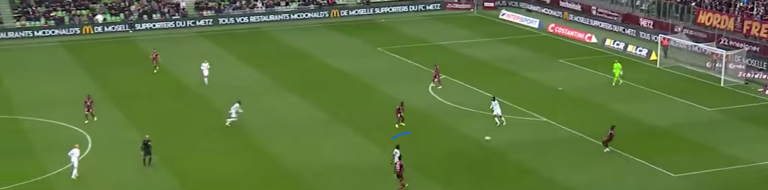
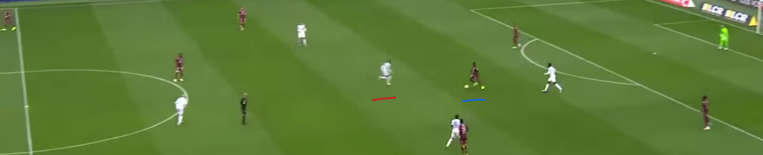
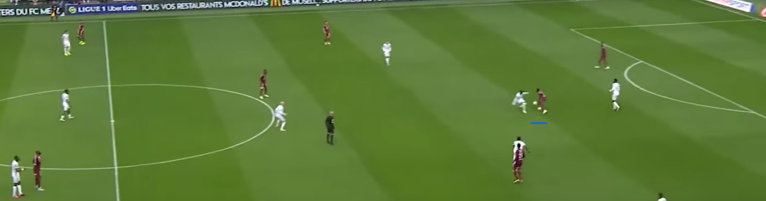
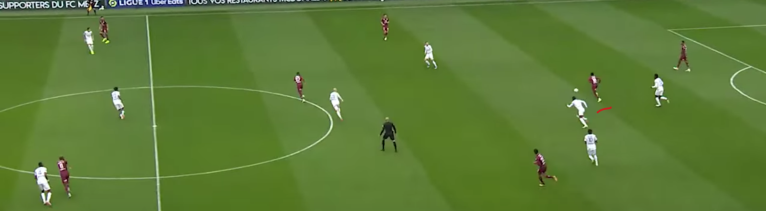
Imagine an opposition midfielder receiving between the lines. Camara does not necessarily have to wait for the player to turn. He can step toward the receiver; The objective is not merely to tackle, It is to reduce the opponent's time and options. That distinction matters. Camara's defensive game is partly about making the next opposition action uncomfortable before it happens.
2. Defending forward
One of Camara's most valuable characteristics is his ability to defend while moving toward the ball rather than constantly retreating toward his own goal.
This is particularly important for teams that want to maintain territorial pressure.
If the opposition attempts to play through midfield, Camara can step into the passing lane.
If a teammate moves out to press, he can occupy the space behind that pressure.
If a centre-back steps forward, Camara can adjust his position to protect the space created.
This creates a form of defensive elasticity.
He can move toward the problem without necessarily abandoning the structure behind him.
However, this is also where his positional discipline becomes important.
Aggressive midfielders can sometimes be manipulated by opponents who deliberately create spaces for them to attack.
The next stage of Camara's development is therefore not about becoming less aggressive.
It is about learning when aggression is structurally correct.
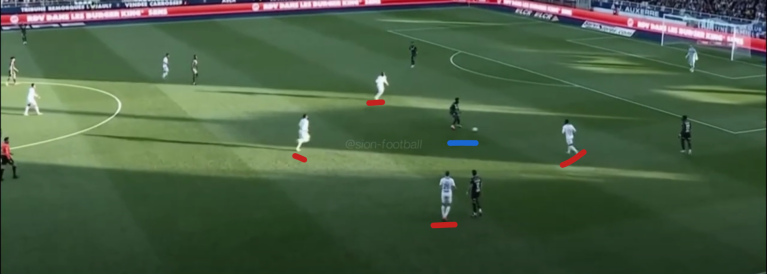
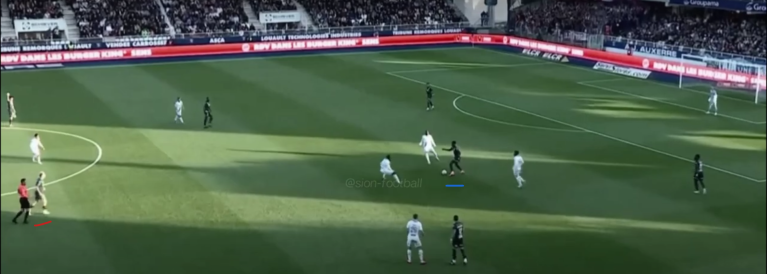
3. The recovery is only the beginning
This is where Camara's profile becomes particularly distinctive.
Consider two midfielders winning the same loose ball.
The first recovers possession and immediately plays backwards.
The second recovers possession, scans forward and attempts to exploit the opponent's temporary disorganisation.
Camara increasingly resembles the second type.
His preferred sequence is:
Recover → scan → progress → attack.
The reason is tactical.
Immediately after losing possession, opponents are often badly positioned for defensive recovery. Full-backs may be advanced. Midfielders may be spread. Attackers may still be ahead of the ball.
That creates a short window.
Camara's ability to recognise and exploit that window can transform an ordinary defensive recovery into a dangerous attacking sequence.
This is why his ball-winning ability should not be analysed independently from his passing and carrying.
They are connected.
4. Ball carrying: his second route through pressure
Passing is not Camara's only method of progression.
He can also carry the ball.
This is significant because midfield pressure is often designed to remove passing options.
When the opponent blocks the forward passing lane, the midfielder has three basic choices:
pass sideways, pass backwards or move forward himself.
Camara can choose the third option.
By carrying through the first line of pressure, he forces the opposition to make a decision.
If a midfielder steps toward him, a passing lane can open behind that player.
If nobody steps forward, Camara continues to advance.
This creates a classic midfield dilemma:
press the carrier and expose space, or hold position and allow progression.
The best ball-carrying midfielders exploit precisely this uncertainty.
Camara's ability to carry therefore adds another layer to his progressive game.
He is not dependent on someone else creating space for him.
At times, his movement with the ball creates the space himself.
5. Verticality: the defining feature of his progression
Camara is naturally inclined toward vertical football.
He wants to move the team forward.
This is one of his greatest strengths, but it is also an area where his game can still mature.
Verticality is valuable only when it is accompanied by appropriate decision-making.
There is a difference between seeing a forward pass and knowing whether the pass should actually be played.
Sometimes a passing lane exists because the opponent wants you to use it.
Sometimes retaining possession is more valuable than forcing progression.
Sometimes a short pass creates a better attacking opportunity two actions later.
Camara's technical ability is not the major question.
The next developmental step is risk management.
His challenge is to preserve the ambition that makes him dangerous while becoming more selective about when to accelerate the game.
This is the kind of refinement that can transform an exciting midfielder into an elite one.
6. Passing: progression rather than possession for its own sake
Camara's passing should not be assessed simply by completion percentage.
The more important question is what his passing achieves.
Does it break a line?
Does it move the opposition block?
Does it find a teammate between the lines?
Does it change the point of attack?
Does it accelerate a transition?
Those are the actions that give his distribution value.
He can play vertically into advanced midfielders.
He can use diagonals to access the half-spaces.
He can switch play when the opposition becomes too narrow.
And, most importantly, he can attempt forward passes immediately after recovering possession.
That final quality is central to his identity.
Camara does not merely recover the ball.
He can weaponise the recovery.
7. The No. 6 version of Lamine Camara
Camara's interpretation of the No. 6 role is more dynamic than that of a purely static defensive midfielder.
He can drop deeper during build-up.
He can position himself alongside the centre-backs.
He can provide an outlet behind the first pressing line.
He can move toward the ball.
And when possession is lost, he can immediately become part of the counter-press.
This creates an attractive proposition for coaches who want their No. 6 to participate actively rather than simply protect the defence.
But it requires balance.
If Camara leaves the central zone, someone has to occupy it.
If he presses aggressively, another player has to understand the space behind him.
If he advances with the ball, the team's rest-defence structure must remain secure.
Therefore, Camara's effectiveness at No. 6 is heavily dependent on collective structure.
He should not be asked to compensate for poor positioning elsewhere.
8. The No. 8 version
The No. 8 role arguably gives Camara even more freedom.
Here, he can begin deeper before advancing into midfield.
He can press opposition midfielders.
He can carry into the final third.
He can support combinations around the half-space.
And he can arrive outside the penalty area to use his shooting ability.
His long-range threat is particularly useful because it forces defenders to make decisions.
If they step toward him, they can create space elsewhere.
If they hold their position, Camara can potentially shoot or continue progressing.
This is the value of midfield unpredictability.
A midfielder who can pass, carry and shoot forces the opposition to defend several possibilities simultaneously.
9. Camara in a double pivot
Perhaps one of the most natural tactical environments for Camara is a double pivot.
A 4-2-3-1 could allow him to operate alongside a more positionally conservative midfielder.
The partner provides security.
Camara provides mobility.
The partner protects the central zone.
Camara can step toward the ball.
The partner holds when Camara advances.
Camara can press.
The partner covers.
This is not about limiting Camara.
It is about giving his aggression a framework.
The objective is to create role complementarity.
A coach should not ask Camara to be the entire midfield.
The coach should construct the midfield so that Camara's strengths become amplified.
10. Camara in a 4-3-3
A three-man midfield provides another interesting possibility.
A positional No. 6 could operate behind Camara, allowing the Senegalese midfielder to function as a more aggressive No. 8.
In possession, he can advance.
Out of possession, he can jump onto opposition midfielders.
During transitions, he can become one of the first players attacking the ball.
The structure could therefore be interpreted as:
No. 6 — security
Camara — pressing and progression
Other No. 8 — creativity and connection
This arrangement gives Camara freedom without completely removing his defensive responsibilities.
It also makes his ability to cover ground particularly useful.
11. The counter-pressing dimension
Camara's profile is naturally suited to counter-pressing.
Effective counter-pressing depends heavily on three qualities:
proximity, anticipation and athleticism.
A player has to be close enough to the ball to intervene.
He has to understand where the next pass is likely to go.
And he has to have the physical capacity to close the space quickly.
Camara possesses the ingredients for all three.
This is why his role can become particularly important for teams that want to dominate territory.
When the ball is lost, he can immediately become a defensive player.
When the ball is recovered, he can immediately become an attacking player.
That ability to switch mental and physical states quickly is increasingly valuable.
12. What would a coach actually ask Camara to do?
From a coaching perspective, Camara's instructions should go far beyond simply telling him to win the ball.
A sophisticated tactical role could require him to:
- protect the central lane during build-up;
- provide a passing option behind the first press;
- jump onto opposition midfielders when pressing triggers are activated;
- attack second balls;
- cover the half-space when a full-back advances;
- step into passing lanes;
- carry through pressure;
- play forward immediately after recoveries;
- switch play when the opposition block becomes narrow;
- support attacks around the edge of the box;
- counter-press immediately after possession is lost.
That is a substantial tactical workload.
But it also demonstrates why Camara is interesting.
His value comes from being able to participate in multiple phases of the game.
He does not have to dominate one phase to influence the entire match.
13. The off-ball Camara
The ball tells only half the story.
Camara's off-ball movement is equally important.
He can press the ball carrier.
He can screen central passing lanes.
He can track midfield runners.
He can cover teammates who have moved forward.
He can attack loose balls.
And he can participate in the defensive transition immediately after possession is lost.
This gives his team greater freedom.
If a full-back wants to advance, Camara can potentially provide cover.
If a midfielder moves forward, Camara can protect the space behind.
If the ball is lost, he can become part of the immediate response.
The result is a midfielder who provides a degree of structural insurance.
That does not mean he should be permanently defensive.
Quite the opposite.
His defensive reliability can allow other players to be more adventurous.
14. The attacking threat
It would be a mistake to reduce Camara to a defensive midfielder who happens to pass well.
His attacking tools are significant.
His long-range shooting gives him a threat outside the penalty area.
His passing can break lines.
His carrying can move the team through midfield.
His movement can create numerical superiority.
And his transition ability can expose an opposition defence before it has reorganised.
He does not necessarily need to become a high-volume scorer to have attacking influence.
His importance lies in creating multiple problems simultaneously.
The opposition must respect the pass.
They must respect the carry.
They must respect the shot.
And they must respect the possibility that he can win the ball back if possession is lost.
That combination creates uncertainty.
15. The weakness: aggression without control
Camara's greatest strength also presents one of his most important developmental challenges.
He wants to play forward.
He wants to press.
He wants to attack the ball.
He wants to progress possession.
All of these characteristics are positive.
But when combined without sufficient control, they can create unnecessary turnovers or positional gaps.
His vertical passing can sometimes become too ambitious.
His pressing can occasionally pull him away from the position he is supposed to protect.
His desire to influence the game can therefore become a liability if the surrounding structure does not support him.
But this should not be interpreted as a reason to remove those qualities.
The coaching objective should be:
not to reduce the aggression, but to organise it.
The best version of Camara will not be a less adventurous player.
It will be a more intelligent adventurous player.
16. Why Chelsea wanted him
The reported collapse of Camara's move to Chelsea adds another important dimension to his story.
Chelsea had identified the Senegalese midfielder as a potential midfield addition following Enzo Fernández's reported move to Manchester City. A deal worth around £47 million was reportedly agreed, but Monaco ultimately pulled out of the transaction. The breakdown occurred amid the wider complications surrounding Folarin Balogun's proposed move from Monaco to Everton.
The important question is not simply why Chelsea wanted Camara.
It is what problem they believed he could solve.
The answer lies in his profile.
Chelsea were not simply looking for another midfielder.
They were looking for a player capable of contributing to the defensive phase while retaining the technical courage to move possession forward.
Camara fits that description.
He has the mobility required for a physically demanding midfield.
He can contribute to pressing.
He can recover possession.
But he is not limited to defensive work.
He can progress the ball after the recovery.
That combination explains why the reported fee was significant.
Chelsea were effectively attempting to purchase a midfielder who could operate across multiple phases rather than one who performed a single specialised function.
17. The failed transfer and what it means for Monaco
From Monaco's perspective, the collapse of the transfer is equally significant.
The club retains a midfielder who has already demonstrated that he can operate at a high level while possessing considerable room for further development.
The failed Chelsea move does not diminish Camara's trajectory.
If anything, it creates another opportunity for Monaco to continue developing him.
The challenge now becomes turning potential into consistency.
Can he become more secure under pressure?
Can he improve his positional discipline?
Can he make better decisions about when to play forward?
Can he control matches rather than simply influence moments?
Those are the questions that will determine his next level.
18. Camara through a recruitment lens
From a recruitment perspective, Camara is attractive because his profile is difficult to replicate.
A purely defensive midfielder can be limited in possession.
A possession controller can sometimes lack defensive aggression.
A box-to-box midfielder can possess energy without offering sufficient positional intelligence.
Camara offers elements of all three.
That makes him tactically adaptable.
A club can recruit him for one role today while potentially developing him into another tomorrow.
That is particularly valuable when squad structures change.
A midfielder who can operate as a No. 6, No. 8 or part of a double pivot provides the coach with tactical flexibility without requiring another specialist for every formation.
19. The Senegal dimension
Camara's development is also significant for Senegal.
The country has developed a generation of technically accomplished and tactically flexible midfielders, and Camara represents another evolution of that profile.
His physical qualities are evident, but they are not the entire foundation of his game.
His athleticism supports his pressing.
His mobility supports his defensive coverage.
His technique supports his progression.
His vision supports his passing.
His shooting adds another attacking dimension.
The combination is what matters.
It is increasingly difficult to describe the modern African midfielder through the outdated lens of athleticism alone.
Camara is a useful example of why that description no longer captures the complexity of elite midfield development.
20. What could the next version of Camara look like?
The most exciting question is not what Camara is today.
It is what he can become.
The foundations are already visible.
He has the athleticism.
He has the technical ability.
He has the willingness to defend.
He has the courage to progress.
He has the ability to operate in different midfield structures.
What remains is refinement.
The next version of Camara needs greater control over tempo.
He needs to become more selective with his forward passing.
He needs to understand when to remain in position rather than chase the ball.
And he needs to develop greater consistency across 90 minutes.
If those areas improve, his tactical value increases significantly.
He would no longer simply be a midfielder who can perform several roles.
He would become a midfielder who can control several phases of the game.
Conclusion: The value of the second action
Lamine Camara's game is best understood not through a single position or statistic, but through the relationship between his actions.
He tackles.
But then he passes.
He intercepts.
But then he carries.
He recovers possession.
But then he attacks.
That second action is where his value lies.
The modern midfielder is increasingly judged by what happens immediately after the ball changes possession, and Camara possesses the technical and physical characteristics to make those moments count.
His journey from Génération Foot to Metz and then Monaco has provided progressively greater tests, while his emergence for Senegal has established him on the international stage. His reported £47 million Chelsea move may have collapsed, but the interest itself underlines how his profile is being viewed: not simply as that of a promising young midfielder, but as a player capable of solving sophisticated tactical problems.
The next step is refinement.
Camara must learn to distinguish between progression and forced progression, between aggression and unnecessary movement, and between influencing a moment and controlling a match.
If he develops those distinctions, his ceiling rises considerably.
Because the most valuable midfielders are not simply those who win possession.
They are those who understand what possession is worth after it has been won.
And that is where Lamine Camara's game becomes particularly compelling.
He does not just win the ball.
He turns the recovery into a weapon.
There is a particular type of midfielder that modern football increasingly demands: a player capable of defending without becoming disconnected from possession, progressing the ball without sacrificing positional discipline, and understanding that winning the ball is only the beginning of the action rather than its conclusion.
Lamine Camara belongs to that category.
Modern midfielders are increasingly being asked to do more than simply occupy space between the defensive and attacking lines. They must be able to recover possession, resist pressure, progress the ball, cover ground, manipulate opponents with their positioning and, perhaps most importantly, turn defensive actions into attacking opportunities.Lamine Camara represents this evolution particularly well.
Football has gradually moved away from the idea that midfielders should be defined by one fixed responsibility. The modern midfielder is expected to defend, build, progress, press, cover, create and, increasingly, determine what happens in the few seconds immediately after possession changes hands. It is within this evolving landscape that Lamine Camara has begun to establish his identity.
The Senegalese midfielder is not simply a ball-winner. Neither is he a conventional deep-lying playmaker or a traditional box-to-box No. 8. His game sits somewhere between these definitions, built around an ability to connect defensive intervention with immediate progression.
He can step out to challenge.
He can intercept a pass.
He can recover a loose ball.
But the important part of his game begins immediately afterwards.
What does he do with the ball once he has won it?
That question provides perhaps the clearest route into understanding Camara.
His instinct is often to look forward. He can carry possession beyond the first line of pressure, attempt a vertical pass, switch play or use his long-range shooting to threaten the opposition from distance. His defensive work therefore has an attacking consequence.
A recovery can become a transition.
A transition can become progression.
And progression can become an opportunity.
That is what makes Camara such an intriguing modern midfielder.
From Génération Foot to the European stage
Camara's development began at Génération Foot, one of Senegal's most important football academies and an institution responsible for producing players capable of making the transition from Senegalese football to Europe's elite leagues.
He joined the academy in 2019 and signed his first professional contract in 2021 before moving to FC Metz in February 2023. His transition to France represented more than a geographical change. It exposed him to a considerably faster tactical and physical environment, where midfielders have less time to receive, scan and execute.
Metz became the environment in which Camara's raw qualities began to acquire structure.
He was no longer simply a talented young midfielder capable of producing moments of individual brilliance. He had to learn how to operate within a team, understand positional responsibilities and make decisions against opponents capable of closing space quickly.
That process accelerated his development.
One of the earliest demonstrations of his technical confidence came against Monaco in October 2023, when he scored from distance after recognising the goalkeeper's advanced position. The goal was spectacular, but the more interesting component was the decision-making that preceded it.
Camara saw the situation.
He processed it.
He acted.
That sequence—perception, decision and execution—has become increasingly important to his identity.
Monaco eventually completed his transfer in July 2024, signing him on a five-year contract. The move elevated his development into another environment, one in which he would be tested not only in Ligue 1 but also in European competition.
And it was at Monaco that his tactical profile became even more interesting.
Camara is not a traditional No. 6 or No. 8
The temptation with a midfielder such as Camara is to search for a simple positional label.
Is he a No. 6?
Is he a No. 8?
Is he a defensive midfielder?
Is he a box-to-box midfielder?
The answer is that he can exhibit characteristics of all four without being completely defined by any of them.
That versatility is one of his greatest assets.
As a No. 6, Camara can provide defensive coverage, participate in build-up and protect the central areas.
As a No. 8, he can advance, press higher, carry the ball and arrive in attacking zones.
In a double pivot, he can operate alongside a more positionally disciplined midfielder and receive greater freedom to press and progress.
In a three-man midfield, he can become the more aggressive ball-winning and transitional component; The crucial point is that his role should be determined by the structure around him. Camara does not necessarily need to be the midfielder who does everything, he needs a structure that allows his best qualities to become more influential. That is a fundamentally different way of evaluating him.
The defensive midfielder who wants to attack
The most interesting aspect of Camara's game is that his defensive and attacking qualities are interconnected.
Many midfielders can win possession.
Far fewer can consistently turn that recovery into an attacking advantage.
Camara's instinct is to do exactly that.
When he wins possession, he does not automatically treat the action as complete. He scans for the next opportunity.
Can he play vertically?
Can he carry?
Is there space on the opposite side?
Has the opposition midfield been pulled out?
Is a forward available between the lines?
These questions determine his next action.
This gives his defensive work an attacking dimension.
Rather than viewing defending and attacking as two separate phases, Camara can function as the bridge between them.
Defending becomes the first action of the attack.
That is a particularly valuable quality in modern football, where transition moments can be more dangerous than settled possession.
1. Defensive intelligence: anticipation before aggression
Camara's defensive value should not be judged simply by how many tackles he makes; The more interesting question is why he is able to make those interventions. Good defensive midfielders understand that positioning can eliminate the need for a tackle. They close passing lanes, They occupy dangerous spaces, They anticipate where the next pass is going and They recognise when an opponent is receiving with limited options.
Camara possesses many of these characteristics.His mobility allows him to move laterally across midfield, while his aggression enables him to step forward when the opportunity to regain possession appears.This combination is particularly useful in an aggressive defensive structure.
Imagine an opposition midfielder receiving between the lines. Camara does not necessarily have to wait for the player to turn. He can step toward the receiver; The objective is not merely to tackle, It is to reduce the opponent's time and options. That distinction matters. Camara's defensive game is partly about making the next opposition action uncomfortable before it happens.
2. Defending forward
One of Camara's most valuable characteristics is his ability to defend while moving toward the ball rather than constantly retreating toward his own goal.
This is particularly important for teams that want to maintain territorial pressure.
If the opposition attempts to play through midfield, Camara can step into the passing lane.
If a teammate moves out to press, he can occupy the space behind that pressure.
If a centre-back steps forward, Camara can adjust his position to protect the space created.
This creates a form of defensive elasticity.
He can move toward the problem without necessarily abandoning the structure behind him.
However, this is also where his positional discipline becomes important.
Aggressive midfielders can sometimes be manipulated by opponents who deliberately create spaces for them to attack.
The next stage of Camara's development is therefore not about becoming less aggressive.
It is about learning when aggression is structurally correct.
3. The recovery is only the beginning
This is where Camara's profile becomes particularly distinctive.
Consider two midfielders winning the same loose ball.
The first recovers possession and immediately plays backwards.
The second recovers possession, scans forward and attempts to exploit the opponent's temporary disorganisation.
Camara increasingly resembles the second type.
His preferred sequence is:
Recover → scan → progress → attack.
The reason is tactical.
Immediately after losing possession, opponents are often badly positioned for defensive recovery. Full-backs may be advanced. Midfielders may be spread. Attackers may still be ahead of the ball.
That creates a short window.
Camara's ability to recognise and exploit that window can transform an ordinary defensive recovery into a dangerous attacking sequence.
This is why his ball-winning ability should not be analysed independently from his passing and carrying.
They are connected.
4. Ball carrying: his second route through pressure
Passing is not Camara's only method of progression.
He can also carry the ball.
This is significant because midfield pressure is often designed to remove passing options.
When the opponent blocks the forward passing lane, the midfielder has three basic choices:
pass sideways, pass backwards or move forward himself.
Camara can choose the third option.
By carrying through the first line of pressure, he forces the opposition to make a decision.
If a midfielder steps toward him, a passing lane can open behind that player.
If nobody steps forward, Camara continues to advance.
This creates a classic midfield dilemma:
press the carrier and expose space, or hold position and allow progression.
The best ball-carrying midfielders exploit precisely this uncertainty.
Camara's ability to carry therefore adds another layer to his progressive game.
He is not dependent on someone else creating space for him.
At times, his movement with the ball creates the space himself.
5. Verticality: the defining feature of his progression
Camara is naturally inclined toward vertical football.
He wants to move the team forward.
This is one of his greatest strengths, but it is also an area where his game can still mature.
Verticality is valuable only when it is accompanied by appropriate decision-making.
There is a difference between seeing a forward pass and knowing whether the pass should actually be played.
Sometimes a passing lane exists because the opponent wants you to use it.
Sometimes retaining possession is more valuable than forcing progression.
Sometimes a short pass creates a better attacking opportunity two actions later.
Camara's technical ability is not the major question.
The next developmental step is risk management.
His challenge is to preserve the ambition that makes him dangerous while becoming more selective about when to accelerate the game.
This is the kind of refinement that can transform an exciting midfielder into an elite one.
6. Passing: progression rather than possession for its own sake
Camara's passing should not be assessed simply by completion percentage.
The more important question is what his passing achieves.
Does it break a line?
Does it move the opposition block?
Does it find a teammate between the lines?
Does it change the point of attack?
Does it accelerate a transition?
Those are the actions that give his distribution value.
He can play vertically into advanced midfielders.
He can use diagonals to access the half-spaces.
He can switch play when the opposition becomes too narrow.
And, most importantly, he can attempt forward passes immediately after recovering possession.
That final quality is central to his identity.
Camara does not merely recover the ball.
He can weaponise the recovery.
7. The No. 6 version of Lamine Camara
Camara's interpretation of the No. 6 role is more dynamic than that of a purely static defensive midfielder.
He can drop deeper during build-up.
He can position himself alongside the centre-backs.
He can provide an outlet behind the first pressing line.
He can move toward the ball.
And when possession is lost, he can immediately become part of the counter-press.
This creates an attractive proposition for coaches who want their No. 6 to participate actively rather than simply protect the defence.
But it requires balance.
If Camara leaves the central zone, someone has to occupy it.
If he presses aggressively, another player has to understand the space behind him.
If he advances with the ball, the team's rest-defence structure must remain secure.
Therefore, Camara's effectiveness at No. 6 is heavily dependent on collective structure.
He should not be asked to compensate for poor positioning elsewhere.
8. The No. 8 version
The No. 8 role arguably gives Camara even more freedom.
Here, he can begin deeper before advancing into midfield.
He can press opposition midfielders.
He can carry into the final third.
He can support combinations around the half-space.
And he can arrive outside the penalty area to use his shooting ability.
His long-range threat is particularly useful because it forces defenders to make decisions.
If they step toward him, they can create space elsewhere.
If they hold their position, Camara can potentially shoot or continue progressing.
This is the value of midfield unpredictability.
A midfielder who can pass, carry and shoot forces the opposition to defend several possibilities simultaneously.
9. Camara in a double pivot
Perhaps one of the most natural tactical environments for Camara is a double pivot.
A 4-2-3-1 could allow him to operate alongside a more positionally conservative midfielder.
The partner provides security.
Camara provides mobility.
The partner protects the central zone.
Camara can step toward the ball.
The partner holds when Camara advances.
Camara can press.
The partner covers.
This is not about limiting Camara.
It is about giving his aggression a framework.
The objective is to create role complementarity.
A coach should not ask Camara to be the entire midfield.
The coach should construct the midfield so that Camara's strengths become amplified.
10. Camara in a 4-3-3
A three-man midfield provides another interesting possibility.
A positional No. 6 could operate behind Camara, allowing the Senegalese midfielder to function as a more aggressive No. 8.
In possession, he can advance.
Out of possession, he can jump onto opposition midfielders.
During transitions, he can become one of the first players attacking the ball.
The structure could therefore be interpreted as:
No. 6 — security
Camara — pressing and progression
Other No. 8 — creativity and connection
This arrangement gives Camara freedom without completely removing his defensive responsibilities.
It also makes his ability to cover ground particularly useful.
11. The counter-pressing dimension
Camara's profile is naturally suited to counter-pressing.
Effective counter-pressing depends heavily on three qualities:
proximity, anticipation and athleticism.
A player has to be close enough to the ball to intervene.
He has to understand where the next pass is likely to go.
And he has to have the physical capacity to close the space quickly.
Camara possesses the ingredients for all three.
This is why his role can become particularly important for teams that want to dominate territory.
When the ball is lost, he can immediately become a defensive player.
When the ball is recovered, he can immediately become an attacking player.
That ability to switch mental and physical states quickly is increasingly valuable.
12. What would a coach actually ask Camara to do?
From a coaching perspective, Camara's instructions should go far beyond simply telling him to win the ball.
A sophisticated tactical role could require him to:
- protect the central lane during build-up;
- provide a passing option behind the first press;
- jump onto opposition midfielders when pressing triggers are activated;
- attack second balls;
- cover the half-space when a full-back advances;
- step into passing lanes;
- carry through pressure;
- play forward immediately after recoveries;
- switch play when the opposition block becomes narrow;
- support attacks around the edge of the box;
- counter-press immediately after possession is lost.
That is a substantial tactical workload.
But it also demonstrates why Camara is interesting.
His value comes from being able to participate in multiple phases of the game.
He does not have to dominate one phase to influence the entire match.
13. The off-ball Camara
The ball tells only half the story.
Camara's off-ball movement is equally important.
He can press the ball carrier.
He can screen central passing lanes.
He can track midfield runners.
He can cover teammates who have moved forward.
He can attack loose balls.
And he can participate in the defensive transition immediately after possession is lost.
This gives his team greater freedom.
If a full-back wants to advance, Camara can potentially provide cover.
If a midfielder moves forward, Camara can protect the space behind.
If the ball is lost, he can become part of the immediate response.
The result is a midfielder who provides a degree of structural insurance.
That does not mean he should be permanently defensive.
Quite the opposite.
His defensive reliability can allow other players to be more adventurous.
14. The attacking threat
It would be a mistake to reduce Camara to a defensive midfielder who happens to pass well.
His attacking tools are significant.
His long-range shooting gives him a threat outside the penalty area.
His passing can break lines.
His carrying can move the team through midfield.
His movement can create numerical superiority.
And his transition ability can expose an opposition defence before it has reorganised.
He does not necessarily need to become a high-volume scorer to have attacking influence.
His importance lies in creating multiple problems simultaneously.
The opposition must respect the pass.
They must respect the carry.
They must respect the shot.
And they must respect the possibility that he can win the ball back if possession is lost.
That combination creates uncertainty.
15. The weakness: aggression without control
Camara's greatest strength also presents one of his most important developmental challenges.
He wants to play forward.
He wants to press.
He wants to attack the ball.
He wants to progress possession.
All of these characteristics are positive.
But when combined without sufficient control, they can create unnecessary turnovers or positional gaps.
His vertical passing can sometimes become too ambitious.
His pressing can occasionally pull him away from the position he is supposed to protect.
His desire to influence the game can therefore become a liability if the surrounding structure does not support him.
But this should not be interpreted as a reason to remove those qualities.
The coaching objective should be:
not to reduce the aggression, but to organise it.
The best version of Camara will not be a less adventurous player.
It will be a more intelligent adventurous player.
16. Why Chelsea wanted him
The reported collapse of Camara's move to Chelsea adds another important dimension to his story.
Chelsea had identified the Senegalese midfielder as a potential midfield addition following Enzo Fernández's reported move to Manchester City. A deal worth around £47 million was reportedly agreed, but Monaco ultimately pulled out of the transaction. The breakdown occurred amid the wider complications surrounding Folarin Balogun's proposed move from Monaco to Everton.
The important question is not simply why Chelsea wanted Camara.
It is what problem they believed he could solve.
The answer lies in his profile.
Chelsea were not simply looking for another midfielder.
They were looking for a player capable of contributing to the defensive phase while retaining the technical courage to move possession forward.
Camara fits that description.
He has the mobility required for a physically demanding midfield.
He can contribute to pressing.
He can recover possession.
But he is not limited to defensive work.
He can progress the ball after the recovery.
That combination explains why the reported fee was significant.
Chelsea were effectively attempting to purchase a midfielder who could operate across multiple phases rather than one who performed a single specialised function.
17. The failed transfer and what it means for Monaco
From Monaco's perspective, the collapse of the transfer is equally significant.
The club retains a midfielder who has already demonstrated that he can operate at a high level while possessing considerable room for further development.
The failed Chelsea move does not diminish Camara's trajectory.
If anything, it creates another opportunity for Monaco to continue developing him.
The challenge now becomes turning potential into consistency.
Can he become more secure under pressure?
Can he improve his positional discipline?
Can he make better decisions about when to play forward?
Can he control matches rather than simply influence moments?
Those are the questions that will determine his next level.
18. Camara through a recruitment lens
From a recruitment perspective, Camara is attractive because his profile is difficult to replicate.
A purely defensive midfielder can be limited in possession.
A possession controller can sometimes lack defensive aggression.
A box-to-box midfielder can possess energy without offering sufficient positional intelligence.
Camara offers elements of all three.
That makes him tactically adaptable.
A club can recruit him for one role today while potentially developing him into another tomorrow.
That is particularly valuable when squad structures change.
A midfielder who can operate as a No. 6, No. 8 or part of a double pivot provides the coach with tactical flexibility without requiring another specialist for every formation.
19. The Senegal dimension
Camara's development is also significant for Senegal.
The country has developed a generation of technically accomplished and tactically flexible midfielders, and Camara represents another evolution of that profile.
His physical qualities are evident, but they are not the entire foundation of his game.
His athleticism supports his pressing.
His mobility supports his defensive coverage.
His technique supports his progression.
His vision supports his passing.
His shooting adds another attacking dimension.
The combination is what matters.
It is increasingly difficult to describe the modern African midfielder through the outdated lens of athleticism alone.
Camara is a useful example of why that description no longer captures the complexity of elite midfield development.
20. What could the next version of Camara look like?
The most exciting question is not what Camara is today.
It is what he can become.
The foundations are already visible.
He has the athleticism.
He has the technical ability.
He has the willingness to defend.
He has the courage to progress.
He has the ability to operate in different midfield structures.
What remains is refinement.
The next version of Camara needs greater control over tempo.
He needs to become more selective with his forward passing.
He needs to understand when to remain in position rather than chase the ball.
And he needs to develop greater consistency across 90 minutes.
If those areas improve, his tactical value increases significantly.
He would no longer simply be a midfielder who can perform several roles.
He would become a midfielder who can control several phases of the game.
Conclusion: The value of the second action
Lamine Camara's game is best understood not through a single position or statistic, but through the relationship between his actions.
He tackles.
But then he passes.
He intercepts.
But then he carries.
He recovers possession.
But then he attacks.
That second action is where his value lies.
The modern midfielder is increasingly judged by what happens immediately after the ball changes possession, and Camara possesses the technical and physical characteristics to make those moments count.
His journey from Génération Foot to Metz and then Monaco has provided progressively greater tests, while his emergence for Senegal has established him on the international stage. His reported £47 million Chelsea move may have collapsed, but the interest itself underlines how his profile is being viewed: not simply as that of a promising young midfielder, but as a player capable of solving sophisticated tactical problems.
The next step is refinement.
Camara must learn to distinguish between progression and forced progression, between aggression and unnecessary movement, and between influencing a moment and controlling a match.
If he develops those distinctions, his ceiling rises considerably.
Because the most valuable midfielders are not simply those who win possession.
They are those who understand what possession is worth after it has been won.
And that is where Lamine Camara's game becomes particularly compelling.
He does not just win the ball.
He turns the recovery into a weapon.
There is a particular type of midfielder that modern football increasingly demands: a player capable of defending without becoming disconnected from possession, progressing the ball without sacrificing positional discipline, and understanding that winning the ball is only the beginning of the action rather than its conclusion.
Lamine Camara belongs to that category.
Modern midfielders are increasingly being asked to do more than simply occupy space between the defensive and attacking lines. They must be able to recover possession, resist pressure, progress the ball, cover ground, manipulate opponents with their positioning and, perhaps most importantly, turn defensive actions into attacking opportunities.Lamine Camara represents this evolution particularly well.
Football has gradually moved away from the idea that midfielders should be defined by one fixed responsibility. The modern midfielder is expected to defend, build, progress, press, cover, create and, increasingly, determine what happens in the few seconds immediately after possession changes hands. It is within this evolving landscape that Lamine Camara has begun to establish his identity.
The Senegalese midfielder is not simply a ball-winner. Neither is he a conventional deep-lying playmaker or a traditional box-to-box No. 8. His game sits somewhere between these definitions, built around an ability to connect defensive intervention with immediate progression.
He can step out to challenge.
He can intercept a pass.
He can recover a loose ball.
But the important part of his game begins immediately afterwards.
What does he do with the ball once he has won it?
That question provides perhaps the clearest route into understanding Camara.
His instinct is often to look forward. He can carry possession beyond the first line of pressure, attempt a vertical pass, switch play or use his long-range shooting to threaten the opposition from distance. His defensive work therefore has an attacking consequence.
A recovery can become a transition.
A transition can become progression.
And progression can become an opportunity.
That is what makes Camara such an intriguing modern midfielder.
From Génération Foot to the European stage
Camara's development began at Génération Foot, one of Senegal's most important football academies and an institution responsible for producing players capable of making the transition from Senegalese football to Europe's elite leagues.
He joined the academy in 2019 and signed his first professional contract in 2021 before moving to FC Metz in February 2023. His transition to France represented more than a geographical change. It exposed him to a considerably faster tactical and physical environment, where midfielders have less time to receive, scan and execute.
Metz became the environment in which Camara's raw qualities began to acquire structure.
He was no longer simply a talented young midfielder capable of producing moments of individual brilliance. He had to learn how to operate within a team, understand positional responsibilities and make decisions against opponents capable of closing space quickly.
That process accelerated his development.
One of the earliest demonstrations of his technical confidence came against Monaco in October 2023, when he scored from distance after recognising the goalkeeper's advanced position. The goal was spectacular, but the more interesting component was the decision-making that preceded it.
Camara saw the situation.
He processed it.
He acted.
That sequence—perception, decision and execution—has become increasingly important to his identity.
Monaco eventually completed his transfer in July 2024, signing him on a five-year contract. The move elevated his development into another environment, one in which he would be tested not only in Ligue 1 but also in European competition.
And it was at Monaco that his tactical profile became even more interesting.
Camara is not a traditional No. 6 or No. 8
The temptation with a midfielder such as Camara is to search for a simple positional label.
Is he a No. 6?
Is he a No. 8?
Is he a defensive midfielder?
Is he a box-to-box midfielder?
The answer is that he can exhibit characteristics of all four without being completely defined by any of them.
That versatility is one of his greatest assets.
As a No. 6, Camara can provide defensive coverage, participate in build-up and protect the central areas.
As a No. 8, he can advance, press higher, carry the ball and arrive in attacking zones.
In a double pivot, he can operate alongside a more positionally disciplined midfielder and receive greater freedom to press and progress.
In a three-man midfield, he can become the more aggressive ball-winning and transitional component; The crucial point is that his role should be determined by the structure around him. Camara does not necessarily need to be the midfielder who does everything, he needs a structure that allows his best qualities to become more influential. That is a fundamentally different way of evaluating him.
The defensive midfielder who wants to attack
The most interesting aspect of Camara's game is that his defensive and attacking qualities are interconnected.
Many midfielders can win possession.
Far fewer can consistently turn that recovery into an attacking advantage.
Camara's instinct is to do exactly that.
When he wins possession, he does not automatically treat the action as complete. He scans for the next opportunity.
Can he play vertically?
Can he carry?
Is there space on the opposite side?
Has the opposition midfield been pulled out?
Is a forward available between the lines?
These questions determine his next action.
This gives his defensive work an attacking dimension.
Rather than viewing defending and attacking as two separate phases, Camara can function as the bridge between them.
Defending becomes the first action of the attack.
That is a particularly valuable quality in modern football, where transition moments can be more dangerous than settled possession.
1. Defensive intelligence: anticipation before aggression
Camara's defensive value should not be judged simply by how many tackles he makes; The more interesting question is why he is able to make those interventions. Good defensive midfielders understand that positioning can eliminate the need for a tackle. They close passing lanes, They occupy dangerous spaces, They anticipate where the next pass is going and They recognise when an opponent is receiving with limited options.
Camara possesses many of these characteristics.His mobility allows him to move laterally across midfield, while his aggression enables him to step forward when the opportunity to regain possession appears.This combination is particularly useful in an aggressive defensive structure.
Imagine an opposition midfielder receiving between the lines. Camara does not necessarily have to wait for the player to turn. He can step toward the receiver; The objective is not merely to tackle, It is to reduce the opponent's time and options. That distinction matters. Camara's defensive game is partly about making the next opposition action uncomfortable before it happens.
2. Defending forward
One of Camara's most valuable characteristics is his ability to defend while moving toward the ball rather than constantly retreating toward his own goal.
This is particularly important for teams that want to maintain territorial pressure.
If the opposition attempts to play through midfield, Camara can step into the passing lane.
If a teammate moves out to press, he can occupy the space behind that pressure.
If a centre-back steps forward, Camara can adjust his position to protect the space created.
This creates a form of defensive elasticity.
He can move toward the problem without necessarily abandoning the structure behind him.
However, this is also where his positional discipline becomes important.
Aggressive midfielders can sometimes be manipulated by opponents who deliberately create spaces for them to attack.
The next stage of Camara's development is therefore not about becoming less aggressive.
It is about learning when aggression is structurally correct.
3. The recovery is only the beginning
This is where Camara's profile becomes particularly distinctive.
Consider two midfielders winning the same loose ball.
The first recovers possession and immediately plays backwards.
The second recovers possession, scans forward and attempts to exploit the opponent's temporary disorganisation.
Camara increasingly resembles the second type.
His preferred sequence is:
Recover → scan → progress → attack.
The reason is tactical.
Immediately after losing possession, opponents are often badly positioned for defensive recovery. Full-backs may be advanced. Midfielders may be spread. Attackers may still be ahead of the ball.
That creates a short window.
Camara's ability to recognise and exploit that window can transform an ordinary defensive recovery into a dangerous attacking sequence.
This is why his ball-winning ability should not be analysed independently from his passing and carrying.
They are connected.
4. Ball carrying: his second route through pressure
Passing is not Camara's only method of progression.
He can also carry the ball.
This is significant because midfield pressure is often designed to remove passing options.
When the opponent blocks the forward passing lane, the midfielder has three basic choices:
pass sideways, pass backwards or move forward himself.
Camara can choose the third option.
By carrying through the first line of pressure, he forces the opposition to make a decision.
If a midfielder steps toward him, a passing lane can open behind that player.
If nobody steps forward, Camara continues to advance.
This creates a classic midfield dilemma:
press the carrier and expose space, or hold position and allow progression.
The best ball-carrying midfielders exploit precisely this uncertainty.
Camara's ability to carry therefore adds another layer to his progressive game.
He is not dependent on someone else creating space for him.
At times, his movement with the ball creates the space himself.
5. Verticality: the defining feature of his progression
Camara is naturally inclined toward vertical football.
He wants to move the team forward.
This is one of his greatest strengths, but it is also an area where his game can still mature.
Verticality is valuable only when it is accompanied by appropriate decision-making.
There is a difference between seeing a forward pass and knowing whether the pass should actually be played.
Sometimes a passing lane exists because the opponent wants you to use it.
Sometimes retaining possession is more valuable than forcing progression.
Sometimes a short pass creates a better attacking opportunity two actions later.
Camara's technical ability is not the major question.
The next developmental step is risk management.
His challenge is to preserve the ambition that makes him dangerous while becoming more selective about when to accelerate the game.
This is the kind of refinement that can transform an exciting midfielder into an elite one.
6. Passing: progression rather than possession for its own sake
Camara's passing should not be assessed simply by completion percentage.
The more important question is what his passing achieves.
Does it break a line?
Does it move the opposition block?
Does it find a teammate between the lines?
Does it change the point of attack?
Does it accelerate a transition?
Those are the actions that give his distribution value.
He can play vertically into advanced midfielders.
He can use diagonals to access the half-spaces.
He can switch play when the opposition becomes too narrow.
And, most importantly, he can attempt forward passes immediately after recovering possession.
That final quality is central to his identity.
Camara does not merely recover the ball.
He can weaponise the recovery.
7. The No. 6 version of Lamine Camara
Camara's interpretation of the No. 6 role is more dynamic than that of a purely static defensive midfielder.
He can drop deeper during build-up.
He can position himself alongside the centre-backs.
He can provide an outlet behind the first pressing line.
He can move toward the ball.
And when possession is lost, he can immediately become part of the counter-press.
This creates an attractive proposition for coaches who want their No. 6 to participate actively rather than simply protect the defence.
But it requires balance.
If Camara leaves the central zone, someone has to occupy it.
If he presses aggressively, another player has to understand the space behind him.
If he advances with the ball, the team's rest-defence structure must remain secure.
Therefore, Camara's effectiveness at No. 6 is heavily dependent on collective structure.
He should not be asked to compensate for poor positioning elsewhere.
8. The No. 8 version
The No. 8 role arguably gives Camara even more freedom.
Here, he can begin deeper before advancing into midfield.
He can press opposition midfielders.
He can carry into the final third.
He can support combinations around the half-space.
And he can arrive outside the penalty area to use his shooting ability.
His long-range threat is particularly useful because it forces defenders to make decisions.
If they step toward him, they can create space elsewhere.
If they hold their position, Camara can potentially shoot or continue progressing.
This is the value of midfield unpredictability.
A midfielder who can pass, carry and shoot forces the opposition to defend several possibilities simultaneously.
9. Camara in a double pivot
Perhaps one of the most natural tactical environments for Camara is a double pivot.
A 4-2-3-1 could allow him to operate alongside a more positionally conservative midfielder.
The partner provides security.
Camara provides mobility.
The partner protects the central zone.
Camara can step toward the ball.
The partner holds when Camara advances.
Camara can press.
The partner covers.
This is not about limiting Camara.
It is about giving his aggression a framework.
The objective is to create role complementarity.
A coach should not ask Camara to be the entire midfield.
The coach should construct the midfield so that Camara's strengths become amplified.
10. Camara in a 4-3-3
A three-man midfield provides another interesting possibility.
A positional No. 6 could operate behind Camara, allowing the Senegalese midfielder to function as a more aggressive No. 8.
In possession, he can advance.
Out of possession, he can jump onto opposition midfielders.
During transitions, he can become one of the first players attacking the ball.
The structure could therefore be interpreted as:
No. 6 — security
Camara — pressing and progression
Other No. 8 — creativity and connection
This arrangement gives Camara freedom without completely removing his defensive responsibilities.
It also makes his ability to cover ground particularly useful.
11. The counter-pressing dimension
Camara's profile is naturally suited to counter-pressing.
Effective counter-pressing depends heavily on three qualities:
proximity, anticipation and athleticism.
A player has to be close enough to the ball to intervene.
He has to understand where the next pass is likely to go.
And he has to have the physical capacity to close the space quickly.
Camara possesses the ingredients for all three.
This is why his role can become particularly important for teams that want to dominate territory.
When the ball is lost, he can immediately become a defensive player.
When the ball is recovered, he can immediately become an attacking player.
That ability to switch mental and physical states quickly is increasingly valuable.
12. What would a coach actually ask Camara to do?
From a coaching perspective, Camara's instructions should go far beyond simply telling him to win the ball.
A sophisticated tactical role could require him to:
- protect the central lane during build-up;
- provide a passing option behind the first press;
- jump onto opposition midfielders when pressing triggers are activated;
- attack second balls;
- cover the half-space when a full-back advances;
- step into passing lanes;
- carry through pressure;
- play forward immediately after recoveries;
- switch play when the opposition block becomes narrow;
- support attacks around the edge of the box;
- counter-press immediately after possession is lost.
That is a substantial tactical workload.
But it also demonstrates why Camara is interesting.
His value comes from being able to participate in multiple phases of the game.
He does not have to dominate one phase to influence the entire match.
13. The off-ball Camara
The ball tells only half the story.
Camara's off-ball movement is equally important.
He can press the ball carrier.
He can screen central passing lanes.
He can track midfield runners.
He can cover teammates who have moved forward.
He can attack loose balls.
And he can participate in the defensive transition immediately after possession is lost.
This gives his team greater freedom.
If a full-back wants to advance, Camara can potentially provide cover.
If a midfielder moves forward, Camara can protect the space behind.
If the ball is lost, he can become part of the immediate response.
The result is a midfielder who provides a degree of structural insurance.
That does not mean he should be permanently defensive.
Quite the opposite.
His defensive reliability can allow other players to be more adventurous.
14. The attacking threat
It would be a mistake to reduce Camara to a defensive midfielder who happens to pass well.
His attacking tools are significant.
His long-range shooting gives him a threat outside the penalty area.
His passing can break lines.
His carrying can move the team through midfield.
His movement can create numerical superiority.
And his transition ability can expose an opposition defence before it has reorganised.
He does not necessarily need to become a high-volume scorer to have attacking influence.
His importance lies in creating multiple problems simultaneously.
The opposition must respect the pass.
They must respect the carry.
They must respect the shot.
And they must respect the possibility that he can win the ball back if possession is lost.
That combination creates uncertainty.
15. The weakness: aggression without control
Camara's greatest strength also presents one of his most important developmental challenges.
He wants to play forward.
He wants to press.
He wants to attack the ball.
He wants to progress possession.
All of these characteristics are positive.
But when combined without sufficient control, they can create unnecessary turnovers or positional gaps.
His vertical passing can sometimes become too ambitious.
His pressing can occasionally pull him away from the position he is supposed to protect.
His desire to influence the game can therefore become a liability if the surrounding structure does not support him.
But this should not be interpreted as a reason to remove those qualities.
The coaching objective should be:
not to reduce the aggression, but to organise it.
The best version of Camara will not be a less adventurous player.
It will be a more intelligent adventurous player.
16. Why Chelsea wanted him
The reported collapse of Camara's move to Chelsea adds another important dimension to his story.
Chelsea had identified the Senegalese midfielder as a potential midfield addition following Enzo Fernández's reported move to Manchester City. A deal worth around £47 million was reportedly agreed, but Monaco ultimately pulled out of the transaction. The breakdown occurred amid the wider complications surrounding Folarin Balogun's proposed move from Monaco to Everton.
The important question is not simply why Chelsea wanted Camara.
It is what problem they believed he could solve.
The answer lies in his profile.
Chelsea were not simply looking for another midfielder.
They were looking for a player capable of contributing to the defensive phase while retaining the technical courage to move possession forward.
Camara fits that description.
He has the mobility required for a physically demanding midfield.
He can contribute to pressing.
He can recover possession.
But he is not limited to defensive work.
He can progress the ball after the recovery.
That combination explains why the reported fee was significant.
Chelsea were effectively attempting to purchase a midfielder who could operate across multiple phases rather than one who performed a single specialised function.
17. The failed transfer and what it means for Monaco
From Monaco's perspective, the collapse of the transfer is equally significant.
The club retains a midfielder who has already demonstrated that he can operate at a high level while possessing considerable room for further development.
The failed Chelsea move does not diminish Camara's trajectory.
If anything, it creates another opportunity for Monaco to continue developing him.
The challenge now becomes turning potential into consistency.
Can he become more secure under pressure?
Can he improve his positional discipline?
Can he make better decisions about when to play forward?
Can he control matches rather than simply influence moments?
Those are the questions that will determine his next level.
18. Camara through a recruitment lens
From a recruitment perspective, Camara is attractive because his profile is difficult to replicate.
A purely defensive midfielder can be limited in possession.
A possession controller can sometimes lack defensive aggression.
A box-to-box midfielder can possess energy without offering sufficient positional intelligence.
Camara offers elements of all three.
That makes him tactically adaptable.
A club can recruit him for one role today while potentially developing him into another tomorrow.
That is particularly valuable when squad structures change.
A midfielder who can operate as a No. 6, No. 8 or part of a double pivot provides the coach with tactical flexibility without requiring another specialist for every formation.
19. The Senegal dimension
Camara's development is also significant for Senegal.
The country has developed a generation of technically accomplished and tactically flexible midfielders, and Camara represents another evolution of that profile.
His physical qualities are evident, but they are not the entire foundation of his game.
His athleticism supports his pressing.
His mobility supports his defensive coverage.
His technique supports his progression.
His vision supports his passing.
His shooting adds another attacking dimension.
The combination is what matters.
It is increasingly difficult to describe the modern African midfielder through the outdated lens of athleticism alone.
Camara is a useful example of why that description no longer captures the complexity of elite midfield development.
20. What could the next version of Camara look like?
The most exciting question is not what Camara is today.
It is what he can become.
The foundations are already visible.
He has the athleticism.
He has the technical ability.
He has the willingness to defend.
He has the courage to progress.
He has the ability to operate in different midfield structures.
What remains is refinement.
The next version of Camara needs greater control over tempo.
He needs to become more selective with his forward passing.
He needs to understand when to remain in position rather than chase the ball.
And he needs to develop greater consistency across 90 minutes.
If those areas improve, his tactical value increases significantly.
He would no longer simply be a midfielder who can perform several roles.
He would become a midfielder who can control several phases of the game.
Conclusion: The value of the second action
Lamine Camara's game is best understood not through a single position or statistic, but through the relationship between his actions.
He tackles.
But then he passes.
He intercepts.
But then he carries.
He recovers possession.
But then he attacks.
That second action is where his value lies.
The modern midfielder is increasingly judged by what happens immediately after the ball changes possession, and Camara possesses the technical and physical characteristics to make those moments count.
His journey from Génération Foot to Metz and then Monaco has provided progressively greater tests, while his emergence for Senegal has established him on the international stage. His reported £47 million Chelsea move may have collapsed, but the interest itself underlines how his profile is being viewed: not simply as that of a promising young midfielder, but as a player capable of solving sophisticated tactical problems.
The next step is refinement.
Camara must learn to distinguish between progression and forced progression, between aggression and unnecessary movement, and between influencing a moment and controlling a match.
If he develops those distinctions, his ceiling rises considerably.
Because the most valuable midfielders are not simply those who win possession.
They are those who understand what possession is worth after it has been won.
And that is where Lamine Camara's game becomes particularly compelling.
He does not just win the ball.
He turns the recovery into a weapon.