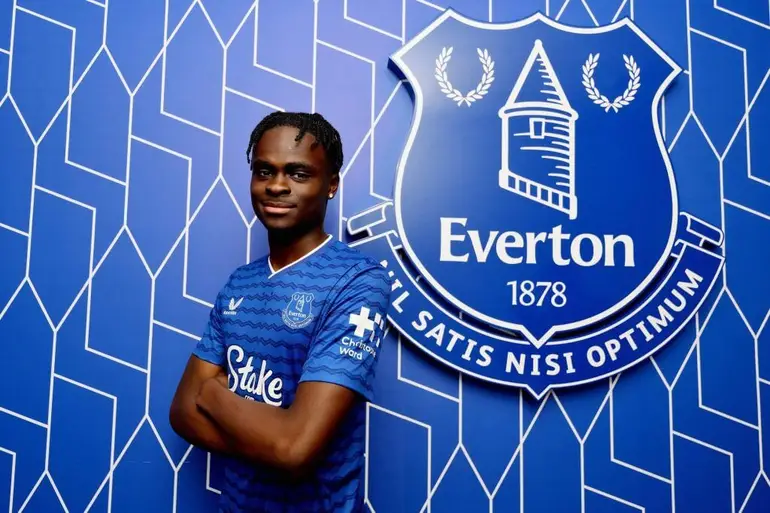
Tyrinque George and the redefinition of playing on the wide areas.
A glimpse of his brilliance in Everton's game against Preston in the second round of the EFL Cup reignite the memories of Raheem Sterling raw pace, low gravity, direct dribbling, and versatility across the forward line. But there is more to know about the Cobham Graduate and what he tend to proffer with his varieties of movement along with the combination of speed, agility and versatility as seen in this video. An analysis prompt the question who is he and what does he bring.
https://x.com/Jay3FC/status/2092714286527156562/video/1
Football has spent decades trying to define the winger. The traditional winger was straightforward: stay wide, receive the ball, attack the full-back and deliver into the penalty area. The modern winger became more complicated, particularly with the emergence of inverted forwards who begin on the flank before moving inside to shoot or create. But the next evolution is different. The wide player is no longer necessarily defined by where he starts. He is defined by how effectively he can manipulate space from that starting position. Tyrique George belongs to this generation.
The Everton forward has developed through one of the most demanding academy systems in English football, progressing from Chelsea's Under-8s to the first team before eventually making the permanent move to Everton in July 2026. Chelsea confirmed that George left having made 37 senior appearances, scoring six goals and winning two trophies.
Yet his career trajectory is interesting precisely because his development has never been restricted to one position. George has played as a winger, He has played as a No. 10, He has played as a striker and that positional background has shaped the way he interprets the wide areas.
He does not simply occupy the flank.
He uses it.
He stretches it.
He leaves it.
He attacks the spaces created by leaving it.
That is why Tyrique George is better understood not simply as a winger, but as a wide attacking playmaker whose starting position is on the flank but whose influence can extend throughout the attacking structure.
THE BEGINNING: FROM CAMDEN TO COBHAM
George's story began in Camden, north London. From the age of three, football was already central to his life. He played grassroots football with TFA Totteridge, initially featuring regularly as a striker before attracting attention from Chelsea.
At eight years old, he joined the Chelsea academy.The significance of that decision cannot be understated.For a young player living in north London, travelling to Chelsea's Cobham training base required substantial commitment from both George and his family. His mother would take him to training after finishing work, with the journey continuing for several years.
Eventually, when George was 12, his family moved from Camden to South Croydon to reduce the distance to Chelsea's training ground. George has spoken about how difficult the decision was because Camden was where his friends, school life and childhood were established.
But football demanded a sacrifice. He made it. And that decision became one of the foundations of his professional career. There is an important lesson in that development. George did not arrive at Chelsea as a finished winger. He arrived as an attacking player. That distinction matters.
THE STRIKER'S INFLUENCE ON THE WINGER
One of the most important elements of George's development is often overlooked: his early experience as a striker. At first glance, that may seem insignificant. It is not.
A player who grows up centrally learns different things from a player who develops exclusively on the wing.
A striker learns to:
- attack the space between centre-back and full-back;
- recognise when defenders are occupied;
- time movements beyond the defensive line;
- attack the penalty area;
- receive with pressure behind him;
- combine with attacking midfielders;
- understand the positioning of central defenders;
- anticipate where the next pass will arrive.
George subsequently moved towards the wing, but he carried those instincts with him. That is why his game does not always resemble that of a conventional touchline winger. When he moves inside, he does not look like a winger who has wandered into midfield. He often looks like an attacker returning to familiar territory. Chelsea themselves have noted that George has played as a striker, including at senior level. George has also repeatedly expressed his willingness to play wherever he can contribute. That positional flexibility is one of his greatest assets.
THE CHELSEA ACADEMY: WHERE THE PROFILE WAS REFINED
Chelsea's academy became the environment in which George's raw attacking ability was gradually transformed into a more complete footballing profile. He made his Under-18 debut during the 2021/22 season while still a schoolboy. By the following season, he had become a regular. Then came the major breakthrough in 2023/24.
George featured across the Under-18 and Under-21 teams and helped Chelsea's Under-18s win the Premier League South title. He was also increasingly exposed to senior football and eventually trained regularly with the first team.
This period was particularly important because he was no longer being developed in isolation.He was moving between age groups.He was facing different physical profiles. He was learning to adapt.And that adaptation is central to his game today. A winger who only succeeds against players his own age can become predictable when he reaches senior football. George was progressively introduced to older, stronger and more tactically sophisticated opponents.That accelerated his understanding of space and tempo.
THE BREAKTHROUGH INTO CHELSEA'S FIRST TEAM
The transition from academy football to Premier League football is where many talented players encounter their biggest obstacle. The game becomes faster, The space disappears, Defenders are stronger, Decision-making windows become smaller.
George crossed that barrier. His senior debut came against Servette in the UEFA Conference League during the 2024/25 campaign. From there, he began accumulating senior appearances across different attacking positions.
Chelsea's own account of his development is revealing: George made 26 further appearances during that breakthrough campaign and scored his first senior goals against Legia Warsaw and Fulham. He also received the club's Academy Player of the Year award. The numbers themselves tell only part of the story. The more important development was tactical.
George was being asked to operate in different attacking roles. Sometimes he was wide, Sometimes he was closer to the striker. Sometimes he was used centrally That experience reinforced something Chelsea's academy had already identified: George's value increases when he is allowed to move.
WHY HE DID NOT REMAIN AT CHELSEA
The eventual departure from Chelsea should not be interpreted as a failure. Quite the opposite.
George had successfully graduated from the academy. The problem was what came next.
Chelsea's first-team environment contains enormous competition for attacking positions, and a young player can reach a point where remaining at the club does not necessarily guarantee the consistent senior minutes required for his next stage of development. During the first half of the 2025/26 season, George made 11 appearances for Chelsea and scored against Lincoln City, Wolverhampton Wanderers and Ajax. He also broke into England's Under-21 team, scoring twice in his first four appearances at that level.
The progress was obvious, But so was the need for greater responsibility. George needed somewhere he could move from being a young player with potential to a young player trusted with a defined role. Everton offered that opportunity.
THE EVERTON LOAN: THE BRIDGE BETWEEN POTENTIAL AND RESPONSIBILITY
In January 2026, George joined Everton on loan. The move was strategically important. Everton were not simply providing him with minutes. They were giving him exposure to a different footballing environment.
Chelsea had developed his technical and positional education. Everton offered the next test:
Could those qualities survive consistently in Premier League football?
The answer was sufficiently positive for Everton to complete a permanent transfer later that summer. George made 11 Premier League appearances during the loan spell. Although his raw attacking numbers were modest, Everton evidently saw enough in his performances, training attitude and underlying qualities to pursue a permanent deal.
The reported structure of the transfer was around £18 million initially, potentially rising to £24 million through add-ons, with Chelsea also negotiating a sell-on clause. That makes the move significant. Everton were not purchasing a speculative academy player.They were buying a player they had already observed inside their own tactical environment.
WHY EVERTON?
The move makes sense from George's perspective.He needed opportunity. Everton needed attacking dynamism.Those two requirements aligned.David Moyes has historically valued players who can attack space, carry the ball and provide intensity without the ball.
George offers a different dimension. He can provide width, He can carry possession, He can attack defenders, He can move inside, He can combine and He can arrive in the box.
And crucially, he can perform these functions without necessarily needing to be the team's primary attacking player.That is valuable.A developing winger does not need every attack to run through him. He needs a system that gives him enough opportunities to influence games. Everton can provide that environment.
GEORGE'S TECHNICAL PROFILE
The most obvious feature of George's game is his close control. But saying he is simply a good dribbler does not explain why. His dribbling is effective because he combines several movements:
deceleration
body feints
changes of direction
changes of speed
close touches
ball protection
forward acceleration
This creates uncertainty. And uncertainty is one of the most valuable weapons in one-versus-one football. A defender wants to predict. George wants to prevent prediction. If the full-back knows that the attacker will always cut inside, defending becomes easier. If the attacker can go outside, inside, stop, accelerate, combine or carry centrally, the defender has to make a decision. George's game is built around creating that decision.
THE FIRST TOUCH AS AN ATTACKING WEAPON
George's first touch is not merely about controlling the ball. It can be used to attack.That distinction is crucial. A conventional first touch might bring the ball under control.An attacking first touch changes the position of the defender.
George can take the ball forward into space; He can move it away from pressure and can receive across his body. He can use his first touch to prepare the next action. This reduces the amount of time he needs to spend stationary. And in the modern Premier League, that matters. A player who receives, stops, looks up and then decides what to do is easier to defend. A player whose first touch already begins the next action is much more difficult to contain.
THE ART OF ONE-VERSUS-ONE FOOTBALL
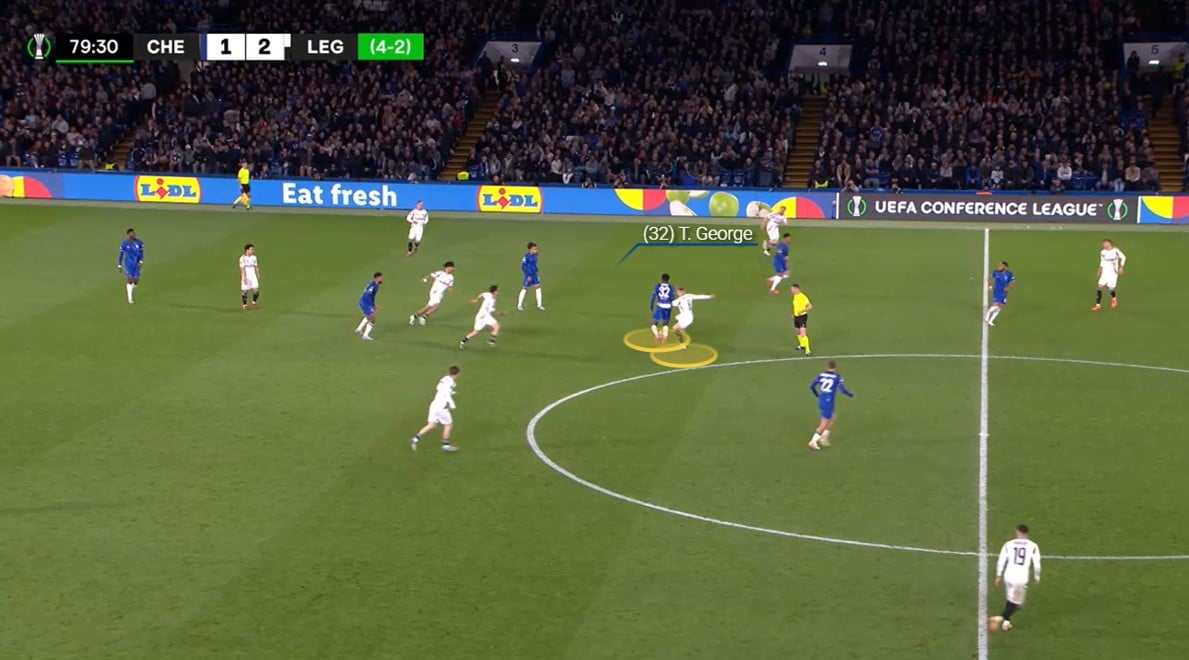
George is particularly interesting because he does not treat one-versus-one situations as isolated battles. The defender is not his only target.The defensive structure is; Suppose George receives wide, the full-back moves towards him.
George does not necessarily have to beat that player. If the full-back steps forward, the space behind him can become available. If the winger carries the ball inside, the midfielder may have to move across.That movement can open another passing lane. This means the dribble can be successful even when it does not end with George beating the defender.
The dribble has still changed the structure. That is advanced wide play.
GEORGE AND THE HALF-SPACE
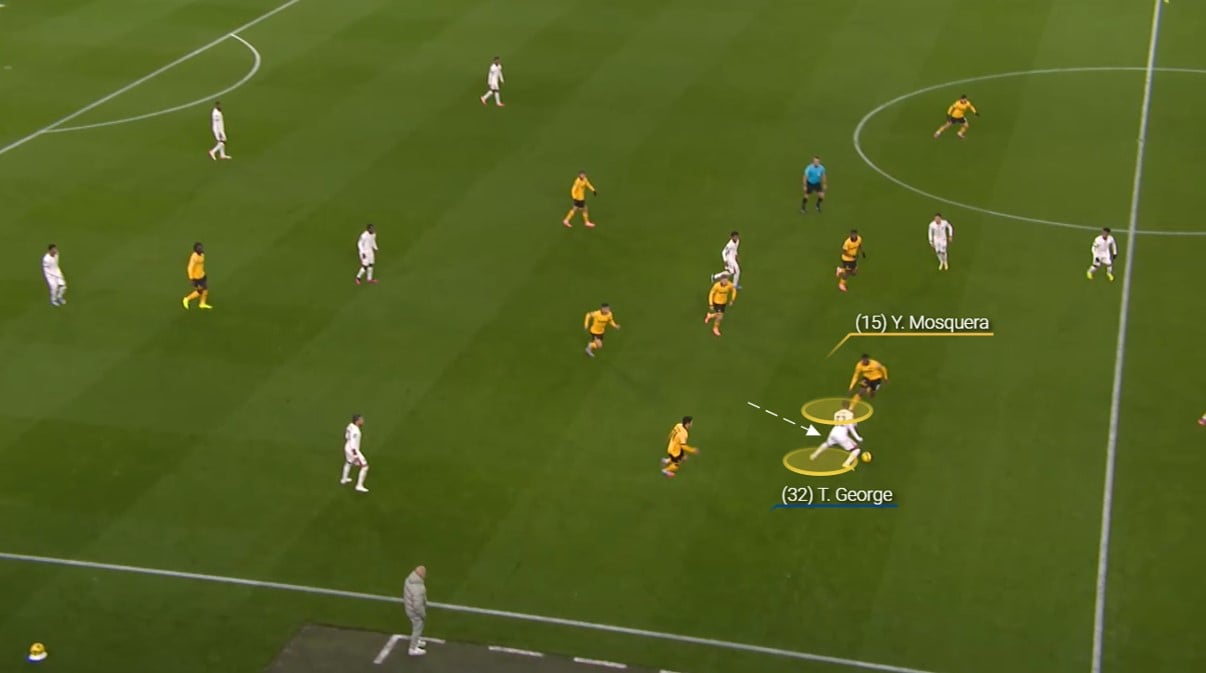
The half-space is arguably the area that best explains George's potential. Modern attacking structures increasingly use the channel between the centre and the wing because it provides access to both central and wide routes. For George, moving into this zone offers several possibilities.
He can:
receive between the lines;
turn and carry;
combine with the No. 9;
release an overlapping full-back;
attack the penalty area;
switch play;
or move back outside.
This is why his position should not be interpreted literally.If the team sheet says "left wing", it does not mean George must remain on the left touchline. His starting position is left. His attacking responsibility is much broader.
THE WINGER WHO CAN BECOME A NO. 10
George's ability to operate centrally is perhaps his most underrated quality. As a No. 10, his game would become less about running at full-backs and more about manipulating midfielders.The space is smaller. The pressure is greater.
But his close control gives him the foundation to receive between lines.
His striker background also becomes useful.
He understands where the forward wants the ball.
He understands how defenders react when the striker drops.
He understands the space behind a centre-forward.
This could eventually allow Everton to use George in hybrid attacking structures.
For example:
George starts wide → moves inside → striker drops → George attacks the space beyond.
Or:
George starts centrally → drifts left → creates an overload → winger/full-back attacks the outside.
That is the kind of positional rotation increasingly associated with elite attacking teams.
THE VALUE OF HIS RIGHT FOOT FROM THE LEFT
George is naturally right-footed, and that has significant tactical implications.
From the left, his stronger foot is naturally positioned towards the centre.
That allows him to:
- carry inside;
- combine with midfielders;
- play through-balls;
- shoot;
- attack the box;
- switch the point of attack.
But the important point is that he does not have to come inside every time. If the defender expects the inverted movement, George can attack outside. This creates a two-way threat. The defender cannot simply show him inside or outside. That uncertainty is what gives the winger control over the duel.
GEORGE'S BALL-CARRYING
https://twitter.com/i/status/2087601689947766961
There are different types of dribblers.
Some dribble to eliminate players.
Some dribble to escape pressure.
Some dribble to gain territory.
George has elements of all three.His carrying is particularly useful during transitions.
When Everton recover possession, George can become an immediate outlet. Instead of waiting for the team to establish possession, he can receive and attack the available space. This changes the tempo of the attack. A quick carry can force defenders to retreat.
Once the defensive line retreats, Everton's midfielders have more time. The centre-forward has more space to move. Other attackers can join the attack.One player carrying the ball can therefore influence the positioning of four or five opponents.
GEORGE WITHOUT THE BALL
This is where his development must continue. A winger's work is not finished once he loses possession.
Modern wide players have multiple responsibilities:
- press;
- recover;
- track runners;
- maintain the defensive block;
- protect the full-back;
- close passing lanes;
- initiate counter-pressing.
George has the athletic capacity and energy to contribute. But tactical intelligence will determine how far he progresses. The best wide players understand not only where to run, but why they are running there. George's next developmental step is therefore to become more sophisticated without the ball.
THE IMPORTANCE OF TIMING
Timing may ultimately be more important to George's evolution than additional tricks.
When should he move inside?
When should he stay wide?
When should he attack depth?
When should he receive to feet?
When should he combine?
When should he make the run behind?
These decisions determine whether a winger becomes merely entertaining or genuinely influential. George already possesses the technical tools. The next phase is making those tools consistently serve the structure of the team.
WHAT HE OFFERS EVERTON IN POSSESSION
Everton can use George in several different attacking structures.
1. Traditional wide structure
George stays outside.
The full-back overlaps.
George isolates the opposition full-back.
This maximises his one-versus-one ability.
2. Inverted winger
George begins wide before moving into the half-space.
The full-back provides the width.
George becomes another central attacking player.
3. Wide playmaker
George receives wide but immediately looks to combine with midfielders and the striker.
This creates fluidity rather than isolation.
4. Inside forward
George attacks the penalty area from the wing.
His striker background becomes particularly useful here.
5. Hybrid No. 10
George begins centrally but drifts towards the left.
This creates numerical superiority in one area of the pitch.
The tactical flexibility means Everton do not have to use George in exactly the same way every week.
That is important over a 38-game season.
WHAT HE OFFERS EVERTON IN TRANSITION
This may be one of his greatest immediate strengths. George is naturally aggressive when space appears.
If Everton win the ball and George is already positioned high, he can immediately become the first attacking option.
His ability to carry the ball means Everton can bypass pressure.
His ability to attack defenders means the opposition cannot simply retreat into a comfortable shape.
This makes him particularly valuable against teams that commit numbers forward.
The transition becomes:
regain → release George → carry → attract defender → create space → combine or finish.
It is a simple sequence.
But it can be extremely effective.
THE GEORGE–FULL-BACK RELATIONSHIP
An overlooked aspect of George's development will be his relationship with Everton's full-backs.
A winger's effectiveness is partly determined by the player behind him. If George stays wide while the full-back overlaps, the opposition has a difficult choice. If the full-back stays behind, George can receive isolation. If George moves inside, the full-back can provide width. This creates a rotational relationship.
George does not have to provide the width himself at all times. He can create the conditions for somebody else to provide it.That is an important distinction between a traditional winger and a modern wide attacker.
THE GEORGE–STRIKER RELATIONSHIP
His relationship with the centre-forward will also be crucial. Because George has striker experience, he understands central movement. If the striker drops towards the ball, George can attack the space behind.
If the striker pins the centre-back, George can attack the channel. If the striker moves towards George's side, George can move centrally. This creates complementary movement.
It also makes George difficult to mark because his position is constantly changing relative to the striker.
WHAT DAVID MOYES CAN DEVELOP
Moyes' role in George's development could be significant. Chelsea gave George his technical foundation.Everton can give him responsibility.
The next step is turning his individual qualities into repeatable tactical output.
Moyes can help him develop:
decision-making
defensive discipline
crossing consistency
final-third efficiency
movement without the ball
physical resilience
game management
The objective should not be to remove George's unpredictability.
It should be to make that unpredictability more productive.
THE EARLY SIGNS AT EVERTON
The opening of the 2026/27 season already provides an interesting indication of how Everton view him.
George started on the left against Crystal Palace as Everton opened their league campaign with a 2-0 victory.
Reuters reported that Moyes praised George's performance and said the young winger "looked a threat from the start", while also identifying the need for more deliveries from him.
That comment is revealing.
Moyes is not asking George simply to entertain.
He wants production.
More deliveries.
More final-third actions.
More end product.
That is the transition George now has to make.
THE NEXT EVOLUTION: FROM EXCITING TO PRODUCTIVE
This is probably the most important stage of his career.
George already possesses qualities that make people notice him.
The next question is:
Can he turn those qualities into numbers and match-winning actions?
A winger can beat a defender five times and still finish a match without a goal or assist.
Elite attackers eventually learn to convert their superiority into tangible outcomes.
That means:
- better final passes;
- more accurate crosses;
- better shot selection;
- more penalty-area touches;
- more attacks of the six-yard area;
- better timing of runs;
- more consistent creation.
George's next challenge is therefore not becoming more exciting.
It is becoming more efficient.
THE LIMITATIONS: WHERE GEORGE CAN STILL IMPROVE
A comprehensive assessment cannot focus only on his strengths.
His biggest developmental challenge is consistency.
Because George is naturally adventurous, he can occasionally prioritise the difficult action over the simple one.
That is understandable for a young attacker.
But Premier League football punishes waste.
There will be moments when the correct decision is to recycle possession.
There will be moments when the correct decision is to make the easy pass.
There will be moments when the defender should be attacked.
The best players recognise those differences instinctively.
George is still developing that judgment.
His crossing and final delivery also need continued refinement. Moyes' early-season comments underline this point: the Everton manager wants more output from George's deliveries.
That is not a criticism of his potential.
It is an indication of where the next improvement can come from.
WHY THE WORD "WINGER" IS BECOMING INSUFFICIENT
This brings us back to the central argument.
What exactly is Tyrique George?
A winger?
Yes.
But that answer is incomplete.
He is also a wide playmaker.
A ball carrier.
A potential inside forward.
A possible No. 10.
A former striker.
And potentially, with further development, a hybrid attacker capable of changing position without changing his effectiveness.
That is what makes him interesting.
The modern winger is no longer necessarily the player closest to the touchline.
The modern winger is the player who understands what the touchline does to the opposition.
It stretches.
It isolates.
It creates gaps.
It opens the half-space.
It forces defenders to make decisions.
George understands this instinctively.
TYRIQUE GEORGE'S TACTICAL DNA
His game can ultimately be understood through six principles.
1. Stretch
He can hold width and force the defensive block to expand.
2. Isolate
He can create one-versus-one situations against the full-back.
3. Manipulate
He can use movement and ball carrying to force defensive reactions.
4. Rotate
He can exchange positions with the full-back, midfielder or striker.
5. Penetrate
He can attack the space behind the defensive line or between defenders.
6. Create
He can use the situations created by his movement to produce opportunities for himself or teammates.
These six functions explain why his role is more sophisticated than the conventional definition of a winger.
THE BIGGER PICTURE
George's transfer from Chelsea to Everton is therefore not merely a story about one academy player leaving a major club.
It is a story about development.
Chelsea gave him the environment.
The academy gave him technical education.
First-team football gave him exposure.
Everton are now giving him responsibility.
And that final stage may determine what kind of footballer he ultimately becomes.
At 20, he is still early in his senior career.
His current strengths are obvious:
close control.
one-versus-one ability.
ball carrying.
versatility.
attacking instinct.
positional flexibility.
central understanding.
But his ceiling will depend on whether he can add:
consistency.
end product.
decision-making.
defensive intelligence.
physical maturity.
tactical discipline.
If those elements develop together, George has the profile to become considerably more than an ordinary Premier League winger.
CONCLUSION: THE WIDE PLAYER OF THE NEXT GENERATION
Tyrique George's story is ultimately a story about movement. He moved from Camden to South Croydon. From grassroots football to Chelsea, From striker to winger,From academy football to the first team.From Chelsea to Everton.And now he is moving towards another stage of his footballing education. But perhaps the most important movement is happening on the pitch.
George represents a generation of wide players who are not defined by staying wide. They are defined by what they can create from wide positions. They can stretch the pitch, They can attack the half-space, They can combine centrally, They can run beyond the striker, They can carry the ball through midfield, They can create overloads.
They can isolate defenders.
They can attack the penalty area.
They can even change position without requiring the entire tactical structure to change.
That is why the term "winger" is increasingly too narrow for players like George.
He is better described as a fluid wide attacker; His starting point is the wing and his destination is wherever the space exists. And that may ultimately be the most important part of his evolution. Tyrique George is not redefining the wide position by abandoning the wing.
He is redefining it by refusing to let the wing define him.