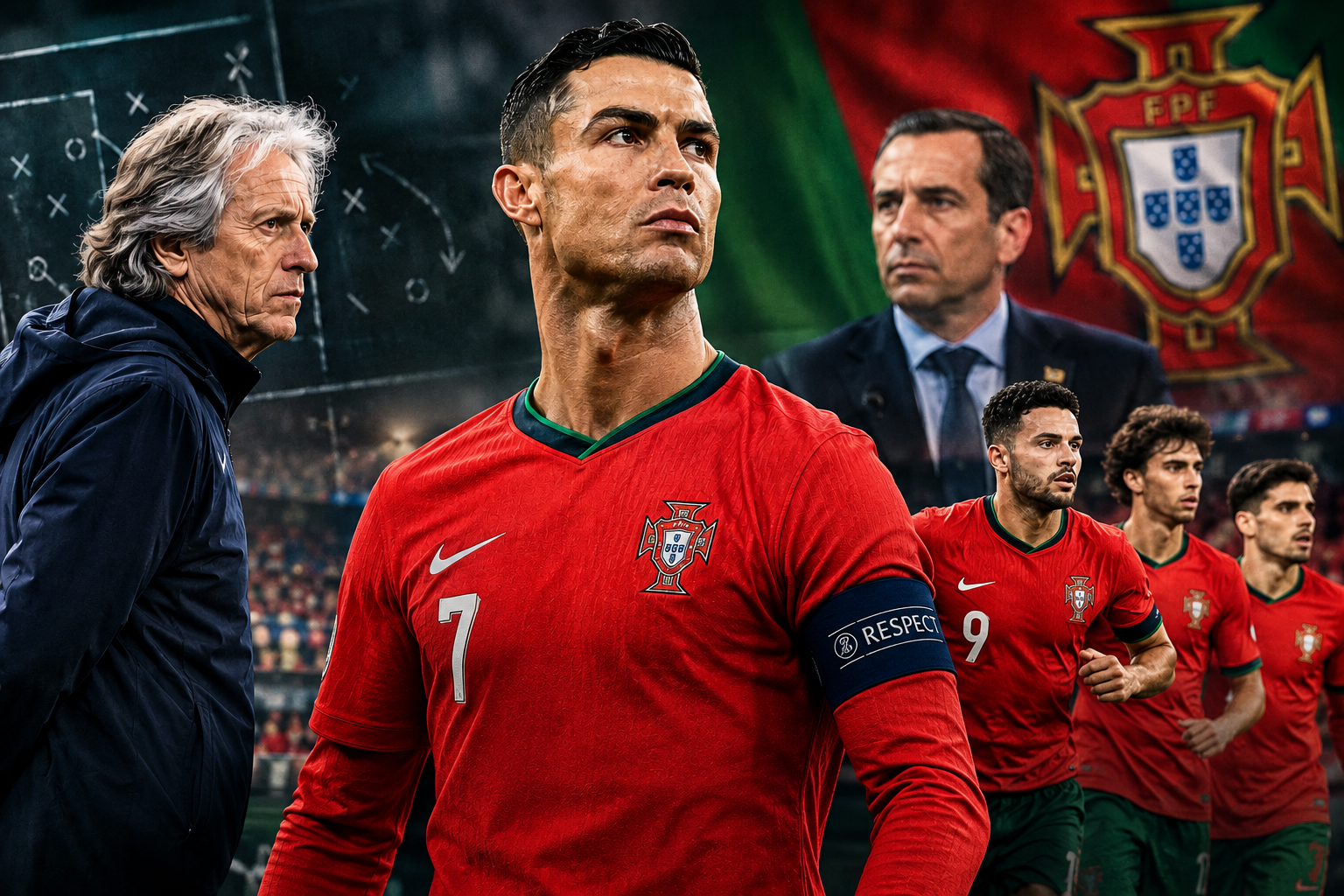
Cristiano Ronaldo vs. The System: Who Has Power in Portugal?
Jorge Jesus wants Ronaldo’s status to command respect, not dictate selection. His decision to leave camp has turned that philosophy into an early test of authority.
The Exit That Changed the Story Cristiano Ronaldo has spent more than two decades at the centre of Portugal’s football universe. Jorge Jesus has now asked whether that universe still needs to revolve around him. Jesus made his position clear when he selected Ronaldo for his first Portugal squad. The forward’s history would be respected, but it would not decide whether he played. Then the situation escalated. After Jesus confirmed that Ronaldo would not start against Denmark, Ronaldo left Portugal’s training camp in Copenhagen. The Portugal captain said his decision came after the manager’s press conference and a conversation with Portuguese Football Federation president Pedro Proença. He did not reveal the full reasons, saying he would explain them “in due course.” A discussion about selection had suddenly become a question of authority. For years, Ronaldo’s place in Portugal’s starting XI was rarely treated as an ordinary tactical decision. Jesus wants to change that. Ronaldo Has Never Been Just Another Player Jesus has described Ronaldo as a player like any other. A national team cannot function if reputation guarantees selection. At 41, Ronaldo has to be judged on his current physical level, tactical role and contribution to the team. But Ronaldo is not just another player. He is Portugal’s record goalscorer with 146 goals and its most-capped player with 234 appearances. He has been the face of the national team across generations, from the disappointment of Euro 2004 to the triumph of Euro 2016 and the years that followed. His influence extends beyond the numbers. Portugal’s modern football identity has been closely connected to him, meaning every manager has had to consider more than his position on the team sheet. That does not mean Ronaldo should be untouchable. It means the consequences of treating him like everyone else are different. Jesus appears to understand that distinction. He has acknowledged that Ronaldo has a different status because of his career while insisting that this status does not influence his selection decisions. That contradiction is now at the centre of Portugal’s new era. Then Came Jorge Jesus Jesus did not arrive to simply maintain Portugal’s previous structure. He replaced Roberto Martínez after Portugal’s World Cup exit and immediately spoke about changing the team’s ideas. His approach has already shown more flexibility in the forward line, including the possibility of using two forwards rather than a rigid 4-3-3. More importantly, Jesus wants Portugal to be more aggressive without the ball. Jesus has shown he is willing to make those decisions based on the match rather than Ronaldo’s reputation. That does not mean Ronaldo has no place in the system. It means the system comes first. For Ronaldo, that represents a significant change. He has spent much of his career as the player around whom the attack is constructed. Jesus is attempting to make him part of a collective structure where his strengths are still important, but his presence does not dictate every decision. The difference may sound subtle. For Portugal, it is enormous. The Tactical Argument: Ronaldo Can Still Fit The easiest version of this story would be to say that Ronaldo can no longer play the football Jesus wants. The evidence does not support that. Against Wales, Ronaldo started and Portugal showed a willingness to press aggressively. Jesus did not simply accept Ronaldo as a passenger without the ball. Portugal used a compact pressing structure in which Ronaldo could step towards the centre-backs while João Félix worked around him. Ronaldo’s value without the ball is not the same as it was at 25, but that does not make him tactically useless. His positioning can still occupy centre-backs, while his movement can pull defenders away from the spaces João Félix or Bruno Fernandes want to attack. Jesus’ decision to replace him with Gonçalo Ramos after around 67 minutes was revealing. He later explained that he needed Ramos’ energy to press. That was not necessarily a judgement that Ronaldo could no longer contribute. It was a decision about which profile Portugal needed at that moment. Once Portugal reaches the final third, few players in the squad offer the same instinct for attacking the penalty area. The question is therefore not whether Ronaldo can fit. It is how much Jesus wants to prioritise the things Ronaldo does best against the things another striker can provide. The choice was not simply Ronaldo versus Ramos. It was one attacking profile against another. Norway Was the First Real Test Three days later, Ramos started against Norway while Ronaldo remained on the bench. Jesus had planned to use Ronaldo during the match, but Ramos changed the equation. The striker scored, remained dangerous and gave Jesus little reason to alter the attacking structure. Ronaldo stayed on the bench as Portugal won 2-1. The result should not be treated as proof that Portugal are better without Ronaldo. Norway had more of the ball and created long spells of pressure, while Portugal were effective in the moments that mattered. Yet Portugal could change their attacking profile without collapsing. Ramos gave Jesus a different reference point at the top of the attack. João Félix, Pedro Neto and Francisco Conceição could operate around him while Portugal looked for transitions rather than trying to make every attacking sequence pass through Ronaldo. That matters because it gives Jesus something every manager wants: options. If Ronaldo starts, Portugal can use his finishing, movement and experience. If Ramos starts, Portugal can increase the intensity and mobility of the front line. Neither choice needs to be a declaration about Ronaldo’s decline. When Selection Became a Question of Authority Jesus’ message has been consistent. Status is one thing. Rules are another. For most players, that would be unremarkable. With Ronaldo, it becomes a test of whether the principle can actually be enforced. A normal player can be dropped and the discussion usually ends with the team sheet. With Ronaldo, the team sheet becomes a national conversation because every decision carries the weight of his history. Jesus is not denying Ronaldo’s importance. He is denying that importance should automatically determine selection. That is a much more difficult line to maintain. If Jesus wants to establish genuine authority, he cannot apply one set of rules to Ronaldo and another to everyone else. At the same time, treating Ronaldo as an ordinary squad player ignores the reality of what he represents to Portugal. Jesus therefore has to balance two realities pulling in opposite directions. Ronaldo deserves respect because of what he has achieved. Jesus needs freedom to make decisions based on what he believes Portugal needs now. The tension between those two ideas is the real story. Ronaldo’s Departure Changes Everything Ronaldo leaving camp turned that tension into something tangible. Before this, Jesus could explain his decisions as tactical management of a 41-year-old forward across an international window. Now the situation has moved beyond the pitch. Ronaldo has left the camp. Yet it is important not to fill the remaining gaps with assumptions. Ronaldo has not said that being left out against Denmark was the sole reason for his departure. His statement specifically said that he would explain the reasons later. That means the exact motivation remains unknown. The sequence, though, is clear. Jesus confirmed Ronaldo would not start against Denmark. Ronaldo then spoke with Proença before announcing his departure from the camp. The timing makes the relationship impossible to ignore, but it does not give us the complete story. That distinction matters. The Third Power: Proença and the FPF There is another figure in this story who cannot be ignored. Pedro Proença represents the institution behind the national team. That creates three different forms of power. Ronaldo has the power of history. Jesus has the power of the manager. The Portuguese Football Federation has institutional power. Ronaldo specifically mentioned his conversation with Proença when explaining why he left the camp. That does not establish that Proença sided with Ronaldo or Jesus. It does show that the situation had reached the federation’s highest level. Reports attributed to Marca also said Jesus and Proença tried to persuade Ronaldo not to leave, although the federation has not independently confirmed those details. The episode reveals that this is no longer simply a disagreement between two football personalities. Portugal is managing the relationship between its most influential player, a new manager establishing his authority and a federation responsible for keeping the national team functioning. The Question Portugal Cannot Avoid Portugal’s next challenge is not simply replacing Ronaldo. It is learning how to use him, if he remains available, without allowing his presence to dictate the entire structure. Ronaldo still offers qualities that are difficult to replace. His finishing, movement around the box and experience remain valuable. At the same time, Portugal have attacking options capable of changing the way the team plays. Ramos offers pressing intensity and mobility. João Félix can operate between lines. Pedro Neto and Francisco Conceição can provide width and carry the ball. That does not mean Ronaldo should become irrelevant. It means his role can change. For the transition to work, Ronaldo has to accept that his place in the team can no longer be guaranteed by history alone. Jesus, meanwhile, has to prove that treating Ronaldo according to footballing principles does not mean ignoring what makes him different. Portugal needs both realities to coexist. Who Controls Portugal’s Football Identity? This was never really about Denmark. It was about what happens when the greatest player in a country’s history encounters a manager determined to make decisions without allowing reputation to dictate them. Jesus is trying to establish a clear principle: Ronaldo’s history deserves respect, but it cannot decide Portugal’s future. That principle is easier to defend in theory than it is when the player involved is Cristiano Ronaldo. Ronaldo’s departure has exposed that difficulty earlier than Jesus would have wanted. The player now faces a different challenge. If he remains part of Portugal, his role may have to change from unquestioned centrepiece to exceptional player within a collective system. Neither side can simply wish the other reality away. Jesus cannot erase Ronaldo’s influence. Ronaldo cannot control every decision simply because of what he has achieved. That is why this story matters beyond Denmark, Norway or one international window. Portugal are entering the most delicate stage of the Ronaldo era: the point where his presence still matters, but his authority over the team can no longer be assumed. The question is no longer whether Portugal can play without Ronaldo. It is whether Portugal can change around Ronaldo without breaking what has held them together for so long.