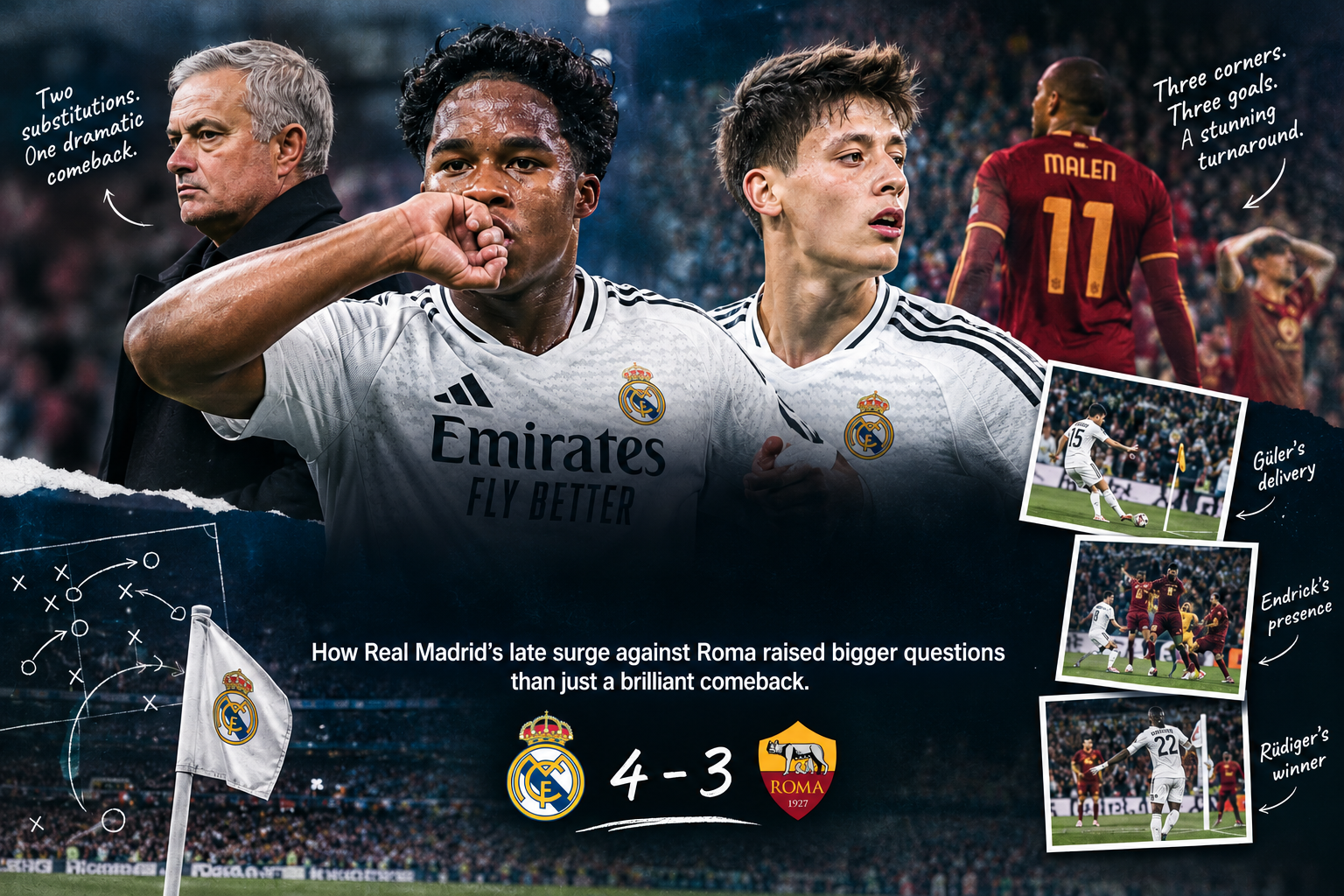
Endrick Finished It. Güler Made It Possible.
Arda Güler's delivery and Endrick's presence transformed Real Madrid's late push against Roma, but three goals from corners raise a bigger question about what Mourinho's substitutions truly changed.
Real Madrid looked destined for defeat when Donyell Malen scored his second goal to put Roma 3–1 ahead in the 57th minute. José Mourinho responded by introducing Arda Güler and Endrick two minutes later, taking off Denzel Dumfries and Vinícius Júnior. The changes helped Madrid produce a remarkable turnaround, with Carlos Espí, Endrick and Antonio Rüdiger scoring in the closing stages. The comeback was dramatic, but its pattern matters. All three goals came from corners delivered by Güler, with Endrick playing a decisive role in the first two. The substitutes gave Madrid a more effective route back into the game, yet the result does not automatically mean their problems in possession had disappeared. To understand the comeback, it is necessary to separate the impact of Mourinho's changes from Madrid's ability to exploit Roma's weaknesses at set pieces.
Madrid's Problems Were Bigger Than the Scoreline Roma had already shown that they could threaten Madrid before taking the lead. Marten de Roon opened the scoring in the 20th minute, and although Kylian Mbappé equalised five minutes later, Madrid never established lasting control of the contest. Their attacking moments offered promise, but Roma continued to find opportunities to threaten at the other end. The second half exposed Madrid's vulnerabilities more clearly. Malen put Roma ahead in the 51st minute, then doubled his tally six minutes later after Matías Soulé played him through on a fast break. The second goal was particularly damaging because it showed how quickly Roma could turn a transition into a clear scoring opportunity. Madrid were now chasing the game while leaving themselves vulnerable to further attacks. Mourinho needed more than an extra forward or a change in tempo. His team needed a different way to make its pressure count. The available evidence does not establish that Madrid's midfield structure or build-up was fundamentally broken, but their defensive transitions had proved costly. Roma had found ways to punish Madrid when possession was lost, leaving Mourinho with a team that needed to recover two goals without exposing itself to further attacks. The challenge was not simply to increase the pressure, but to make that pressure more dangerous.
Güler Gave Madrid a More Reliable Route Into the Box Güler's introduction gave Madrid a reliable way to turn pressure into danger, particularly from set pieces. While he offered another creative option in possession, his decisive contribution came from the corner flag rather than a sustained run of chances created through open play. In the 83rd minute, his corner found Endrick, whose header was saved by Pierluigi Gollini. Carlos Espí reacted to the rebound and scored from close range to make it 3–2. Two minutes later, Güler delivered another corner that Endrick headed into the net, bringing Madrid level. After the substitutions, Mbappé had a goal ruled out for offside. Later, Madrid threatened again from a Güler corner when Jude Bellingham sent a header narrowly wide. These moments showed that Madrid continued to threaten, but they did not establish that the team had suddenly become more effective at progressing through midfield. Güler's impact was significant because his delivery gave Madrid a repeatable source of danger when they needed goals. Whether his presence also improved their open-play attack is a separate question. The evidence is strongest when it comes to his set pieces, and that distinction matters when assessing the substitutions.
Endrick Changed the Nature of Madrid's Attack Endrick offered Madrid a different attacking option. His presence gave Güler a clear target in the penalty area and allowed Madrid to attack the ball more directly instead of depending entirely on combinations around Roma's defence. Endrick's contribution to the comeback went beyond scoring the equaliser. His aerial presence helped create the first goal and then gave Madrid another target for Güler's delivery. The two moments demonstrated how effectively their qualities complemented each other. That is the clearest evidence of what the substitution changed. Endrick gave Madrid a direct attacking option that complemented Güler's delivery. It does not prove that he solved their problems in open play, but it does show how his presence complemented Güler's delivery when Madrid needed a direct route back into the game.
Roma's Retreat Made the Difference Possible Madrid's substitutions explain only part of the comeback. Roma's response to taking a 3–1 lead also matters. As Madrid pushed forward, Roma appeared increasingly focused on protecting their advantage, leaving Madrid opportunities to deliver into the penalty area. The more direct approach suited the qualities Mourinho had introduced. The contrast between the teams became clearest at corners. Güler repeatedly delivered dangerous balls, Endrick attacked the first contact, and Madrid were ready to react when the initial effort was saved. Espí's rebound goal exposed the cost of failing to clear the danger, while Endrick's equaliser showed that Roma could not prevent Madrid from conceding another decisive aerial opportunity. Güler's delivery then set up Rüdiger's late winner, completing a comeback in which Madrid scored all three goals from corners. Three goals from corners in such a short period point to a clear weakness in Roma's defending, even if the exact reasons for their failure would require closer analysis of the footage. Madrid still needed the delivery, movement and execution to take advantage, but Roma's inability to deal with those situations was central to the result. The comeback was more than individual brilliance or luck. Mourinho introduced players whose strengths suited the situation, and Madrid repeatedly exploited the same route to goal. Yet that success does not establish that their build-up problems had disappeared. The substitutions gave Madrid a more effective way to attack the penalty area; whether they could also improve the team's control and chance creation in open play remains unanswered.
A Comeback, Not Yet a Complete Solution Real Madrid's 4–3 victory over Roma showed the value of changing an attack's profile when the usual approach is struggling. Güler supplied the delivery, Endrick provided the aerial threat, and Espí and Rüdiger helped complete a remarkable turnaround. Their complementary qualities gave Madrid a route back into a game that had appeared lost. But the comeback does not prove that Madrid's wider problems were solved. The decisive goals came from corners, while questions remain about their ability to progress through midfield and create consistent danger in open play. Mourinho's substitutions worked because they gave Madrid an effective alternative, and Roma failed to contain it. Whether that combination can also help Madrid control matches more consistently is the more important test ahead.