Paraguay's Defensive Masterclass: The Wall Germany Could Not Break
Germany had the ball. Paraguay had the answers. Over 120 exhausting minutes in Boston, Gustavo Alfaro's side produced a defensive performance that transformed survival into an art form and Orlando Gill into a national hero.
In the 93rd minute, Gustavo Gómez celebrated a blocked shot like he had scored the winning goal.
Jamal Musiala had finally found a pocket of space on the edge of the penalty area. Germany's brightest attacking talent shifted the ball onto his stronger foot and fired a low drive toward goal. For a split second, it looked like the moment that would finally break Paraguay. Then Gómez launched himself across the turf. The ball smashed into his thigh and ricocheted away from danger. Before Germany could react, Paraguay's captain was already on his feet. He roared toward his teammates, fists clenched, chest puffed out, celebrating the block with the emotion most players reserve for a decisive goal. Germany saw a clearance. Paraguay saw survival. That moment explained everything about a night that ended with Paraguay defeating Germany 4-3 on penalties after a 1-1 draw and reaching the Round of 16 for the first time since 2010. History will remember the result. It should remember the resistance.
Germany Had Possession. Paraguay Had Control The statistics tell a familiar story. Germany finished with 76% possession. They attempted 21 shots. They delivered 38 crosses into the penalty area. They spent most of the match camped inside Paraguay's half. On paper, it looked like domination. On the pitch, it looked like frustration. Possession can create the illusion of control. Paraguay spent 120 minutes proving those two things are not the same. From the opening whistle, Gustavo Alfaro's side retreated into an ultra-compact defensive structure. Officially, it was a 4-5-1. In practice, it constantly shifted and adapted. Wingers Miguel Almirón and Julio Enciso tracked deep enough to create a temporary six-man defensive line. Gabriel Ávalos often dropped into midfield, turning Paraguay into what occasionally resembled a 4-6-0. The objective was simple. Germany could have the ball. But they could not have the space. Every dangerous central zone was crowded. Every passing lane into the penalty area was contested. Every attempt to attack through the middle ended with another red-and-white shirt stepping into the path. Germany dominated territory. Paraguay defended reality.
Defending Became The Main Character
Modern football worships possession. Coaches obsess over pressing systems, build-up structures and attacking patterns. The assumption is simple: the team with the ball controls the game. Paraguay spent 120 minutes destroying that assumption. Germany completed hundreds more passes. They dominated possession. They owned territory. Yet every minute felt increasingly desperate. Paraguay reminded everyone that football's oldest truth remains unchanged. Control is not measured by possession. Control is measured by who forces the game to be played on their terms. Germany played where they wanted. Paraguay made them play how they wanted.
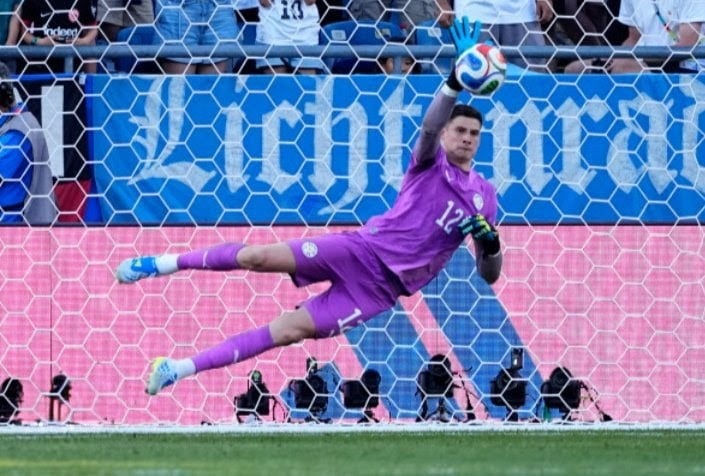
Orlando Gill Became The Face Of Resistance Every great defensive performance eventually needs a goalkeeper. Paraguay had Orlando Gill. The 24-year-old delivered one of the defining goalkeeping displays of the tournament. He finished with six saves during regular and extra time, including four from inside the penalty area. He claimed three crosses, punched away another, and never allowed Germany's pressure to descend into chaos. The most impressive aspect of Gill's performance was not the saves themselves. It was calmness. As Germany increased the pressure, Gill looked increasingly composed. Crosses disappeared into his gloves. Loose balls were collected cleanly. The panic Germany hoped to create never arrived. Even when Germany thought they had finally found a breakthrough late in extra time, Gill remained central to the resistance. Under heavy contact during a set-piece, he absorbed the collision, forcing a VAR review that ultimately ruled out what would have been a dramatic German winner. The pressure kept building. Gill kept absorbing it. Then came the penalties.
The Shootout That Defined A Career Penalty shootouts often belong to goalkeepers capable of controlling emotion. Gill controlled the entire stadium. Before Kai Havertz stepped forward to take Germany's opening penalty, the Paraguay goalkeeper deliberately slowed everything down. He wandered around the area, delaying the moment, forcing Havertz to wait. It was a small act. It was also psychological warfare. Gill guessed correctly and made the save. Suddenly Germany were chasing the shootout instead of controlling it. The decisive moment arrived later when Nick Woltemade stepped up needing a goal to keep Germany alive. Gill exploded to his left, producing a spectacular diving save that effectively ended the contest. Moments later, José Canale calmly converted the winning penalty. Paraguay were through. Germany was gone. And Gill had written himself into Paraguay football history.
A Defensive Unit Built On Sacrifice As brilliant as Gill was, he was never working alone. José Canale produced arguably the best outfield performance on the pitch. He won every tackle he attempted, dominated aerial duels, and repeatedly stepped into dangerous spaces before German attackers could exploit them. Alongside him, Gómez provided leadership and relentless communication. Every clearance, every block, every recovery carried the urgency of a team that understood exactly how much was at stake. The full-backs were equally disciplined. Júnior Alonso neutralized Leroy Sané for long stretches and finished with four successful tackles. Juan José Cáceres remained positionally flawless against Germany's constant attempts to overload wide areas. In front of them, Andrés Cubas performed the least glamorous role and perhaps the most important one. His job was to deny Germany access to the space just outside the penalty area. For 120 minutes, he turned one of football's most dangerous attacking zones into a traffic jam. Germany never stopped attacking. Paraguay never stopped sacrificing.
The Underdogs Who Stopped Believing They Were Underdogs The result becomes even more remarkable when viewed through the lens of Paraguay's recent history. They arrived in the tournament ranked 41st in the world. They had failed to qualify for the previous three World Cups. They entered 2026 with modest expectations and opened their campaign with a heavy 4-1 defeat against the United States. Most observers expected them to disappear quietly. Instead, they survived the group stage and then eliminated one of international football's traditional powers. More importantly, they did it by defeating a European nation in a World Cup knockout match for the first time in their history. That matters. Because this was not a miracle built on luck. It was a performance built on preparation, discipline, and belief. Germany spent 120 minutes searching for a weakness. Paraguay spent 120 minutes proving there wasn't one.
The Art Of Saying No Modern football often celebrates creativity. It celebrates goals, possession, pressing systems, and attacking brilliance. What Paraguay produced in Boston was a reminder that defending remains one of the sport's purest arts. Every block carried meaning. Every clearance carried purpose. Every save carried belief. The winning goal will appear in highlight reels. The penalty shootout will dominate headlines. Orlando Gill will deservedly receive most of the attention. But the true story of Paraguay's victory existed in everything Germany could not do. They could not find space, created panic and broke the wall. And by the time José Canale converted the decisive penalty, the outcome felt less like an upset and more like a reward. Germany had the ball. Paraguay had the answers. In the end, that was enough to reach the Round of 16. And for one unforgettable night in Boston, it was enough to make defending look beautiful.