Pierre Sage: How Quickly Football Forgets
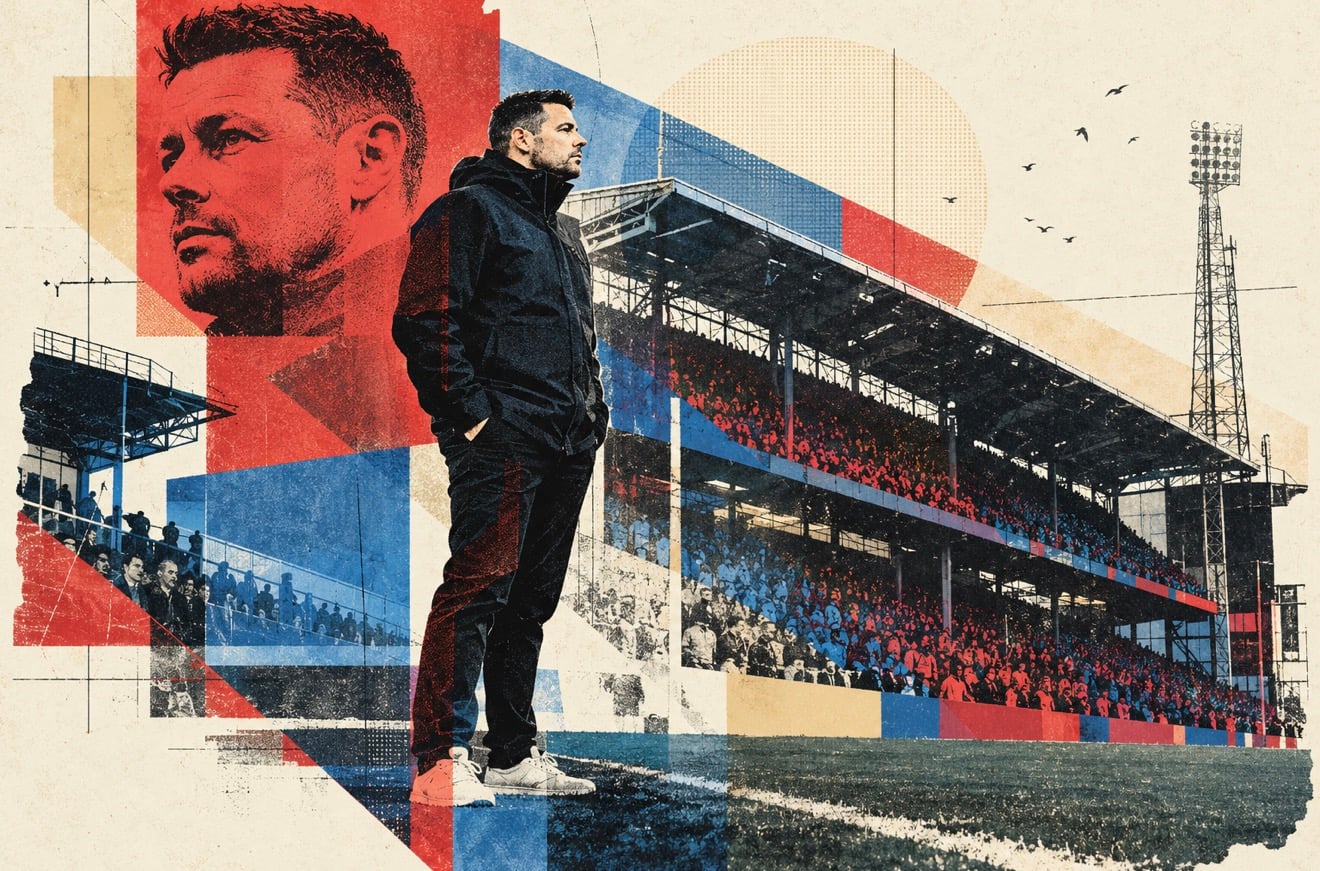
Five months after leading Lens to a historic Coupe de France triumph, Pierre Sage is already under pressure at Crystal Palace. His short career is a lesson in how quickly yesterday’s success can lose its value.
22 May 2026. Just under a year after taking over at R.C. Lens, Pierre Sage is one of the most talked-about managers in Europe. In that season, Sage had done the unthinkable. Lens had pushed Paris Saint-Germain all the way in the title race, even leading Ligue 1 at the halfway point of the season. They would eventually finish second, but return to the Champions League. Then, on that warm May evening at the Stade de France, Lens beat Nice to win the Coupe de France for the first time in their history.
Four months later, he is watching on at the Amex Stadium as Diego Gómez scores from the halfway line and Brighton & Hove Albion beat Crystal Palace 5-0. Having taken over at the south London club in July 2026, Sage is facing arguably the biggest challenge of his short career. After the game, Sage was asked whether he thought he would be given enough time to rectify Palace’s difficult start to the season, his reply is telling of the modern game:
“It’s not my decision. I don’t know.”
When Palace appointed Sage in June 2026, they must have known the risks and the size of the job facing their new manager. Oliver Glasner’s departure had felt like a drawn-out, acrimonious divorce. Glasner, Palace’s most successful manager, had frequently been at loggerheads with the board over transfer business, and by January had publicly accused the club of leaving his squad “abandoned completely”. Despite this Glasner had delivered a club-record Premier League points total, European football, the FA Cup and, in his final game, the Conference League. But during that period Palace had also repeatedly sold some of their best players to Premier League rivals, including Eberechi Eze and Marc Guéhi, while Glasner became increasingly frustrated at what he saw as inadequate reinvestment in the first-team squad.
The Unlikely Rise
With Glasner gone, Palace decided not to turn to an experienced manager but instead to one with barely three seasons of senior management behind him. At 47 years old, Pierre Sage has a remarkably short CV. Having spent much of his career working in youth football and coaching development, he joined Olympique Lyonnais as academy director in July 2023. Four months later, Fabio Grosso was sacked with Lyon bottom of Ligue 1 and Sage was handed the first team on an interim basis.
But Sage had other plans than simply keeping the seat warm until a permanent replacement arrived. Lyon not only avoided relegation but finished sixth, qualifying for the 2024/25 Europa League. He also guided them to the Coupe de France final, where they narrowly lost 2-1 to Paris Saint-Germain.
His success was not instantaneous. Lyon lost Sage’s first two matches in charge. But rather than tear everything up and attempt to build a new side overnight, he initially worked with what was available to him. Experienced players such as Alexandre Lacazette, Corentin Tolisso and Nicolás Tagliafico formed the spine, with younger players around them.
Once Sage had stabilised results, Lyon gradually moved towards a more controlled possession and positional game, while talented younger players were expected to earn responsibility rather than simply being handed it. By July 2024, Lyon had seen enough to give Sage a contract until June 2026.
Sage went into the 2024/25 season with plenty of credit in the bank with both supporters and the board. But the goodwill built during that remarkable first season did not last indefinitely. By January 2025, Lyon had gone five matches without a win in all competitions, including an embarrassing Coupe de France exit to fifth-tier Bourgoin-Jallieu. Despite sitting sixth in Ligue 1 and still firmly in the European picture, Lyon dismissed him. Sage had learnt a valuable lesson: football has a notoriously short memory.
Building Credit
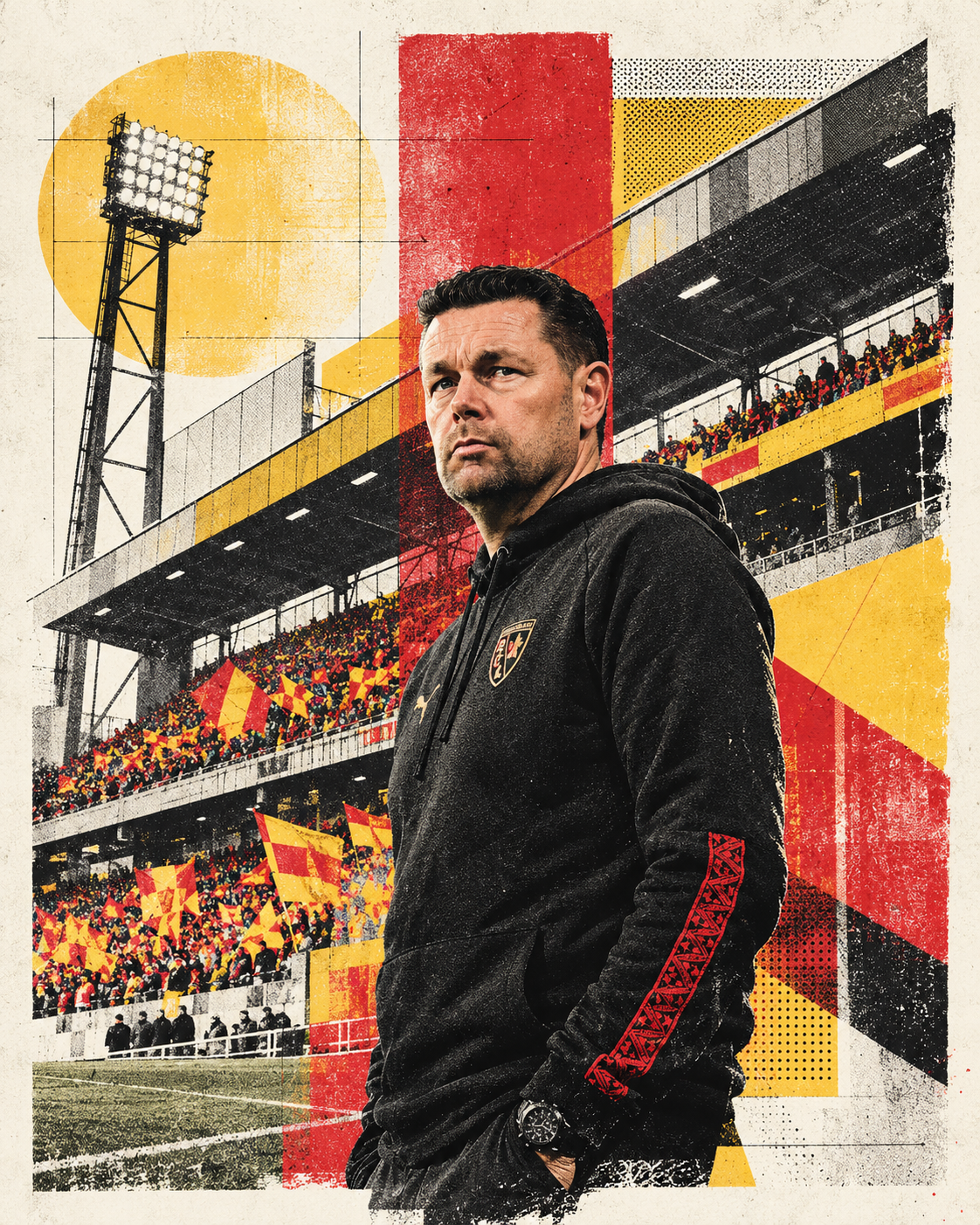
In June 2025, R.C. Lens took a risk on a manager with just 56 senior professional games under his belt. Despite his sacking by Lyon, Lens saw a manager capable of getting the best out of the players available to him rather than demanding an expensive rebuild. It seemed a perfect fit for a club in self-imposed austerity and increasingly willing to sell their best players for a profit. Lens were looking for stability after the previous manager, Will Still, had left prematurely for personal reasons. That summer would bring yet more upheaval, with a further three key players, Facundo Medina, Neil El Aynaoui and Andy Diouf, all departing.
Going into the 2025/26 season, few expected Lens to challenge at the top of Ligue 1. Pre-season projections generally placed them comfortably mid-table, with even European qualification viewed as requiring the club to outperform its resources. Sage once again showed his ability to adapt to what he had rather than look to rebuild a squad in his own image. At Lyon he had generally adopted a 4-3-3 formation but at Lens he retained the three-man defence the players were already accustomed to. What he did repeat was building a spine of experienced players. Florián Thauvin, Adrien Thomasson, Wesley Saïd and Ruben Aguilar formed the core of the Lens team under Sage.
Sage built his Lens team around intensity rather than control. They averaged 51.1% possession across the league season but were deadly after winning the ball back. Their pressing was aggressive and targeted, allowing them to turn the ball over high up the pitch and create chances before opponents could reorganise. Under Sage Lens had an xG of 1.95 per game, while the league average was 1.41 xG per game. Width was also central to the way they attacked. Lens attempted 773 crosses, more than any other Ligue 1 side, completing 29.9% of them. Set pieces were another major weapon, with 13 goals from dead ball situations. Sage had created a side that was direct, physical and relentless, capable of overwhelming opponents without needing to dominate possession.
Sage far exceeded the pre-season expectations. For much of the season they were genuine title contenders, sitting top of the league at the winter break. They would eventually finish second behind PSG's state-backed financial machine. This was an extraordinary achievement for a club expected, at best, to fade into mid-table obscurity. In his first season at the club and only his second full season as a manager Sage had guided Lens back to the Champions League.
But the best was yet to come. On 22 May 2026, the night with which the article began, Sage would reach his second Coupe de France final in three seasons. Unlike with Lyon there would be no defeat this time. Lens beat Nice 2-1 to win the competition for the first time in their history. Once again, Sage had been given a remit of stabilisation. Once again, he had far surpassed it. And once again, his footballing credit was sky high.
Credit in the Bank
So it was in July 2026 that Crystal Palace came calling. Sage had built a clear reputation as a manager who can adapt to what a club already has rather than demanding expensive recruitment to shape the team in his image. At both Lyon and Lens, he adapted to what was available to him. He trusted experienced players, but blended youth into his teams. Most importantly of all, he had shown his ability to extract considerably more from his teams than had been expected. It isn't hard to see why Palace were willing to overlook the short CV and turn to Pierre Sage.
But Sage was not joining a club still riding high from the success of winning the UEFA Conference League. Once again, he was joining a club in transition, and one that expected its manager to cope with star players being sold. While Crystal Palace had undoubtedly enjoyed the most successful period in their history, all was not well. Over the previous two years, the club had sold Michael Olise, Maxence Lacroix, Eberechi Eze, Joachim Andersen, Daniel Muñoz and Marc Guéhi.
Going into the 2026/27 season, the Palace squad looked a shadow of the one that had won the FA Cup and Conference League. But the problem went deeper than simply losing a few important players. Palace had steadily dismantled much of the side that had delivered the FA Cup and UEFA Conference League, selling key defenders, attacking players and leaders without always replacing them with equivalent quality. Glasner had grown increasingly frustrated with that cycle before his departure.
A major part of Glasner’s success had been built around the security of his three centre-backs, the aggression of his wing-backs and the individual quality of players such as Eze. By the time Sage arrived, much of that structure had disappeared. That was partly why Palace had chosen him: his reputation had been built on making the most of difficult circumstances. But this was also a squad carrying the expectations created by recent trophies without necessarily retaining the quality that had won them.
There is a sense of déjà vu to the situation. At Lyon Sage inherited a crisis. At Lens he inherited a club cutting costs and selling important players. Now Palace were asking him to provide stability while the squad was being broken apart around him. Pre-season expectations placed Palace in the lower reaches of mid-table, with the possibility that, if things went badly, they could be dragged into a relegation battle.
Despite these relatively modest expectations the start has not gone well. Palace have won two, drawn one and lost four of their opening seven league matches. Palace have conceded 17 goals, the worst in the league, and scored just 9. Despite the poor start, going into the September/October international break, there was little sign of widespread discontent towards Sage. One game back after the break and the mood feels considerably more fragile.
Palace’s rivalry with Brighton is one of English football’s stranger derbies, but it is nevertheless a fiercely contested rivalry. It is also a fixture that has previously seen the demise of Palace managers. Lose the game is bad enough. Losing 5-0 is unacceptable. Palace were 3-0 down after only 10 minutes and the contest was all but over. Brighton’s intensity exposed a Palace defence that looked disorganised and fragile under pressure, while at the other end Sage’s side again lacked creativity and confidence. The Brighton match shouldn’t be viewed in isolation, these issues were not new and had been present throughout the opening seven league matches.
This is where Sage’s past matters. At Lyon and Lens, he showed what he could do given enough time to understand the squad, adapt to its strengths and gradually impose his ideas. Palace appointed him because of that record. Yet after just four months, much of the credit he built in France already appears to be losing its value.
Pierre Sage has proved that, given time, he can make teams exceed expectations. In barely three years as a senior manager he has built up an extraordinary amount of credit, only to discover repeatedly how quickly football can wipe the slate clean. He is now among the favourites to be the first Premier League manager to leave, while questions around his future have intensified since the Brighton defeat.
Palace knew what they were appointing. Sage is still developing as a manager and is far from the finished article. To appoint someone with that profile and then panic when things do not immediately work would be counterproductive. Managers need time, but in the modern game that is increasingly a luxury rarely given. Palace should ignore the external noise and give Sage the opportunity to prove that what happened at Lyon and Lens was more than coincidence.
Football is a cruel mistress. It cares little for yesterday.
By Tom Welch